- 240 pages
- English
- ePUB (mobile friendly)
- Available on iOS & Android
eBook - ePub
About this book
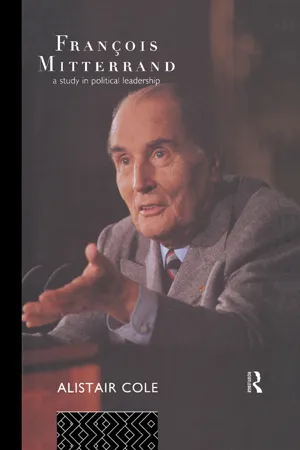
Francois Mitterrand is one of France's most famous twentieth-century politicians, yet interpretations of his values and leadership vary widely.
Alistair Cole's in depth study starts with a chronological overview of Mitterrand's career, and proceeds with a policy-based assessment of Mitterrand's presidency. By evaluating Mitterrand's policies in relation to various key roles such as the party leader, the President, the dispenser of patronage, the European statesman and the World Leader, this book places his leadership in comparative perspective, and offers a new understanding of him as an individual political leader.
This fully up dated paperback edition will be invaluable for students of contemporary European politics as well as those interested in the career of one of post-war Europe's leading statesmen.
Information
Chapter 1
The origins of a political leader, 1916–58
François Mitterrand’s youthful background left little to presage that he would be elected as the first left-wing president of the Fifth Republic. He was born in 1916 in west central France in the small village of Jarnac, near Cognac in the Charente département. This region of France was in many senses representative of the country as a whole during the early twentieth century: rural, Catholic, bourgeois and conservative. He grew up in a family of eight children within which his mother, a devout Catholic, reputedly exercised a powerful influence. Little concrete can be drawn from what we know of Mitterrand’s childhood and youthful experience: Mitterrand was an average provincial adolescent from a bourgeois family. Those who knew him during this period assert that he was pious, of above average intelligence, romantic, with a consuming passion for literature.1
It would have been surprising if Mitterrand had not been deeply influenced by the Catholic culture within which he grew up: from the earliest age, he was encouraged to participate fully in the rituals of the Catholic Church. His early religious socialisation was strengthened by a Catholic education at the hands of les pères maristes at a boarding school in Angoulême. According to one interpretation, this instilled in Mitterrand in later years a dislike for organised Catholic rituals and the hierarchical ethos of the Catholic Church.2 The Catholic reference point remained with Mitterrand in later years, articulated by references to a distaste for materialist concerns (see Chapter 5). In his autobiography, Mitterrand condemned money as ‘the enemy, the corrupter’, the antithesis of ‘fundamental values such as the nation, religion, freedom and dignity’.3 In the case of the Mitterrand family, the professed hatred for money appeared typical of those Catholic, provincial bourgeois families who were adequately endowed to afford such sentiments.
In 1934, at the age of 18, François Mitterrand cast aside his provincial background and left for university in Paris to study law at the École Libre des Sciences Politiques. His educational background thus distinguished Mitterrand somewhat from that typical of the Fifth Republican political elite. He was too old to have attended the École Nationale d’Administration (ENA, created in 1945), but, unlike brother Robert, François did not attempt the examination for the highly prestigious schools, Polytechniques or the École Normale Supérieure. Mitterrand entered into a Paris dominated by conflict between the left-wing parties (themselves divided) and the extra-parliamentary leagues of the extreme-right, the most important being the Croix de feu. According to one of his biographers (Catherine Nay), Mitterrand’s political convictions during this period were ‘openly those of the Croix de feu’.4 There is some speculation that Mitterrand sympathised with the Cagoule, a violent organisation of the extreme-right, as well as with Action française, the standard-bearer of the counter-revolutionary Right, but there is no sustained evidence that linked Mitterrand to either organisation, or, indeed, to the Croix de feu.5 What evidence there is points to the young Mitterrand adopting a variety of different stances. Contemporaries recall his favourable position towards the Croix de feu, but also his defence of an anti-fascist professor harassed by the leagues of the extreme Right.6 Despite his later claim to be the inheritor of Léon Blum, there is no evidence that Mitterrand displayed any real enthusiasm for the Popular Front, the first Socialist-led government in France’s history. Nor was he mobilised by the Republican cause during the Spanish civil war, the other great rallying cry of the European Left in 1936–37. What evidence there is suggests that Mitterrand was an average bourgeois student from the provinces, if anything marked by his rather conservative upbringing. In face of the conflicting accounts by contemporaries, we are left with Mitterrand’s own recollection of his political activity during his student days:
In fact, having been sheltered for such a long time, I did not really feel a strong sense of political consciousness… I did not really feel engaged in politics… I had instinctive, rather than properly thought-out ideas.7
WARTIME AND RESISTANCE
Mitterrand was twenty-two when the Second World War broke out in September 1939, engaged in his compulsory military service. If we consider his wartime record, three salient themes emerge: courage, captivity and ambiguity.
Courage Even his enemies have paid tribute to the mental and physical courage of Mitterrand, who after the war was awarded the Croix de guerre for personal bravery. When the German attack on France began in May 1940, Mitterrand’s unit found itself faced with the advancing German armies. In the course of an ordered retreat, Sergeant Mitterrand was wounded on 14 June 1940, hit in the right shoulder by a stray bullet. Taken prisoner by the Germans, he eventually managed to escape captivity – at his third attempt and at great personal risk – into unoccupied Vichy France in December 1941. Mitterrand’s courage later as a resistance leader was illustrated subsequently on a number of occasions. The most celebrated of these was on the evening of 10 July 1943, when he openly heckled members of the Vichy elite at a public meeting, at considerable personal risk. In the months leading up to the liberation of France, Mitterrand experienced a number of narrow escapes from the Gestapo and collaborationist police. He personally played a highly symbolic role in the liberation of the capital, by leading an armed assault on the Commissariat général aux prisonniers de guerre.
Captivity If we believe the autobiographical evidence, in terms of personal philosophy, the French resistance was one of the most important formative experiences in shaping the political outlook of the young Mitterrand. This political evolution was far from exceptional: many French people experienced a similar sentiment. The Vichy regime discredited the French Right for a generation, and patriotism became transformed into a virtue of the Left. The notion that captivity forces men to re-evaluate previously held beliefs, and that the experience of wartime crystallises and accentuates movements which might otherwise not have occurred, appears highly plausible. In his major autobiography, Ma part de vérité, Mitterrand claims that it was while a prisoner in Germany that he first discovered the ‘social contract’: faced with common adversity, men grouped together and cooperated in their mutual interest.8 Whatever credence we accord this, there is no doubt that Mitterrand’s eventual escape tells us a great deal about his solitary courage, faced with considerable personal danger.
Ambiguity As a result of family connections, Mitterrand eventually obtained employment in March 1942 working for the Commissariat général aux prisonniers de guerre (henceforth Commissariat), a bureaucratic sub-unit of the Vichy government officially responsible for maintaining relations with French prisoners of war in German camps. The fact that he accepted employment for the Vichy state has been used against him by his critics; the argument runs that other resistance figures would have refused such an eventuality, whatever t6he justification. And yet, numerous future resistance figures were initially attracted to work for Vichy. Indeed, the London-based resistance officially supported this course of action, to provide resistants with legitimate cover for their clandestine activities. More specifically, service in the Commissariat appealed to former prisoners who were anxious above all to provide material and emotional help to those French people still being held in captivity. These justifications usually serve for sympathetic biographers to explain why Mitterrand took up employment within the Vichy administration. Less charitable accounts portray Mitterrand as sympathetic to the objectives of Pétain’s National Revolution,9 even reverential of the Marshal, with whom Mitterrand allegedly shared provincial bourgeois origins, a strong sense of patriotism, and a distrust for the Third Republic.
It is far from certain what his initial motivations were, but it is clear that Mitterrand’s resistance activity developed within the confines of the Vichy regime itself. This pattern was not unusual. Mitterrand’s first clandestine activity was to falsify documents and to plan escape routes to help prisoners in German camps. After the occupation of the free zone by the Germans in November 1942, Mitterrand, Maurice Pinot (the head of the Commissariat) and others resigned from the administration (in January 1943), and gradually became fully fledged clandestines. In the course of 1943, Mitterrand (who adopted the pseudonym Captain Morland) and Pinot helped to create an effective resistance network, Le mouvement national des prisonniers et déportés de guerre. This gave him access to the highest reaches of the French resistance leadership, and brought him into contact with the external resistance for the first time.
Even if we accept a charitable interpretation of Mitterrand’s employment in the Vichy state, areas of ambiguity remain relating to his behaviour. The incident which has retained most attention in this respect is that of the francisque. In his capacity as a former civil servant for the Vichy regime, Mitterrand was awarded the francisque in November 1943, an honour conferred by Marshal Pétain personally on civil servants. Interpretations differ as to his motivations. Catherine Nay takes the francisque as proof that Mitterrand sympathised with the objectives of the Vichy regime, and appreciated the personality of Marshal Pétain. Charles Moulin, by contrast, pleads that Mitterrand accepted the francisque because ‘he considered it to be an excellent cover for his clandestine activities’, a path of action recommended by the London-based resistance.10 Although conferred routinely, critics contend that Mitterrand did not have to allow his name to go forward for the honour; indeed, his proposers were themselves personalities closely connected with Vichy.11 Set against this, Mitterrand’s francisque must be placed in context. All other leading members of the Commissariat were also conferred awards by Pétain, who appreciated the practical assistance offered to French prisoners in German camps. Finally, once offered, it would have been dangerous not to accept the award.
The real biographical interest in this episode and its aftermath was that it revealed an important aspect of Mitterrand’s character: he refused consistently to respond to what he considered to be absurd allegations relating to his personal integrity. However sincere, his silence was misconstrued by his political opponents as showing that he had something to hide. For years afterwards, suspicions lingered that Mitterrand was somehow dealing with both sides, that his integrity was less than complete. That President Mitterrand’s decision to lay a wreath on Marshal Pétain’s grave in November 1992 caused such dismay among his supporters must be seen in the context of this sentiment, as well as the continuing outrage felt by those on the Left to the wartime Vichy regime.12
Mitterrand was awarded the francisque in absentia in November 1943, while attempting to establish contact with the leadership of the external resistance first in London and then in Algiers. By November 1943, de Gaulle had imposed himself as the main leader of the external resistance. The young Mitterrand was determined that the General should consecrate his leadership of the ex-prisoners’ resistance movements against the claims of rivals. Mitterrand met de Gaulle briefly, in a short meeting in Algiers, variously described as ‘acrimonious’, ‘rude’, and ‘polite but frosty’. In the course of this meeting, de Gaulle criticised Mitterrand for not having agreed to fight with the Free French forces based in London, and insisted that three rival prisoners’ movements be fused and placed under the command of Michel Cailliau, de Gaulle’s nephew. Mitterrand resisted this decision, arguing that the internal resistance had its own rules, and that it could not be controlled in an arbitrary manner from outside. De Gaulle angrily concluded the meeting after 30 minutes. In his account in Ma part de vérité, it is clear that Mitterrand could not accept the manner in which he had been treated by de Gaulle, and carried away a painful memory of the meeting.13 Most biographies of Mitterrand have selected this episode to conjecture what might have happened to the subsequent course of French history had Mitterrand and de Gaulle entertained warmer personal relations with each other. Such speculation is ultimately fruitless in terms of assessing what actually did happen, above all given the different stature of the two men.
Poor relations between de Gaulle and the young Mitterrand reflected the mutual distrust prevailing between the internal and the external resistance movements. From de Gaulle’s perspective, the internal resistance lacked a sense of realism, of what it was possible for the French resistance to achieve by itself, and of the need to collaborate with the allies. Behind all of this lay the fact that the internal resistance was dominated by the Communists, who were portrayed by de Gaulle as fighting an ideology (Nazism) rather than a country (Germany), leaving the external resistance fighters as the only true patriots. It was scarcely surprising that a young turk such as Mitterrand should have met with a frosty reception from the Gaullist administrators in London, and then from de Gaulle himself in Algiers. At the Liberation, all other things being equal, Mitterrand might have expected to have become one of de Gaulle’s (junior) associates in the postwar provisional government. De Gaulle and Mitterrand had a great deal in common: they both came from provincial, Catholic backgrounds, had a developed sense of honour, and a proven patriotism. But personal antagonism and mutual political mistrust decreed that this was not to be the case. It was also during the resistance that Mitterrand came to respect, and distrust, the power and organisational discipline of the French Communists.
Mitterrand’s contribution to the resistance was recognised by his nomination as General Secretary for prisoners of war in the provisional government formed while awaiting de Gaulle’s return, a position he held for two weeks. At the age of 27, Mitterrand had already made his mark. But this early contact with power was to be extremely short-lived. Mitterrand’s services were not retained by de Gaulle in the 1944 provisional government.
Mitterrand’s behaviour during the years 1942–44 was certainly not devoid of ambiguity. His defence would require demonstration that working for Vichy was a deliberate cover for Resistance activities, which is certainly difficult to establish as his initial motivation.14 His personal temperament contributed subsequently to the sense of malaise surrounding certain of his wartime activities; already fiercely individualist, he refused to respond to base allegations concerning his behaviour. On balance, however, retrospective appraisals have tended unnecessarily to minimise Mitterrand’s status as a resistant, for which he was decorated after the war. They have also distorted the prevailing perception of the Vichy regime among many French patriots until November 1942: as a patriotic, anti-German regime within which it was possible to serve the nation without any suspicion of collaboration with the enemy.15
FRANÇOIS MITTERRAND AND THE FOURTH REPUBL...
Table of contents
- Cover
- Title Page
- Copyright Page
- Table of Contents
- List of tables
- List of abbreviations
- Preface
- 1 The origins of a political leader, 1916–58
- 2 From Republican opponent to President of the French, 1958–81
- 3 François Mitterrand and the Left in power, 1981–93: an overview
- 4 The enigma of François Mitterrand
- 5 The party leader
- 6 The President
- 7 Mitterrand’s governing style
- 8 The European statesman
- 9 The world leader
- 10 François Mitterrand and the new Europe
- 11 Mitterrand’s political leadership: an evaluation
- 12 Conclusion
- Notes
- Bibliography
- Index
Trusted by 375,005 students
Access to over 1.5 million titles for a fair monthly price.
Study more efficiently using our study tools.
Frequently asked questions
Yes, you can cancel anytime from the Subscription tab in your account settings on the Perlego website. Your subscription will stay active until the end of your current billing period. Learn how to cancel your subscription
No, books cannot be downloaded as external files, such as PDFs, for use outside of Perlego. However, you can download books within the Perlego app for offline reading on mobile or tablet. Learn how to download books offline
Perlego offers two plans: Essential and Complete
- Essential is ideal for learners and professionals who enjoy exploring a wide range of subjects. Access the Essential Library with 800,000+ trusted titles and best-sellers across business, personal growth, and the humanities. Includes unlimited reading time and Standard Read Aloud voice.
- Complete: Perfect for advanced learners and researchers needing full, unrestricted access. Unlock 1.5M+ books across hundreds of subjects, including academic and specialized titles. The Complete Plan also includes advanced features like Premium Read Aloud and Research Assistant.
We are an online textbook subscription service, where you can get access to an entire online library for less than the price of a single book per month. With over 1.5 million books across 990+ topics, we’ve got you covered! Learn about our mission
Look out for the read-aloud symbol on your next book to see if you can listen to it. The read-aloud tool reads text aloud for you, highlighting the text as it is being read. You can pause it, speed it up and slow it down. Learn more about Read Aloud
Yes! You can use the Perlego app on both iOS and Android devices to read anytime, anywhere — even offline. Perfect for commutes or when you’re on the go.
Please note we cannot support devices running on iOS 13 and Android 7 or earlier. Learn more about using the app
Please note we cannot support devices running on iOS 13 and Android 7 or earlier. Learn more about using the app
Yes, you can access Francois Mitterrand by Alistair Cole in PDF and/or ePUB format, as well as other popular books in Politics & International Relations & Political Biographies. We have over 1.5 million books available in our catalogue for you to explore.