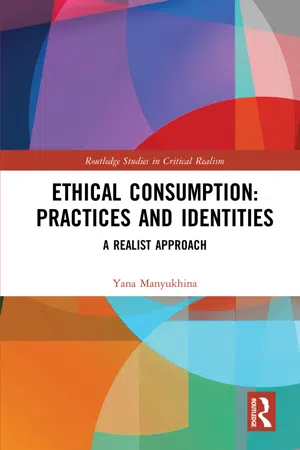
This book engages with the topic of ethical consumption and applies a critical-realist approach to explore the process of becoming and being an ethical consumer. By integrating Margaret Archer's theory of identity formation and Christian Coff's work on food ethics, it develops a theoretical account explicating the generative mechanism that gives rise to ethical consumer practices and identities. The second part of the book presents the findings from a qualitative study with self-perceived ethical food consumers to demonstrate the fit between the proposed theoretical mechanism and the actual experiences of ethically committed consumers. Through integrating agency-focused and socio-centric perspectives on consumer behaviour, the book develops a more comprehensive and balanced approach to conceptualising and studying consumption processes and phenomena.
- 184 pages
- English
- ePUB (mobile friendly)
- Available on iOS & Android
eBook - ePub
About this book
Information
Part I
Theorising the ethical consumer
1Analysing consumption
Towards an integrated approach
An approach which integrates social influences and scope for reflexivity and responsibility can explain things which neither of these one-sided theories can.
(Sayer, 2011, p. 56)
In much of the sociological literature on ethical consumption, the display of alternative consumer positions and attitudes has been conceptualised in terms of collective action in pursuit of political and social progress. Within the stream of research interpreting ethical consumption as a form of political participation and governance, the work of Micheletti (2010, 2011) has been especially influential, but many other scholars in the field of consumer studies have approached the analysis of ethical consumer behaviour from the same conceptual angle (e.g. Boström & Klintman, 2008; Clarke, Barnett, Cloke & Malpass, 2007). Representations of ethical consumption as a means of political engagement and a vehicle for social change are based on an implicit assumption that consumers’ adoption of ethical lifestyles is driven largely by practical goals, such as raising awareness of the deficiencies of modern production systems and driving structural changes in agriculture and industry. Reflecting the growing interest in ethical consumers as citizens and political agents, the focus of academic enquiry has been predominantly on external manifestations of the “consumer self” and its effectiveness in enacting social change. Meanwhile, aspects of individual engagement in ethical consumption have remained in the shadows, with very few concerted efforts being directed towards producing an effective account of the subjective meanings and personal motives invested in ethical consumer behaviour. In 2001, Tallontire, Rentsendorj, and Blowfield undertook a wide-ranging review of academic literature on fair trade, which revealed a glaring gap in the contemporary understanding of the meanings of ethical purchases for individual consumers and the ways these meanings translate into actions, highlighting the need for more exploration into this area.
Since then, however, there has been an observable proliferation of research aimed at recognising and exploring the implicit and explicit motivations, intentions, aspirations and goals attached to ethical consumer choices. In this chapter, I will situate this burgeoning stream of literature vis-à-vis the prevailing theoretical approaches to consumption that emerged and developed in the last several decades and whose core presuppositions have been informing empirical investigations of consumer behaviour. My aim is to critically review these frameworks in order to identify and expose their ontological and analytical biases, which continue to inhibit a comprehensive understanding of consumption phenomena at both the individual and social levels and, building upon this critique, argue for the benefits of critical realism for developing a much more complete, balanced and nuanced perspective on ethical consumption and consumer behaviour more broadly.
A view on consumption: lessons from the past, directions for the future
Since the 1980s, there has been a considerable increase in the scholarly attention to the subject of consumption. Among sociologists, a once dominant theoretical view of consumer habits as a direct reflection of material circumstances and class positions has gradually lost its appeal; a more nuanced understanding of consumption as shaped by a wide range of individual and social forces has arisen instead (Warde, 1997). Inspired by this new, more extensive understanding of the motives and antecedents of consumer choice, various perspectives on consumer behaviour emerged which have placed the focus of conceptual and analytical concern at different locations along the structure-agency spectrum, depending on whether society or the individual is seen as the ultimate author and source of consumption practices. At one end of this spectrum are theoretical views that take the consumer to be the prime mover of practices and a chief focus of scientific investigation, while on the other side are socio-centric approaches within which consumers are conceived of as merely bearers of practices, and the scientific interest shifts towards the social roots of consumption behaviour and the wider societal contexts in which it takes place.
Among agency-focused frameworks, the theorisation of consumers as identity-seeking, meaning-creating individuals engaged in a continuous reflexive process of constructing a coherent self through the creative appropriation of a range of commodities has been highly influential. The idea that consumption serves as the main medium in which the reflexive project of the self unfolds, has been substantiated by some of the most influential thinkers in the field of consumer studies, as demonstrated by the following quote from Alan Warde (1997, p. 68):
today, people define themselves through the messages they transmit to others via the goods and practices that they possess and display. They manipulate or manage appearances, thereby creating and sustaining a ‘self-identity’.
Consumer Culture Theory has played a vital role in inspiring a systematic and extensive enquiry into the part played by consumption in identity creation and communication and promoting the image of the active, freely choosing consumer reflexively engaging with mythic and symbolic resources circulating within the post-modern marketplace. Arnould and Thompson’s (2005) synthesising review of two decades of research on the symbolic, socio-cultural, experiential, and ideological aspects of consumption contains numerous examples of studies theorising and empirically demonstrating the links between individuals’ identity projects and consumption behaviours. The view of consumption as an arena of reflexive self-production and consumers as active agents continuously negotiating their identities through a complex variety of product choices has penetrated into sociological thinking about eating and food. On the one hand, associations between what people eat and their personal and social identities have been claimed (Fischler, 1988; Lang & Heasman, 2004; Warde, 1997) and exemplified in research: Warde’s (1997) study of culinary recipes in popular women’s magazines, Goodman’s (2004) analysis of the contemporary nature of fair trade, and Diner’s (2001) investigation of food practices of three distinct migrant groups in America all finely argue for the symbolic role and identity value of food. On the other hand, the idea of reflexivity has been introduced into sociological accounts of eating patterns in post-traditional societies to compensate for the “decline in ‘the spirit of discipline’” (Warde, 1997, p. 13) in the domain of food consumption. It has been argued that in a world where people are no longer embedded in traditional social contexts and no longer belong to familiar collectivities, the questions of what, when, and how to eat are increasingly a matter of individual rather than collective decisions (Fischler, 1980). In the absence of a social and cultural framework for eating habits, so the argument goes, individuals lack the usual reassurance about their dietary behaviour:
Denied is the sense of comfort and security that can be derived from knowing that our tastes and preferences, even in the humble field of food, are endorsed and shared by others, whom we respect and with whom we consider we belong.
(Warde, 1997, p. 173)
In such conditions reflexivity takes over from traditions to provide guidelines for appropriate eating practices, and a reflexive food consumer – the one who exhibits a “broader sense of agency in the realm of consumption choices, reflected in knowledge-seeking, evaluation, and discernment” (Guthman, 2002, p. 299) – emerges.
The requirement to be reflexive has intensified as a result of processes caused by rapid, radical transformation of the global food environment. A succession of safety scandals plaguing modern-day food industry (well exemplified by the salmonella controversy of 1988, the Alar scare of 1989, the BSE crisis of 1996, the E. coli outbreak of 2011, and the horsemeat scandal of 2013) and unprecedented advances in production technologies ceaselessly fuel public thinking about food in terms of danger and risk, which increasingly self-reliant and autonomous consumers have to negotiate on their own. The profile of “discerning food consumers” (Murdoch & Miele, 1999, p. 469) has been further rising in the light of mounting evidence and a growing recognition of the adverse effects of the modern food system on our physical, societal, economic, and environmental well-being (Fraj & Martinez, 2007; Lang, Barling, & Caraher, 2009). This is symptomatic of Beck’s risk society, wherein the notion of risk is systematically generated and nurtured by “hazards and insecurities induced and introduced by modernisation itself” (Beck, 1992, p. 21). Concomitantly, studies began to appear suggesting that people are progressively incorporating reflexivity in their daily consumption decisions (Arvola et al., 2008; Torjusen, Lieblein, Wandel, & Francis, 2001). The same conclusion wraps up Hilton’s analysis of a centuries-long discourse on consumption, indicating that “an increasing number of consumers are beginning to think more closely and more often about the basis of their own comfort” (2004, p. 119).
The figure of a reflexive, identity-pursuing consumer has consequently established a presence in sociological accounts of ethical consumer behaviour (see, e.g., Adams & Raisborough, 2008; Barnett, Cloke, Clarke, & Malpass, 2005; Cherrier, 2006; Gabriel & Lang, 2006; Halkier, 2001; Micheletti, 2003). Examples of studies emphasising the links between various forms of ethical consumption and individual as well as collective identities abound. Shaw’s (2007, p. 141) investigation of boycotting behaviour describes a group of consumers for whom the display of alternative consumer attitudes and positions was an important way of “marking your own identity”. Shaw and Shiu’s (2003) earlier enquiry into the factors influencing ethical choice and Newholm’s (2005) research on consumer engagement in responsible shopping both argue that the integrity of personal identity is a key motive behind ethical consumer behaviour. Taking the identity theme further still, sociological research started to supply commentary on the potential of ethical consumption to serve not only as a tool for self-construction, but also as a mechanism of self-control whereby “individuals in the act of constructing and reconstructing their own biographies monitor their own behaviour and thereby, at least half-consciously, discipline themselves with a view to self-improvement” (Warde, 1997, p. 93). Barnett et al. (2005, p. 29) epitomise this idea in the concept of “moral selving”, which refers to the process of creating and displaying different forms of selfhood through engagement in alternative consumption practices.
The view of ethical shopping as a means of cultivation of a better self through morally responsible choices finds considerable support in empirical research. Kozinets and Handelman’s (1998) study of boycotts, for example, highlights the powerful individualizing and morally transforming the potential of boycotting behaviour which consumers tap into to define “a personal morality that has ‘evolved’ beyond hedonistic commercial interests”. Ethical consumption, authors argue, creates opportunities for the activation of such values as compassion, care, reciprocity, and responsibility, through which consumers can materialise their ideal self. Likewise, Moisander and Pesonen (2002, p. 330) interpret ethical consumer behaviour as a mode of self-formation that involves “a permanent questioning and reinventing of the self”. In their study of environmentalism, the authors discuss how the practice of green living allows individuals the opportunity to re-invent themselves as moral subjects as opposed to materialistic consumers, and how acts of ethical consumption can be used as elements in the “politics of the self”. Similar conclusions emerge from Cherrier’s (2006, p. 520) analysis of consumer use of eco-friendly shopping bags revealing the role of ethical product choices in shaping a person’s view of herself as “a recycler, a green voter, an environmentally conscious consumer or an ethical citizen”. These studies offer an empirical record of the potential of ethical consumption not only to tell “the story of who we are”, but also to fulfil the “fantasy of what we wish to be like” (Gabriel & Lang, 2006, p. 94). The interpretation of ethical consumption as a means for moral self-enhancement clearly presupposes agency, reflected in the ability of consumers to resist and refuse materialist subjectivities imposed by the dominant consumer culture and imagine, create, and promote alternative forms of individuality.
Another stream of research has drawn out lessons for understanding the motives underlying ethical consumer behaviours from the argument that “we use consumption symbolically not only to create and sustain the self but also to locate us in society” (Wattanasuwan, 2005, p. 179). This line of thought interprets ethical shopping through Veblen’s (2009) lens, namely as a form of “conspicuous consumption” aimed at projecting a higher social, economic, and cultural status through appropriation and display of commodities that confer particular attributes on those who possess them. The representation of ethical consumption as a strategy for social distinction rests on the assumption that being a responsible consumer presupposes certain levels of financial and cultural capital. In addition, Veblen’s original view of expensiveness as a key product characteristic that provides the impression of social superiority has been re-thought to argue that “class is not just a matter of money” (Warde, 1997, p. 175), and that other symbols can offer channels for social distinction. The idea that values find material expression in goods itself is not new: in his classic study of the landmark Parisian department store, Le Bon Marché, Miller (1981) describes how the important bourgeois value of respectability was made “real” and “concrete” through a range of material goods, such as clothing and furnishing. Accordingly, some commentators have put forward the view that ethical products may be used as a proxy for personality traits – compassion, selflessness, kindness – that bring high-status rewards independently of financial success (Allison, 2009; Barnett et al., 2005). The potential of goods with ethical attributes to contribute to a desired self-presentation has been demonstrated through empirical research. The following quote from a participant of Shaw et al.’s (2005, p. 190) study of ethical shoppers illustrates the perceived status-enhancing effect of ethical choices:
If you’re putting Cafedirect [Cafedirect is a brand of fair trade coffee in the UK] in your trolley and driving around with it, then you’re saying to other people I’m clever enough to know the difference between this and Nescafe.
A previously mentioned study of green shopping bag users by Cherrier (2006) gives another line of empirical evidence...
Table of contents
- Cover
- Epigraph
- Half-Title
- Series
- Title
- Copyright
- Dedication
- Contents
- Foreword by Margaret S. Archer
- Preface
- Introduction
- PART I Theorising the ethical consumer
- PART II Studying the ethical consumer
- Conclusion
- Index
Trusted by 375,005 students
Access to over 1.5 million titles for a fair monthly price.
Study more efficiently using our study tools.
Frequently asked questions
Yes, you can cancel anytime from the Subscription tab in your account settings on the Perlego website. Your subscription will stay active until the end of your current billing period. Learn how to cancel your subscription
No, books cannot be downloaded as external files, such as PDFs, for use outside of Perlego. However, you can download books within the Perlego app for offline reading on mobile or tablet. Learn how to download books offline
Perlego offers two plans: Essential and Complete
- Essential is ideal for learners and professionals who enjoy exploring a wide range of subjects. Access the Essential Library with 800,000+ trusted titles and best-sellers across business, personal growth, and the humanities. Includes unlimited reading time and Standard Read Aloud voice.
- Complete: Perfect for advanced learners and researchers needing full, unrestricted access. Unlock 1.5M+ books across hundreds of subjects, including academic and specialized titles. The Complete Plan also includes advanced features like Premium Read Aloud and Research Assistant.
We are an online textbook subscription service, where you can get access to an entire online library for less than the price of a single book per month. With over 1.5 million books across 990+ topics, we’ve got you covered! Learn about our mission
Look out for the read-aloud symbol on your next book to see if you can listen to it. The read-aloud tool reads text aloud for you, highlighting the text as it is being read. You can pause it, speed it up and slow it down. Learn more about Read Aloud
Yes! You can use the Perlego app on both iOS and Android devices to read anytime, anywhere — even offline. Perfect for commutes or when you’re on the go.
Please note we cannot support devices running on iOS 13 and Android 7 or earlier. Learn more about using the app
Please note we cannot support devices running on iOS 13 and Android 7 or earlier. Learn more about using the app
Yes, you can access Ethical Consumption: Practices and Identities by Yana Manyukhina in PDF and/or ePUB format, as well as other popular books in Philosophy & Ethics & Moral Philosophy. We have over 1.5 million books available in our catalogue for you to explore.