![]()
1 Historical intersections between disability and music performance
Musicians with disabilities experience disabling barriers in music conservatoria, orchestras, music festivals and music competitions. In many instances, their impairments are used as an excuse to preclude them from participating in music-making. To understand the historical role that disability has occupied in music performance, this chapter traces the contextual understanding of disability throughout different performers' contemporary cultural environments. Rather than seeing impairments as a deficit and an endpoint, it conceptualises them as valuable difference and diversity. The chapter then goes on to provide a brief overview of the historical model of disability, which is used as the basis for most of the literature available in the field of music and disability studies, and its application to some of the historical intersections between disability and music.
Earliest notations to the sixteenth century
The first problem confronting anyone interested in learning about the participation of disabled people in music-making is the impossibility to state a universal definition of disability. As ethnographic research has established, the contingent nature of the category 'disabled' is influenced by historical and cultural contexts (Ingstad & Reynolds-Whyte 1995, pp. 5–6). Social constructions of physical and psychological disabilities throughout the Middle Ages differed considerably from the modern understanding of what it means to be disabled. For medieval society, impairments were understood and accepted as part of a diverse and multifaceted reality. They were a natural anomaly without negative connotations. Disability did not inspire feelings of fear or rejection; instead, its acceptance as part of an all-round reality was heavily influenced by religious connotations. Encounters with disabled people offered an opportunity 'to do good and to praise God for the infinite diversity of his creation and the mysterious harmony of his design' (Stiker 1999, pp. 65–66).
For medieval society, embodiment was a universal representation of all people (Bakhtin 1984, p. 19). Thus, corporeal difference was not constructed as an individualised condition; it was part of a bigger order that just happened to exist. Discrimination against disabled people, in the modern sense of the word, did not exist. Impairments were not seen in a negative way, or in any way at all, they were just there, another 'part of the great human lot of misery' (Stiker 1999, p. 79). This placed disabled people in an ambivalent social position. While medieval people accepted impairments, they failed to understand them (Stiker 1999, p. 70).
The physical and behavioural strangeness that could place people with disabilities as the underside of society, could also bestow upon them privileged positions in certain contexts. The political stance that disabled people occupied in some monarchies and courts exemplifies this ambivalence. Several kings and princes
kept a dwarf or hunchback near them. This disabled person, the king's fool, was permitted to mock the prince and his power. He had the right to tell the truth to the wielder of political power. Alongside the serious and the sacred character of the man who headed the affairs of society was his inverted counter-image in his anti-role of ironist and mocker.
(Stiker 1999, p. 70)
Laughing at the 'king's fool' was not perceived as a discriminatory deed; on the contrary, laughter embodied a self-critical commentary about the organisation of medieval society (Bakhtin 1984, p. 88).
Throughout the Middle Ages, impairments gradually lost their ambivalent nature and almsgiving—the practice of giving money or food to poor people—became the rule in the religious treatment of corporeal difference. Medieval Christian communities, however, 'never found an entirely stable position, nor an effective praxis to address disability' (Stiker 1999, p. 87). While they saw in biological difference an opportunity to exercise virtue, their cultural representations of disability, such as the ones found in biblical texts, depicted impairments as a form of divine punishment and associated physical disabilities with sinful behaviour (Stiker 1999, pp. 65–89).
Throughout the Renaissance, medical treatises replaced religious texts as the main source of knowledge. As such, disability immigrated from the religious to the medical terrain (Stiker 1999, p. 91). Works of scholarship such as Aldrovandi's Monstrorum historia, Boiastuau's Histoires prodigieuses, Lycosthenes' Prodigiorum ac ostentorum chronicon and Rueff's De conceptu et generatione homines presented detailed descriptions of hoaxes, allegorical figures and physical impairments. By the end of the sixteenth century, these texts became the prime medium to studying and understanding impairments. Ambroise Paré's Des monstres et prodiges, perhaps the most often reprinted publication that studied body diversity throughout the sixteenth century, ultimately established the understanding of impairments as a medical problem in 1573 (Fiedler 1981, pp. 231 33).
Des monstres et prodiges reframed disability in scientific terms.1 For the modern reader, the use of the word 'monster' to describe a person with impairments may appear offensive. Des monstres et prodiges, however, uses it without any of its current negative connotations.2 This text's main topics are dictated by a genuine appreciation for diversity and written with the purpose to instruct and inform (Paré & Pallister 1983, pp. xxi, xxvii). While today it may be difficult to read Paré's treatise without filtering it through the veil cast by nineteenth-century literature's over-medicalisation of disability, the use of the word 'monster' remained, until very recently, the standard term to describe physical impairments in medical treatises.3
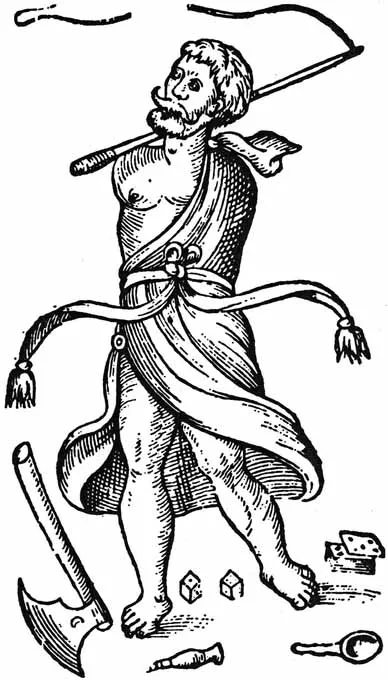
Des monstres et prodiges contains one of the first documented examples of a disabled person's participation in music performance. The eighth chapter includes an engraving labelled 'man without arms.' While this engraving was published in 1573, it may be safe to assume that it predates the 1430s.4 Paré describes this person as 'a man without any arms, forty years old, or thereabouts, strong and robust, who performed almost all the actions that another might do with his hands' (Paré & Pallister 1983, p. 36). The engraving presents a collection of objects around the man's feet that represent the multiplicity of activities that he could perform with his lower limbs; among them, a wind instrument, near his right foot, suggests his ability to perform music (see Figure 1.1).
Figure 1.1 Engraving of a 'man without arms,' Ambroise Paré, Des monstres et prodiges (1573)5
Additional descriptions of disabled performers come from the 1430s. In his treatise, De inventione et usu musicae ('On the invention and use of music'), Tinctoris (cited in Taruskin 2010a) provides a detailed account of the performance of two blind musicians: 'at Bruges I heard Charles take the treble and Jean the tenor in many songs, playing the fiddle (vielle) so expertly and with such charm that the fiddle has never pleased me so well.' Around the 1440s, Martin Le Franc (cited in Taruskin 2010a) described the same performers as two blind brothers who 'astonished and abashed the court musicians of Burgundy, including Binchois and Du Fay, with their amazing virtuosity.' Polk (2012, pp. 337 38) also identifies them as siblings. According to Polk,
Jehan de Cordeval and Jehan Fernandez arrived at the court of Burgundy in 1433. The two, both evidently blind, were from the Iberian Peninsula, and had arrived in the retinue of the new duchess, Isabella of Portugal. As they arrived, each bore the title 'player of the lute' ('joueur de luth').
Polk further identifies the Fernandez siblings in his 'description of the famous banquet given by the Duke of Burgundy in 1454 at a gathering of the knights of the Golden Fleece,' where 'the two played on fiddles, while a young woman from the court of the duchess sang with them.' These blind performers must have possessed remarkable performing skills to attract detailed commentary from contemporary observers. Without access to literate music, their performance must have put 'their learned colleagues to shame with their flamboyant improvisations on standard tunes' (Taruskin 2010a).
Descriptions of the Fernandez siblings focus on their abilities to improvise, surprise and astonish audiences with their virtuosity. Their performing styles, however, remained outside the boundaries of music literacy. It is not surprising that most disabled performers around this period of music history remain anonymous. Music history has paid more attention to the life of disabled musicians who made the transition to literacy; among these, the fourteenth-century composer Francesco Landini (1325–1397) offers one of the earliest examples of a disabled keyboard performer who made this transition.
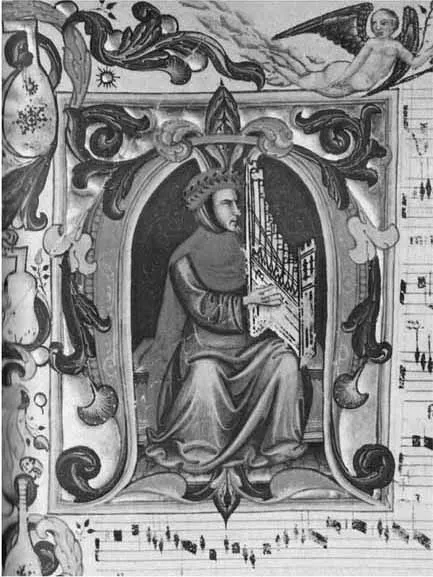
Landini was a blind composer and performer of portative organ, lute, flute and other instruments (Milsom 2013). The surviving portrait of the composer, in the Squarcialupi Codex, has attracted the interest of disability scholars for two reasons (see Figure 1.2). First, the composer is wearing a laurel crown, a pictorial detail 'given to the greatest poets' (Cuthbert 2016, p. 518). Second, the portrait shows the composer 'facing to the side, with his one visible eye half closed,' which has been interpreted as a representation of his visual impairment (Straus 2011, p. 20). The iconography of the eyes, however, was not used as a representation of blindness throughout the Middle Ages and the Renaissance. It is not until the seventeenth century that eyes became a marker of disability in visual depictions of blind people. In the case of the Squarcialupi Codex, there is further evidence to suggest that Landini's blindness was represented through the absence of a music score (Barasch 2001, pp. 4, 141).
Figure 1.2 Francesco Landini, 'Magister Franciscus Cecus Horganista de Florentia,' f. 121V, Squarcialupi Codex6
Conrad Paumann (c. 1410–1473) offers another compelling example of a blind keyboard performer who made the transition to literacy. Paumann's
first professional post was as organist in the St Sebaldus church in his native Nuremberg in 1446. In 1447 he was appointed to the civic chamber ensemble of lute and organ, also in Nuremberg. In 1450 he moved to serve the Duke of Bavaria in Munich, and remained in that service until the end of his life. He made one notable trip to Italy in 1470, where he was described as 'miracoloso'. History remembers him primarily as an organist, but he was also a master lutenist, appearing both as a soloist and in lute ensembles in a variety of official visits to such German towns as Augsburg as a musical representative of the Duke of Bavaria. His abilities were noteworthy on a pair of accounts. First, Tinctoris singled out Paumann's supreme ability to play more than one line on the lute — this in contrast to other contemporaries who specialised in monophonic performance. Second, he was also a fine composer. We only have one piece extant, but it reveals complete mastery.
(Polk 2012, p. 338)
Surviving accounts from this period tend to portray disabled keyboard performers using a religious tone that suggests divine overcompensation as justification for their technical skills (Polk 2012, p. 338). These descriptions, however, are also some of the earliest written biographical reports of performers ever recorded in Western history. As such, these accounts fostered the notion that keyboard performers, in their dual role as composers performers, possessed 'all the supernatural abilities later accorded to the well-known virtuosi of the nineteenth century—often bordering on the fantastic' (Jamason 2012, p. 109). It is difficult, therefore, to dissociate the aspects of their performance, which were understood as divine compensation for their impairments, from the implausible and fantastic characteristics that would be associated with any other non-disabled performer.
Disabled musicians sang and/or performed music with instruments such as: fiddle (vielle), lutes (when written in plural, that means instruments in more than one size), keyboard instruments (portative organ), flute and other non-specified wind and string instruments. Throughout the twelfth and thirteenth centuries, performers with visual impairments were also associated with instruments such as the organastrum, a 'sort of "fake" bowed instrument in which the strings vibrate against a spinning wheel, rather than against a bow.'7 The 1436 payment entries of Jehan de Cordeval and Jehan Fernandez reveal that scribes referred to them as 'joueurs de bas instruments.' This term verifies their 'ability to double in a variety of instruments,' as was expected of chamber performers (Polk 2012, p. 337). Blind performers worked with 'relative independence from music notation' and were famous for their memory and their ability to improvise.8 Their creative process must have included artistic interdependency in their relationship with scribers or transcribers (Straus 2011, p. 21). Lastly, Paré's engraving suggests that disabled performers with missing limbs might have performed music using limb substitution, revealing one of the earliest examples of instrumental technique adaptation of individualised bodies.
The historical model of disability used in musicology suggests these musicians' impairments were not stigmatised. This, however, does not imply that responses to disability were effective or functional during the Middle Ages and the Renaissance. The downside of a social order that understood corporeal difference through acceptance and dealt with it through charity is the non-existing concept of human and civil rights.9 While corporeal difference was recognised as the rule rather than the exception throughout this period of music history, future attitudes towards disabled musicians were beginning to appear in their primitive form. Descriptions of disabled performers from this period present the embryonic form of a discriminatory attitude that would follow keyboard performers with visual impairments for many centuries to come, a cultural process known as social spreading—that is, embedding character to a set of generalised physical attributes or impairments (Murphy 19...