There is much debate about postfeminism, what it is, and its role in feminist politics. Whilst postfeminism has become increasingly influential in the study of literature, popular culture, and philosophy, it has so far received comparatively little attention in law. This book aims to remedy this situation. The book brings together feminist legal scholars working in different contexts to examine the idea of postfeminism and assess its contemporary relevance. It explores a range of questions including the following: Does postfeminism describe an age that follows modernism, an age where identity politics has realised its goals and feminism is no longer needed? Or does postfeminism describe the feminism of a postmodernist age where identity can mean anything at all? Or, differently again, does the term capture a 'new feminism' that discredits feminism and attempts to reshape its political consciousness? And what might the answers to these questions mean for law and legal theory, and a feminist politics of law reform?
eBook - ePub
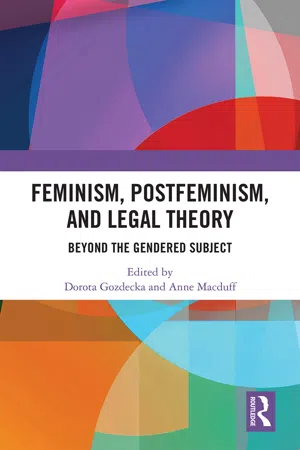
Feminism, Postfeminism and Legal Theory
Beyond the Gendered Subject?
- 170 pages
- English
- ePUB (mobile friendly)
- Available on iOS & Android
eBook - ePub
Part I
Legal feminism
1 The feminist fandango with the legal academy1
Margaret Thornton
Introduction
This chapter argues that the fortunes of feminism in the Australian legal academy are closely intertwined with the prevailing political ideology. Social liberalism, with its commitment to egalitarianism, a robust civil society, and a modicum of tolerance for the Other, coincided with the flowering of second-wave feminism. This led to the appointment of feminist academics in law schools and the incorporation of feminist perspectives into their teaching. In contrast, neoliberalism, with its aggressive entrepreneurialism and promotion of the self, encouraged a sloughing off of a commitment to feminist values. Mirroring the values of neoliberalism and reacting against the second wave, postfeminism initially resulted in a depoliticisation and a turning away from collective action with neoliberalism moving in quickly to colonise it. This incarnation of postfeminism, which one might term ‘neoliberal feminism’, encouraged entrepreneurialism and productivity, particularly on the part of upwardly mobile individual women. It also resonated with the neoliberal law school where students were anxious to secure a position on the corporate track in light of mounting tuition debts and increased competition. More recently, there has been a reaction against neoliberalism, which has once again brought with it a revived incarnation of feminism and a progressive understanding of the ‘post’.
Feminism possesses neither a precise denotation nor a manifesto, but an amorphous constellation of values. First- and second-wave feminisms were primarily political movements concerned with improving the quality of women’s lives, but no comparable assertion can confidently be made about postfeminism, which is beset with ambiguities. Indeed, the only reason for holding onto the word ‘feminist’ by one strand of postfeminism may be to accentuate a reactive anti-feminist standpoint. In contrast, third-wave feminism is a variation of the ‘post’, which recognises that feminism is both possible and necessary (Budgeon 2011). Nevertheless, these terms are not discrete, and to avoid a confusing proliferation of terms, I use ‘postfeminism’ to encompass its various iterations. The inference I seek to draw is that the fortunes of feminism are closely intertwined with the dominant political values of the day.
With particular reference to the Australian context, I consider the ramifications for the legal academy of the transition from the second wave to postfeminism and beyond but stress the contradictions that multiple feminisms pose for law, which prefers clear lines and neat categories.
The twin variables of liberalism – freedom and equality – have been key animating forces underpinning the trajectory of feminism. First-wave feminism of the 19th century was inspired by the struggles for freedom and equality that were central to both the anti-slavery and the universal suffrage movements (Phillips-Anderson 2012). White women sought to be ‘let in’ to the public sphere in order to exercise the same rights as men. The second wave of the late 20th century was influenced by contemporary currents of political radicalism, such as the struggle against apartheid and the sexual revolution, as well as the anti-conscription and anti-Vietnam War movements (Curthoys 1988). I stress the political radicalism that underpinned the women’s liberation movement and the multifarious strands of the second wave. This is despite the revisionist accounts of feminism, which averred that all women were victims who lacked agency. Such accounts, however, appear to have been largely a product of the subsequent backlash.2
Second-wave feminism was primarily concerned with securing gender equality, social justice, and autonomy for women, graphically symbolised by the well-known aphorism ‘the personal is the political’,3 where the aim was to shine a light on the dark recesses of private life so long hidden. Domestic violence, sexuality – consensual and non-consensual – as well as issues such as contraception, abortion, and child care became politicised and the subject of law reform. A major strand of concern for the second wave related to inequality and discrimination at work, including the sexual division of labour, maternity leave, and pay equity. Some aspects of the private sphere, such as wages for housework, were discussed but never resolved (Curthoys 1988, 16).
I wish to stress at the outset that I am not seeking to hark back to the ‘good old days’ in emphasising the conjunction between second-wave feminism and social liberalism, but to suggest that the feminist reform agenda of the second wave was cognisable to law in a way that has not been the case since.4 While the politics of feminism have fragmented over the 40-year period, liberal legalism has remained highly resistant to change; we cannot talk meaningfully about post-legality in the way we talk about postfeminism, for example. Taking its cue from the political economy of neoliberalism, one dimension of postfeminism is preoccupied with individual choice and promotion of the self. Individual choice, as the pièce de résistance, induced Sarah Projansky (2001, 89) to define postfeminism as a ‘self-defined particular historical moment’, a subjectivity that can only bemuse legal positivism, which consistently remains the dominant legal theory of our times. I suggest that the ambiguities of postfeminism, particularly in its ‘spent force’ sense, in conjunction with the conservatism associated with neoliberalism has induced a turning away from institutionalised feminism in the legal academy. The major intellectual movements of postmodernism and poststructuralism have destabilised the feminist subject but barely touched liberal legalism, which remains a quintessentially modernist discourse. This is apparent when one looks at the reported decisions of any appellate court.
The political landscape has changed dramatically in 40 years. For example, more varied iterations of race have emerged in the 21st century fuelled by 9/11 and the war on terror, together with the refugee crisis and the struggle over constitutional recognition of Indigenous peoples in Australia. Most significantly for conceptualising the ‘post’, the simple binarisms of male/female and heterosexual/homosexual that were for so long central to law have been complicated by new iterations emerging from their intersectionality. In this respect, we see glimmers of the transformative understanding of the ‘post’ in postfeminism.
My focus is the changing nexus between feminism and the legal academy by elaborating, first, on the way social liberalism facilitated feminist reformism on the part of the state and, second, to show how, in conjunction with the neoliberal turn, ‘the gains of the 1970s and 1980s have been relentlessly undermined’ (McRobbie 2009, 11) leading to a turning away from feminism in the legal academy. More recently, however, a revival of overt misogyny, as evinced by prominent figures, such as President Donald Trump, has triggered a corresponding revival of feminism. It is too early to gauge what impact this most recent iteration of feminism will have, but it is clear that the short history of feminism in the legal academy cannot be represented by a linear trajectory.
Social liberalism
While necessarily constrained by capitalism, social liberalism includes an element of distributive justice effected by the state through welfare policies and a regime of progressive taxation. Programs include universal health care and education, as well as income support for the unemployed, senior citizens, people with disabilities, and single mothers. Although social liberalism is a market system committed to competition, the values of public good and distributive justice prevent the market from having free rein. The high point of social liberalism in Australia is associated with Labor Prime Minister Gough Whitlam (1972–1975) (Kelly and Bramston 2015) when a swag of social justice reforms were enacted that accorded with the feminist agenda. They included no-fault divorce, equal pay initiatives, removal of the sales tax on contraceptives, paid maternity leave for federal public servants, support for single mothers, universal health care, anti-discrimination initiatives, and the abolition of conscription.
The public service, which was expanded to administer these reforms, was regarded as a strategic destination for feminist activists and policymakers. Indeed, the Australian neologism, ‘the femocrat’, coined to encapsulate the idea of a feminist bureaucrat (Eisenstein 1996), was crucial in formulating election policies and preparing cabinet documents (Dowse 1982, 332 et seq.). The interrelationship between feminism and the state was further underscored by the appointment of women’s advisory councils to government. The tenor of these reforms meant that engagement with the state was viewed positively by feminist activists. Indeed, the Women’s Liberation Movement, which was generally sceptical about the institutionalisation of feminism, was supportive of refuges and rape crisis centres being funded by government for the first time (Curthoys 1988, 86). This nexus between second-wave feminism and the state paved the way for the relationship between feminism and the legal academy.
Feminism comes to law school
Lawyers were in demand to administer the new legislation and this factor, in conjunction with the optimism about reform, the growth in the economy, the circulation of a popular pro-feminist discourse, and the abolition of university fees in 1974, led to a rapid increase in the enrolment of women in law school – from around 10 per cent in the 1960s to approximately 25 per cent by the 1970s, with the tipping point being reached in the 1980s. Young women who chose to enrol in law were excited by the possibility of what a feminist lawyer might be able to achieve. Newly established law schools, such as the University of New South Wales, promised a commitment to social justice and, during the 1970s, it was associated with progressive causes such as the Prisoners’ Action Group and the establishment of the Redfern Legal Centre (Genovese 2010, 55–58).
The feminist critique of the claimed universality of knowledge, which exposed its partiality, struck a particular chord with feminist legal scholars because of the dominance of doctrinal or ‘black letter law’ pedagogy, together with the pervasive myth that justice is blind (Thornton 1986; Naffine 1990, 24ff.). Feminist legal scholars were concerned with demonstrating how ‘law’s internal presumption created subjects of law that were inherently gendered’ (Genovese 2015, 1). They were inspired to incorporate feminist perspectives into their teaching – cautiously at first and then with growing confidence. The overtly gendered nature of law within areas such as sexual assault, violence against women and family law lent itself more readily to the inclusion of feminist critiques than, say, constitutional or commercial law, which purported to be gender neutral. In time, optional subjects such as discrimination law and women and the law appeared, followed by law and gender and feminist legal theory, the teaching of which was aided by the first feminist textbooks (Graycar and Morgan 1990, 2002; Davies 1994, 2008). Such courses were contingent on the appointment of a critical mass of creative feminist scholars who were able to support one another (Naffine with Heath 2015, 24). However, the discipline of law was never subject to the full-scale epistemological assault similar to that experienced by the humanities and the social sciences. The various state and territory admitting authorities were able to constrain the deconstructive exercise by virtue of their role in certifying that law graduates are qualified to practise law. Their privileged role includes the specification of a raft of 11 compulsory subjects known as the ‘Priestley Eleven’.5 Critical approaches to law, including legal theory and social justice, have never featured in these requirements (Thornton 2017).
Feminism nevertheless exerted an impact on the core curriculum during the two decades in which it flourished, despite the assertion of Richard Johnstone and Sumitra Vignaendra in 2003 that the influence of feminism on the Australian legal academy was almost zero (Johnstone and Vignaendra 2003, 130). This not only discounted the considerable body of innovative scholarship that was published (e.g. Graycar 1990; Naffine 1990; Thornton 1990; Petersen 1993; Howe 1994; Kirkby 1995; Thornton 1995; Chea, Fraser, and Grbich 1996; Thornton 1996; Naffine and Owens 1997; Easteal 1998; Berns 1999; Charlesworth and Chinkin 2000; Moreton-Robinson 2000; Occasions and Events 2015) but also measures such as the Australian government-supported initiative in 1993 designed to sensitise all law students to issues of gender bias. This initiative emerged after Justice Bollen, in the course of a South Australian Supreme Court judgement dealing with rape in marriage, stated that a little ‘rougher than usual handling’ was acceptable on the part of a husband towards a wife who was less than willing to engage in sexual intercourse (R. v Johns 1992, 12–13).
Following extensive adverse media publicity, the Commonwealth Attorney-General accepted a submission from feminist legal scholars that law students needed to familiarise themselves with gender issues and to understand that the stance of Justice Bollen could no longer be tolerated. Accordingly, gender-sensitive materials for the compulsory core – the ‘Priestley Eleven’ – were prepared by several prominent feminist legal academics on the themes of citizenship, work, and violence.6 Copies of the materials were sent to all law schools and made available on the Internet. The fact that Justice Bollen’s remarks featured in dozens of front-page stories in newspapers around the country is testament to the responsiveness of popular culture to second-wave feminism. The outcry meant that the crude sexism that had long pervaded the legal discourse of sexual assault in both courtrooms and law school classrooms began to recede, even if it did not disappear altogether.
The take-up of the gender-sensitive materials was nevertheless not believed to be very high and the materials eventually disappeared from sight, undoubtedly aided by the neoliberal turn. Ironically, they were completed in 1996, the very year that conservative Prime Minister, John Howard, assumed office, which signalled the retreat from social liberalism.
The neoliberal turn
The ostensible success of institutional feminism in the legal academy was short-lived. Indeed, the seeds of a more market-oriented incarnation of liberalism had been sown by Gough Whitlam himself in advocating trade liberalisation in the 1960s and cutting tariffs by 25 per cent in the 1973 budget (Cahill 2004, 89).7 This initiative was built upon by Labor Prime Ministers Hawke and Keating in the 1980s and 1990s, although they both remained supportive of Labor’s social liberal values. Neoliberalism did not become the dominant political ideology until John Howard’s Prime Ministership (1996–2007).
While neoliberalism lacks a coherent ideology, its key elements include the erosion of the welfare state, the privatisation of public goods, profit maximisation, entrepreneurialism, regressive taxation, and individualism at the expense of the collective good, with the overall political aim of restoring the power of economic élites (Harvey 2007, 19; Dumenil and Lévy 2011, 329). The paradigmatic individual of neoliberalism can be described as self-motivating and autonomous, and is free to exercise choice and reinvent the self in order to maximise his or her life chances. Flexibility and choice are the key to managing the self, preferably in a competitive, marketised context. However, neoliberalism is not ‘just a system of economic power relations but a...
Table of contents
- Cover
- Half Title
- Title Page
- Copyright Page
- Dedication Page
- Table of Contents
- List of contributors
- Introduction: the provocation of the ‘post’ in postfeminist legal theory
- Part I Legal feminism
- Part II The politics of law reform
- Part III Law
- Index
Trusted by 375,005 students
Access to over 1.5 million titles for a fair monthly price.
Study more efficiently using our study tools.
Frequently asked questions
Yes, you can cancel anytime from the Subscription tab in your account settings on the Perlego website. Your subscription will stay active until the end of your current billing period. Learn how to cancel your subscription
No, books cannot be downloaded as external files, such as PDFs, for use outside of Perlego. However, you can download books within the Perlego app for offline reading on mobile or tablet. Learn how to download books offline
We are an online textbook subscription service, where you can get access to an entire online library for less than the price of a single book per month. With over 1.5 million books across 990+ topics, we’ve got you covered! Learn about our mission
Look out for the read-aloud symbol on your next book to see if you can listen to it. The read-aloud tool reads text aloud for you, highlighting the text as it is being read. You can pause it, speed it up and slow it down. Learn more about Read Aloud
Yes! You can use the Perlego app on both iOS and Android devices to read anytime, anywhere — even offline. Perfect for commutes or when you’re on the go.
Please note we cannot support devices running on iOS 13 and Android 7 or earlier. Learn more about using the app
Please note we cannot support devices running on iOS 13 and Android 7 or earlier. Learn more about using the app
Yes, you can access Feminism, Postfeminism and Legal Theory by Dorota Gozdecka,Anne Macduff in PDF and/or ePUB format, as well as other popular books in Law & Gender & The Law. We have over 1.5 million books available in our catalogue for you to explore.