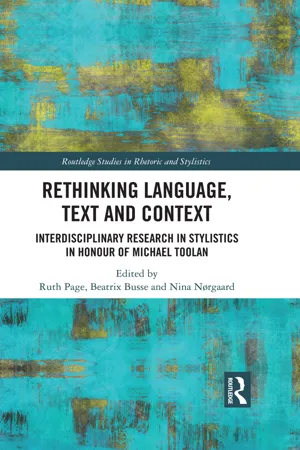
This collection of original research highlights the legacy of Michael Toolan's pioneering contributions to the field of stylistics and in so doing provides a critical overview of the ways in which language, text, and context are analyzed in the field and its related disciplines. Featuring work from an international range of contributors, the book illustrates how the field of stylistics has evolved in the 25 years since the publication of Toolan's seminal Language, Text and Context, which laid the foundation for the analysis of the language and style in literary texts. The volume demonstrates how technological innovations and the development of new interdisciplinary methodologies, including those from corpus, cognitive, and multimodal stylistics, point to the greater degree of interplay between language, text, and context exemplified in current research and how this dynamic relationship can be understood by featuring examples from a variety of texts and media. Underscoring the significance of Michael Toolan's extensive work in the field in the evolution of literary linguistic research, this volume is key reading for students and researchers in stylistics, discourse studies, corpus linguistics, and interdisciplinary literary studies.
eBook - ePub
Rethinking Language, Text and Context
Interdisciplinary Research in Stylistics in Honour of Michael Toolan
- 332 pages
- English
- ePUB (mobile friendly)
- Available on iOS & Android
eBook - ePub
Rethinking Language, Text and Context
Interdisciplinary Research in Stylistics in Honour of Michael Toolan
About this book
Information
1
Introduction
Language, Text and Context Revisited
1. ‘Only Connect’: Language, Text and Context
The connections between language, its use, text and context have always been central to stylistics and stylistic analysis. Stylistics is an empirical discipline, where usually, although not exclusively, the analyst focuses on the textual patterns created by (literary) language. The process of interpreting these linguistic patterns does not take place in a vacuum, but, by necessity, always in a combination of at least cognitive, cultural and historical contexts. In this respect, since its emergence, stylistics has tended to avoid the abstraction of theoretical linguistics and the universalising assumptions found in structuralist models of the text. The stylistic conceptualisation of context has also moved from its product-oriented view outside text and discourse to a procedural and dynamic perspective which sees context as being construed in and constructive of language and other semiotic modes as well as by the reader. The stylistic emphasis on contextualisation was made explicit in Michael Toolan’s (1992) seminal collection of essays: Language, Text and Context. The title of our present collection is a deliberate echo of that earlier project—to honour Michael Toolan’s work as well as to highlight the trendsetting potential of his view of context then. The essays brought together in the 1992 collection illustrate clearly the breadth of each of the title’s key terms as these were conceived at the time. First, the collection illustrated the wide range of texts which are of interest within stylistics; texts which are by no means limited to a canonical set of text types, but instead consider a range of (literary) genres such as poetry, prose and plays alongside advertisements in a matrimonial column and the headlines of reports published in a tabloid newspaper. Second, the interpretive frameworks used to explore the language in these texts were similarly broad and showed the branches to which stylistics had already spread out, such as pragmatic stylistics, functional stylistics and critical stylistics. Finally, the kinds of contexts that were important in these essays varied and included the textual context of particular passages which were subject to stylistic scrutiny, as well as the historical and ideological contexts in which those texts and the language therein were situated. As the editor’s Preface pointed out, Toolan’s 1992 collection was a landmark that demonstrated the value of making connections between text and context, and between different disciplinary contexts, especially those found at the interface between linguistic and literary scholarship.
Some 25 years on, it is time to revisit the connections between language, text and context, for whilst each of these three key terms has remained central to the stylistic enterprise, much has also changed. There are several reasons for this. First, as stylistics has matured over the decades, it has continued to broaden and deepen its interdisciplinary connections. The contextual range of stylistics now incorporates a number of sub-branches, such as cognitive stylistics, corpus stylistics, multi-modal stylistics, historical stylistics, postcolonial stylistics and pragmatic stylistics, to name but a few. This widening interdisciplinarity opens up different methods for exploring language, draws attention to different aspects of context and expands the linguistic meaning-making that might be of interest to the stylistician. Second, significant theoretical shifts have taken place within linguistics over the last 25 years and have had important implications for stylistics. It is now less easy to pin down what we might mean by ‘language’ or ‘context’, or even what counts as the ‘text’. For example, a ‘text’ may be considered a single, written artefact, such as a poem, but can also extend beyond this to include semiotic resources and paratextual elements, such as the ways in which a poem performed, recorded and then uploaded to a social media platform like YouTube will also incorporate the sound, gestures and camera angle presented in the video and the resources of the YouTube template itself (including comments, ranking and metadata). Third, the last decade of the twentieth century was marked—among others—by significant social, cultural and technological changes. Technological changes made it possible to investigate language on a large-scale basis and to store natural language data in large quantities in a computer-readable format. These facilitate the quantitative investigation of language in language corpora by means of specific corpus linguistic tools and methodology and allow for innovative ways of interpreting the relationship between language use, text and context. Technological changes have also facilitated the development of new kinds of texts and uses of language.
In this Introduction, taking Toolan’s 1992 collection of essays as a starting point, we examine what the theoretical, technological and methodological implications of these changes are for exploring the connections between language, text and context.
2. Looking Back to Look Forward
In order to show why we need to revisit the connections between language, text and context, we begin by setting Toolan’s 1992 collection in its wider scholarly context. Stylistics was not the only discipline where ‘context’ was gaining particular attention at the end of the twentieth century. The 1990s saw the publication of several key scholarly texts in the social sciences that reoriented the way researchers thought about the relationship between language, text and context. These publications can be understood as a part of a longer, scholarly trajectory, where from the 1970s and 1980s scholars had reacted against the earlier, structuralist attempts to identify universal accounts of language. In these preceding decades, into which modern stylistics was ‘born’, we observe a general shift towards building theoretical models about language and language use based on the empirical observation of texts (which include spoken interactions as well as written data). For example, in their seminal work on narrative structure, Labov and Waletzky (1967) claimed that we could not understand the universal patterns of storytelling set out by narratologists without first attending to the minimal stories that people actually told about their experiences.
Whilst the ‘text’ began to gain greater precedence as the means by which scholars developed linguistic theory, so too were the last decades of the twentieth century characterised by an increasing attention to the socially situated nature of language use. In this regard, scholars in the social sciences and the humanities were drawing on models of context whereby they could describe the contrast in different forms of language use according to social categories, such as age, class or gender, which in the classic works of variationist sociolinguistics are said to be reflected in a speaker’s use of language variables. During the 1970s and 1980s, the interest in the social and cultural contexts within applied linguistics, for some scholars, became decidedly political. Emerging from the theoretical starting point of Marxism, the field of critical linguistics led by Fairclough (1989) and Fowler (1986) began to think about how the differences in social categories might be understood as shaped by and contributing to various forms of power. The impact of these ways of thinking about context is evident in the 1992 collection Language, Text and Context. There is particular interest in the social category of gender, with a section devoted to the framing of women in various literary and non-literary texts, just as the lexico-grammatical analysis found in several papers shows the scholarly interest in interpreting the relative agency of particular persons and/or ways of thinking. However, it is perhaps telling that whilst celebrating this contextualist turn, there is little in the essays from our 1992 predecessor that really explores what context might be. Instead, context seems to be thought of as a relatively stable entity, somehow outside the text (and thus, extra-textual), but accessible by means of interpreting the language and the patterns found therein. It is this view of context which is challenged by other publications contemporary with Toolan’s collection in the 1990s and which led to a more complex, nuanced and multi-layered view of the connections between language, text and context.
3. Language, Text and Context: From Product to Process
Within the social sciences, one of the pivotal texts which reoriented scholarly concepts of context was Alessandro Duranti’s (1992) collection Rethinking Context. There is no mention of stylistics in Duranti’s collection, nor indeed do any of the essays interrogate literary texts but rather focus on spoken interactions of various kinds. Nonetheless, the influence of Rethinking Context on discourse studies, pragmatics, linguistic anthropology and sociolinguistics—all fields which intersect with developments in stylistics—means that the central claims proposed by Duranti should be considered here. Perhaps the most far-reaching claim was the repositioning of context as a process that emerged from language use rather than a predefined form that constrains language performance. In many ways, this view of context is implicit in the way in which stylistics proceeds: contextual factors are inferred from the language in the text. However, typically the interpretation of context within stylistics tends to treat it in a less fluid and co-constructed manner than proposed by Duranti’s work. This opens up further challenges for the stylistician, who might then question how far these claims about the co-constructed nature of context operate also for textual interactions where the sender and recipients of the text are not co-present, and how we as analysts might begin to observe this co-construction of context on an empirical basis.
The kinds of texts interrogated by the authors of the essays in Duranti’s collection illustrate neatly the turn towards examining the interactional context as the site where meaning is negotiated by the interlocutors. The essays focused on spoken interaction, observed and analysed in relation to the performances situated in particular, physical places. This led to greater attention to and conceptualisation of the behavioural context and to the physical spaces and places in which texts are produced and consumed, seen, for example, in the sociolinguistic work of Scollon and Scollon (2003). This began to expand the range of communicative resources of interest to the linguist, to include gesture, facial expression and other kinds of embodied interactions. Again, at first sight, this might seem to bear little influence on the stylistic analysis of an individual, print-based text. However, the empirical turn towards context can be seen as part of the wider developments more recently in stylistics which have analysed the experiences of actual readers and their interpretation of particular texts.
The tendency for stylistics to approach context via the language found in a pre-existing, often written, text means that the complexities of the textual production and reproduction are not always as obvious as they appear when other kinds of linguistic performances are considered. However, at the same time that Toolan’s 1992 collection was published, within linguistic anthropology, Bauman and Briggs (1990) drew attention to the complex ways in which texts are made and remade across different contexts. In their influential essay ‘Poetics and Performance’, Bauman and Briggs set out three elegant concepts: entextualisation, contextualisation and recontextualisation. These ‘telling resources’ have become part of a crucial toolkit within discourse studies (De Fina and Georgakopoulou, 2012, p. 133) which have shaped the understanding of text and context as a dynamic, renegotiated process that unfolds over time. These concepts point to the strategic ways in which language is turned into a stretch of text, how the meanings of those texts are constructed and reconstructed as the interaction unfolds and how those texts can be reinterpreted as they are inserted into new contexts. These concepts are important, for they also emphasise the fluid, interactional process of contextualisation, but, in addition, point to the ways in which texts can be renegotiated iteratively across successive contexts. This demonstrates how the view of context has expanded in terms of the dimensions of time, space and setting, all of which might be of importance in understanding what the language in a particular text might mean.
The relationship between one text and another, prior text is an aspect of context that has long been of interest to stylisticians, literary critics and linguists. The ways in which interdiscursive contexts have been explored is varied, including work that draws on Bakhtin’s (1986) notions of heteroglossia and dialogism, the field of fidelity studies and within stylistics. But Briggs and Bauman’s (1990, 1992) work has been particularly pivotal within later scholarship emerging from mediated discourse analysis and geosemiotics, where these chains of recontextualisation are interpreted from a socio-political perspective. The work of Scollon (2008) in particular brought this together with systemic functional linguistics to explore how the processes of recontextualisation were combined in texts with different semiotic qualities, across textual genres in ways that might obscure or promote the agency of one textual producer rather than another. This work was also influenced by a separate but inter-related theoretical development that took place in the 1990s, namely, the emergence of social semiotics as a distinct field of research, led by the work of Kress and van Leeuwen (1996, 2001). The impact of this work within stylistics has been to expand the range of semiotic resources that are perceived as meaningful within any given text and its context, beyond the verbal focus typical of much earlier stylistic research. Thus, whilst the essays in Toolan’s 1992 collection focus solely on verbal patterns, in our present collection we find essays that also include attention to visual aspects of the text such as image and (within the image) gaze (see chapters by Caldas-Coulthard and Pihlaja) and to aural forms of communication (see Jobert’s chapter).
The co-constructed nature of context does not result alone from the externally observable, multimodal interactions in which interlocutors engage. The interpretation of language, texts and their context is also a cognitive matter. One of the most influential developments in stylistics since the 1990s has been what has been described as ‘the cognitive turn’. Although the start of this ‘cognitive turn’ pre-dates the 1990s, the last decade of the twentieth century saw the publication of a number of texts which signal the gaining traction and influence of cognitive linguistics on stylistics and its understanding of ‘context’. In relation to the interpretation of literary texts in particular, Tsur’s (1992) Towards a Theory of Cognitive Poetics, Turner’s (1991) Reading Minds and (1998) The Literary Mind were landmark publications that marked the increasing interest in modelling how readers made sense of the complexities of literary texts. In the same decade, Ryan’s (1990) work Possible Worlds and the posthumous publication of Paul Werth’s (1999) work Text Worlds set out influential frameworks for describing the ways in which readers make sense of fictional worlds and their various imagined configurations.
In many ways, the cognitive turn is a contrasting direction within stylistics that runs counter to the empirical turn in Rethinking Context. As Gavins and Steen (2003) point out, the work of Tsur (1992) and Turner (1991) is in many ways aligned with the structuralist poetics of the 1970s, whilst at the same time sharing with the contextualist turn a commitment to exploring the relationship between the text and the reader. It is perhaps no surprise then that the models proposed in the key texts that were published in the 1990s within cognitive poetics and the interpretations proposed are not founded on empirical observations of neuroscience—that is, the reactions and responses of actual readers—but rather are heuristic models that allowed the analyst to map carefully the readings that were possible from particular literary texts. It is only with later developments that cognitive science has taken into account the behaviour of actual readers, for example, as modelled through eye-tracking technologies, or inferred from the responses gathered in focus groups or interviews.
Although the co-constructed, fluid and multi-layered nature of ‘context’ is underpinned to at least some extent by empirical observations of textual interactions, explaining the relationship between the patterns of text and context often seems a matter of interpretation. In particular, certain aspects, such as the historical, social and cultural contexts, are not tractable in the same way that the situational contexts of face-to-face interaction might be. One influential model, from social psychology, more or less contemporary with the publication of Toolan’s 1992 collection, was put forward b...
Table of contents
- Cover
- Title
- Copyright
- Dedication
- Contents
- List of Tables
- List of Figures
- Acknowledgements
- Preface
- 1 Introduction: Language, Text and Context Revisited
- SECTION 1 Plots and Progression
- SECTION 2 Patterns and Predictions
- SECTION 3 Pragmatics and Perception
- SECTION 4 Projection and Positioning
- SECTION 5 Politics
- List of Contributors
- Index
Trusted by 375,005 students
Access to over 1.5 million titles for a fair monthly price.
Study more efficiently using our study tools.
Frequently asked questions
Yes, you can cancel anytime from the Subscription tab in your account settings on the Perlego website. Your subscription will stay active until the end of your current billing period. Learn how to cancel your subscription
No, books cannot be downloaded as external files, such as PDFs, for use outside of Perlego. However, you can download books within the Perlego app for offline reading on mobile or tablet. Learn how to download books offline
Perlego offers two plans: Essential and Complete
- Essential is ideal for learners and professionals who enjoy exploring a wide range of subjects. Access the Essential Library with 800,000+ trusted titles and best-sellers across business, personal growth, and the humanities. Includes unlimited reading time and Standard Read Aloud voice.
- Complete: Perfect for advanced learners and researchers needing full, unrestricted access. Unlock 1.5M+ books across hundreds of subjects, including academic and specialized titles. The Complete Plan also includes advanced features like Premium Read Aloud and Research Assistant.
We are an online textbook subscription service, where you can get access to an entire online library for less than the price of a single book per month. With over 1.5 million books across 990+ topics, we’ve got you covered! Learn about our mission
Look out for the read-aloud symbol on your next book to see if you can listen to it. The read-aloud tool reads text aloud for you, highlighting the text as it is being read. You can pause it, speed it up and slow it down. Learn more about Read Aloud
Yes! You can use the Perlego app on both iOS and Android devices to read anytime, anywhere — even offline. Perfect for commutes or when you’re on the go.
Please note we cannot support devices running on iOS 13 and Android 7 or earlier. Learn more about using the app
Please note we cannot support devices running on iOS 13 and Android 7 or earlier. Learn more about using the app
Yes, you can access Rethinking Language, Text and Context by Ruth Page, Beatrix Busse, Nina Nørgaard, Ruth Page,Beatrix Busse,Nina Nørgaard in PDF and/or ePUB format, as well as other popular books in Languages & Linguistics & Linguistics. We have over 1.5 million books available in our catalogue for you to explore.