The increased militarization of the police in the United States has been a topic of controversy for decades, brought to the public eye in notable events such as the Los Angeles Police Department's use of battering rams in the 1980s and the siege of the Weaver family at Ruby Ridge, Idaho, in the 1990s, among others. The issue of police militarism has been back at the forefront of criminal justice policy discussions in the wake of the militaristic police response to the protests that took place after the fatal shooting of Michael Brown by a police officer in Ferguson, Missouri, in 2014. This book examines the issue of militarization in a post-Ferguson environment from the perspective of those inside policing.
Drawing from a variety of data—including historical analysis of newspaper articles to examine the use of firearms in policing; original data from police respondents attending the Federal Bureau of Investigation's National Academy in Quantico, Virginia; interviews with police chiefs and tactical officers regarding their direct experiences; and a sample of National Academy attendees reporting on the deployment of patrol rifles in policing—this work provides a nuanced look at police militarization that will inform future conceptual discussions and empirical research into the phenomenon. Considerations identified for police policy-makers include politics, media, leadership, and marketing. These themes are explored in detail, suggesting multiple dimensions, both theoretical and empirical, to better understand policing and policy, making this book an excellent resource for students, scholars, and professionals in law enforcement, political science, and public administration.
eBook - ePub
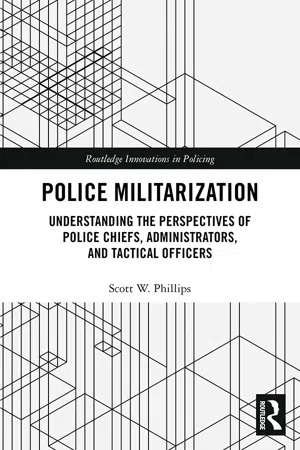
Police Militarization
Understanding the Perspectives of Police Chiefs, Administrators, and Tactical Officers
- 192 pages
- English
- ePUB (mobile friendly)
- Available on iOS & Android
eBook - ePub
Police Militarization
Understanding the Perspectives of Police Chiefs, Administrators, and Tactical Officers
About this book
Trusted by 375,005 students
Access to over 1.5 million titles for a fair monthly price.
Study more efficiently using our study tools.
Information
Chapter 1
Introduction
The assertion that the police exist to overcome resistance is not a usual feature of policing discourse. The policing role is frequently conceptualized in vague terms because the many functions performed by officers make clarity far too difficult (Goldstein, 1977). Most public as well as private sector organizations have fairly straightforward objectives, but the goals of policing are diverse and nebulous (Manning, 1977). We are told that the police are only as far away as the nearest phone, so police officers are expected help people who are in distress. Another commonly expected policing goal is procedural justice (Murphy & Tyler, 2017). Whether traffic violations or criminal transgressions, a policing objective is to handle all citizens and offenders the same and ensure equal protection and fair treatment. A more intense expression of their role is that the police fight crime; they are the “thin blue line” protecting citizens from danger (Kelling & Moore, 1989; Manning, 1977). It has been suggested that the crime fighting goal has become such an integral part of policing for so long that it “almost require[s] that officers place themselves between citizens and danger” (Phillips, 2014, p. 3). The police have promoted these different goals for decades (Bayley, 1994) and there is a public expectation that the police live up to each of these objectives (Crank & Langworthy, 1992; Manning, 2001). The role of the police, however, may simply depend on the observer. A person who dials 911 likely has a different interpretation of the police role than a person who sees flashing red and blue lights in their rear-view mirror.
The assumed goals of policing—to serve and protect, fairly enforce the law, or fight crime—are not necessarily mutually exclusive. A police agency can assert that extra patrols in high-crime areas are intended to fight crime as well as protect innocent citizens from danger. The development of a zero tolerance enforcement strategy can by justified with the argument that when the police focus intensively on minor crime or disorder it can serve as a deterrent for more serious criminals. It is also conceivable that a street-level police officer can use any of these goals when handling a single incident. In addition, an officer may shift from a service goal to an enforcement goal because of the dynamics of an individual event. The assumed role of the police in society, therefore, is imprecise and sometimes mercurial.
During the late 1970s and early 1980s the police were experiencing a “quiet revolution” where the police and the public were supposed to work in concert to solve problems (Kelling, 1988). This period had been characterized as a democratization of the police, with less reliance on the historic quasi-military approach to law enforcement strategies that existed since policing was first developed. Rather, “community policing” was the new strategy to reduce crime and improve the quality of life of citizens (Kraska & Cubellis, 1997; Kraska & Paulsen, 1997). In the past few decades a substantial amount of scholarship examined deeply a variety of community policing tactics and strategies. Yet, “with academicians so keenly focused on [community policing] reforms, they may have ignored a parallel development in the form of police militarization” (Kraska & Paulsen, 1997, p. 254).
The role of the police is more cluttered when considering the notion of police militarism and militarization. Part of the problem is that no one has conceptualized clearly these terms (Kraska, 2001a) or what it means to be militarized. Kraska provided a description of militarization that included “high technology, science, information management, and surveillance” (2001a, p. 160). He argued that these features of modern military organizations have crept into contemporary policing as crime control tactics, blurring any distinction between the police and the military in a democratic society. Kraska (2001a) suggested also that American society in general has been attracted to the application of a military approach for solving problems. Using military-like tactics and strategies is more than welcomed by the public, it is actually expected. It is sensible for police agencies to utilize a military approach to achieve their goals.
While there are definitions of militarization in the literature that related to values, appearances, and equipment, there is a clear implication when any variation of the term “military” is applied to the police. That is, when the police are described as militarized they are assumed to be “like the military.” Yet there is no discussion on precisely what being “like the military” actually means with respect to the police. It would seem that possessing values, appearances, and equipment similar to the military is insufficient to argue that the police are like the military. If this were the case than the Boy Scouts should be considered like the military. With the exception of standard-issue firearms, the Boy Scouts have an organizational structure with ranks and designated leaders and they wear fairly distinct uniforms. Scouts are also trained in many of the skills associated with basic military knowledge (e.g., camping, orienteering, survival). Thus, it would seem there is something more to the notion of the police being like the military that goes beyond simply examining the values, appearances, and equipment of the police. This gap in the conversation must be addressed in order to better understand the role of contemporary policing to overcome resistance.
What is “the Military?”
When politicians and media pundits ascribe the actions of a police officer, a tactical unit, or the overall behavior of a police agency, to being like the military there is a missing component to this assertion: a definition or description of the military. Linking the police and military may be warranted, but without a rudimentary understanding of the purpose of a military organization, it is also conceivable that a simplistic link between the police and the military is unjustified. An examination of the role of the military is necessary. This will be complemented with a more thorough review of the assumptions of a militarized police structure in the U.S.
A straightforward description of the goals of a military organization is provided in Adam Smith’s The Wealth of Nations: “The first duty of the sovereign, that of protecting the society from the violence and invasion of other independent societies, can be performed only by means of a military force” (Otteson, 2004, p. 153). Essentially, the sole task of that military force is to protect a civilization by engaging in war against an enemy (Smith, 1986 [1776], p. 311; P.H. Wilson, 2008). Military groups act with a full “readiness to take life and destroy property” (P.H. Wilson, 2008, p. 22). A military force “is a matter of Darwinian dominance or survival for states, and of life or death for individuals” (Lynn, 1996, p. 509). Armies exist “to crush organized resistance and prevent external interference” (P.H. Wilson, 2008, p. 23). Gat (2001) described the purpose of military conflict with a bit more detail:
The aims in the conduct of war are (a) to conquer and destroy the armed forces of the enemy; (b) to take possession of the resources of his army; and (c) to win public opinion. These aims, it must be noted, are not alternative but complementary; they are intended to secure the complete defeat of the enemy.
(p. 207)
Hence a military force is a formal governmental organization that protects one society from an external enemy, and the use of violence, possibly extreme violence, is expected as part of its mission. A military institution can also be justified as a means of defense rather than offense. Art (1980) discussed the need of a military force to deter another entity from engaging in an attack. An organized military force signals a preemptive threat of retaliation and possible punishment for an adversary that ignores the warning. Art (1980) also proffered the notion of “compellent,” which is the “deployment of military power so as to be able either to stop an adversary from doing something that he has already undertaken or to get him to do something that he has not yet undertaken” (p. 8). Where deterrence is a passive action (i.e., a show of force is not same as the use of force), compellence entails the active use of force, even if it is limited. Art, too, stated that a military force can be used to conquer the territory of another.
Based on these various descriptions, a military organization can be used by a government to (1) defend something which they already possess, (2) compel an adversary to behave in—or avoid—some type of activity that is beneficial to the first party, or (3) take something that belongs to another entity. If another governmental institution, such as the police, is going to be described as being “like the military,” this definition of a military organization provides a starting point for any comparisons.
If it Looks Like a Duck …
Terms such as “militarism,” “militarization,” and “militarized” are often applied to the police as if they have the same meaning as being “like the military.” Each expression, however, is unique. Militarism refers to military-based values and ideals (Caulfield, 2001) that “glorifies military power, hardware, and technology as its primary problem-solving tools” (Kraska, 2001a, p. 16). Possessing military-based values are also criticized as being anti-democratic because military beliefs may usurp the civil authority that commonly manages and limits military power in Western societies (Giroux, 2008). Militarization is the capacity of an entity to behave in a manner that supports the values of militarism (Giroux, 2008). Geyer stated that militarization is the “social process in which civil society organizes itself for the production of violence” (as cited in Giroux, 2008, p. 59). The social process of militarization is not restricted to the police, however; it can include the “shaping of other institutions in synchrony with military goals” (Lutz, 2002, p. 723). When a society or entity is militarized it exists in a context that is “organized around the preparation for war” (Caulfield, 2001, p. 123). Still, it is unclear if military values, the capacity to behave in a way that supports those values, and preparation for the ability to make war, are the same being “like the military.”
Fortunately, the casual application of these terms to the police that are common among politicians and pundits is avoided by scholars. Unfortunately, the conceptual development of these notions within policing research seem to borrow heavily from their original definition, and thus remain imperfect for characterizing the police as “like the military.” For example, Kraska (2007) described police militarism as an “ideology” for the police to handle different problems or situations. “It is a set of beliefs, values, and assumptions that stress the use of force and threat of violence as the most appropriate and efficacious means to solve problems” (Kraska, 2007, p. 503). Police militarization is the “process” of implementing that ideology through the arming, planning, and training of a portion of society, the police, “for the production of violence” (Kraska, 1999a, p. 208). Kraska’s description of police militarization is in line with Slotkin’s (1992) notion of “productive violence.” Slotkin asserted that “violence is an essential and necessary part of the process through which American society was established and through which its democratic values are defended and enforced” (1992, p. 352). Conceivably, militarism and militarization lead to the policing being militarized. This conclusion, however, ignores the subtle aspects of policing and their use of values, appearances, and equipment (Kraska, 2007).
As suggested earlier, when the police are characterized as ascribing to militarism, increased militarization, or being militarized, these accusations seem to be primarily associated with appearances. That is, they look like the military in values, appearance, and equipment. Kraska (2007) supported this argument with respect to material indicators (e.g., equipment), cultural indicators (e.g., using military language and uniforms), organizational indicators (e.g., normalizing tactical units), and operational indicators (e.g., intelligence gathering). When these indicators are placed on a continuum and move in the direction of “more,” then a police agency is “more militarized.” For example, the more “material indicators” possessed by a police agency then they are more highly militarized. As a police agency increases its use of military-style uniforms or military equipment (i.e., patrol rifles, military-style vehicles) it is considered more militarized. This was a finding of the federal report regarding the police response in Ferguson, which argued the use of armored vehicles and police officers in “camouflage-patterned battle dress uniforms” presented a military appearance (Institute for Intergovernmental Research, 2015, p. 57).
den Heyer (2014), however, had a difference of opinion with most of the assertions regarding police militarism and militarization. He suggested that modern policing, particularly their use of tactical units and their use of material, organizational, and cultural indicators, is not a symptom of being more militarized. Rather the growth in tactical units is the result of the overall weaknesses in American police organizations and policies. That is, some of the problems handled by the police are more complex than in the past. Regular patrol officers are unable to overcome resistance as they traditionally did when they answered calls for service or made routine arrests. den Heyer proposed that there was “a natural progression in the evolution” of policing and that tactical units help to professionalize the police (2014, p. 347). His argument is that an increased use of tactical units, with their uniforms, firearms, and armored vehicles, demonstrates nothing more than a natural progression of the police.
What is missing from den Heyer’s examination of policing’s natural evolution toward the use of tactical units is a more thorough discussion of the history of policing’s military organizational structure. A historical review is necessary to provide context to the argument that policing is becoming more militarized. It is possible that den Heyer’s suggestion of a natural evolution of tactical units can help explain the current state of military-like policing and its effort to overcome resistance.
The Military Model of Policing
It is important to contrast police militarism as an ideology of beliefs and values that glorifies military power against the military model originally used to organize and structure the police. It is reported that the Metropolitan Police in London were structured along the lines of the military in order to provide stability and structure to this new social institution (H.A. Johnson, Wolfe, & Jones, 1988; Palmer, 1988; Skolnick & Fyfe, 1993). This model was also intended to “identify the police force with the legal system … and the restraint of procedural regularity and guarantees of civil liberties” (W.R. Miller, 1975, p. 84). Cities in the United States envisioned a policing system with similar responsibilities, such as law enforcement and order maintenance duties that were to be conducted “almost mechanically and without favor” (Lane, 1980, p. 10).
If Peel’s new police agency was originally developed using a military model, it has been suggested that accessing this model as an organizing structure was simply a matter of expediency (Lentz & Chaires, 2007; Skolnick & Fyfe, 1993). Essentially, the police in England were formed to replace the British military in their limited role of crime prevention. The organizing principles that were used by Peel when he developed the Metropolitan Police were based on his experience of the military framework. Basically, Peel had no other organizing principle to follow, and rather than reinvent the wheel he tapped the military model for the new police (Auten, 1981). It is also argued that the police application of a military model has, over time, mismanaged the model’s leadership and decision-making principles (Cowper, 2000).
There is no question that the police share a variety of similarities with the military, and several of these similarities were applied when the police were first developed. The most visible similarity is the police officer’s uniform. When the uniform for the Metropolitan Police in England was designed it was important to “avoid any color or decoration that suggested military dress” (H.A. Johnson, Wolfe, & Jones, 1988, p. 177). The first police uniform was blue, which avoided the British military color of the time (Monkkonen, 2004), and had a civilian cut along with a top hat (Auten, 1981). This feature made officers easily recognizable to citizens (Lane, 1980; W.R. Miller, 1975) while avoiding any suggestion that police officers were part of the military (Auten, 1981). In the antebellum United States many departments also required officers to wear uniforms so they could be easily recognized by citizens (Fogelson, 1977). Police agencies also utilize organizational aspects of the military model, including a hierarchical organizational structure that includes rank assignments and management by command and control (Campbell & Campbell, 2010; Monkkonen, 2004). Clearly, the most common element of the military that was adopted by United States police agencies was the firearm. Officers began carrying revolvers in the 1850s, but the practice was not officially recognized by police administrations until the end of the 1860s (Lane, 1980; W.R. Miller, 1975). Standardized proficiency requirements were not established until the end of the nineteenth century (Morrison & Vila, 1998).
It should be noted that the earliest American police agencies were less rigid with respect to using a military structure. It was the reformers of the Progressive Era (1890s–1920s) who employed the military model for police agencies in order to establish discipline among the officers and reduce the corruption that was common among government officials and police leaders and officers during the Political Era (1840s–1890s) (Auten, 1981). Fogelson (1977) described the Progressive Era as embracing a corporate model, where governments were seen as a business, and scientific management and sound business principles could improve the effectiveness and efficiency of city agencies. As part of the reforms the police would be removed from political influences that interfered with enforcement of many laws (i.e., drinking and gambling). Reformers, however, retained a military model for the police because crime and social disorder remained problematic. Police departments were considered equivalent to a military body and officers were the soldiers in a war on crime shortly after World War I ended. Policing would adopt characteristics of the military structure, including a centralized command structure, a hierarchical rank system, clear lines of communication, and the use of threats or coercion at the street-level (Auten, 1981). Fogelson (1977) suggested that reformers retained a military framework for the police to convey the importance of dealing with crime, demonstrate their comm...
Table of contents
- Cover
- Half Title
- Fm
- Title
- Copyright
- Dedication
- Contents
- Preface
- Acknowledgments
- 1 Introduction
- 2 Methods and Data
- 3 History
- 4 National Academy Survey
- 5 Professional Opinions
- 6 Police Chief Interviews
- 7 Tactical Officer Interviews
- 8 The Patrol Rifle
- 9 Conclusion
- Appendix: Sample Threat Matrix
- References
- Index
Frequently asked questions
Yes, you can cancel anytime from the Subscription tab in your account settings on the Perlego website. Your subscription will stay active until the end of your current billing period. Learn how to cancel your subscription
No, books cannot be downloaded as external files, such as PDFs, for use outside of Perlego. However, you can download books within the Perlego app for offline reading on mobile or tablet. Learn how to download books offline
Perlego offers two plans: Essential and Complete
- Essential is ideal for learners and professionals who enjoy exploring a wide range of subjects. Access the Essential Library with 800,000+ trusted titles and best-sellers across business, personal growth, and the humanities. Includes unlimited reading time and Standard Read Aloud voice.
- Complete: Perfect for advanced learners and researchers needing full, unrestricted access. Unlock 1.5M+ books across hundreds of subjects, including academic and specialized titles. The Complete Plan also includes advanced features like Premium Read Aloud and Research Assistant.
We are an online textbook subscription service, where you can get access to an entire online library for less than the price of a single book per month. With over 1.5 million books across 990+ topics, we’ve got you covered! Learn about our mission
Look out for the read-aloud symbol on your next book to see if you can listen to it. The read-aloud tool reads text aloud for you, highlighting the text as it is being read. You can pause it, speed it up and slow it down. Learn more about Read Aloud
Yes! You can use the Perlego app on both iOS and Android devices to read anytime, anywhere — even offline. Perfect for commutes or when you’re on the go.
Please note we cannot support devices running on iOS 13 and Android 7 or earlier. Learn more about using the app
Please note we cannot support devices running on iOS 13 and Android 7 or earlier. Learn more about using the app
Yes, you can access Police Militarization by Scott W. Phillips in PDF and/or ePUB format, as well as other popular books in Social Sciences & Criminology. We have over 1.5 million books available in our catalogue for you to explore.