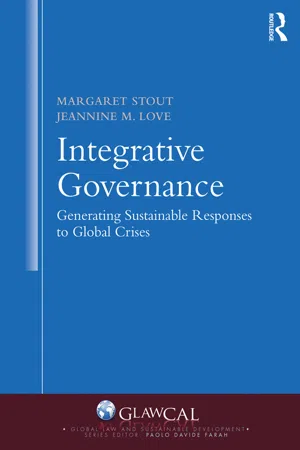
Dominant governance theories are drawn primarily from Euro-American sources, including emergent theories of network and collaborative governance. The authors contest this narrow view and seek a more globally inclusive and transdisciplinary perspective, arguing such an approach is more fruitful in addressing the wicked problems of sustainability—including social, economic, and environmental crises. This book thus offers and affirms an innovative governance approach that may hold more promise as a "universal" framework that is not colonizing in nature due to its grounding in relational process assumptions and practices. Using a comprehensive Governance Typology that encompasses ontological assumptions, psychosocial theory, epistemological concepts, belief systems, ethical concepts, political theory, economic theory, and administrative theory, the authors delve deeply into underlying philosophical commitments and carry them into practice through an approach they call Integrative Governance. The authors consider ways this approach to radical self-governance is already being implemented in the prefigurative politics of contemporary social movements, and they invite scholars and activists to: imagine governance in contexts of social, economic, and environmental interconnectedness; to use the ideal-type as an evaluative tool against which to measure practice; and to pursue paradigmatic change through collaborative praxis.
eBook - ePub
Integrative Governance: Generating Sustainable Responses to Global Crises
- 260 pages
- English
- ePUB (mobile friendly)
- Available on iOS & Android
eBook - ePub
Integrative Governance: Generating Sustainable Responses to Global Crises
Part I
Situating Integrative Governance
Part I sets the stage for Integrative Governance and why we believe it is necessary. Chapter 1 provides an overview of the contemporary governance context and its social, economic, and environmental crises. We explain how the interconnected nature of these complex problems cannot be resolved by government alone, and have therefore given rise to the concept of governance. Yet, historical governance approaches have failed to prevent or significantly mitigate these crises of sustainability and have even compromised the legitimacy of governance itself.
Chapter 2 presents an overview of contemporary governance theories that seek to resolve these shortcomings through network structures and collaborative practices, considering the manner in which governance theory is on an ongoing developmental path. We examine the ideal and why collaborative governance networks still fail to achieve the substantive and democratic benefits they promise.
Chapter 3 responds to these failures, considering the manner in which governance theory has been too insular to draw in the necessary ideas and practices to achieve its substantive and democratic goals. Empirically, it relies on insufficient objects of study to develop an understanding of collaborative networks. By anchoring itself to thin theoretical ground, governance theory is unable to respond to the world as it is now understood. It is philosophically misaligned with the ideal of collaboration and the reality of interdependence. Both intersectoral governance and sustainability create new objects of study that require a transdisciplinary approach – one that is beyond the grasp of any one discipline.
1 Complex global crises
OUR political life is stagnating, capital and labor are virtually at war, the nations of Europe are at one another’s throats because we have not yet learned how to live together. The twentieth century must find a new principle of association… . Group organization is to be the new method in politics, the basis of our future industrial system, the foundation of international order. Group organization will create the new world we are now blindly feeling after, for creative force comes from the group, creative power is evolved through the activity of the group life.
– (Follett 1918, 3)
This chapter situates the need for Integrative Governance within the current context. “The world today confronts not one, but a series of interlocking crises – economic, political, social, and ecological” (Bookchin and Taylor 2015, loc. 81). Social crises arise in response to various forms of social strife and oppression, including forms of systemic discrimination and state-sanctioned violence. These tensions fuel both internal and international conflicts such as the civil war in Syria and NATO-led or sanctioned military actions in Afghanistan, Iraq, and Lebanon. They also manifest in civil unrest and a proliferating number of social movements, such as the Arab Spring, Democracy Now!, Occupy, and Black Lives Matter. Many of these social crises are driven, at least in part, by economic and environmental crises. Growing global inequality – both within and between societies – follows more than three decades of market deregulation, liberal global trade agreements, and government austerity measures (Elson 2017). Social and economic conditions are exacerbated by environmental crises, including extended droughts, super storms, flooding, and coastal loss (Gemenne 2015, Renner 2015). These interdependent crises generate a global crisis of sustainability.
While we discuss the escalating ideological crises associated with competing governance reform efforts elsewhere (Stout and Love 2016), here, we focus instead on the empirical conditions of the contemporary world and governance responses. Regardless of their ideological grounding and form, governments are meant to craft and enforce the rules by which society functions, including political, economic, and civil spheres. Governments must seek collaboration with others (e.g., other governments, nongovernmental organizations [NGOs], corporations, and citizens) to address issues beyond their narrowing scope and capacity or those that cross over national boundaries. Yet, even these institutional and intersectoral arrangements fail to mitigate the pressing social, economic, and environmental crises we confront. Violent conflict has not abated, economic catastrophe has not been avoided, and environmental disasters continue to become more frequent and extreme.
Globalization has replaced a state-based international system of governments with a decentralized, heterogeneous, intersectoral system of network governance (Keohane and Nye 2000). As a result, governing functions are increasingly likely to occur through associations of nation-states, associations of cities, partnerships of public and nonprofit agencies, and networks of affected citizens and stakeholders from across sectors. Nation-state sovereignty is impacted by expanding governance networks, thus creating a crisis of government. The meaning of governance is no longer grounded in a reified assumption that nation-states are “the foundation of politics” (Rosenau 1999, 287). Within this context, a new understanding of public agencies arises and national, institutional, and sectoral boundaries blur (Roll and Thomas 2014, Wachhaus 2014). We are now in an age of governance as opposed to state governments (Pierre and Peters 2000).
Although the terrain is well-traveled, to contextualize the need for this project, the following sections provide a brief account of today’s empirical situation with a focus on three dimensions of sustainability: social, economic, and environmental. Each section describes the manner in which governance networks and social movements have arisen in attempt to address these respective crises, and then considers the forms of resistance these efforts elicit. This history details the transformation of nation-states into “network states … hailed as necessary to meet the challenges of increased complexity, interconnectedness, and globalization” (Bang and Esmark 2009, 14). Thus, what follows is simultaneously a historical overview of the formation of international and intersectoral governance institutions as well as the rise of the corollary crisis of government. From this vantage point, it becomes clear that the emergence of governance networks has resulted in a bifurcated populist reaction, one that may either return us to the protectionism of the past as nation-states reclaim the seats of power, or move us forward on a path toward radical democracy.
Due to their interconnectedness, disaggregating social, economic, and environmental crises is challenging. Likewise, due to the feedback loops among them, it is difficult to pick one as the start of a causal chain. For instance, one might point to economic policies that focus on growth, trade, and deregulation as underpinning both social crises and environmental crises. Alternatively, beginning the analysis with environmental crises allows for consideration of how climate change is a result of pro-growth economic policies that have also exacerbated social strife through environmental justice issues. Because we are particularly interested in understanding how all of these crises foment a crisis of government, we make social crises our point of departure.
Social crises
Social crises are evident in international military actions and civil unrest within nations. Social crises have myriad driving forces (e.g., histories of slavery, colonization, and genocide; competing worldviews; growing income disparities; corporate control of natural and economic resources; and dominating relationships between governments and the governed). Of the wide range of possible responses, mass protest, and violent conflict are the most visible (Kirton and Stefanova 2017). Here, we consider historical trends that have direct pertinence to the emergence of global governance and resistance to it, including relations among nations as well as relations between nation-states and their constituents.
International relations
International law was created due to a shared desire to establish global peace, or at minimum reduce the likelihood of unilateral acts of aggression. Its roots can be traced to the Peace of Westphalia treaty of 1648 that ended the Thirty Years Wars among European nations, establishing an international system of sovereign state actors (Olsen and McCormick 2017) who engaged in diplomatic relations based on their own interests, ultimately backed by threat of force (Held 1992). In the aftermath of World War I, however, there was a move to foster international cooperation that would ensure a lasting peace among members; this was first envisioned as the ill-fated League of Nations (Office of the Historian 2017). In response to the enormous destruction of life and infrastructure in World War II (Favreau 2011), the goal of multinational cooperation was revisited and became viable with the creation of the United Nations (UN) in 1945 (Held 1992). Its founding charter stresses the goals of preventing war, protecting human rights, and bolstering international law by nations being “good neighbours” and uniting their strength (UN n.d.-b). The Charter was originally signed by 26 nations and has since expanded to 193 UN member states (UN n.d.-a).
Since then, UN-orchestrated treaties and organizations have steadily expanded international law to protect member states, individual rights, and natural resources. For instance, the Universal Declaration of Human Rights of 1948 outlined fundamental inalienable human rights of all persons during times of war or peace. Signatory nations pledged to protect and preserve the basic human rights of all persons within their borders in an attempt to curb some of the driving forces of social crises ranging from systemic oppression to genocide. The Declaration was supplemented by the Convention on the Prevention and Punishment of the Crime of Genocide of 1948, which authorizes punishment of member nations that engage in acts of genocide. Similarly, the Geneva Conventions, crafted in 1949, specify the requirements for providing medical assistance to the wounded during wartime and acceptable treatment of prisoners of war (ICRC n.d.). Other agreements aim to prevent conflict through the stewardship of resources, such as the 1962 Convention on the High Seas, which regulates activities within international waters.
The UN itself has also created several specialized agencies and committees. For instance, the Food and Agriculture Organization (1945) was created to address hunger worldwide through treaties, technical assistance, and policy recommendations (Ivanova 2014). The UN also continues its original focus on preventing and responding to conflict through its Security Council, which determines when and where UN Peacekeeping missions are necessary and can compel member states to assist. Its military counterpart is the North Atlantic Treaty Organization (NATO). Whereas the UN is a global deliberative body, NATO is a strategic alliance of Western nations who agree to combine military efforts in order to share the risks and benefits of collective defense (NATO 2017). NATO’s founding treaty commits member states to the principles of the UN Charter and declares the shared values of consensus decision making, liberty, democracy, human rights, and rule of law (NATO 2017, June 2). Additionally, members agreed not to pursue unilateral military action.
Perhaps the most complicated example of international cooperation is the European Union (EU), which initially arose as the European Coal and Steel Community through the Paris Treaty of 1951in response to the enormous death toll and devastation of agriculture and infrastructure across Europe during World War II, as well as a centuries-long history of wars on the continent. As Olsen and McCormick (2017) note, the EU is an example of confederalism in which each state retains sovereignty for actions such as entering into international treaties; yet the EU has its own legislative system, a common currency and market, and EU citizens can cross member state borders at will.
Such international alliances are a global phenomenon. In 1945, several Arab states signed onto the Pact of the League of Arab States, forming the Arab League. Its goals were to coordinate political activities in the region, to improve financial matters of trade and customs, to address shared infrastructure, and to promote general welfare and public health in the region (LAS 1945). Responding to the Cold War and related conflicts in the region, a group of Southeast Asian states formed the Association of Southeast Asia (ASA) in 1961, which became the Association of Southeast Asian Nations (ASEAN) in 1967. The African Union was established in 1999 – out of the Organization of African Unity – to unite the nation-states on the African continent. Most recently, the Union of South American Nations (UNASUR) was created in 2008 (Flannery 2017).
While the vast majority of actors involved in these multilateral coalitions have been states, they work closely with NGOs to achieve shared aims, as noted in the UN’s founding charter (Sidhu 2007). For example, the UN Security Council often works in tandem with Médecins Sans Frontières (Doctors Without Borders) to provide medical assistance in areas of military conflict during peacekeeping missions. The Geneva Conventions were developed at a conference convened by the Red Cross with 16 states and four charitable organizations (ICRC n.d.).
These multinational coalitions serve to solidify relations between various state actors and to provide mechanisms for allowing states to come to consensus and take action on a variety of issues from military intervention to common resource management to human rights. The perceived benefits of membership in these coalitions – and the risks of exclusion – have fueled the spread of new coalitions across geographic regions and the exponential growth in membership. They also mark the initial move away from solitary nation-states acting unilaterally for their own self-interest toward collaboration. Yet, global asymmetries of power remain intact in institutions such as the UN Security Council, whose decisions are made by majority rather than consensus, are binding rather than voluntary, and provides permanent positions and sole veto power to five of the ten members (Sidhu 2007). Similarly, power asymmetries and oppressive forces remain in play; many nation-states that have signed the Universal Declaration of Human Rights routinely fail to protect the rights of all persons within their borders.
Domestic governmental relations
Nation-states are also experiencing challenges from within. In nations with federal systems, the relationship between national and sub-governments is inherently agonistic. The ongoing negotiation and interpretation of constitutional policy making authority and implementation responsibility maintains a constant source of challenge to nation-state sovereignty. Dubnick and Meehan (2004) describe the dynamics of the last several decades as centrifugal, including both diffusion and dispersion of authority. This is evident in the late 1980s trends toward adoption of business practices and privatization of functions through both load shedding and contracting out to private organizations. As the authority and capacity of government bureaucracies are minimized through deregulation and budget cuts, agencies must enter public-private partnerships to tackle complex governance goals (O’Toole 1997b). These practices are often collected under banners of Reinventing Government (Osborne and Gaebler 1992) and the New Public Management (Barzelay 2001, Kaboolian 1998). The result of these trends is described as the “hollowing out of the state” (Milward and Provan 2000, Rhodes 1994).
However, with diminishing resources, devolution of authority has also meant significant budget cuts to grants in aid between levels of government. These austerity measures have left states and localities on their own to manage the social, economic, and environmental effects of globalization. In response, cities are creating their own networks to address common problems and share strategies with one another. Barber (2013) argues that cities are already more networked and globally interconnected through pragmatic collaboration than any grouping of sovereign nations. Formal associations go back at least to 1924 with the US Municipal League (now the National League of Cities), arising alongside the concept of the League of Nations. These municipal networks now include the City Protocol Network, the United Cities and Local Governments, the International Union of Local Authorities, Metropolis, the National League of Cities (US), CityNet, the European Union Secretariat of Cities, the US Conference of Mayors, and the Global Parliament of Mayors. Collectively, their agendas navigate myriad sources of interdependence: addressing global economic markets and crises, ensuring security in the face of global terrorism, responding to environmental degradation and catastrophes, leveraging global communications technology toward public participation, and increasing citizen engagement in governance. Recognizing the potential within these networks of localities, Barber (2013) argues for a sort of global parliament or World Assembly of Cities that “is already half-grown, waiting rather to be recognized, exploited, and formalized” (7).
The increasing devolution of responsibility to cities foments challenges to federal authority. For example, although the sanctuary city movement in the US began in 1979 in Los Angeles (H.B.C. 2016), this form of local resistance to national immigration policy has received renewed attention in response to actions by the Trump administration. Localities across the US and Canada have declared themselves “sanctuaries” for undocumented immigrants, placing restrictions on the extent to which local law enforcement voluntarily works with Immigration and Customs Enforcement (ICE) (Graber and Marquez 2016, Kopan 2017, Jan. 25). In March 2017, representatives of sanctuary cities across the US convened for the first time to share their determination and their strategies for facing these threats (Acevedo 2017, Mar. 27). Similarly, in response to slow federal action to curb human trafficking, NGOs, local businesses, and government agencies are forming regional networks of “slavery-free cities” (Allies Against Slavery 2015) or “slavery-free communities” (Slave-Free Community Project n.d.), taking steps to identify and support victims of human trafficking and ensure that all public and private supply chains are slavery-free.
Diffusion of authority is taken further through growing citizen demands for sovereignty, voice, and direct participation in self-governance, reflecting a trend in the narrative of democracy that has become increasingly participatory in character (Saward 2003). Indeed, the Worldwatch Institute’s comprehensive review notes a common theme underlying the policy ideas and reforms analyzed: “the necessity of citizen empowerment and citizen responsibility” (Prugh and Renner 2014, 248). In effect, through such public participation efforts, communities have become the “ ‘new’ institutional site” of governance networks that are “mediating integration arrangements between increasingly disconnected citizen-state relations” (Brown and Keast 2003, 124). For instance, the participatory budgeting movement that began in Porto Alegre, Brazil, empowers citizens to det...
Table of contents
- Cover
- Title
- Copyright
- Dedication
- Contents
- List of figures
- List of tables
- Foreword
- Preface
- Acknowledgements
- Part I Situating Integrative Governance
- Part II A transdisciplinary understanding of governance
- Part III Illustration and affirmation of Integrative Governance
- References
- Glossary
- Index
Trusted by 375,005 students
Access to over 1.5 million titles for a fair monthly price.
Study more efficiently using our study tools.
Frequently asked questions
Yes, you can cancel anytime from the Subscription tab in your account settings on the Perlego website. Your subscription will stay active until the end of your current billing period. Learn how to cancel your subscription
No, books cannot be downloaded as external files, such as PDFs, for use outside of Perlego. However, you can download books within the Perlego app for offline reading on mobile or tablet. Learn how to download books offline
We are an online textbook subscription service, where you can get access to an entire online library for less than the price of a single book per month. With over 1.5 million books across 990+ topics, we’ve got you covered! Learn about our mission
Look out for the read-aloud symbol on your next book to see if you can listen to it. The read-aloud tool reads text aloud for you, highlighting the text as it is being read. You can pause it, speed it up and slow it down. Learn more about Read Aloud
Yes! You can use the Perlego app on both iOS and Android devices to read anytime, anywhere — even offline. Perfect for commutes or when you’re on the go.
Please note we cannot support devices running on iOS 13 and Android 7 or earlier. Learn more about using the app
Please note we cannot support devices running on iOS 13 and Android 7 or earlier. Learn more about using the app
Yes, you can access Integrative Governance: Generating Sustainable Responses to Global Crises by Margaret Stout,Jeannine M. Love in PDF and/or ePUB format, as well as other popular books in Law & Environmental Law. We have over 1.5 million books available in our catalogue for you to explore.