![]()
1Mining and sustainable development
Sumit K. Lodhia
The role of mining in sustainable development
Mining is a transformative activity which has numerous economic, social and environmental impacts. These impacts can be both positive and adverse, enhancing as well as disrupting economies, ecosystems and communities (Moran et al., 2014). From economic development, construction of infrastructure and development of communities, to severe environmental effects during the entire mining life cycle, displacement of local communities and concerns over wealth inequities, the mining industry (also referred to as minerals or extractive industries) plays a critical role in local and national economies and communities.
The extractive industries have been criticised heavily for their adverse impacts and involvement in significant social and environmental scandals (Franks, 2015). Incidents such as those in the OK Tedi and Baia Marie mine sites (Lodhia, 2007) at the turn of the century and, more recently, the Samarco mining dam failure (Garcia et al., 2017) are some examples of the adverse consequences of mining operations. This has resulted in constant scrutiny of mining activities by stakeholders and an increasing pressure on mining companies’ social licence to operate (Lodhia, 2007; Lodhia and Hess, 2014). These industries have sought to respond to negative perceptions and have embraced the core principles of sustainability (Moran et al., 2014; Franks, 2015; Bice, 2016).
The minerals sector could be regarded as a leader in sustainability initiatives, evident from the various frameworks in mining and sustainability that have emerged over time. Guidance such as the Global Mining Initiative and the Extractive Industries Transparency Initiative globally (Franks, 2015), and local sustainable development codes such as Enduring Value for the Australian mining industry (Lodhia, 2007), indicate the seriousness with which sustainability issues are regarded in the mining industry. It can be concluded that over time, mining companies are required to be responsive to their social and environmental responsibilities and contribute positively towards sustainable development (Bice, 2016).
This rest of this chapter is structured as follows. A framework for exploring current sustainable development issues in mining is introduced in the next section. This framework provides the broad parameters through which the major themes of this book are organised. The chapters of this book are discussed in relation to this framework. The final section presents the implications arising from this book and discusses specific issues that could be explored further in future work.
A framework for mining and sustainable development
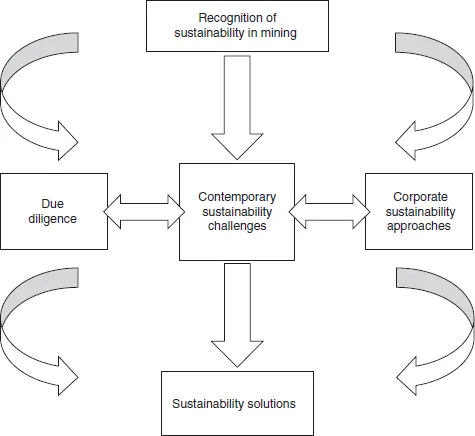
Having acknowledged the importance of sustainability in the mining industry, a framework is developed in order to establish current issues in mining and sustainable development. There are five key elements to this framework: recognition of the increasing importance of sustainability in mining (as discussed above); due diligence mechanisms for addressing sustainability matters in mining; contemporary challenges to sustainability in the mining industry, corporate approaches towards mining and sustainability; and sustainability solutions.
Figure 1.1A framework for mining and sustainable development.
The framework is predicated on the premise that business as usual is no longer acceptable and that sustainability matters are critical for survival of the mining industry. In order to ensure that mining companies are contributing positively to sustainability, due diligence mechanisms in the form of social and environmental impact assessments are needed. Due diligence exercises ensure that mining companies are cognisant of the social and environmental aspects of their operations, both in relation to reducing negative impacts and enhancing the benefits provided by mining. These activities are essential for ensuring the integrity of mining operations during their entire life cycle. At the same time, contemporary challenges in sustainability and mining cannot be ignored and should be monitored on an ongoing basis. These can include both social and environmental challenges and could be specific to a particular region. Further, corporate approaches such as management and accounting (including sustainability accounting and reporting), and taxation, are also fundamental to ensuring that economic, social and environmental sustainability are addressed. These three elements are not mutually exclusive; there is often overlap between them. For instance, a contemporary sustainability challenge may be identified in due diligence and would require a corporate sustainability approach to manage this challenge. Taken together, due diligence, addressing contemporary challenges and corporate sustainability approaches have the potential to facilitate sustainability solutions, thereby highlighting that the mining industry is not the problem but, rather, part of the solution to sustainability.
Using this framework, this book examines current topical issues in mining and sustainable development. The chapters in this book provide a contemporary understanding of sustainability opportunities and impediments in the mining industry.
Current issues in mining and sustainable development
This book consists of thirteen chapters and five sections. Following this introductory section and chapter, the remaining five parts represent each element of the framework: recognition of the importance of sustainability; due diligence mechanisms for sustainability; contemporary sustainability challenges in the mining industry; corporate mining approaches that address sustainability; and sustainability solutions.
Part I provides an overview of mining and sustainable development with emphasis on the increasing importance of sustainability for mining. The chapters emphasise the changing role of minerals in society and the social acceptance of mining. Part II discusses due diligence, with discussion of social and environmental impact assessments. Part III focuses on two critical and contemporary challenges in mining: indigenous issues and transit worker accommodation in remote communities. Part IV takes a corporate focus with emphasis being on sustainability reporting, and mining taxation. Part V provides examples of sustainability solutions for mining and these include discussion of renewable energy and shared-use mining infrastructure.
An overview of the importance of sustainability in the mining industry is provided in the second and third chapters. Ali (Chapter 2) highlights the changing role of minerals in society through a focus on its supply and demand. He addresses the vexed issues of non-renewability and sustainability of minerals and applies notions of industrial ecology and the circular economy to mining. Such a systematic perspective suggests an increasingly vital role of minerals in society, leading to a need for broader and effective considerations of mineral supply and demand. Moffat et al. (Chapter 3) address the social acceptance and trust of mining operations by drawing upon extensive global surveys of communities. The authors posit that contact experience with corporate personnel, procedural and distributional fairness, and confidence in governance of social and environmental issues are fundamental drivers of trust and acceptance of mining. The social acceptance of mining by stakeholders has the potential to lead to a more sustainable mining industry.
Part II of this book addresses due diligence in mining operations. Due diligence in the form of environmental and social impact assessments are critical elements in ensuring that the adverse sustainability impacts of mining operation are minimised and addressed effectively. Bond and Morrison-Saunders (Chapter 4) discuss environmental impact assessment (EIA) and apply this notion to mining activities. The authors highlight that EIA has moved from a mere environmental focus to a sustainability focus with emphasis on the contribution of a proposed activity to sustainable development. The application of EIA to mining suggests a need for sustainable mining which the authors contend is feasible. Best practice EIA principles are discussed in relation to mine planning, implementation and closure. Similarly, Joyce et al. (Chapter 5) highlight the transition in social impact assessment (SIA) from an analysis of negative impacts of mining to management of its social impacts and enhancement of social benefits. The role of SIA in the entire mining life cycle is discussed. The authors suggest that for SIA to be successful, it needs to be incorporated into business decision making processes at an early stage. Local perspectives through engagement with communities also need to be embedded into risk and impact management.
Salcito and Wielga (Chapter 6) discuss due diligence in relation to mining operations. Fundamental tools for due diligence include impact assessments such as EIA and SIA discussed previously. The authors focus on human rights due diligence, developed as a result of the UN Guiding Principles on Business and Human Rights. This is an exploratory concept in the mining industry. Despite this, the authors contend that there is cause for optimism and that bold companies would transition to such due diligence in the foreseeable future. Aizawa et al. (Chapter 7) also discuss the challenges of human rights due diligence for mining companies through a focus on its financing. It is envisaged that in addition to law and policy, a number of alternative financing arrangements could ease the burden of financing human rights diligence and thereby encourage an increasing adoption of this mechanism by mining companies. These include tax incentives, financing assistance, social impact bonds and crowdfunding.
The third part of this book addresses contemporary challenges in mining and sustainable development. Two contemporary issues are addressed here. O’Faircheallaigh (Chapter 8) highlights the inherent contradiction of mining and sustainability from an indigenous perspective. However, the author suggests that mining activities could be sustainable from an indigenous perspective if their development and needs were considered. Involvement of indigenous people in environmental management of large-scale projects and the use of minerals revenue to promote economic and social development in communities that is sustained even after mining ends are perceived as critical in enabling mining to contribute to indigenous development and sustainability. The author posits that these issues are broader than mining projects and require a state-wide systematic response which empowers indigenous groups to engage with extractive industries. Mckenzie and Singleton (Chapter 9) address the push and pull factors for transit worker accommodation in remote Australian mining communities. The concern for such a mechanism is that it does not lead to development of regional communities and may impact worker’s welfare. However, work flexibility and mobility, and reduction in costs for companies are perceived as beneficial. The authors suggests that mining companies, communities and governments should collaborate and ensure that regions benefit from transit worker accommodation.
Part IV of this book addresses mining and sustainable development from a corporate perspective. Lodhia (Chapter 10) discusses the evolution in studies on sustainability reporting in the mining industry. Sustainability reporting is an approach that mining companies utilise to provide accountability over the social and environmental aspects of their activities. There is much that needs to be investigated in relation to sustainability reporting in this industry and the chapter provides future research directions for research on sustainability reporting in the mining industry. Guj (Chapter 11) discusses mining taxation in minerals rich developing countries. Three fiscal approaches are discussed: those focusing on economic efficiency and equity, revenue maximisation and stability, and transparency and administrative efficiency. The author provides comprehensive guidance on improving mining fiscal regimes which he suggests will depend on the improvement of tax administration processes in host countries.
The final part of this book discusses possible sustainability solutions for mining operations. McLellan et al. (Chapter 12) focus on emissions from mining activities and highlight the role of renewable energy in mining. The key drivers and potential for renewable energy in the mining industry are identified. An examination of the longer-term trends in mining indicates a changing landscape for renewable energy under specific technological changes in the mining industry. Toledano and Maennling (Chapter 13) focus on another critical issue, sustainable development goals, and specify how the mining industry could contribute to them. More specifically, the authors highlight how the mining industry could provide increasing access to infrastructure. Such infrastructure has primarily been geared towards corporate activities but it could be shared and developed to meet the needs of host countries. Shared-use mining infrastructure could contribute positively to addressing the funding gaps for infrastructure development required under the sustainable development goals.
Contributions and future possibilities
The chapters in this book make an important contribution to comprehending the interplay between mining and sustainable development. They will be of relevance to mining practitioners, governments and civil society, as well as scholars and students with interests in mining and sustainability. This book has a number of broad implications which are discussed next before further areas worthy of future investigation are discussed. Overall, it highlights a shift in emphasis in the mining industry from a mere management of social and environmental issues to being proactively involved in addressing global sustainability challenges.
The earlier chapters in this book reiterate the changing role of the mining industry and a need for the industry to have social acceptance, thereby providing evidence of the increasing importance of sustainability for mining companies. Due diligence through social and environmental impact assessments are perceived as critical and a foundational step in addressing sustainability challenges in the mining industry. Contemporary challenges such as Indigenous issues are paramount for the mining industry and a need to collaborate with local communities is essential for mining companies in earning the trust of their host communities. This would ensure the social acceptance of mining. Transit worker accommodation is another complex sustainability challenge that affects mining employees and regional development, and requires cooperation among communities, companies and governments.
Corporate approaches to sustainability by mining companies are essential in addressing social and environmental issues in the mining industry. Sustainability reporting has been highlighted as a mechanism that mining companies can use to provide social and environmental accountability to their various stakeholders. The discussion of mining taxation in this book provides insights into fiscal regimes that could ensure a fair distribution of mining revenues.
Sustainability solutions can be provided by the mining industry. Renewable energy has a vital role in the mining industry and the final chapter confirms the contribution of the mining industry to the global society. The concept of shared used infrastructure is a novel concept that suggests that mining companies can contribute positively towards building sustainable societies as envisioned by global bodies such as the United Nations.
This book provides a mere snapshot of current issues in mining and sustainable ...