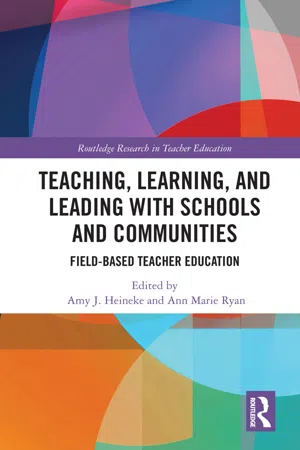
Re-envisioning the role, impact, and goals of teacher education programs, this volume immerses readers in the inner workings of an innovative, field-based teacher preparation program in Chicago. Grounded in sociocultural theory, the book documents how teacher educators, school and community partners, and teacher candidates in the program confront challenges and facilitate their students' learning, development, and achievement. By successfully and collaboratively developing instructional partnerships and embedding programs in urban schools and communities, the contributors demonstrate that it is possible to break the conventional mold of teacher education and better prepare the next generation of teachers.
eBook - ePub
Teaching, Learning, and Leading with Schools and Communities
Field-Based Teacher Education
- 252 pages
- English
- ePUB (mobile friendly)
- Available on iOS & Android
eBook - ePub
Teaching, Learning, and Leading with Schools and Communities
Field-Based Teacher Education
About this book
Information
Part I
Foundations and Frameworks
1 Innovation and Collaboration in Teacher Education
How should we prepare preschool-through-grade-12 (P–12) teachers? There is no simple answer to this question, nor should there be, since teaching and learning are complex matters. Consequently, teacher preparation has been fiercely debated for nearly two centuries in the United States. The historical and contemporary roots of this long-standing debate, along with Loyola University Chicago’s efforts to address it are the focus of this chapter. Loyola faculty chose to ground its redesigned teacher education program in the principle of mutual benefit, which required university, school, and community partners to share in the benefits and responsibility associated with preparing educators to support P–12 student development, learning, and achievement (Kruger, Davies, Eckersley, Newell, & Cherednichenko, 2009). This principle underpins Teaching, Learning, and Leading With Schools and Communities (TLLSC), Loyola’s field-based apprenticeship model of teacher education.
Unlike traditional models, TLLSC relies on the expertise of university teacher educators, P–12 students, teachers, staff and administrators, school communities, and professionals from community-based organizations and cultural institutions. A central goal of TLLSC is for this range of community members and educational professionals to support teacher candidates as they develop into resilient novice teachers. TLLSC takes place almost exclusively in field sites over the course of candidates’ 4-year undergraduate experience (1–2 years for graduate candidates). This developmental model of teacher education has sequences of learning which build on each other and bring candidates into a community of practice (Lave & Wenger, 1991) where they are apprenticed into the teaching profession in purposeful situated learning experiences (Rogoff, 1994).
Teaching and Learning faculty in the School of Education designed TLLSC with its school and community partners from 2010 to 2012. It was implemented with undergraduate teacher candidates in 2013 and graduate candidates in 2014. The impetus for this comprehensive redesign grew from an understanding that federal and state teacher education policy was shifting, with increased calls for formal cooperation between P–12 schools and new mandates for greater accountability for university-based programs were on the horizon.
A Shared Past
It is the [sic] crying shame that boys and girls of America today must go to school to teachers who are, as a group, less educated and less well trained professionally than are the teachers of any other civilized country in the whole world.
(Strayer, 1921, p. 5)
Currently, far too many teachers and administrators report that new teachers are unprepared when they first enter the classroom, even after completing a teacher preparation program.
(U.S. Department of Education, 2016, p. 4)
Nearly 100 years apart, these statements share a similar lament. Researchers and practitioners understand how imprecise these commentaries are, yet they persist. However, they demonstrate how the perceived problem of teacher preparation and the resulting substandard education delivered by teachers has been a perennial one. Understanding our current context requires grappling with this challenging past.
During the early years of the republic, few people had access to education and those prepared to teach found education through small academies, religious institutions, private colleges, and home schooling (Fraser, 2007). As the common school movement took root in the 1830s, the demand for teachers increased and prompted the growth of normal schools and institutions offering more formal training to teachers who staffed public schools. Normal schools prepared teachers with curricula that exceeded the elementary school and included pedagogy courses, but remained uneven in quality with limited funding and expertise.
By the 1860s, teacher education in the United States had become more sophisticated through specific institutions: “[a]cademies, and colleges, teachers’ institutes, and private, municipal, and county normal schools” (Ogren, 2005, p. 51). This trend continued in the late 19th century with the further development of the normal school and the ever-increasing demand for teachers. In the early 20th century, normal schools moved beyond quasi-high school and college programs. With the growth of high schools, normal schools had to become more clearly defined as college programs with 2- and 4-year options (Fraser, 2007).
The 20th century signaled a new era in the preparation of teachers with compulsory schooling legislation. Normal schools began to shift into state teachers’ colleges offering 4-year degrees. At mid-century, all states required teachers to have a 4-year degree to teach, which resulted in teacher education programs being squarely located in universities (Fraser, 2007). However, teacher education programs were often perceived to have less status (similar to P–12 educators) by their broader university colleagues (Labaree, 2008; Mehta, 2013).
As schools of education attempted to establish academic credibility, they often pulled away from cultivating meaningful relationships with P–12 partners to distinguish themselves as scholars (Fraser & Watson, 2014). This eventually resulted in policy makers, government officials, and foundation representatives launching wholesale critiques of university-based teacher preparation for being disconnected and too theoretical. However, contemporary university-based programs are more diverse and nuanced than the critiques cast upon them; although, these charges have also hit on some vulnerabilities. As teacher educators in the late 20th century concentrated on their scholarly reputations, programs such as Teach For America (TFA), founded in 1989, zealously moved in and partnered with schools focused solely on preparing teachers in a narrow skills-based approach. TFA and others have gained favor with policy makers, foundations, and philanthropists over traditional university-based preparation programs, leaving the ever-shrinking pool of public and private funding evermore elusive in times of low enrollment and considerable competition.
Shared Challenges
The increased pressure on P–12 schools from the U.S. Department of Education has further confounded the relationship between schools and teacher education programs (Darling-Hammond, 2006). Federal educational policies, such as the No Child Left Behind Act in 2001 and Race to the Top in 2009, have made school reform a constant in the life of schools, especially under-performing schools which invariably cluster in urban and rural areas (McGuinn, 2015). More recently the passage of the Every Student Succeeds Act (ESSA) in 2015 and the subsequent repeal of its stiff teacher education accountability regulations in 2017 has shifted the focus of regulation back to the states (Bauer & Mann, 2017). The effects of ESSA are still unknown, but the hyper-regulation culture of teacher education shows no signs of abating.
The result of 21st-century educational policies legislated at the federal level and enacted at the state, district and local school level has been to scapegoat classroom teachers as America’s primary education problem. The solution has been to adopt high-stakes evaluation systems (e.g., value-added) and common standards (e.g., Common Core Standards [CCS]) aligned to common assessments (e.g., Partnership for Assessment of Readiness for College [PARCC] or Careers and Smarter Balanced Assessment Consortium). States have sought to use these measures to compare schools, teachers, and students’ performance (Briggs, 2011); however, they have also contributed toward the historical trend of de-professionalizing teaching (Mehta, 2013). The passage of ESSA and other factors such as testing fatigue are playing a role in some states re-evaluating their use of cross-state assessments like PARCC (Gewertz, 2017). Again, the ultimate direction that this will lead is unclear, but it does not yet seem to be shifting the tide away from the high-stakes and accountability culture in schools.
Given the P–12 education landscape and its demands for teachers who meet legislated expectations, debates over the quality of teacher preparation programs have taken center-stage. The more vocal critics of university-based teacher education programs has been former U.S. Secretary of Education Arne Duncan and the National Council for Teacher Quality (Duncan, 2011; Greenberg, McKee, & Walsh, 2013), both also happen to be ardent supporters of TFA. Yet, the U.S. is not alone in reforming its teacher education programs; Akiba (2017) claims this is an international trend responding to the accelerating knowledge economy. With the entry of U.S. Secretary of Education Betsy DeVos in 2017 and her push for privatization in all sectors of education, the direction of U.S. policy on teacher education is less clear, but states continue to focus on accountability and standardization (Zeichner, 2018).
There have been divergent responses to the accountability movement. Some teacher education programs have pushed back against critiques (Ball, Maguire, Braun, & Hoskins, 2011; Ryan et al., 2014). National organizations, such as the Council for the Accreditation of Educator Preparation (CAEP) and the American Association of Colleges of Teacher Education (AACTE), have encouraged reforms that prepare teachers for the complex demands of 21st-century teaching through field-based approaches to teacher education and the use of performance-based assessments, like the Education Teacher Performance Assessment (edTPA) (AACTE, 2010). These programs and professional organizations tend to accept reasonable expectations (e.g., CCS), but remain engaged in debates over those issues that chip away at the profession of teaching (e.g., value-added evaluation systems).
Along with the broader critiques lodged at teacher education, there are persistent calls for specific programmatic reforms like the need for teacher preparation programs to focus more on preparing teachers to teach all students. This includes demands that general education teachers better meet those identified with special needs and English learners (ELs) (Blanton, Pugach, & Florian, 2011; Samson & Collins, 2012). Additionally, others argue that teachers are not ready to use the teaching and learning technologies in U.S. school buildings (U.S. Department of Education, 2017, p. 35).
Beyond instructional and technical skill sets, schools and school districts want teacher education programs that can prepare teachers to address their demographic needs—urban, rural, refugee or other populations. This demand is highly contextual and makes the local nature of teacher preparation critical. It is at this local intersection where teacher educators and their P–12 school and community partners can make a difference, not only for P–12 students, but for P–12 educators as well. Through innovative and collaborative relationships, support for the profession of teaching can be effective. This has been one of the emerging outcomes of TLLSC. When asked about the benefits of the TLLSC program, a teacher in a partner school responded:
[TLLSC] has made a lot of us more mindful about our practice and it’s given us better opportunities for reflection. As we get to have more conversations with teacher candidates, and their instructors, some people that have been out of [school] for a while have come into contact with newer theories or research. And some of the conversations that we have had have led to changing the focus of professional development.
(TLLSC Partner School Teacher, 2015)
This offers some evidence of how mutual benefit has been understood by TLLSC’s members. TLLSC intended to inform and enrich all members as it was implemented, since it was designed to be an educative model to support the learning of all involved (Kruger et al., 2009). This edited volume offers evidence of how that is coming to fruition, as well as the challenges involved.
Teaching, Learning, and Leading With Schools and Communities
What do we need to do to better prepare diverse candidates to work with diverse learners in diverse settings to have a positive impact on student learning and behavior outcomes? Although somewhat inelegant, this question served as an organizing feature for our work early in our process. It focused on several social justice issues that we hoped to address with our P–12 and community partners. In large part, this led us to choosing the framework of mutual benefit (Kruger et al., 2009), since it provided a foundation for making a difference and acknowledging upfront how partnerships benefitted the university. It also made it clear that we wanted TLLSC to integrate community knowledge and offer benefits to our partners.
Teaching and Learning faculty anticipated revised national and state mandates and had alrea...
Table of contents
- Cover
- Title
- Copyright
- Dedication
- Contents
- List of Tables
- List of Figures
- List of Contributors
- Preface
- Acknowledgments
- Part I Foundations and Frameworks
- Part II Mutually Beneficial Partnerships
- Part III Curriculum, Instruction, and Assessment
- Part IV Macro-level Practice and Policy
- Index
Trusted by 375,005 students
Access to over 1.5 million titles for a fair monthly price.
Study more efficiently using our study tools.
Frequently asked questions
Yes, you can cancel anytime from the Subscription tab in your account settings on the Perlego website. Your subscription will stay active until the end of your current billing period. Learn how to cancel your subscription
No, books cannot be downloaded as external files, such as PDFs, for use outside of Perlego. However, you can download books within the Perlego app for offline reading on mobile or tablet. Learn how to download books offline
Perlego offers two plans: Essential and Complete
- Essential is ideal for learners and professionals who enjoy exploring a wide range of subjects. Access the Essential Library with 800,000+ trusted titles and best-sellers across business, personal growth, and the humanities. Includes unlimited reading time and Standard Read Aloud voice.
- Complete: Perfect for advanced learners and researchers needing full, unrestricted access. Unlock 1.5M+ books across hundreds of subjects, including academic and specialized titles. The Complete Plan also includes advanced features like Premium Read Aloud and Research Assistant.
We are an online textbook subscription service, where you can get access to an entire online library for less than the price of a single book per month. With over 1.5 million books across 990+ topics, we’ve got you covered! Learn about our mission
Look out for the read-aloud symbol on your next book to see if you can listen to it. The read-aloud tool reads text aloud for you, highlighting the text as it is being read. You can pause it, speed it up and slow it down. Learn more about Read Aloud
Yes! You can use the Perlego app on both iOS and Android devices to read anytime, anywhere — even offline. Perfect for commutes or when you’re on the go.
Please note we cannot support devices running on iOS 13 and Android 7 or earlier. Learn more about using the app
Please note we cannot support devices running on iOS 13 and Android 7 or earlier. Learn more about using the app
Yes, you can access Teaching, Learning, and Leading with Schools and Communities by Amy J. Heineke, Ann Marie Ryan, Amy J. Heineke,Ann Marie Ryan in PDF and/or ePUB format, as well as other popular books in Education & Education General. We have over 1.5 million books available in our catalogue for you to explore.