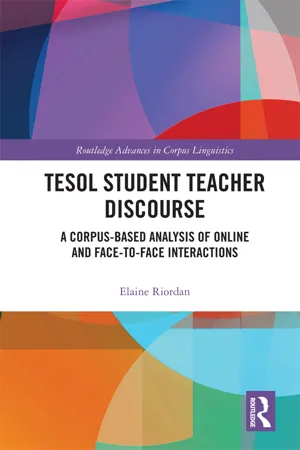
This book explores the use of online and face-to-face interactions in language teacher education (LTE) by assessing the formation and practices of a community of practice (CoP), and evaluating the roles discussions between student teachers and a peer tutor can play in terms of identity formation, articulating narratives, reflective practices, and maintaining affective relationships. The specific context within which this is embedded is a Teaching English to Speakers of Other Languages (TESOL) programme, often known as English Language Teaching (ELT), at a third-level Irish institution. The data drawn on come from student teachers on a master's (MA) programme who interacted with a peer tutor (the researcher) via a number of modes (face-to-face and online). The approach to data analysis is a corpus-based discourse analytical one, which examines the linguistic features of student teacher and peer tutor talk; the features of CoP practices in the discourse; and how different modes of communication shape the nature of this discourse. Perceptive data from the student teachers is used to outline their reactions to the modes of communication and the activities they participated in.
eBook - ePub
TESOL Student Teacher Discourse
A Corpus-Based Analysis of Online and Face-to-Face Interactions
- 238 pages
- English
- ePUB (mobile friendly)
- Available on iOS & Android
eBook - ePub
TESOL Student Teacher Discourse
A Corpus-Based Analysis of Online and Face-to-Face Interactions
About this book
Information
1 Introducing the Context
LTE, Social Learning, and CoPs
1.1 Introduction
This book explores the use of online and face-to-face interactions in language teacher education (LTE) by assessing the formation and practices of a community of practice (CoP) (Lave and Wenger 1991; Wenger 1998a), and evaluating the roles that discussions between student teachers and a peer tutor can play in terms of identity formation, articulating narratives, reflective practices, and maintaining affective relationships. The specific context within which my research is embedded is a Teaching English to Speakers of Other Languages (TESOL) programme, often known as English Language Teaching (ELT), at a third-level Irish institution. The data I draw on come from student teachers in a master’s (MA) programme who interacted with a peer tutor (the researcher) via a number of modes (face-to-face and online).
My approach to data analysis is a corpus-based one, where I examine the linguistic features of student teacher and peer tutor talk; the features of community practices in the discourse; and how different modes of communication shape the nature of this discourse. Perceptive data from the student teachers are used to outline their reactions to the modes of communication and the activities they participated in. Examining the discourse in such ways allows me to explore how student teachers engage with one another and what the content of their talk is, which should offer a better understanding of student teachers. In order to provide an overview of LTE for corpus linguists in particular, in this chapter, I briefly discuss historical issues within LTE, before considering the theoretical foundation on which this book rests: namely, social learning and CoPs.
1.2 Language Teacher Education
1.2.1 Historical Issues in LTE
LTE in the field of TESOL dates back to the 1960s. Since then, there have been many shifts in the theories underlying the education field, the first of which was a move from a behaviouristic perspective to a more constructivist one.
Transmission from Product-Process to Constructivist Processes
The 1960s and 1970s saw the transmission of knowledge and product-oriented theories (behaviourism) to a more constructivist, process-oriented approach (Crandall 2000; Freeman 2001; Abednia 2012), resulting in greater focus on teacher cognition, reflection, and teacher development. The behaviourist view of learning focussed on teachers’ behaviours and how they impacted teaching and learning (Freeman 2001; Johnson 2009). This approach was felt to ignore the individual experiences of teachers (Freeman and Johnson 1998), and although some argue that it improved teaching practices to some extent (Freeman 2001), it was acknowledged that for ‘teacher education to be fully effective, it is crucial to examine how teachers arrive at their explanations and understandings of what they do in their classroom practice, and the role formal teacher education plays in that process’ (Freeman 1991, 439).
The constructivist view of learning proposes that knowledge is constructed by people, and meaning is derived through experiences; thus, the shift from behaviourist to constructivist approaches resulted in more emphasis being placed on how the teachers learned, how they were in classrooms, and why they made practice-related decisions (Cochran-Smith 2005). As will be seen in later chapters, these are some of the issues I tried to tease out of the discussions I had with the student teachers during the data collection phases of my research.
Focus on Situated Cognition
In the 1970s, attention was placed on situated teacher cognition (Freeman and Johnson 1998), which emphasised the interdependence of knowing and doing, whereby knowledge is connected to activity, context, and culture (Brown, Collins, and Duguid 1989). For LTE, this meant that the linking of theory and practice was a priority, and that teachers should learn from social interactions in authentic contexts. It was acknowledged that ‘teacher learning is not viewed as translating knowledge and theories into practice but as constructing new knowledge and theory through participating in specific social contexts and engaging in particular types of activities and processes’ (Richards 2008, 6). Taking the view that learning happens through social participation falls in line with the community of practice (CoP) framework (Richards 2008), connects with sociocultural theories1 and social learning, and acknowledges the importance of identity construction, dialogue, and collaboration, all of which are important in the context of my data.
Teachers’ Prior Learning and Inquiry
In the late 1980s, Freeman (1989) stated that LTE had become somewhat unfocussed, and courses for teacher education often lacked coherence and a sound foundation. Accordingly, a paper by Freeman and Johnson (1998) proposed a new knowledge base for LTE, basically stating that any content (methodologies, theories, and so on) should be delivered and ‘understood against the backdrop of teachers’ professional lives’ (ibid., 405). They stressed the value of both theoretical and practical knowledge, and they placed emphasis on the teacher as researcher/investigator ‘with respect for the role of teachers in developing theory and directing their own professional development through collaborative observation, teacher research and inquiry, and sustained inservice programs’ (Crandall 2000, 36). This shift thus underlined the significance of teachers’ prior learning experiences, which were realised via observation and reflection (Freeman 1991, 2001; Johnson 2009). Rather than viewing teachers as ‘empty vessels waiting to be filled’ (Freeman and Johnson 1998, 401), they were considered to have previous experiences, their own personal values and opinions, all of which impact upon classroom practices.
Professionalising LTE
In the late 1990s, Freeman and Johnson (1998, 398) cautioned that there had been little research implemented in LTE, stressing that ‘much of the work […] has been animated more by tradition and opinion than by theoretical definitions, documented study, or researched understandings’. The impact this paper had was profound, and stirred an impetus in published works in the field. Today, teacher education is more grounded than before (Johnstone 2004; Wright 2010)—it has more interest in reflective practice, teacher knowledge, cognition and learning, school-based learning (mentoring), peer coaching, teacher narratives, and the link between the teacher and the researcher (Mann 2011), elements which manifest themselves throughout the chapters that follow.
1.2.2 Reflective Practice
I now move on to consider reflective practice for language teachers, as this is one of the fundamental practices which has emerged from the historical development of LTE, and is core to later parts of this book. Dewey (1933, 16) defined reflection as ‘active, persistent, and careful consideration of any belief or supposed form of knowledge in the light of the grounds that support it and the further conclusions to which it tends’. Extending Dewey, Schön (1991) identifies the concepts of ‘professional knowledge’ and ‘experiential knowledge’, with the former referring to the facts and theories that teachers know about teaching, and the latter concerning the knowledge which stems from actual experience. Schön’s (1991) reflective model therefore includes reflection-in-action (reflection while practising, which is often at a sub-conscious level, unless a break-down in an established routine happens), and reflection-on-action (reflection on the practice retrospectively). In modern LTE programmes, student teachers are asked to reflect on issues important to language teaching and pedagogy (reflection-on-action), and to reflect during their teaching practice (reflection-in-action).
Reflective practice is an active and evidence-based process where the teacher considers their own classes and those of other teachers in order to learn about teaching. This can include student teachers considering themselves and their teacher roles and identities, their students, their practice, and issues related to teaching and learning, where they explore, construct meaning, generate knowledge, draw conclusions, and use new knowledge to make decisions about their practice (Riordan 2012; Farr and Riordan 2015). Reflective practice is deemed most beneficial when it results in positive alterations in one’s practice (Ray and Coulter 2008), as this can demonstrate that learning has occurred (Forbes 2011). The process of reflection has been aptly likened to a compass whereby the teacher can stop, observe, and ascertain where they currently are, so they can make a decision about where they want to go in the future (Farrell 2012). Teachers need support during this process (Mena-Marcos, García-Rodríguez, and Tillema 2013; Farr 2015), and therefore an important figure within reflective practice is the teacher educator who scaffolds reflections (examples of this will be seen later in the analytical chapters).
Further research is needed to more fully understand reflective practice (Kramsch and Ware 2004; Collin, Karsent, and Komis 2013), and interestingly Akbari (2007) finds no evidence of reflective practice leading to improved teacher performance, although Farr (2011, 13) argues that ‘[…] to say that this means that it is not an effective tool, among others, is perhaps taking it a step too far’. So, while reflective practice has been described as a ‘catch phrase in teacher education’ (Wang, Chen, and Levy 2010, 779), it has found a continued place in LTE (Lloyd and Bahr 2010; Farr and Riordan 2012; Farr 2015; Farrell 2016). In fact, Farrell (2012) points out that the terms reflection and reflective practice are almost obligatory terms in LTE today.
Frameworks of Reflection
The model of reflective practice applied in this book comes from Jay and Johnson (2002), which derives from the work of teacher educators on the University of Washington’s Teacher Education Programme, and comprises three dimensions. The first, Descriptive Reflections, ‘involves the intellectual process of “setting the problem;” that is, determining what it is that will become the matter for reflection’ (ibid., 77). Therefore, at this level, the student teacher describes the issue, which could be a problem in class, a feeling, an experience, or a theory. The second dimension, Comparative Reflections, involves considering an issue through number of different lenses so that the student teacher can better understand it, and to ‘discover meaning [they] might otherwise miss’ (ibid., 78), while the third dimension, Critical Reflections, is where ‘one makes a judgement or a choice among actions, or simply integrates what one has discovered into a new and better understanding of the problem’ (ibid., 79). Although there are other useful models of reflection, Jay and Johnson’s model acknowledges the different levels of reflection and therefore attempts to capture the complexity of reflective practice. In addition to this, I find the three dimensions and the accompanying guiding questions in their framework suitable for the description and categorisation of the reflections found within my own data (see also Riordan 2012; Farr and Riordan 2015).
1.2.3 Summary
To date, LTE is in a state of situated, social cognition, with a focus on professional development, teacher narratives and identities, and reflective practice. There has been momentum in LTE research particularly from a sociocultural point of view (Norton 2004), and a well-cited paper by Johnson (2006) highlights the importance of the ‘sociocultural turn’ and the impact this has had on LTE. Concerning the ‘sociocultural turn’, she discusses the shift from behaviourist and cognitivist views of learning to a focus on the fact that knowledge is dynamic, social, and situated, and that cognition is intertwined with context and participation (which I outlined earlier). As sociocultural theories have clearly impacted LTE, some of the key players in this field (Jean Lave and Etienne Wenger)2 are therefore the focal point of the following section. This will provide a backdrop to the aforementioned developments in LTE, but is also connected to the concept of CoPs, a major theoretical framework employed in this book.
1.3 Lave and Wenger’s Social Theory of Learning
The concept of CoPs draws on Lave and Wenger’s (1991) social theory of learning, namely situated learning, which comprises four main elements: people are social beings; knowledge is considered as competence within an enterprise; knowing is participating in and engaging with such enterprises; and learning should produce meaning that derives from our experiences of the world (Wenger 1998a). Such elements lead them to take social participation as the main focus of their CoP framework, which constitutes four components: namely, meaning, which can be viewed as learning through experience; community, which assumes learning by belonging; practice, signifying learning by doing; and, identity, referring to learning as becoming (Wenger 1998a). Although this framework was not put forward with student teachers in mind, these four components can be used to describe the learning that student teachers engage in. For example, student teachers learn about teaching through teaching practice, observation, and continued professional development activities (meaning); they learn by being integrated with and feeling part of the teaching community (community); they continue to learn as they master their craft (practice); and their identity as a teacher evolves and is shaped through their practice and interactions with others (identity).
1.3.1 Legitimate Peripheral Participation
Lave and Wenger (1991) argue that the most important characteristic of their theory of learning is Legitimate Peripheral Participation (LPP), whereby learners participate at first peripherally in CoPs, and then with time gain skills and knowledge which facilitate fuller participation in the CoP. They state:
“Legitimate peripheral participation” provides a way to speak about the relations between newcomers...
Table of contents
- Cover
- Title
- Copyright
- Dedication
- Contents
- Acknowledgements
- List of Tables
- List of Figures
- List of Abbreviations
- 1 Introducing the Context: LTE, Social Learning, and CoPs
- 2 Technologies in LTE
- 3 Corpus-Based Discourse Analysis
- 4 Community Discourse: Frequent Linguistic Features
- 5 Community Discourse: Identity Formation and Representation
- 6 Community Discourse: Affective Relationships
- 7 Conclusions
- Appendices
- Index
Trusted by 375,005 students
Access to over 1.5 million titles for a fair monthly price.
Study more efficiently using our study tools.
Frequently asked questions
Yes, you can cancel anytime from the Subscription tab in your account settings on the Perlego website. Your subscription will stay active until the end of your current billing period. Learn how to cancel your subscription
No, books cannot be downloaded as external files, such as PDFs, for use outside of Perlego. However, you can download books within the Perlego app for offline reading on mobile or tablet. Learn how to download books offline
We are an online textbook subscription service, where you can get access to an entire online library for less than the price of a single book per month. With over 1.5 million books across 990+ topics, we’ve got you covered! Learn about our mission
Look out for the read-aloud symbol on your next book to see if you can listen to it. The read-aloud tool reads text aloud for you, highlighting the text as it is being read. You can pause it, speed it up and slow it down. Learn more about Read Aloud
Yes! You can use the Perlego app on both iOS and Android devices to read anytime, anywhere — even offline. Perfect for commutes or when you’re on the go.
Please note we cannot support devices running on iOS 13 and Android 7 or earlier. Learn more about using the app
Please note we cannot support devices running on iOS 13 and Android 7 or earlier. Learn more about using the app
Yes, you can access TESOL Student Teacher Discourse by Elaine Riordan in PDF and/or ePUB format, as well as other popular books in Education & Education Theory & Practice. We have over 1.5 million books available in our catalogue for you to explore.