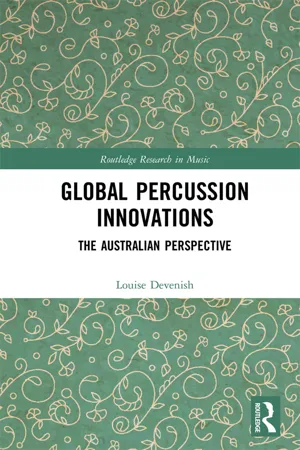
First emerging in North America and Europe in the late 1920s, contemporary percussion practices have transitioned from the fringes of contemporary music to the forefront over the past 90 years. In the 1960s contemporary percussion practices reached Australian shores and a new generation of artists added their voices to this narrative. The role of Australian activity is not yet embedded in the wider narrative of international contemporary percussion, nor is the significance of developments in contemporary percussion practices fully realised in the context of Australian music history. In this monograph, political, social and cultural influences on this art form will be examined for the first time in a historical survey of contemporary percussion music in Australia over a 50-year period, from 1960 to 2010. The rise of the percussion ensemble in the twentieth century to a standard chamber music ensemble is now recognised as one of the major advances in western art music practice internationally. A focus will be placed on ensemble activity via definitive documentation and analysis of ensembles that are amongst the most pioneering and longest established of Australian contemporary music organisations, including the Australian Percussion Ensemble, Synergy Percussion, Adelaide Percussions, Nova Ensemble, Tetrafide Percussion, Taikoz, Clocked Out and Speak Percussion amongst others. Closing with a discussion of influences and identity, this historical narrative will expand our understanding of the impact of Australian contributions to the international contemporary music scene while simultaneously examining how developments in contemporary percussion have contributed to Australia's cultural identity.
- 174 pages
- English
- ePUB (mobile friendly)
- Available on iOS & Android
eBook - ePub
About this book
Information
1 Contemporary percussion in Australia
The 1960s and 1970s
Prior to 1970 there was very limited awareness in Australia of the contemporary percussion practices that had been emerging in North America and Europe since the 1930s.1 Australia’s geographical isolation was a contributing factor in the delayed development of contemporary percussion music there, simply because the innovations of European and American percussionists and composers had not yet reached Australian shores. This was also true for other forms of contemporary music, including experimental, avant-garde, electronic and improvisatory new music, which began to take root in Australia in the 1960s. The years between 1960 and 1975 saw rapid changes in the Australian cultural climate, changes that made room for the new practices of contemporary percussion music. Until the 1960s, many Australian composers and performers had identified largely with the English pastoral style of creating music and focussed largely on classical and neoclassical forms, genres that traditionally do not focus on percussion instruments. Described as ‘an unparalleled and unique sociological and cultural revolution’ (Murdoch, 1975: xi), Australian musical activity during this period reflects ‘a new-found self-confidence’ (Rogers, 2009: 242) amongst musicians. Increased recognition via the presentation of new professional and educational opportunities in Australia was inspiring a new generation of Australian composers who embraced influential modernist musical styles. Greater awareness of and some level of pride in Australian contemporary music making followed, and this was recognised at a federal level in the late 1960s.
During his time as Prime Minister (1968–1971), John Gorton’s government established a number of federally funded arts boards designed to support film, literature, music and the visual arts: the Commonwealth Art Advisory Board, Commonwealth Literary Fund and Advisory Board, Australian National Film Board and Commonwealth Assistance to Australian Composers (CAAC) Advisory Board. Composed of Bernard Heinze, Frank Callaway, John Hopkins and later Ernest Llewellyn, CAAC provided financial assistance in the form of fellowships and grants, supporting the creation of new Australian compositions. Following his election as Prime Minister in 1972, Gough Whitlam’s government amalgamated these boards to form the Australian Council for the Arts, later the Australia Council. The amalgamation was accompanied by a significant increase in funding capacity over three years, from 7 million dollars to 24 million dollars (Whitlam, 1985: 563). This led to the establishment of many small performing arts groups, and artists of all disciplines began taking greater creative risks in their work, resulting in greater diversity of output. In 1975, the Australian Music Centre was established to document and support the work of Australian composers.
Additionally, the return of expatriates and immigration of international musicians aided this change. In reflecting on this, Warren Burt refers to the beginnings of a contemporary music climate in 1960s and 1970s Australia when he states that ‘much of the energy, and many of the new developments in Australian music seem to be the result of migrant musicians, or of Australians returning home after extended periods overseas’ (Burt, 2007). Although Burt refers primarily to the contributions made by experimental and avant-garde composers, this proves to be true for the development of Australian contemporary percussion as well. The efforts of the composers to whom Burt refers – for example, Keith Humble and Felix Werder in Melbourne and David Ahern in Sydney – contributed to the development of Australian percussion music and ought to be mentioned.
Australian composer Keith Humble (1927–1995) returned to Melbourne for the second time in 1966 after an extended period of working in electronic and experimental music in Paris, where he had directed the world-renowned performance space Le Centre de Musique. Humble founded Le Centre de Musique at the American Artists Centre in Paris in 1959 and Le Centre operated until 1968. In addition to bringing numerous ideas about experimental music with him to his students at the Melbourne University Conservatorium of Music, Humble invited his international colleagues to engage with Australian musicians within the department. One of these colleagues was French percussionist and composer Jean-Charles François, who, in coming to Melbourne in 1969 at Humble’s invitation, was highly influential as a composer. At this time, François was the only percussionist living in Australia with any experience of contemporary percussion performance practices. While François’ arrival presented the first opportunity for an introduction of contemporary percussion practices to Australia, local musicians and audiences were initially not receptive to this style of music and most of François’ contributions within the Australian contemporary music climate of the time were made within the field of experimental composition. In an interview with John Whiteoak, Humble reflected that during this period at Melbourne University, François’ work ethic demonstrated to composers there – who were very enthusiastic about contemporary composition, yet lacking in relevant musical or performance skills – one way to reach the artistic standards they desired:
I was lucky in the sense that I had a young colleague, Jean-Charles François in France who had a more radical platform than myself in relation to the composition/performance of contemporary music. He particularly wanted to go to the United States, but I said: ‘Don’t go to the United States straight away, come to Australia?’ So he did come to Australia. He had a platform which was basically: it really didn’t matter how much talent you had, it was a question of getting the work done. He persisted, and he worked very, very hard while he was here. He also had to realise that there was, culturally, a difference between that French idea of: it didn’t matter if you were professional or not, you learnt mechanically to play an instrument, and you learnt in life to be efficient, whereas in Australia we’re not very efficient. The process of discovering this hurt. So, to answer your question: yes, it was a particular problem.
(Whiteoak, 1989)
As a percussionist, François began to work on a casual basis with the Melbourne Symphony Orchestra, and in 1970 he accepted the position of principal timpanist. Following this appointment, a position teaching orchestral percussion was created for him at the Melbourne University Conservatorium of Music. Despite his regular orchestral work, François’ main interest remained in contemporary music, which he attributes to the French musical climate in which he trained (François, 2012). François reflects that in the late 1960s, many Australians had ‘a strong opposition to any forms of contemporary arts’ and much of the activities at Melbourne University under Keith Humble’s direction were simply efforts to introduce new repertoire and contemporary music practices such as electronic music and improvisation to Australian audiences (François, 2012). Occasionally, François performed solo percussion concerts that included his own compositions, but he found:
Critics in Australian newspapers were very negative towards my activities, they could not accept the Dadaist aspects of many of my performances and compositions. But when I played a farewell recital in Melbourne before my return to France, the Herald critic who had been the most negative before, titled his article ‘Farewell to One of the Best’.2
(François, 2012)
A small group of experimental musicians, many of whom were based at the Melbourne University Conservatorium of Music, shared François’ passion for contemporary music. François had some influence on a small number of young percussionists during his time in Melbourne, in that some awareness of contemporary percussion practices was gleaned. One such student was John Seal, whose impact on contemporary percussion in Melbourne will be discussed further in Chapter Two. However, the lack of interest or skills to perform contemporary percussion music from both his students and François’ professional orchestral percussionist colleagues, coupled with the relatively short period he was in Melbourne, prevented François from having a strong or long-term impact on percussion in Australia. Likewise, Australia’s isolation proved both productive and frustrating for François. A lack of performance opportunities for a contemporary percussionist in Melbourne at that time allowed François to thoroughly practice the big works of the solo multiple percussion repertoire of the day – Stockhausen’s Nr. 9 Zyklus (1959), Feldman’s The King of Denmark (1964) and Wuorinen’s Janissary Music (1966) – however without the opportunity to perform them. Consequently, François left Melbourne in 1972 in order to pursue contemporary music in a more vibrant environment. Shortly after his return to France he was appointed Head of Percussion at the University of California San Diego, whose music department was renowned for its progressive methods at that time. François also published a number of articles on new music, including ‘Organization of Scattered Timbral Qualities: A Look at Edgard Varèse’s Ionisation’ (François, 1991), which has become one of the most respected analyses of the work. Although these contributions were made following his departure from Australia, François believes
without that stay [in Australia] far away from the rest of the world, my career in America would not have been as successful. It is difficult for me to measure in return what impact I had on the Australian musical community and percussion playing.
(François, 2012)
Similarly, Humble left Australia around the same time. Although Humble wanted to live and work in Australia, the lack of opportunities for contemporary music in Australia in the late 1960s forced him to leave Melbourne in 1971 to take up a teaching post at the University of California San Diego. Humble returned to Melbourne in 1974 when an opportunity to establish a contemporary music department arose at La Trobe University, where he was appointed Foundation Professor. By this time, contemporary music awareness was beginning to grow and Humble remained in this post until his retirement in 1989.
Professional training for Australian percussionists
The first pocket of Australian percussion activity outside the orchestra arose in South Australia in the 1960s. Richard ‘Dick’ Smith (1911–1991), principal timpanist with the Adelaide Symphony Orchestra (ASO) was at the centre of this burgeoning percussion scene as a performer and educator. A largely self-taught musician, Smith was passionate about percussion and sound. As a young man, he performed as a xylophone and traps percussionist in pit orchestras for silent cinema. His interest in 1920s ragtime xylophone music further led him to develop his xylophone technique by ord...
Table of contents
- Cover
- Title
- Copyright
- Dedication
- Contents
- List of figures
- List of tables
- List of musical examples
- List of abbreviations
- Acknowledgements
- Introduction
- 1 Contemporary percussion in Australia: the 1960s and 1970s
- 2 The emergence of Australian contemporary percussion: 1970s Melbourne
- 3 Contemporary percussion ensembles in Sydney
- 4 Contemporary percussion in Adelaide
- 5 Percussion in Western Australia
- 6 Percussion in Brisbane, Canberra and Hobart
- 7 The question of identity: looking back, looking out, looking in, looking forward
- Bibliography
- Index
Trusted by 375,005 students
Access to over 1.5 million titles for a fair monthly price.
Study more efficiently using our study tools.
Frequently asked questions
Yes, you can cancel anytime from the Subscription tab in your account settings on the Perlego website. Your subscription will stay active until the end of your current billing period. Learn how to cancel your subscription
No, books cannot be downloaded as external files, such as PDFs, for use outside of Perlego. However, you can download books within the Perlego app for offline reading on mobile or tablet. Learn how to download books offline
Perlego offers two plans: Essential and Complete
- Essential is ideal for learners and professionals who enjoy exploring a wide range of subjects. Access the Essential Library with 800,000+ trusted titles and best-sellers across business, personal growth, and the humanities. Includes unlimited reading time and Standard Read Aloud voice.
- Complete: Perfect for advanced learners and researchers needing full, unrestricted access. Unlock 1.5M+ books across hundreds of subjects, including academic and specialized titles. The Complete Plan also includes advanced features like Premium Read Aloud and Research Assistant.
We are an online textbook subscription service, where you can get access to an entire online library for less than the price of a single book per month. With over 1.5 million books across 990+ topics, we’ve got you covered! Learn about our mission
Look out for the read-aloud symbol on your next book to see if you can listen to it. The read-aloud tool reads text aloud for you, highlighting the text as it is being read. You can pause it, speed it up and slow it down. Learn more about Read Aloud
Yes! You can use the Perlego app on both iOS and Android devices to read anytime, anywhere — even offline. Perfect for commutes or when you’re on the go.
Please note we cannot support devices running on iOS 13 and Android 7 or earlier. Learn more about using the app
Please note we cannot support devices running on iOS 13 and Android 7 or earlier. Learn more about using the app
Yes, you can access Global Percussion Innovations by Louise Devenish in PDF and/or ePUB format, as well as other popular books in Media & Performing Arts & Music. We have over 1.5 million books available in our catalogue for you to explore.