Louis I. Kahn was one of the most influential architects, thinkers and teachers of his time. This book examines the important relationship between his work and the city of Rome, whose ancient ruins inspired in him a new design methodology. Structured into two main parts, the first includes personal essays and contributions from the architect's children, writers and other designers on the experience and impact of his work. The second part takes a detailed look at Kahn's residency in Rome, its effects on his thinking, and how his influence spread throughout Italy. It analyses themes directly linked to his architecture, through interviews with teachers and designers such as Franco Purini, Paolo Portoghesi, Giorgio Ciucci, Lucio Valerio Barbera and the architects of the Rome Group of Architects and City Planners (GRAU). Rome and the Legacy of Louis I. Kahn expands the current discourse on this celebrated twentieth-century architect, ideal for students and researchers interested in Kahn's work, architectural history, theory and criticism.
- 206 pages
- English
- ePUB (mobile friendly)
- Available on iOS & Android
eBook - ePub
Rome and the Legacy of Louis I. Kahn
About this book
Information
Part I
Rome and Kahn
Elisabetta Barizza
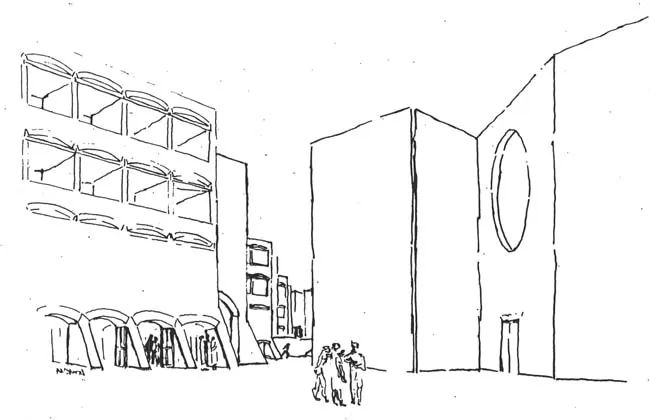
Figure 1.1 Louis I. Kahn’s perspective of the Indian Institute of Management, Ahmedabad, India, 1962–1974.
Collection of Nathaniel Kahn, courtesy of N. Kahn by permission.
1 Rome and Kahn
The Italian edition of this book was first published in 2014, the fortieth anniversary of Louis Kahn’s death in Pennsylvania Station in New York on 17 March 1974. Kahn became one of the central figures in the attempt to re-establish modern architecture by reclaiming its past history, but at the height of his artistic career and while he was fully engaged in his profession as architect, by some bizarre twist of fate, his heart gave out in the very place where, little more than 10 years earlier, there had stood one of the symbols of American beaux arts architecture that he so loved: the Pennsylvania Station building, constructed in 1910, one of the most important of the works of the architects McKim, Mead and White. The station was modelled on the Baths of Caracalla (also a source of inspiration for Louis Kahn in his last 20 years). At the end of the 1930s, the station was still splendid to behold:
Nine acres of travertine and granite, 84 Doric columns, a vaulted concourse of extravagant, weighty grandeur, classical splendor modeled after royal Roman baths, rich detail in solid stone, and an architectural quality in precious materials that set the stamp of excellence on a city.1
Despite a fierce battle fought in the 1960s by many citizens and celebrities of New York to save the building (among them architect Philip Johnson), demolition began in October 1963 to make way for Madison Square Garden and other new urban infrastructures. The destruction of the Pennsylvania Station would become an emblem for the later battles that led to the birth of conservationism and an awareness of the importance of history in America:
A lack of history and any of its physical manifestations encouraged the first generations of Americans of European origin to adopt a form of culture that looked solely toward the future. For many of them (and this remained true for succeeding waves of immigrants) the American experience meant a break with the past and a repudiation of history. It took time for a strong attachment to history to develop [. . .] historicism became a cultural mainstay: at the Columbian Exposition of 1893, classical antiquity became the touchstone for the ordering of the expanding American cities. The conservationists were more concerned with history and tradition rather than architecture itself, and their efforts extended to the natural environment [. . .] With the creation of the first national parks under President Teddy Roosevelt in 1906 the National Park Service became responsible, as it is today, for the upkeep and restoration of architectural works [. . .] only in 1929 was this task extended to city buildings [. . .] Historical conservation and historicism entered into a symbiotic relationship which continues to this day.2
In 1944, while Europe was in the throes of the Second World War, Kahn presented his famous essay ‘Monumentality’ at the New Architecture and City Planning conference organised by Paul Zucker at Columbia University in New York. The conference reiterated the topics addressed in the manifesto Nine Points on a New Monumentality, signed by Sigfried Giedion, Josep Lluis Sert and Fernand Léger and published in 1943, where they announced the need for a new monumentality, how it could be reinvented and how its inherent dangers could be averted. The New York manifesto was supported by the American Abstract Artists association and was considered to be an American answer to the manifestos of the European CIAM issued between the wars, which had endorsed the birth of the Modern Movement. At the conference, Giedion (who, along with Le Corbusier, had already organised the first CIAM in 1928 in La Sarras in Switzerland) traced out the development of modern architecture from the 1920s to 1943, and declared:
All of us are perfectly aware of the fact that monumentality is a dangerous affair in a time when most of the people do not even grasp the elementary requirements for a functional building. But we cannot close our eyes; whether we want it or not, the problem of monumentality is lying ahead in the immediate future. All that can be done within the limits of our humble efforts, is to point out dangers and possibilities [. . .] This is the period of pseudo-monumentality. The greater part of the nineteenth century belongs to it.3
Modern architecture, Giedion goes on to say, was in its origins dedicated to functionality, then it began to concentrate on city planning; now it needs to take a further step:
The third step lies ahead. In view of what had happened in the last century and because of the way modern architecture had come into being, it is the most dangerous and the most difficult step. This is the reconquest of the monumental expression [. . .] The people want buildings representing their social, ceremonial and community life. They want their buildings to be more than a functional fulfilment. They seek the expression of their aspirations for monumentality, for joy and excitement [. . .] Monumentality derives from the eternal need of the people to own symbols which reveal their inner life, their actions and their social conceptions.4
With his 1944 essay ‘Monumentality’, Kahn entered the debate with an entirely personal contribution and attempted a form of synthesis, which many thought impossible; he based the last 30 years of his career on the two dialectically opposed doctrines of modernisation and new monumentality, and thus issued his challenge. On the one hand, he extolled modernity and the building methods of industrialisation, and on the other he pointed the way towards a new way of envisaging the past, in order to once again give character to architecture and to restore quality to living spaces and cities:
Monumentality is enigmatic. It cannot be intentionally created. Neither the finest material nor the most advanced technology need enter a work of monumental character for the same reason that the finest ink was not required to draw up the Magna Carta [. . .] The influence of the Roman vault, the dome, the arch, has etched itself in deep furrows across the pages of architectural history. Through Romanesque, Gothic, Renaissance and today, its basic forms and structural ideas have been felt. They will continue to reappear but with added powers made possible by our technology and engineering skill [. . .] Standardization, prefabrication, controlled experiments and tests, and specialization are not monsters to be avoided by the delicate sensitiveness of the artist [. . .] They give the necessary knowledge the artist must have to expel fear in their use, broaden his creative instinct, give him new courage and thereby lead him to the adventures of unexplored places. His work will then be part of his age and will afford delight and service for his contemporaries. I do not wish to imply that monumentality can be attained scientifically or that the work of the architect reaches its greatest service to humanity by his peculiar genius to guide a concept towards a monumentality. I merely defend, because I admire, the architect who possesses the will to grow with the many angles of our development. For such a man finds himself far ahead of his fellow workers.5
As Kenneth Frampton said: “right from the start, Kahn dealt with the question of monumentality in a rather atypical fashion, by laying emphasis on the tectonic elements and making them paramount above all other considerations,” but it was in Rome that he expanded and finalised this idea by introducing the key concept of the institution.6 During his second stay in the city, when he was at the American Academy, in fact, Kahn perfected his idea of a universal architecture inspired by the great models of the past, which could provide ‘new institutions’ for contemporary mankind.
Kahn’s sensitivity towards history had its roots in his own European Jewish origins, but this was offset by a completely American sense of freedom that was an essential feature of the New World. Observing Rome in the 1950s, where the ancient ruins stood side by side with the building sites of the post-war reconstruction, Kahn seemed to echo the words of Goethe:
I wish to see Rome in its permanent and abiding features, and not as it passes and changes every ten years [. . .] Above all, one may study history here quite differently from what one can on any other spot. In other places one has to read oneself into it from without, here one fancies that he reads from within outwards: all arranges itself around you, and seems to proceed from you. And this holds good not only for Roman history but also for that of the whole world.7
Thanks to his artistic training, Kahn could study the architecture of Rome and manage to see the potential “unity of form as a synthesis of many shapes,” and uncover the secrets of the architectural and urban spaces of the Eternal City. Apart from his decision to focus on masonry architecture, the design projects from Kahn’s mature period show the large variety of spatial solutions that he produced within a stringent compositional framework, organised according to his theory of ‘order and design’. Using a series of repetitive components that are often limited in number, Kahn succeeded in obtaining the maximum amount of spatial contrast, producing surprising effects, variations, unexpected changes in direction, a judicious selection of viewpoints, and rhythmic sequences within the architectural space. Similarly, by making use of compositional categories such as symmetry and axiality – outlawed by the Modern Movement – he went on, with “compositions of dissimilar parts brought together by hypotaxis and parataxis”8 to reinvent forms that generated spaces flooded with light, in a consistent and irrevocable coherence of construction. The coherence between form and structure was for Kahn the central feature that endowed architecture with solemnity. Writing on Kahn’s creative process, Mario Manieri Elia, an architect belonging to the Roman group STASS, commented:
Kahn spoke of ‘psyche’ (feeling) as distinct from ‘thinking’ [. . .]; psyche, when placed in a ‘historical’ relationship with an architectural subject, captures a form (feeling). The form, as it is developed in the design which is continuously controlled by the order, tends to ripen and perfect itself until beauty results.9
This is the distinguishing feature of Kahn’s vision of the city and its architecture: he experienced its built reality by perceiving its unity of form inwardly, before he engaged with it on a rational level. This unity derived from the correspondence of the infrastructures with the ancient architecture, ‘the order of the air, the order of the water, the order of construction, the order of movement’, which had to be maintained and focused upon in every new design project. Rome was always the perfect example of a city built as an organic unity produced by layers upon layers of history. The balance between a building and its surrounding natural environment, the addition of new elements to pre-existing structures, and the transformation of buildings over the centuries by a process of ‘re-fusion’ is proof that in Rome, it is the architecture that creates the city. By investigating the ruins, Kahn was able to grasp the potential of adaptable masonry-built architecture that was based on the harmony between the structural and the spatial order. Two years after his stay at the American Academy, in fact, he wrote to Anne Tyng, who was then in Rome giving birth to their daughter Alexandra:
Order I believe is mostly the structure. The structural idea embodying, harboring the need of air, light, quiet, noise etc. It is what makes the structure grow into a life of fiber enveloping the space so that its nature can be felt. It is the seed.10
The perfect balance between the structural arrangement and the spatial and distributive features that he could perceive in Roman architecture became for Kahn the key he sought in order to remodel his architectural language. When he discovered the importance of the organic form of masonry-built architecture, in which ‘the choice of structure is the choice of light’, he found the answer to the questions that from 1946 onwards had led him to apply for a fellowship to study at the American Academy in Rome. He wanted to give to modern architecture a new shape and a new monumentality generated by the same structural coherence and expressiveness to be found in historical buildings. In fact, as he wrote in a letter to AAR in 1946, he was looking for answers “on the problem of structure in relation to new architectural space.” It was the organic qualities of the fabric of a city in relation to those found within each institution that Kahn held in such high regard, and which, from 1950 on, he would make reference to in all his design projects.
Kahn firmly believed that the purity and beauty of the generating form should be evident and perceptible. This beauty was not to be thought of as an end in itself, but as the end result of a creative process bent on ensuring architectural integrity. This concept of architecture was made clear by Kahn when he said: “from beauty comes wonder and from wonder realization that the form is made of inseparable parts, parts that you cannot separate.”11 And when he maintained that form is ‘what’ and design is ‘how’, he was harking back to his beaux arts-trained teacher, Paul Philippe Cret (1876–1945), for whom designing consisted in knowing how to give form to an idea, how to make it buildable and meaningful by choosing the proper proportions that were needed to achieve spatial and structural unity in an architectural organism composed of finite and mutually dependent elements. This is a loftier concept of design, seen not as a simple overlapping of beauty and function, but as some...
Table of contents
- Cover Page
- Rome and the Legacy of Louis I. Kahn
- Routledge Research in Architecture
- Title
- Copyright
- Contents
- List of Figures
- Foreword: The Common Thread that Ties Things Together
- Introduction: Tomorrow Never Knows
- Part I Rome and Kahn
- Part II Kahn and Rome
- Afterword: Why Kahn
- Bibliography
- Index
Trusted by 375,005 students
Access to over 1.5 million titles for a fair monthly price.
Study more efficiently using our study tools.
Frequently asked questions
Yes, you can cancel anytime from the Subscription tab in your account settings on the Perlego website. Your subscription will stay active until the end of your current billing period. Learn how to cancel your subscription
No, books cannot be downloaded as external files, such as PDFs, for use outside of Perlego. However, you can download books within the Perlego app for offline reading on mobile or tablet. Learn how to download books offline
Perlego offers two plans: Essential and Complete
- Essential is ideal for learners and professionals who enjoy exploring a wide range of subjects. Access the Essential Library with 800,000+ trusted titles and best-sellers across business, personal growth, and the humanities. Includes unlimited reading time and Standard Read Aloud voice.
- Complete: Perfect for advanced learners and researchers needing full, unrestricted access. Unlock 1.5M+ books across hundreds of subjects, including academic and specialized titles. The Complete Plan also includes advanced features like Premium Read Aloud and Research Assistant.
We are an online textbook subscription service, where you can get access to an entire online library for less than the price of a single book per month. With over 1.5 million books across 990+ topics, we’ve got you covered! Learn about our mission
Look out for the read-aloud symbol on your next book to see if you can listen to it. The read-aloud tool reads text aloud for you, highlighting the text as it is being read. You can pause it, speed it up and slow it down. Learn more about Read Aloud
Yes! You can use the Perlego app on both iOS and Android devices to read anytime, anywhere — even offline. Perfect for commutes or when you’re on the go.
Please note we cannot support devices running on iOS 13 and Android 7 or earlier. Learn more about using the app
Please note we cannot support devices running on iOS 13 and Android 7 or earlier. Learn more about using the app
Yes, you can access Rome and the Legacy of Louis I. Kahn by Elisabetta Barizza,Marco Falsetti in PDF and/or ePUB format, as well as other popular books in Architecture & Architecture General. We have over 1.5 million books available in our catalogue for you to explore.