eBook - ePub
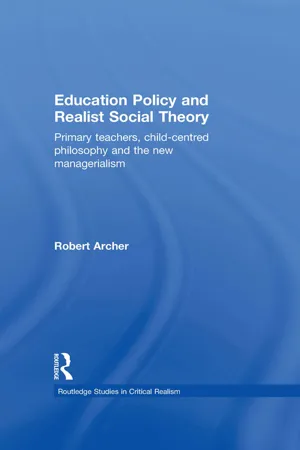
Education Policy and Realist Social Theory
Primary Teachers, Child-Centred Philosophy and the New Managerialism
- 272 pages
- English
- ePUB (mobile friendly)
- Available on iOS & Android
eBook - ePub
Education Policy and Realist Social Theory
Primary Teachers, Child-Centred Philosophy and the New Managerialism
About this book
In Europe welfare state provision has been subjected to 'market forces'. Over the last two decades, the framework of economic competitiveness has become the defining aim of education, to be achieved by new managerialist techniques and mechanisms. This book thoughtfully and persuasively argues against this new vision of education, and offers a different, more useful potential approach.
This in-depth major study will be of great interest to researchers in the sociology of education, education policy, social theory, organization and management studies, and also to professionals concerned about the deleterious impact of current education policy on children's learning and welfare.
Information
Part I
Establishing the theoretical framework
1
Structure, agency and educational change
Morphogenesis and the need for analytical dualism
Introduction
As indicated in the introduction, the principal aim of this book is to theorise about the interplay of child-centred philosophy, (new) managerialism and teacher mediation via the morphogenetic approach. It may therefore strike some readers as odd that my first chapter is devoted solely to thinking about social structure and human agency. Whilst structural analysis always needs to be complemented by cultural analysis, the reason for devoting this chapter to structure is two-fold. First, in order to provide a robust explanatory grip on structural (and cultural) dynamics, a particular social ontology and concomitant methodology have to be outlined and defended. The social ontology defended throughout this book is a stratified one, grounded in transcendental realism, and practically fleshed out, so to speak, by the latter’s methodological complement of the morphogenetic approach. In view of the complexity of the morphogenetic approach’s corpus of methodological propositions vis-à-vis structure, and their transposability to culture, it makes sense to spell out in some detail its explanatory methodology before linking culture in the next chapter. However, second, the morphogenetic approach is explicitly counterposed to Giddens’s (1979, 1984) structuration theory in order to highlight the primacy that the former gives to ontological rigour as against structuration theory’s ontological (and methodological) dilution. Many sociologists were quick to join the structurationist bandwagon (Willmott 2000b). Educational sociology has by no means been immune from this bandwagon effect. However, the reason for this is entirely laudable yet over-hasty. Its laudability derives from the need to avoid reifying social structure, treating it as a ‘thing’ above-and-beyond agency; its haste consists of compacting them into one indistinguishable amalgam, thereby precluding examination of their interplay over time. This chapter will proceed more slowly, arguing that a stratified approach to structure and agency does not entail reifying the two (or conceiving of them as separate).
What is transcendental realism?
At a common-sense level, it would seem that attachment to realism implies a rational grasp of the way things are, which in turn guides subsequent action. However, critical realism begins from the premise that the way things are affects us regardless of our own fallible epistemological grasp. For the lay commentator, poorly paid, recently divorced Claire, faced with the decision of whether to re-mortgage her house in order to pay for a long-awaited family holiday to Disney in Florida, would be held to exemplify realism if she opted for a weekend in Weymouth. Her reasons would conceivably make reference to the likelihood of incurring substantial debts and the impossibility of keeping up with repayments if she opted for the holiday abroad. Many would not dispute this accurate assessment. The difference, however, between Claire’s assessment and any sociological assessment lies in the latter’s attempt to provide an explanatory account of Claire’s (objective) predicament and her (subjective) response. Here, sociology would aim to go beyond, though fundamentally not negate or disregard, actors’ accounts, since social reality is not just the aggregation of agential interpretations. If that were true, then we would not be able to explain why some people are strategically manipulated into vicious cycles of debt. In brief, transcendental realism is committed to what social reality must be like in order to make analysis of it intelligible. In other words, it makes claims as to the necessary conditions that make it a possible object of knowledge. What is often confused is the a priori necessity of generalising the nature of social (or natural) reality and specific attempts to capture it theoretically (see, for example, Johnson et al. 1984). Transcendental social realism does not make claims as to what structures constitute social reality, but only that it is structured. Thus, for instance, any substantive disagreement about the precise role of the Secretary of State for Education and Employment, vis-à-vis the implementation of the 1988 Education Reform Act, necessarily presupposes irreducible social structures; in this case we make reference to the educational system, government machinery and so on.
The early development of transcendental realism was concerned with the natural sciences (Bhaskar 1975; Harré 1970; Harré and Madden 1975).1 The possibility of a priori knowledge, namely that which can be known independently of any experience, is associated with Kant. Kant transcendentally derived such possibility; that is to say, a priori knowledge is knowledge of the world that must be so if the world is to be known. However, as Collier (1994: 212) points out, Kant did not think that we could know if the noumenal world in itself had these properties – he thought that our mind merely imposed this knowable form on it. Bhaskar appropriates Kant’s term ‘transcendental’ in a slightly different sense. The difference is that, while Kant’s arguments lead to a theory about the structure-imposing power of the mind vis-à-vis the world, Bhaskar’s lead to extra-discursive conclusions, namely about what the world must be like. This is where Bhaskar parts company with Kant, since we are not dealing with unknowable things-in-themselves (we do not see the powers that are deposited within the position of Secretary of State, but we know they exist by virtue of their effects). Furthermore, Bhaskar’s use of the term ‘transcendental’ is different, in the sense that Bhaskar posits underlying mechanisms, which are unobservable and yet causally efficacious. Such mechanisms can be posited by virtue of transcendental argumentation in conjunction with the causal criterion. Thus it could be argued that, had Kant made the distinction between transcendental arguments and transcendental idealism, ‘he could have deployed a transcendental argument to establish the knowability of the transcendental subject who synthesized…the phenomenal world and thus avoided blocking off the transcendental subject and the understanding-in-itself and the transcendental object and the world-in-itself from the experiencing human ego’ (Bhaskar 1994: 46, original emphasis).
The existence of events and the underlying mechanisms that generate them signals the stratified nature of reality. Part and parcel of Bhaskar’s transcendental differentiation of reality into the three key strata of the real, actual and empirical is his rejection of Humean empiricism. The substantial powers at the Secretary of State’s disposal (1988 Education Act) belong to the realm of the real. They are mechanisms that only exist by virtue of human agency (as impersonal social relations) but are real because of their causal efficacy. When such powers are exercised, we enter the realm of events. However, other mechanisms may (and often do) intervene to preclude simple deduction of generative structural mechanisms from such events. Indeed, events themselves may not manifest the workings of generative mechanisms, due to contingencies that suspend their powers. Moreover, agents do not always experience such events (or experience them in a manner congruent with their provenance) – to assume otherwise turns every agent into an infallible sociologist. Hence the importance of delineating the realm of the empirical. All three realms are real and must be kept distinct in order to provide satisfactory explanatory accounts of social activity. The example of the powers deposited in the position of Secretary of State should be sufficient to underscore this. For (a) such powers may remain unexercised or exercised but unperceived because counteracted by other mechanisms; or (b) may be wrongly experienced as emanating from other structural sources. To reiterate, the methodological problem that confronts any researcher is that the exercise of causal powers is not readily transparent from patterned empirical events. For example, a deputy head may confront a staff meeting whose agenda the head and senior management team had prearranged, yet at the same time s/he remains unaware of this exercise of power or that the powers of Heads of Department had been offset. Indeed, the deputy may misinterpret (or be led to misinterpret) the meeting as resulting from the machinations of governors and certain members of the management team. What complicates matters further is that Heads of Department themselves may have only a partial understanding of the situation, whose accounts cannot therefore always be held a priori incorrigible. Furthermore, transcendental social realism enables the social analyst to ask counterfactual questions in order to unravel the complexity of social reality. If the head had exercised powers buttressed by those of the governing body, could the head’s positional powers still be exercised or exist without the existence of a governing body? Does a school remain a school without one? Though this is to jump ahead, it does provide a flavour of the explanatory power of social realism.
Essentially, Humean empiricism remains wedded to the realm of the actual, that is, at the level of observable events. Bhaskar has termed this ‘actualism’, which entails a denial of the real existence of underlying generative structures that account for things and/or events. The problem with Humean empiricism is its a causality. For Hume, the external world consists of nothing more than contingently related events. Causality is untenably implied to reside in constant conjunctions of events. There are no real or necessary connections between a child’s ability to write and the handed-in piece of written work. All we can say is that event A, the child writing, was followed by event B, the handing-in of the piece of written work. In fact, to ensure Humean consistency, one cannot even talk of pupil ability, for this is unobservable. To reiterate, instead of A caused B, we have A occurred followed by B. Clearly, to say that A occurred and then B occurred does not imply that A caused B. Yet to say that A caused B is to say that the occurrence of A is a necessary and/or sufficient condition for the occurrence of B. Yet to observe regularly the teacher opening the window and Jonathan sniffing every morning at ten o’clock does not tell us whether the opening of the window is a necessary and/or sufficient condition for Jonathan’s capacity to sniff. There is no necessary causal link between the two. Ultimately, empiricism cannot account for either Jonathan’s sniffing or the teacher’s physical ability to open windows.
In everyday life we experience mechanical causation, that is, the displacement of physical masses in time and space in terms of transitive verbs such as ‘pushing’ and ‘pulling’, which cannot be explained ostensively; rather they embody an intensional relationship between cause and effect (Bhaskar 1975: 90). This is simply a complicated way of saying that such verbs cannot specify the generative mechanisms that enable the teacher to open the window. Causality concerns not a relationship between discrete events (the teacher opens the window lock, pushes the window and it opens) but the causal powers or liabilities of objects or relations or their mechanisms (Sayer 1992: 104). The ability to open such a window exists by virtue of the body’s necessary powers. Humean actualism fails to acknowledge that reality has depth, principally because of its insistence upon the criterion of observability to establish reality. Yet we cannot observe a magnetic force field, but accept its reality. We accept its reality because of its causal effects. This applies equally to social structure. Social realism insists, as a matter of intelligibility, that social structure is ontologically distinct from human agency and is knowable via the causal criterion. This distinction is not one of heuristic convenience. Social structures are held to possess sui generis properties and powers, that is, causal properties that are examinable independently of agency and yet necessarily depend upon agency for their existence.2
Transcendentally, social reality is structured and differentiated and thus provides social science with its subject matter. To explain why individuals as role incumbents perform specific tasks on a regular basis, as manifested at the level of observable events (e.g. annual public examinations), necessarily presupposes some kind of phenomenon that is extra-individual. The activities of individuals within the school setting are often structured in quite specific ways, and such activities are not about the individual qua individual. The very notion of role signifies that its required actions are independent of purely personal properties (though this is not to suggest passive acceptance). The ‘extra-individual’ is what we normally refer to as ‘the social’. However, social realism differentiates the social into unintended sui generis emergent and aggregate properties that act back to condition subsequent activity. The activities of teachers, pupils, administrators and governors are the mediated results of sui generis emergent properties. Such structural emergent properties are causally efficacious (why the teacher teaches, the pupil learns, and so on) yet cannot be observed. However, not all realists subscribe to the view that mechanisms are always underlying and unobservable, since ‘Clockwork, the ways of producing commodities, electing MPs etc. involve mechanisms which are no less observable than the effects they produce’ (Sayer 1992: 280). Yet when MPs are elected, what exactly are we observing? We can readily observe a succession of individuals greeting election officials, who in turn direct them to booths in which slips of paper are placed into wooden boxes. These boxes are then moved to the local town hall for counting by other local government officials.
We can observe that the conditions for voting are dependent upon the observable scrutiny of voter documentation, and that the handing over of the voting slip enables the voter to mark an X in the appropriate box. The handing over of the slip enables the voter to vote, and voting would not be possible without this transaction. But the handing over of the slip is not the key generative mechanism, since the prior inspection of documentation would have been already approved. Whilst the latter is observable, the conditions for voting are not: they reside in internal social relations between positions (voter/local government official; local government official/ central government official…). The electoral system cannot be seen, but proportional representation versus first-past-the-post influences how many people vote and who wins. It is granted that we may observe the mechanisms in clockwork, but is it not the case that such observed workings are the result of a stratum of combined unobservable generative mechanisms, such as magnetic fields and the properties of the materials concerned? We can observe the teacher instructing the pupil to attend detention or read aloud, but this in itself does not explain such behaviour. Explanation of such behaviour consists of positing the unobservable reality of irreducible emergent properties (the emergent social relation between teacher and pupil). In accounting for the powers of teachers, social realists point to the internal and necessary relation between teacher and pupil (a teacher would not be a teacher without a pupil, and vice versa). As Sayer (1992) rightly argues, this internal social relation is sui generis because it modifies the causal powers of the individuals qua individuals. Sayer is either conflating a sophisticated (realist) theory and the events that are its subject matter, or, much more likely, neglecting the fact that unobservable social relations condition the observable mechanisms of interaction in organisations. Of course, some mechanisms are observable, but this does not make observability necessary for a generative mechanism to be at work.
The above introduction to transcendental realism may strike a positive chord with those intuitively attracted to what has been proposed or deemed not only confusingly complex but also unwarranted by those predisposed to a less ontologically driven approach to social analysis.3 Indeed, the transcendental presumption of sui generis structures does not tell us what such structures consist of and how they condition agential activity. In other words, it does not provide a workable methodology that captures the processes and mechanisms of structural conditioning and subsequent structural change (morphogenesis) or stasis. So we have to infer which specific ones are at work in any given area by virtue of their effects there.
Social structure, emergence and the Cartesian legacy
An emergent stratum of social reality
As McFadden has observed, ‘…questions about structure and agency, particularly in education, are obviously not going away’ (1995: 295). For some commentators, the ‘problem of structure and agency’ cannot be practically resolved (Abraham 1994: 239). It will be argued that the ‘problem of structu...
Table of contents
- Cover
- Half Title
- Series Page
- Title
- Copyright
- Contents
- Acknowledgements
- Introduction
- PART I Establishing the theoretical framework
- PART II Child-centred philosophy, new managerialism and the English education system: A morphogenetic account
- PART III At the managerial chalk face: Southside and Westside
- PART IV Concluding remarks
- Notes
- References
Trusted by 375,005 students
Access to over 1.5 million titles for a fair monthly price.
Study more efficiently using our study tools.
Frequently asked questions
Yes, you can cancel anytime from the Subscription tab in your account settings on the Perlego website. Your subscription will stay active until the end of your current billing period. Learn how to cancel your subscription
No, books cannot be downloaded as external files, such as PDFs, for use outside of Perlego. However, you can download books within the Perlego app for offline reading on mobile or tablet. Learn how to download books offline
Perlego offers two plans: Essential and Complete
- Essential is ideal for learners and professionals who enjoy exploring a wide range of subjects. Access the Essential Library with 800,000+ trusted titles and best-sellers across business, personal growth, and the humanities. Includes unlimited reading time and Standard Read Aloud voice.
- Complete: Perfect for advanced learners and researchers needing full, unrestricted access. Unlock 1.5M+ books across hundreds of subjects, including academic and specialized titles. The Complete Plan also includes advanced features like Premium Read Aloud and Research Assistant.
We are an online textbook subscription service, where you can get access to an entire online library for less than the price of a single book per month. With over 1.5 million books across 990+ topics, we’ve got you covered! Learn about our mission
Look out for the read-aloud symbol on your next book to see if you can listen to it. The read-aloud tool reads text aloud for you, highlighting the text as it is being read. You can pause it, speed it up and slow it down. Learn more about Read Aloud
Yes! You can use the Perlego app on both iOS and Android devices to read anytime, anywhere — even offline. Perfect for commutes or when you’re on the go.
Please note we cannot support devices running on iOS 13 and Android 7 or earlier. Learn more about using the app
Please note we cannot support devices running on iOS 13 and Android 7 or earlier. Learn more about using the app
Yes, you can access Education Policy and Realist Social Theory by Robert Archer in PDF and/or ePUB format, as well as other popular books in Education & Educational Policy. We have over 1.5 million books available in our catalogue for you to explore.