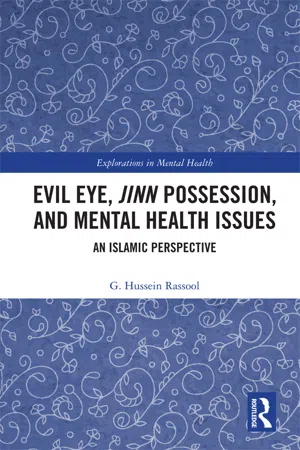
Evil Eye, Jinn Possession, and Mental Health Issues raises awareness of the cultural considerations, religion and spirituality involved in the assessment of Muslim patients with mental health problems. The belief that Jinn spirits can cause mental illness in humans through affliction or possession is widely accepted among Muslims, meaning this belief is a crucial, but frequently overlooked, aspect of mental health problems with Muslim patients in psychiatric care. This book explores the nature of such beliefs, their relationship to mental health and the reasons for their importance in clinical practice.
The book argues that it is vital to consider mental disorders as a multifactorial affair, in which spiritual, social, psychological and physical factors may all play a role. It suggests differential diagnostic skills may have an important part to play in offering help to those who believe their problems are caused by possession, and provides accessible literature on clinical issues and practice, interventions, management and evidence-based practice to help health workers achieve a better understanding of Muslim beliefs about possession and how to work with patients that hold such beliefs.
Evil Eye, Jinn Possession, and Mental Health Issues is an essential manual for mental health professionals, social workers and psychologists. It should also be of interest to academics and students in the healthcare sciences.
Islam is a monotheistic, world religion whose constituents include a vast range of races, nationalities and cultures across the globe united by their common Islamic faith. Islam that includes beliefs, values and core practices. It is considered one of the Abrahamic, monotheistic faiths, along with Judaism and Christianity. Islam is an Arabic term, which translated literally means ‘surrender’ or ‘submission’ and the term reflects the essence and the central core of Islam, which is the submission to the will of God. The same Arabic root word gives us “Salaam alaykum” (“Peace be with you”), the universal Muslim greeting. Islam is both a religion and a complete way of life based on the guidance of God from the Noble Qur’an and teachings and practices of the Prophet Muhammad (
) (Peace and blessing be upon him). Hence, a Muslim is a person who submits to the will of God, or a follower of Islam. However, in the West, there is an orientalist misperception or negative perception about Islam and this is associated with overt or covert hostility, fear, hatred, prejudice toward Islam and Muslims which have given rise to microaggressions and Islamophobia. This chapter will enable the reader to have a basic understanding of the principles of the Islamic faith, Islamic culture, beliefs and practices.
Global Islam and diversity
There is great diversity in the ethnic composition of Muslims migrants in Western and Northern Europe, North America and Australasia. The increasingly visible presence of different ethnic groups in specific countries is the result of different politico-social and economic factors including forced migration, post-decolonisation migration patterns, labour needs, asylum seekers, refugee flows from war-torn countries (Amnesty International, 2012); and regional conflicts and fleeing ‘ethnic cleansing’.” The wide diversity of social, socioeconomic, ethnic and religious backgrounds among the Muslim population influences explanatory models of illness, coping mechanisms and help-seeking behaviour. It is important that health and social care professionals have an awareness of this heterogeneous group in order to provide culturally congruent and appropriate care and management.
Nearly one-fourth of the world’s population today is Muslim and the total Muslim population is over 1.62 billion followers worldwide, reaching 2.2 billion in 2030 (Pew Forum on Religion & Public Life, 2011). The largest number of Muslims live in the Asia-Pacific region (about 60%), 43.3% live in Africa and fewer than 20% of Muslims live in the Middle East and North Africa. Countries with a significant majority of Muslim populations (about 99.5% or more of the native populations) include Bahrain, Comoros, Kuwait, Maldives, Mauritania, Mayotte, Morocco, Oman, Qatar, Somalia, Saudi Arabia, Tunisia, United Arab Emirates, Western Sahara, and Yemen (Adherents.com). Muslims will remain relatively small but significant minorities in Europe and the Americas, but they are expected to constitute a growing share of the total population in these regions. The United Kingdom (UK) has a long history of contact with Muslims, with links forged from the Middle Ages onward (The Muslim Council of Britain, 2002).
A considerable share of Muslims living in Switzerland is from former Yugoslavia, whereas the biggest groups of Muslims in Catalonia (Spain) are originally from Algeria, Mali, Morocco, Pakistan and Senegal. Muslims from Iran and Iraq are relatively numerous in the Scandinavian countries of Sweden, Norway and Denmark, if compared with other European countries (Amnesty International, 2012). The top countries of origin for Muslim immigrants to the United States (US) in 2009 were from Pakistan and Bangladesh. In Canada, Muslims make up about 3.2% of the population and Islam is the fastest growing religion in Canada (National Household Survey (2011). In Australia, 2.2% of the total Australian population were Muslims, making it the third largest religious grouping, after Christianity and Buddhism.
Mental health and service provision
With the growth of Muslims globally and the rise of Muslim migrants in different countries, there has been a corresponding rise in the need for mental health service provision and delivery as a result of the psychosocial effects of migration, prejudice, discrimination, Islamophobia and microaggressions. Muslims, beside dealing with day-to-day life stressors, also have the responsibility of defending basic religious rights and values as being normal and acceptable (Podikunju-Hussain, 2006). In addition, for indigenous Muslims, there are added psychological problems including the lack of family support; the presence of tensions in the family when conflicting core ethnic values between parents and children emerge (for example, relations with the opposite sex, career decisions, and other social values); prejudice or discrimination in the workplace or in the society; and racism (Das and Kemp, 1997).
More health and social practitioners are coming into contact with Muslim patients but due to the lack of cultural competence, find themselves at a loss to intervene effectively with Muslim patients. Despite the extent and nature of mental health problems in the Islamic community, most Western or Eurocentric-oriented practitioners are not fully cognisant of Islamic values and beliefs, or the conceptions of mental health problems from the worldview of the Muslim patients. Moreover, the Muslims’ perception of mental health problems is based on traditional beliefs that include spiritual and supernatural origins for mental illness. Haque and Kamil (2012) uphold the view that the “lack of knowledge about the beliefs and values of a religious group that is under continuous scrutiny can be problematic within a clinical setting, especially in light of the potential importance spirituality may have for a client” (p. 3). Many Muslims with psychosocial and psychiatric disorders are reluctant to seek help from mental health professionals. There is evidence to suggest Muslims are reluctant to seek professional help because they consider it debasing or inappropriate to speak of one’s troubles to strangers; professionals are perceived as being stereotyped and being culturally insensitive to their needs (Moshtagh and Dezhkam, 2004); they want their concerns addressed from a religious viewpoint (Abdullah, 2007; Podikunju-Hussain, 2006) and express a hesitancy to trust mental health professionals, fearing that their Islamic values may not be respected (Dwairy, 2006; Hedayat-Diba, 2000; Hodge, 2005; Mohamed, 1996). Consequently, it is important for mental health practitioners to be culturally sensitive to the patients’ beliefs, values and practices of Islam and to have an awareness of the impact of these on the psychological well-being of Muslims. This would enhance the rapport and therapeutic relationship between the client and the practitioner and lead to the provision of culturally appropriate intervention strategies.
Fundamentals of Islam as a religion
Islam is not a new religion, but is the continuation of the religion of our patriarch Abraham focusing on monotheistic belief. In the traditional sense, Islam connotes the one true divine religion, taught to mankind by a series of Prophets, some of whom brought a revealed book. Such were the Torah, the Psalms and the Gospel, brought by the Prophets Moses (Musa), David (Dawud) and Jesus (Eesa). Prophet Muhammad (
) was the last and greatest of the Prophets. The Noble book, the Qur’an, completes and supersedes all previous revelations. Christianity and Judaism like Islam believe in the ‘oneness’ of God, and go back to the Patriarch Abraham; the Prophets are directly descended from his sons (Morgan, 2010). Islam has at its core a simple message that applies to all human beings. Islam tolerates other beliefs as it is one function of Islamic law to protect the privileged status of minorities, and this is why non-Muslim places of worship have flourished all over the Islamic world. History provides many examples of Muslim tolerance towards other faiths. The Constitution of Medina (S.ah.īfat al-Madīnah) is the earliest known written constitution in the world. To this effect, it instituted a number of rights and responsibilities of the Muslim, Jewish and pagan communities of Medina (Saudi Arabia), bringing them within the fold of one community-the ‘Ummah’.”
The Qur’an, the last revealed Word of God, is the prime source of every Muslim’s faith and practice. The Qur’an is a record of the exact words revealed by God through the Angel Gabriel to the Prophet Muhammad, recited by him and immediately memorised and recorded by large numbers of his companions.
There are 114 chapters in the Qur’an, which is written in classical Arabic. All the chapters except one begin with the sentence ‘Bismillah ir Rahman ir Raheem,’ ‘In the name of Allah, the Entirely Merciful, the Especially Merciful.’ The longest chapter of the Qur’an is Surah Baqarah (The Cow) with 286 verses and the shortest is Surah Al-Kawthar (abundance) which has 3 verses. The Qur’an includes the history of mankind from the creation and addresses rules for everyday social life like marriage issues, divorce, personal rights, inheritance, charity to the poor, importance of brotherhood and community, social justice, proper human conduct, dealing with ecological issues and an equitable economic system. In addition to the Qur’an, there are the Sunnah (the practices and examples of the Prophet) and Hadith. A Hadith is a reliably transmitted report of what the Prophet said, did, or approved. Belief in the Sunnah is part of the Islamic faith.
The five pillars of Islam
The obligations of Muslims are known as the five pillars of Islam that all Muslims around the world will follow in relation to their daily activities, lifestyle and practices. The model framework of Muslims’ lifestyle and practices are: Shahadah, prayer (Salah), self-purification (Zakat), Fasting (Ramadhan) and pilgrimage (Hajj) to Makkah. The most important fundamental teaching of Islam is belief in the Oneness of God – this is termed Tawheed.
Shahadah, the first Article of Faith: “I bear witness that there is no god but Allah and I bear witness that Muhammad is his servant and messenger.” In fact, there is no one worthy of worship except Allah. This simple yet profound statement expresses a Muslim’s complete acceptance of, and total commitment to Islam.
Salah, prayer, is the second pillar. There are obligatory prayers that are performed five times a day at designated times. The Islamic faith is based on the belief that individuals have a direct relationship with God. In addition, Friday congregational service is also required. Although Salah can be performed alone, it is meritorious to perform it with another or with a group. It is permissible to pray at home, at work or even outdoors; however it is recommended that Muslims perform Salah in a mosque.
Zakat means purification and growth. Our wealth, held by human beings in trust, is purified by setting aside a proportion for those in need. Zakatis calculated individually and involves the payment each year of a fixed proportion of their wealth to the needy and poor. This provides guidelines for the provision of social justice, positive human behaviour and an equitable socioeconomic system. One of the Hadith (saying) of Prophet Muhammad (
) relating to charity is that “The wealth of a servant is never decreased by paying charity.” (Muslim). The Zakat is equal to 2.5 percent of an individual’s total net worth, excluding obligations and family expenses.
Sawm, fasting during the Holy month of Ramadhan, is the fourth pillar of Islam. Every year during the month of Ramadhan, Muslims fast from first daylight until sunset, abstaining from eating, drinking and sexual relations. Although the fast is beneficial for health, it is regarded spiritually as a method of self-purification. The spiritual dimension involves reflective practices, increased prayers and having positive thought towards other people and remembering Allah in all thoughts and actions. Ramadhan, the month during which the Holy Qur’an was revealed to the Prophet Muhammad, begins with the sighting of the new moon, after which abstention from eating, drinking and other sensual pleasures is obligatory from dawn to sunset. The end of Ramadhan is observed by three days of celebration called Eid Al-Fitr, the feast of the breaking of the fast. Customarily, it is a time for a family reunion and the favoured holiday for children who receive new clothing and gifts.
Hajj, the pilgrimage to Makkah, is the fifth pillar and the most significant manifestation of Islamic faith and unity in the world. The annual pilgrimage to the Hajj in Makkah, Kingdom of Saudi Arabia, is an obligation for all Muslims once in a lifetime. However, there are ...
Table of contents
Cover
Title
Copyright
Dedication
Contents
List of illustrations
Preface
Acknowledgements
Part I Context and background
Part II Evil eye and Possession Syndrome
Part III Prevention, therapeutic and spiritual interventions
Index
Trusted by 375,005 students
Access to over 1.5 million titles for a fair monthly price.
Study more efficiently using our study tools.
Frequently asked questions
Yes, you can cancel anytime from the Subscription tab in your account settings on the Perlego website. Your subscription will stay active until the end of your current billing period. Learn how to cancel your subscription
No, books cannot be downloaded as external files, such as PDFs, for use outside of Perlego. However, you can download books within the Perlego app for offline reading on mobile or tablet. Learn how to download books offline
Perlego offers two plans: Essential and Complete
Essential is ideal for learners and professionals who enjoy exploring a wide range of subjects. Access the Essential Library with 800,000+ trusted titles and best-sellers across business, personal growth, and the humanities. Includes unlimited reading time and Standard Read Aloud voice.
Complete: Perfect for advanced learners and researchers needing full, unrestricted access. Unlock 1.5M+ books across hundreds of subjects, including academic and specialized titles. The Complete Plan also includes advanced features like Premium Read Aloud and Research Assistant.
Both plans are available with monthly, semester, or annual billing cycles.
We are an online textbook subscription service, where you can get access to an entire online library for less than the price of a single book per month. With over 1.5 million books across 990+ topics, we’ve got you covered! Learn about our mission
Look out for the read-aloud symbol on your next book to see if you can listen to it. The read-aloud tool reads text aloud for you, highlighting the text as it is being read. You can pause it, speed it up and slow it down. Learn more about Read Aloud
Yes! You can use the Perlego app on both iOS and Android devices to read anytime, anywhere — even offline. Perfect for commutes or when you’re on the go. Please note we cannot support devices running on iOS 13 and Android 7 or earlier. Learn more about using the app
Yes, you can access Evil Eye, Jinn Possession, and Mental Health Issues by G. Hussein Rassool in PDF and/or ePUB format, as well as other popular books in Psychology & Mental Health in Psychology. We have over 1.5 million books available in our catalogue for you to explore.