This book offers a novel sociological examination of the historical trajectories of Burundi and Rwanda. It challenges both the Eurocentric assumptions which have underpinned many sociological theorisations of modernity, and the notion that the processes of modernisation move gradually, if precariously, towards more peaceable forms of cohabitation within and between societies. Addressing these themes at critical historical junctures – precolonial, colonial and postcolonial – the book argues that the recent experiences of extremely violent social conflict in Burundi and Rwanda cannot be seen as an 'object apart' from the concerns of sociologists, as it is commonly presented. Instead, these experiences are situated within a specific route to and through modernity, one 'entangled' with Western modernity. A contribution to an emerging global historical sociology, Entanglements of Modernity, Colonialism and Genocide will appeal to scholars of sociology and social theory with interests in postcolonialism, historical sociology, multiple modernities and genocide.
eBook - ePub
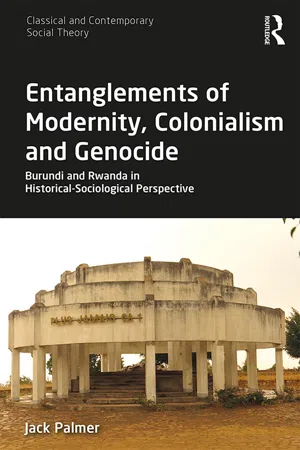
Entanglements of Modernity, Colonialism and Genocide
Burundi and Rwanda in Historical-Sociological Perspective
- 214 pages
- English
- ePUB (mobile friendly)
- Available on iOS & Android
eBook - ePub
Entanglements of Modernity, Colonialism and Genocide
Burundi and Rwanda in Historical-Sociological Perspective
About this book
Information
Part I
Modernity, colonialism, genocide
1 Genocide and colonialism
At this point, it is necessary to elucidate what is meant by two key terms to be employed throughout this book, genocide and colonialism, and to address some conceptual and normative problems that any study of them cannot avoid. I will treat genocide and colonialism in turn. I then turn to a discussion of recent historical scholarship in genocide studies on the entanglements of genocide and colonialism. This will pave the way for their incorporation into the theorisation of the concept of the multiplicity of modernity to follow in Chapter 2.
Genocide
Moral, political and legal dimensions of genocide
A consideration of the literature in genocide studies and broader debates concerning violence in contemporary societies immediately raises definitional difficulties. The first problem arises when trying to distinguish genocide as an observable event from a moral-historical concept. Though its moral and empirical components may be separable analytically, in practice the definition of genocide is not simply a neutral designation of a factual category. It is a moral act, always situated in highly charged political contexts. To declare genocide is to declare evil.
The practice of genocide, it has been argued, has been facilitated by the institutional features of modern societies and has often been committed with a future-orientation, in the names of progress, revolution, liberation and nation (Bauman, 1989; Stone, 1999, 2004b; Eisenstadt, 2000, 2005a, 2005b; Levene, 2005a, 2005b; Mann, 2004; Bloxham, 2008; Moses, 2008a, 2008b; Shaw, 2013). Less acknowledged, however, is that the concept of genocide must also be seen as a phenomenon of modernity. The concept of genocide gave a name to a crime that has been a perennial aspect of human history (Sartre, 1968:13; Eisenstadt, 2005a:635; Bloxham and Moses, 2010:chs 12–16) and it posited that this crime could in principle be prevented or even eradicated in a future shaped by human intervention, in the name of peace.
The most vivid institutional expression of this future-orientation is the Convention on the Prevention and Punishment of the Crime of Genocide (1948). The preamble to the Convention promises to ‘liberate mankind from … an odious scourge’ that has ‘inflicted great losses on humanity’ and is ‘condemned by the civilised world’. Genocide itself is defined as:
any of the following acts committed with intent to destroy, in whole or in part, a national, ethnical, racial or religious group, as such: (a) Killing members of the group; (b) Causing serious bodily or mental harm to members of the group; (c) Deliberately inflicting on the group conditions of life calculated to bring about its physical destruction in whole or in part; (d) Imposing measures intended to prevent births within the group; (e) Forcibly transferring children of the group to another group.
It is well-known that this definition developed from the work of the legal scholar, Raphael Lemkin. Genocide, like the concepts of war crimes, crimes against peace and crimes against humanity, was a product of a very recent period in human history that saw the development of international legal norms and human rights law (Schabas, 2009:18). Prior to this, what we today call genocide was typically seen as by-product of war or colonial conquest, overwhelmingly committed under state direction.1 The definition of genocide here was incorporated (alongside crimes against humanity, war crimes and the crime of aggression) into the Rome Statute of 1998 which outlined the aims and orientations of the International Criminal Court (ICC). The ICC came into force on 1 July 2002, following the establishment of ad hoc international criminal trials for Yugoslavia (ICTY) and Rwanda (ICTR). The ICTR was the first major international trial to prosecute defendants for genocide since the Holocaust2 (May, 2010:5) and it employed the same definition of genocide as appears in the Convention (UN Security Council, 1994).
While a legal definition helps us to interpret culpability for genocide or to demonstrate that genocide has taken place, it does not explain or aid understanding of why or how genocide occurs. Furthermore, various elements of the definition in the Convention are problematic from a sociological perspective. The nature and definition of ‘intent’, extremely difficult to establish in terms of prosecution, raises a number of difficulties relevant to the sociological categories of individual and collective action. There are also controversies surrounding the notion of ‘groups’, both in terms of how groups are socially constituted and the omission of important categories. Political groups, as distinct from national, ethnic or religious groups, were excluded from the Convention, despite being frequent targets of state violence (Snyder, 2010:53, 413; Feierstein, 2014:29–31). Gender identities and socio-economic classes are also omitted.3 Problems also arise from the fact that the practice of genocide is always a vast, collective undertaking involving large-scale societal coordination but whose prosecution necessarily aims at establishing individual culpability (May, 2010:7).
Martin Shaw (2007b) has convincingly demonstrated Lemkin’s definition was far more sociological than its later iteration in the Convention suggests. Contrary to contemporary popular understandings, genocide involved much more than mass killing for Lemkin4:
The term does not necessarily signify mass killings although it may mean that. More often it refers to a coordinated plan aimed at destruction of the essential foundations of the life of national groups so that these groups wither and die like plants that have suffered a blight. The end may be accomplished by the forced disintegration of political and social institutions, of the culture of the people, of their language, their national feelings and their religion. It may be accomplished by wiping out all basis of personal security, liberty, health, and dignity. When these means fail the machine gun can always be utilised as a last resort.(Lemkin, 2009 [1945]:6)
Furthermore, the Convention definition de-emphasises genocidal expulsions, often referred to as ‘ethnic cleansing’. Lemkin’s definition was intimately concerned with space: genocide explicitly meant the destruction of a particular group within a given territory. However, violent population removal was not incorporated into the Convention (Schabas, 2000a:196), an omission that is partly attributable to the context of realpolitik at the time when the Convention was being drafted and ratified. In the aftermath of the Second World War, enormous numbers of ethnic Germans were forcibly removed from Soviet-controlled Central and Eastern Europe, and millions were displaced in the partition of India as well as in the Middle East following the establishment of the state of Israel, each under the auspices of prominent international powers (Snyder, 2010:413; Shaw, 2013:78–89).
International political tensions have also shaped the interdisciplinary literature in genocide studies. In spite of its clear contribution to the task of understanding and preventing genocide, genocide studies has since its emancipation from Holocaust historiography in the 1980s been marked by a Historikerstreit5 centred on how events other than the Holocaust ought to be situated. For some, trying to understand the Holocaust in comparative terms with other genocides is an unacceptable denial of its unique evil. For many more, it is implicitly or explicitly posited as the ideal typical case of genocide against which others’ genocidality should be measured.6 Even for Zygmunt Bauman – who argued against the presentation of the Holocaust as a unique and particular event in Jewish–German relations which makes it ‘comfortably uncharacteristic and sociologically inconsequential’ and belittles its significance for ‘sociology as the theory of civilisation, of modernity, of modern civilisation’ (1989:1) – the Holocaust is uniquely modern.7
This has resulted in a situation whereby a large proportion of work has been produced with the political aim of recognition, of ascertaining whether or not a particular event or set of events constitutes genocide (Shaw, 2013:25). In this sense, genocide studies reflects transnational debates about how traumatic events and processes, such as the histories of Atlantic slavery and European colonial-imperialism, ought to be memorialised vis-à-vis the Holocaust. The crime of genocide is considered morally unique – the ‘crime of crimes’ – and it is thus very much imbricated in broader communal struggles for the recognition and memorialisation of historical suffering and atrocities experienced and interpreted by collective identities (Fraser, 2000; Schabas, 2009:11–12; Wieviorka, 2012:8).
This evokes the paradoxical relationship between the universalising and particularising dynamics of what Jeffrey Alexander (2009, 2012) terms ‘cultural trauma’. For Alexander, the memorialisation of the Holocaust has a universalising thrust, in that it involves a process of making a specific historical event affecting a particular community a model for much broader processes of ethical commemoration and reconstruction. Notwithstanding critiques of the spectatorial voyeurism of what some see as the assimilation of the Holocaust into the ‘culture industry’ (Finkelstein, 2000; Wood, 2010), this raises the question of how to understand those fiercely particularistic forms of collective memory which feed into narratives of exceptionalism and material practices of securitisation and pre-emptive defence. In his superb account of the intertwined development of Lemkin’s concept of genocide and Hersch Lauterpacht’s concept of crimes against humanity, Phillipe Sands (2016:183) wonders whether the concept of genocide reproduces the same ‘group-thinking’ that lies at the root of the practice of genocide. Indeed, one of the most sobering paradoxes of the legacy of the twentieth century, which has been called the ‘century of genocide’ (Weitz, 2003; Totten et al., 2009), is that the declaration of ‘Never Again’ which underpinned the ratification of the 1948 genocide convention has been invoked just as often as a call to arms as it has been a call for preventative awareness.8
Burundi and Rwanda are illustrative cases. As I shall demonstrate in Chapter 6, post-independence genocide cannot be sufficiently understood without consideration of how perpetrators’ perceptions of historical injustices and evil inform their collective identity. A significant number of Burundian Hutu refugees in Rwanda were among the participants in the genocide perpetrated against Tutsi in Rwanda in 1994 (Des Forges, 1995:197). These refugees had fled inter-ethnic massacres in the wake of the 1993 Tutsi-led coup and murder of Melchior Ndadaye, the first democratically elected (Hutu) president of Burundi, itself perceived as a replay of the 1972 genocide against Hutu (Malkki, 1995; Lemarchand, 2009:75). Furthermore, there is strong evidence that the Rwandan Patriotic Front (RPF), the current governing force of Rwanda whose seizure of power stopped the 1994 genocide, has presided over genocidal atrocities in eastern Congo – in the name of securitising Hutu refugee camps – in the years after the genocide (United Nations High Commissioner for Human Rights, 2010; Lemarchand and Reyntjens, 2011; Okosan and Kibiswa, 2013). The RPF themselves invaded Rwanda in 1990 from southern Uganda, where they had been in exile since the anti-Tutsi violence which accompanied the 1959 Rwandan social revolution, beginning the civil war which culminated in the 1994 genocide.
The forced movement of people in the region, and the movement of cultural trauma with them, thus compels us to move beyond narrow interpretations focused on spontaneous eruptions of violence contained within nation states. In Burundi and Rwanda, genocide and ethnic violence have often been the culmination of a ‘rational’, if often delusional and paranoid, security decision made by the perpetrators, and the subsequent mobilisation of a retributive response by a fearful section of a population against a perceived external threat. The targets are defined as both outside and within national borders. Genocide is connected to the logic of counter-insurgency and, certainly in the cases of Burundi and Rwanda, has tended to be embedded in regional systems of international relations (Lemarchand, 2009; Shaw, 2013; Jones, 2014).
Clearly, then, there are problems of value- and political-orientation inherent in any study of genocide. I claim that it is desirable and possible, to a degree, to attempt to reflexively disentangle or detach oneself from these orientations. My concern is not with contributing a neglected case to a taxonomy of violence or with furthering specific causes in competitive terms with better memorialised cases, worthwhile as these pursuits may be on the civic stage. Rather, inasmuch as the book is a contribution to genocide studies, it is an attempt to understand the various and specific ways in which genocidal violence was experienced throughout the nineteenth and twentieth centuries, situated in broader experiences of entangled routes to and through modernity. I propose that this constitutes a way of doing justice to the specificity of genocide and genocidal violence in Burundi and Rwanda. They are not unique, singular or incomparable instances and neither are they reducible to nomothetic historical laws; rather they are specific events entangled in various broader historical processes of racism, colonial-imperialism and nation-building (Moses, 2002:28; Stone, 2004b:127; Lentin, 2008:494). Subsequently, there is a strong affinity, I suggest, between the emphasis on the multiplicity of modernity and the practice of what has been called ‘multidirectional memory’ (Rothberg, 2009; Silverman, 2013).
Distancing, process reduction and concept reduction
We still have to arrive at a workable definition of genocide. In order to do so, I will present a brief critique of two tendencies which I label ‘process reduction’ and ‘concept reduction’. Process reduction, discussed by Norbert Elias (1978:113–116), refers to the reification of social processes to the extent that they take on the status of a static, isolated object in a state of rest. For my purposes, it is encapsulated by the idea that genocide is solely an ‘event’, detached from the processes that precede it, and thus appears as an extraordinary action well outside the realm of ‘ordinary’ social practices. Concept reduction, a term which I borrow from the philosophy of science (Bunge and Mahner, 1997), refers to the notion that genocide is identical with the processes from which it emerges.9
My main critique in terms of process reduction is aimed at a prominent conception of genocide which is marked by methodological nationalism and associates genocide with stigmatised populations construed as ‘distant’ from the West in various ways (Kressel, 1996; Power, 2002; for critique see Moses, 2008c). In spatial terms, this distance is produced by the assumption that genocides typically occur in faraway ‘local’ contexts, and that globality is only relevant in terms of whether developed ‘Western’ states or international organisations ought to intervene to stop these ‘local’ genocides (Meister, 2012). Genocide is presented as an evil of ‘bad’ countries – ‘failed states’ – rather than as an event, emergent in a given context from the entanglement of various processes and structures operating both within and across state boundaries. Important here, as Burundi and Rwanda demonstrate, are historical colonial relationships and their persistence in ‘coloniality’ (Maldonado-Torres, 2007; Mignolo, 2012; Ndlovu-Gatsheni, 2013) after the formal event of independence, as well as global economic institutions such as the World Bank, the power blocs of the Cold War, international political and legal institutions, NGOs and development assistance and arms trade networks. Process reduction also distances genocide in temporal terms. Genocides are deemed to happen in places at an earlier, or ‘backward’, stage of modernisation. They are commonly referred to in terms of ‘ancient tribal hatreds’ and other descriptors that suggest timelessness. This produces what Johannes Fabian (1983) called a ‘denial of coevalness’. The violent histories of the ‘developed’ nation-states from which these discourses tend to emanate, particularly in the context of colonial-imperialism, are deemed to be firmly in the past, if not ignored altogether. In this sense, the effect of spatio-temporal distancing is that genocide appears as a phenomenon that is far away and long ago.
Distancing is also produced in the very constitution of genocide studies. The specialisation of genocide studies has led to a separation between mainstream social-scientific research and social theorising and the substantive topic of genocide (Bauman, 1989; Bauman and Weltzer, 2002:105). The comparative method that is dominant in genocide studies, and the endeavour to construct a trans-historical and nomothetic general theory of genocides across a wide array of cases, also produces a form of distance. As Martin Shaw (2013:31) has suggested, ‘comparative genocide studies has … got badly stuck with the idea that what it is studying are discrete “genocides”’. This is quite straightforward in terms of the present book: the Rwandan genocide in 1994 is frequently treated without reference to the aforementioned regional context, including Burundi (e.g. Powell, 2011:ch. 7; Sagall, 2013:ch. 8).10
The effort to construct trans-historical and global theories of genocide tends to privilege a certain kind of genocidal violence that fits into pre-defined typologies. These cases are typically what Mark Levene (2005a:163) calls ‘mega-genocides’, referring to frequently discussed cases like the Holocaust, Armenia, Rwanda and Cambodia. More ‘contentious’ cases, such as the genocides in Burundi or Indonesia in 1965, are typically not included in these accounts, for various reasons including political expediency, conceptual fuzziness and historical amnesia (Lemarchand, 2011b; Hinton et al., 2013).
The pursuit of ‘hard knowledge in the form of universal laws with predictive potential’ so that genocide can be mapped ‘in the manner of a mathematical equation’ (Moses, 2008c) also tends to engender an overly deterministic view of history which downplays both contingency and human creativity. In the words of the philosopher of creativity, Cornelius Castoriadis (1997b:4):
Determinacy leads to the negation of time, to atemporality: if something is truly determined, it is determined since always and forever. If it changes, the ways in which it can change and the forms that this change can bring about are already determined. Then ‘events’ only realize laws, and ‘history’ is but the unfolding along a fourth dimension of a ‘succession’ that, for an Absolute Mind (or for the accomplished scientific theory), would only be coexistence. Time is then sheer repetition, if not of ‘events’, then of the instantiations of laws.
The quest for a definitive theory of genocide and the genocidal process, to paraphrase Hannah Arendt (1967 [1951]), necessarily deduces the present from the past and as such is always potentially blindsided by the unprecedented. This is not a defeatist declaration that genocide cannot be prevented or that its processes might not be better understood and intervened in. Rather it is to say that und...
Table of contents
- Cover
- Half Title
- Title Page
- Copyright Page
- Dedication
- Table of Contents
- Acknowledgements
- Introduction
- PART I: Modernity, colonialism, genocide
- PART II: Entangled routes to and through modernity
- Conclusion
- Index
Trusted by 375,005 students
Access to over 1.5 million titles for a fair monthly price.
Study more efficiently using our study tools.
Frequently asked questions
Yes, you can cancel anytime from the Subscription tab in your account settings on the Perlego website. Your subscription will stay active until the end of your current billing period. Learn how to cancel your subscription
No, books cannot be downloaded as external files, such as PDFs, for use outside of Perlego. However, you can download books within the Perlego app for offline reading on mobile or tablet. Learn how to download books offline
Perlego offers two plans: Essential and Complete
- Essential is ideal for learners and professionals who enjoy exploring a wide range of subjects. Access the Essential Library with 800,000+ trusted titles and best-sellers across business, personal growth, and the humanities. Includes unlimited reading time and Standard Read Aloud voice.
- Complete: Perfect for advanced learners and researchers needing full, unrestricted access. Unlock 1.5M+ books across hundreds of subjects, including academic and specialized titles. The Complete Plan also includes advanced features like Premium Read Aloud and Research Assistant.
We are an online textbook subscription service, where you can get access to an entire online library for less than the price of a single book per month. With over 1.5 million books across 990+ topics, we’ve got you covered! Learn about our mission
Look out for the read-aloud symbol on your next book to see if you can listen to it. The read-aloud tool reads text aloud for you, highlighting the text as it is being read. You can pause it, speed it up and slow it down. Learn more about Read Aloud
Yes! You can use the Perlego app on both iOS and Android devices to read anytime, anywhere — even offline. Perfect for commutes or when you’re on the go.
Please note we cannot support devices running on iOS 13 and Android 7 or earlier. Learn more about using the app
Please note we cannot support devices running on iOS 13 and Android 7 or earlier. Learn more about using the app
Yes, you can access Entanglements of Modernity, Colonialism and Genocide by Jack Palmer in PDF and/or ePUB format, as well as other popular books in Social Sciences & Sociology. We have over 1.5 million books available in our catalogue for you to explore.