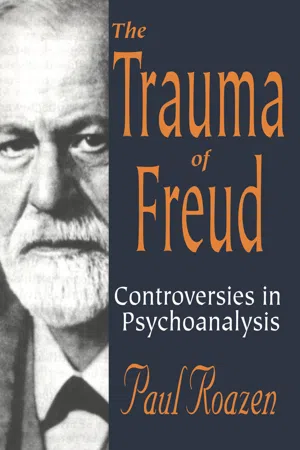
Over one hundred years have passed since Sigmund Freud first created psychoanalysis. The new profession flourished within the increasing secularization of Western culture, and it is almost impossible to overestimate its influence. Despite its traditional aloofness from ethical questions, psychoanalysis attracted an extraordinary degree of sectarian bitterness. Original thinkers were condemned as dissidents and renegades and the merits of individual cases have been frequently mixed up with questions concerning power and ambition, as well as the future of the "movement." In The Trauma of Freud, Paul Roazen shows how, despite this contentiousness, Freud's legacy has remained central to human selfawareness.Roazen provides a much-needed sequence and perspective on the memorable issues that have come up in connection with the history of Freud's school. Topics covered include the problem of seduction, Jung's Zurich school, Ferenczi's Hungarian following, and the influence of Melanie Klein and Anna Freud in England. Also highlighted are Lacanianism in France, Erik Erikson's ego psychology, and Sandor Rado's innovations. In considering these historical cases and related public scandals, Roazen continually addresses important general issues concerning ethics and privacy, the power of orthodoxy, creativity, and the historiography of psychoanalysis. Throughout, he argues that rival interpretations are a sign of the intellectual maturity and sophistication of the discipline. Vigorous debate is healthy and essential in avoiding ill-considered and dogmatic self-assurance.He observes that potential zealotry lies just below the surface of even the most placid psychoanalytic waters even today. Examining the past, so much a part of the job of scholarship, may involve challenging those who might have preferred to let sleeping dogs lie. Roazen emphasizes that Freud's approach rested on the Socratic conviction that the unexamined life is not worth living and that this constitutes the spiritual basis of its influence beyond immediate clinical concerns. The Trauma of Freud is a major contribution to the historical literature on psychoanalysis.
- 301 pages
- English
- ePUB (mobile friendly)
- Available on iOS & Android
eBook - ePub
The Trauma of Freud
About this book
Information
1
The Problem of Seduction
The first controversy I would like to discuss is that connected with what has come to be known as the “seduction theory,” even though Freud never advanced anything under that specific title. Curiously enough this is a dispute whose literature has only proliferated relatively recently. At the time it first took place, especially in the 1890s and the first decade of the twentieth century, Freud’s views about seduction must have had a major impact on the standing his work had among his immediate contemporaries. But it is only in the last two decades that this subject, dating from the beginnings of psychoanalysis, has become of central historical concern.
Freud’s 1897 abandonment of the theory he had first held in the mid-1890s, which attributed central significance in the origin of neuroses to the sexual seduction of children, is generally considered momentous enough that both his devoted friends and ardent foes consider that to be the time when psychoanalysis as a distinct entity arose. Thanks to the survival of Freud’s correspondence then to his intimate friend Wilhelm Fliess we have an unusual contemporaneous record of the workings of Freud’s professional thought processes. It is true that whether one reads Freud’s letters as a young man, or those composed during the most painful years of old age, he continues to sound very much like he was during the phase which has come to be known as the Fliess period. Freud was perhaps emotionally freer in writing to Fliess than he was in his more guarded later years, but the overall continuities and consistencies stand out.
Freud’s official biographer Ernest Jones thought that the fall of 1897, when Freud first wrote Fliess about the collapse of his own confidence in his seduction hypothesis, “was a turning point in his scientific career,” and most students of the field would agree with Jones’s assessment. Jones, however, took a propagandists view when he maintained that the crisis connected with the abandonment of the seduction theory “tested his integrity, courage and psychological insight to the full. Now he had to prove whether his psychological method on which he had founded everything was trustworthy or not. It was at this moment that Freud rose to his full stature.”1
Freud had characteristically abruptly changed his mind in such a way that he was able to minimize self-criticism, although others, including his patients, were not to escape blame. Freud, feeling more right than ever, plunged almost immediately into his theory of the Oedipus complex, and it may not be surprising that Fliess, usually stigmatized only as a wild thinker, decided initially to remain silent about Freud’s version of the significance of the Oedipus story.
We can get something of the range of opinion about this incident in which Freud gave up his central emphasis on childhood seduction if we remember, first, that Jones felt that “1897 was the acme of Freud’s life.”2 Ronald Clark, unlike Jones an outside biographer, called his chapter about this incident “Splendid Isolation: Disaster.”3 And Jeffrey M. Masson subtitled a whole book “Freud’s Suppression of the Seduction Theory,” as Masson alleged Freud’s cowardice in the face of contemporary medical criticism.4 There was weighty significance to Masson’s notion that Freud had suppressed rather than abandoned his early concept, and the difference in words gives an idea of what a curious world psychoanalytic history can be. All objects of devotion, religions in both the best and least attractive senses, lead to others becoming embroiled in terminological disputes which are bound to seem incomprehensible to impartial observers.
No one can know the exact frequency of the dreadful occurrence of the sexual abuse of children, either in Freud’s time or our own, yet to argue as Freud did, in writing to Fliess in April of 1896 and in a 1896 paper, that Freud had discovered the equivalent of the source of the Nile, now looks to many as off the wall. It is not surprising that Freud’s 1896 professional audience, before whom he presented a memorable paper on the origins of hysteria, should have given him in his words “an icy reception,” or that the famous psychiatrist-sexologist Richard von Krafft-Ebing should have reportedly observed of Freud’s theory, “It sounds like a scientific fairy-tale.” Freud wrote Fliess about what had happened, and said that such skeptics were “asses” who could “go to hell, euphemistically expressed.”5
Yet Freud jumped headlong, after giving up his seduction theory, only a little more than a year after this, to a conviction about the Oedipus complex which he held tenaciously to the end of his life. It has taken almost a hundred years of psychoanalytic revisionists who have sought to alter Freud’s own mature commitments to succeed in amending his version of oedipal emotions. In his last years he accepted the concept of the pre-Oedipus phase of childhood thinking, but I doubt that many reasonable outsiders would be likely to share our own respect, as historians of ideas, for the intricacies of those who have consciously or unconsciously labored to change Freud’s ideas so as not to be excommunicated from the fold of the faithful.6
My own tack will be to try and approach this whole matter in the spirit of intellectual history; detachment seems to be relatively out of fashion these days, yet it remains, I think, a necessary scholarly ideal. It is always easy to make past figures look ridiculous in their thinking by the mere passage of time, but my objective is not to damage the reputations of any psychoanalytic pioneer, much less Freud himself. He initiated a revolution in ideas about human nature which continues to influence how we think about motives and feelings; studying his work, alongside that of his followers and rivals, is incumbent on anyone who wants to make sense of some of the most deeply contested controversies of the twentieth century. But I readily acknowledge, just as in reflecting on other historical or theological disputes, that it can take restraint not to smirk at some of the curious belief systems that were once entertained.
Freud’s central publication on the sexual seduction of children was his 1896 “The Aetiology of Hysteria.” But earlier that same year he had published an article “Further Remarks on the Neuro-psychoses of Defence,” the first section of which was devoted to the problem of hysteria; Freud’s introductory remarks should be enough to alert one to the dangers of any infallibilistic ways of reasoning. Psychoanalysis was, he held, a “laborious but completely reliable method,” one which he had used in making “investigations” which also constituted “a therapeutic procedure.”7 Even after Freud repudiated the theories he once expressed about hysteria (and seduction supposedly had played a central part in obsessions and psychoses as well) Freud clung to the firmest conviction about the reliability of his methods. He waited until 1906 to acknowledge publicly, in qualified terms, that he had changed his mind, nine years after confiding with Fliess about it in private. It never seems to have dawned on orthodox Freudians that Freud’s initial reasoning had provided realistic grounds for the iciness of the reaction to his 1896 ideas. And by waiting so long to express his new position, I believe that Freud had helped damage his own professional standing in Vienna. His early campaign in 1884 on behalf of the supposedly safe medical uses of cocaine (which may well be the first of the many controversies in Freud’s career8) left him exceptionally exposed to further medical criticism.
It is, I think, greatly to Freud’s credit that he was struggling to get beyond the therapeutic nihilism that can be associated with an exclusive concentration on hereditary factors. Many of the same problems about nature versus nurture continue to arise in today’s contemporary clinical practice. Further, Freud was on a pathbreaking course in trying to penetrate, as a psychologist, behind patients' symptoms to their causes. In 1896 Freud was still, and this would last up to 1914, relying on the authority of his Viennese mentor Josef Breuer, even though their collaboration had come to an end by 1894. Freud, in fact, came to loathe Breuer in private, yet cited him approvingly long after their falling out. The whole relationship between Freud’s personal thoughts as opposed to his public behavior is a complicated subject in itself; Henry James memorably understood the naive American confusion and moralistic awe, a set of emotions that I happen to share, in the face of the complexities of European manners.9
Hysterical symptoms, Freud had maintained, cannot arise from reality alone, "but... in every case the memory of earlier experiences awakened in association to it plays a part in causing their symptoms.”10 For years afterwards Freud continued to be, from today’s perspective, too insistent on looking for a traumatic scene that might prove curative when recalled, but his overall concern with memories marked him from the outset as preeminently a psychologist.
Freud pulled no punches about the centrality of sex in his 1896 paper on hysteria: "in the end we infallibly come to the field of sexual experience.”11 He cited eighteen cases to support his position. (Jones was such a blind proponent of Freud’s that he did not seem to realize how he was endangering Freud’s position by the claim that these were “fully analyzed cases,”12 whatever that hyperbole might be taken to mean.)
Freud was unusually persuasive as a writer in part because he anticipated possible objections. And he raised the point that what might have happened is that he had forced “such scenes upon his docile patients, alleging that they are memories, or else that the patients tell the physician things which they have deliberately invented or have imagined and that he accepts those things as true....” Freud took comfort from the fact that “only the strongest compulsion of the treatment can induce them to embark on a reproduction” of the childhood scenes. Nor did he shy away from saying, in his own behalf, that the patients had “no feeling of remembering” such childhood traumas. “Why should patients,” he asked, “assure me so emphatically of their unbelief, if what they want to discredit is something which — from whatever motive — they themselves have invented?”13
Fliess knew Freud well enough, and understood enough about the impact of the psychoanalytic treatment setting as conducted by Freud, to propose later (in Freud’s words) that “the reader of thoughts merely reads his own thoughts into other people,” a proposition which Freud felt rendered all his “efforts valueless,”14 and one of the central grounds for Freud breaking their friendship. One can imagine that Fliess could not jump through each new hoop as rapidly as Freud could hold them up, and it ought not to be surprising if Freud’s reversal on the score of seduction tarnished the standing Freud’s method could have for Fliess.
Still it is noteworthy that in Freud’s 1896 paper he had proposed to cure hysteria “by transforming ... unconscious memories of the infantile scenes into conscious ones.” Such a procedure, once detached from the quest for the finite memories of specific experiences, comes close to what modern psychotherapy, with the aim of heightened awareness, would be interested in. Freud attributed to hysterics “a general abnormal sensitivity to stimuli,” a “high degree of readiness to feel hurt on the slightest occasion,” which he attributed in part to “a physiological basis.” Freud concluded his paper by asking that his concrete conclusions be accorded less attention than the procedure he was introducing. That “new method of research,” exploring “processes of thought which have remained unconscious,” was recommended by Freud as a “new pathway to knowledge” that even psychiatry would benefit from.15 (Freud’s own training was in neurology, a field in Vienna which was distinct from psychiatry.)
In 1905 Freud began publicly, if guardedly, to retract his seduction theory, presumably in a way that his methodology could survive intact. I am not suggesting that Freud was proceeding with dishonest intent; rather, he was so committed to the neutral validity of his approach that I think he really believed that reversing himself on seduction need not cast doubt on the validity of his method for arriving at what he called his “findings.” In the course of his Three Essays on the Theory of Sexuality, Freud brought up the sensitive issue of his 1896 proposal about the central role of seduction:
I cannot admit that in my paper on “The Aetiology of Hysteria” I exaggerated the frequency or importance of that influence, though I did not then know that persons who remain nomai may have had the same experiences in their childhood, and though I consequently overrated the importance of seduction in comparison with the factors of sexual constitution and development.
After having claimed what he could not “admit,” it seems to me that Freud immediately went on to do just that. “Obviously,” he concluded with the hindsight of his new conviction about the significance of infantile sexuality, “seduction is not required in order to arouse a child’s sexual life; that can also come about spontaneously from internal causes.”16
Then ...
Table of contents
- Cover
- Half Title Page
- Title Page
- Copyright Page
- Dedication
- Contents
- Preface
- 1 The Problem of Seduction
- 2 Carl Gustav Jung: The Zurich School
- 3 Sandor Ferenczi: The Budapest School
- 4 Kleinianism: The English School
- 5 Anna Freudian
- 6 Ethics and Privacy
- 7 The Power of Orthodoxy
- 8 Lacanianism
- 9 Erikson’s Ego Psychology
- 10 Jackson Pollock and Creativity
- 11 The History of Psychotherapy
- 12 Public Scandal
- 13 Sandor Rado
- Conclusions: A Plea for Toleration and the Future
- Index
Trusted by 375,005 students
Access to over 1.5 million titles for a fair monthly price.
Study more efficiently using our study tools.
Frequently asked questions
Yes, you can cancel anytime from the Subscription tab in your account settings on the Perlego website. Your subscription will stay active until the end of your current billing period. Learn how to cancel your subscription
No, books cannot be downloaded as external files, such as PDFs, for use outside of Perlego. However, you can download books within the Perlego app for offline reading on mobile or tablet. Learn how to download books offline
Perlego offers two plans: Essential and Complete
- Essential is ideal for learners and professionals who enjoy exploring a wide range of subjects. Access the Essential Library with 800,000+ trusted titles and best-sellers across business, personal growth, and the humanities. Includes unlimited reading time and Standard Read Aloud voice.
- Complete: Perfect for advanced learners and researchers needing full, unrestricted access. Unlock 1.5M+ books across hundreds of subjects, including academic and specialized titles. The Complete Plan also includes advanced features like Premium Read Aloud and Research Assistant.
We are an online textbook subscription service, where you can get access to an entire online library for less than the price of a single book per month. With over 1.5 million books across 990+ topics, we’ve got you covered! Learn about our mission
Look out for the read-aloud symbol on your next book to see if you can listen to it. The read-aloud tool reads text aloud for you, highlighting the text as it is being read. You can pause it, speed it up and slow it down. Learn more about Read Aloud
Yes! You can use the Perlego app on both iOS and Android devices to read anytime, anywhere — even offline. Perfect for commutes or when you’re on the go.
Please note we cannot support devices running on iOS 13 and Android 7 or earlier. Learn more about using the app
Please note we cannot support devices running on iOS 13 and Android 7 or earlier. Learn more about using the app
Yes, you can access The Trauma of Freud by Paul Roazen in PDF and/or ePUB format, as well as other popular books in Psychology & History & Theory in Psychology. We have over 1.5 million books available in our catalogue for you to explore.