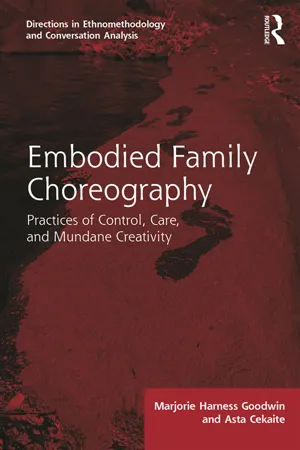
Embodied Family Choreography documents the lived and embodied practices employed to establish, maintain, and negotiate intimate social relationships in the family, examining forms of control, care, and creativity. Making use of the extensive video archives of family interaction in the US and Sweden, it presents the first investigation of how touch and interaction between bodies, in conjunction with talk, constitute a primary means of orchestrating activities through directives, thus creating rich relationships through supportive interchanges, and engaging in playful explorations of the world. Through close investigation of the sequential and simultaneous engagement of bodies interacting with other bodies, this book makes visible the important role touch plays in the context of contemporary Western middle class family life and is pioneering in its analysis of how the visual, aural, and haptic senses (usually analysed separately) mutually elaborate one another. As such, Embodied Family Choreography will appeal to scholars of child development, the sociology of the family and ethnomethodology and conversation analysis.
eBook - ePub
Embodied Family Choreography
Practices of Control, Care, and Mundane Creativity
- 290 pages
- English
- ePUB (mobile friendly)
- Available on iOS & Android
eBook - ePub
Embodied Family Choreography
Practices of Control, Care, and Mundane Creativity
About this book
Information
Part I
Control
Directive/response trajectories
3
Directive response sequences
3.1. Creating social inhabitants through directives
Shaping of children as particular kinds of social inhabitants and actors in the family, members who are responsible and accountable within an organization that is intrinsically differentiated by age and hierarchy, involves complex and, at times, contradictory social aims and endeavors. While developing children’s behavioral, moral, and social competencies and accomplishing practical tasks, a social ambience of love and affection needs to be preserved.
Directives as actions for getting things done
Central to the task of working out how to foster accountable actors is the process of “getting things done” (Aronsson & Cekaite, 2007). For more than 40 years, we have been investigating the organization of directives – the particular constructions and practices used for getting someone else to do something. Indeed, of the many activities that occur in everyday life, directives provide the central locus for constituting local social order. Different choices among various directive and other communicative practices create different types of social actors, social organizations, and alignments (M. H. Goodwin, 1980a; M. H. Goodwin, 1990b; Cekaite, 2012; Cekaite et al., 2014). We analyze the practices that families make use of by examining the so far largely unexplored embodied and temporal character of directive trajectories.
The term “directive” has many usages in work in social science. It has been employed by sociologists such as Lareau (2003) to differentiate working-class from middle-class parental styles: “[Working class] parents tend to use directives: they tell their children what to do rather than persuading them with reasoning” (Lareau, 2003, p. 3). Lareau uses the term “directive” to refer to imperative forms that control the behavior of the child in opposition to requests accompanied by accounts that persuade. Linguists and conversation analysts make similar distinctions, differentiating “requests,” actions through which “we seek the help of another in doing or managing things that we could not do, or could not so easily do, or would prefer not to do, by ourselves” (Drew & Couper-Kuhlen, 2014a, p. 2) from directives, or “forms that have the pragmatic function of controlling the behavior of another” (Drew & Couper-Kuhlen, 2014a, p. 8) (as in asymmetrical relations between parents and children).
In the analysis of requesting, some conversation analysts now use the term “recruitment” (Kendrick & Drew, 2016) to refer to the linguistic and embodied ways in which assistance can be sought (requested or solicited). Work on recruitment (Floyd et al., 2014; Floyd, Rossi, & Enfield, in preparation) deals with how adults solicit help from another to resolve difficulties, given hypothesized shared orientations to altruism, cohesion, and affiliation (Lindstrom & Sorjonen, 2013) in social interaction. In the data we examine in this book, we are less concerned with requests for soliciting help than with how parents and children achieve collaboration in tasks and practical actions. We note that children’s responsibilities are at times accomplished with considerable verbal intensity and force (as well as tactile coercion), as will be discussed in Chapter 3.
Directive trajectories
A variety of forms of social organization between participants can be established through ways in which speakers format directives (Drew & Couper-Kuhlen, 2014b), utterances designed to get someone else to do something (Austin, 1962; Blum-Kulka, 1997; Ervin-Tripp, 1976; Labov & Fanshel, 1977), and recipients sequence their next turns. M. H. Goodwin (1980a; M. H. Goodwin, 1990b) demonstrated that in comparable task activities, the precise linguistic resources (syntax and subject pronoun use) employed to build directives constitute very different kinds of social organization in children’s peer groups (for example, hierarchical versus egalitarian social structures). A bald imperative form such as “Gimme the pliers!” or “Go down there now!” displaying the speaker’s entitlement contrasted with a declaratives with modal verbs such as “We could use a sewer” or “Maybe we can slice them like that.” Hortative sentences that express strong encouragement for someone to do something use inclusive first-person plural pronouns as in utterances such as “Let’s move these out first!” or “We gotta clean’em.” The social force of a directive, as well as its emotional valence, is also heavily shaped through the deployment of resources such as prosody and embodiment (Goodwin & Cekaite, 2014; Goodwin & Goodwin, 2000).
Directive response sequences occur in trajectories of action. Sacks (1995b, p. 331) in his lecture “Poetics: Requests, Offers, and Threats: The ‘Old Man’ as an Evolved Natural Object” urges us to consider the objects “offer, request warning, threat – not as though they’re a series of different things, but to see them as sequential versions of a something.” Moving from a variety of offers to a request and threat implicates a changing set of “operative identities” (Sacks, 1995b, p. 327) for a 70-year-old man whose children present ever-more-forceful actions urging of him to eat. As Sacks (1995b, p. 330) argues, the stubborn old man that Max becomes, that his children have to take care of, “is an identity that the sequence brings into focus.” We consider the life history of a directive situated within a trajectory of action to be crucial. By focusing on trajectories of directive/response sequences, we can examine the practices through which child and parent co-construct local identities.
The family constitutes a universal social form in which members of a society are socialized through and to language use (Ochs & Schieffelin, 1984). This includes learning how to give and receive a range of directive forms, central to the organization of everyday tasks and interaction among family members (Aronsson & Thorell, 1999). While some forms display forms of entitlement (of the speaker to issue them) (Curl & Drew, 2008; Fox & Heinemann, 2016), directness (Brown & Levinson, 1987), or “aggravation” (Labov & Fanshel, 1977, pp. 84–86) (“Get up, Get themarkers, Get in theshower. Rightnow”), others are produced as “mitigated” (Labov & Fanshel, 1977, pp. 84–86), polite, or “contingent” (“Shall we?”). Because tasks in the home, like moves in games of jump rope (M. H. Goodwin, 1985) or hopscotch (M. H. Goodwin, 2006a) or doctor–assistant interaction (Ervin-Tripp, 1976, p. 47) during surgery (Mondada, 2011) must often be performed within a constricted time frame, it is not uncommon for directives to be formatted using bald imperative forms.
According to Ervin-Tripp, O’Connor, and Rosenberg (1984, p. 118), “A speaker who is high in esteem has the right to receive verbal deference from others and can make control moves boldly, without offering deference to those who are lower in esteem.” Blum-Kulka (1997, p. 150) comments that “the politeness system of family discourse is highly domain-specific and … within it unmodified directness is neutral or unmarked in regard to politeness.” Parents’ use of directness indexes both power and solidarity. Forms of mitigation, including tone of voice, affective nicknames, pronoun choice, laughter, as well as non-vocal interactions such as kissing or massaging a child’s shoulders can soften degrees of coerciveness.
Negotiations in response to parental directives are central to the organization of family life. They can take different forms and display a range of alternative sequencing patterns resulting from many different factors; these not only include the type of directive given, accounts or reasons given for the directive, and next moves to the directive but also the facing formations of participants (Kendon, 1985) and stances, or affective alignments that participants maintain vis-à-vis one another.
Communicative projects
To explore the ways that families build their social lives in quite distinctive ways, we will investigate how parents and children manage or orchestrate routine tasks in the family (hygiene, cleaning, getting dressed, homework), many embedded within larger “communicative projects” (Linell, 1998). According to Linell (1998, p. 210) a “dialogic” approach to language, as contrasted with a more limited monologic speech act approach, stresses the principle of sequentiality (the meaning of any discourse contribution deriving partly from its position in the sequence), as well as the principle of the social nature and joint construction of discourse. Finally, and most important to the analysis of directive/response trajectories we undertake, is the principle of activity dependence or activity-act co-constitution. Linell (1998, p. 210) argues that “individual utterances are dependent on the various over-arching communicative activities they are part of and partly constitute (Levinson, 1979)”. Further elaborating the implications of his position, he states the following:
The embedded constituent utterance and the embedding activity cannot be accounted for independently of each other. That elementary communicative acts and global activities co-constitute each other was of course envisaged already in Wittgenstein’s (1958) concept of language game.
(Linell, 1998, p. 210)
Getting ready for bed, for example, is a communicative project that entails multiple sub-projects, such as reading a book, taking a bath or shower, brushing teeth, and so forth. Directives, as attempts to move an addressee to action, constitute a very basic way in which tasks and activities of everyday life get organized. As many of these tasks are activities that children like to postpone, looking at responses in directive/response trajectories provides an especially rich site for examining how children agentively and creatively orient themselves to a project and often attempt to derail the directive. Alternative trajectories develop during directive/response sequences (Goodwin & Cekaite, 2014) in the midst of family routine tasks.
Doing things with bodies in time and space
Directives and their responses can be progressively adapted or calibrated across time and space to fit local contingencies of the activity. Family members are frequently engaged in their own separate forms of activities; participants are not necessarily aligned into a single focus of attention where they are positioned as mutually available to one another (as they might be, for example, at a dinner table conversation). Coordinating the activities of family members is an achievement that often entails physical action as well as talk. While philosopher John Austin considered directives ways of “doing things...
Table of contents
- Cover
- Title
- Copyright
- Dedication
- Contents
- List of figures
- Transcription system
- Acknowledgments
- INTRODUCTION Our materials and perspectives for the study of human interaction
- PART I Control: directive/response trajectories
- PART II Care: intimate tactile intercorporeality
- PART III Mundane creativity: improvisation and enskilment in family interaction
- References cited
- Author index
- Subject index
Trusted by 375,005 students
Access to over 1.5 million titles for a fair monthly price.
Study more efficiently using our study tools.
Frequently asked questions
Yes, you can cancel anytime from the Subscription tab in your account settings on the Perlego website. Your subscription will stay active until the end of your current billing period. Learn how to cancel your subscription
No, books cannot be downloaded as external files, such as PDFs, for use outside of Perlego. However, you can download books within the Perlego app for offline reading on mobile or tablet. Learn how to download books offline
Perlego offers two plans: Essential and Complete
- Essential is ideal for learners and professionals who enjoy exploring a wide range of subjects. Access the Essential Library with 800,000+ trusted titles and best-sellers across business, personal growth, and the humanities. Includes unlimited reading time and Standard Read Aloud voice.
- Complete: Perfect for advanced learners and researchers needing full, unrestricted access. Unlock 1.5M+ books across hundreds of subjects, including academic and specialized titles. The Complete Plan also includes advanced features like Premium Read Aloud and Research Assistant.
We are an online textbook subscription service, where you can get access to an entire online library for less than the price of a single book per month. With over 1.5 million books across 990+ topics, we’ve got you covered! Learn about our mission
Look out for the read-aloud symbol on your next book to see if you can listen to it. The read-aloud tool reads text aloud for you, highlighting the text as it is being read. You can pause it, speed it up and slow it down. Learn more about Read Aloud
Yes! You can use the Perlego app on both iOS and Android devices to read anytime, anywhere — even offline. Perfect for commutes or when you’re on the go.
Please note we cannot support devices running on iOS 13 and Android 7 or earlier. Learn more about using the app
Please note we cannot support devices running on iOS 13 and Android 7 or earlier. Learn more about using the app
Yes, you can access Embodied Family Choreography by Marjorie Harness Goodwin,Asta Cekaite,Marjorie Goodwin in PDF and/or ePUB format, as well as other popular books in Ciencias sociales & Sociología. We have over 1.5 million books available in our catalogue for you to explore.