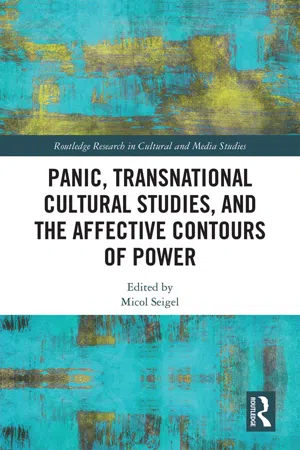
This volume explores the panic that is a central affective register of our current international order. Fears of Somali pirates, "Gypsy" kidnappers, African warlords, Ebola, "Mexican meth," pimps, coyotes, gangs, climate refugees and more, structure the dark side of a metropolitan unconscious. These are terrors over things that (might) cross borders, threatening the sanctity of territoriality and capital. Inspired by scholarship challenging panics around human and sex trafficking, the contributors to this volume develop the umbrella category of the global moral panic. Embracing the challenge of grasping a phenomenon not previously regarded as cohering, they consider panics provoked by travel, passage, transgression; panics over bodies that move. Like panics over trafficking, the episodes narrated here ride and feed a field of common sense regarding crime, rights, and state power. Their logics of victims and villains nourish notions of the centrality of punishment, drawing from and feeding taxonomies of gender, race, and nation, solidifying the order craved by capital. They spotlight the coloniality of power, the ongoing salience of empire, the savior logics of rescue, and the profound sexism organizing hierarchies of bodies and places. Panic, this volume diagnoses, is a crucial, undertheorized facet of contemporary local-global relations.
- 310 pages
- English
- ePUB (mobile friendly)
- Available on iOS & Android
eBook - ePub
Panic, Transnational Cultural Studies, and the Affective Contours of Power
About this book
Information
Part I
The Coloniality of Panic
1 Privateers and Public Ends
Piracy as Global Moral Panic
Jatin Dua
The Muntakhab al-Lubab, a seventeenth-century chronicle of Mughal India written by the historian Maulavi Kabir Al-Din Ahmad (Khāfī Khān), describes a particularly gruesome incident of raiding at sea. In 1695, the Ganj-i-Sawai, one of the largest Mughal trading vessels belonging to the emperor Aurangzeb, was returning to Surat, a major port in Western India, with around 600 pilgrims from Mecca and revenue from the sale of Indian goods at Mocha and Jeddah. Given its valuable cargo, the ship was heavily armed with 80 cannons and 400 muskets, and escorted by another ship, the Fateh Muhammad. As the ships sailed across the Bab-el-Mandeb, a ragtag group of pirate vessels led by the notorious “King of Pirates,” the Englishman Henry Avery, started chase. After sacking the Fateh Muhammad, Avery’s crew pursued the Ganj-i-Sawai, waged a ferocious battle, and then boarded and ransacked the ship. The Muntakhab details the dreadful treatment meted out by Avery and his crew:
For a week the pirates (duzd darya) tortured the faithful. Beatings and murder were commonplace and even the honor of women was not spared. So much so that many women jumped overboard in order to escape the fate that awaited them at the hands of these barbarians. After having remained engaged for a week, in searching for plunder, stripping the men of their clothes and dishonoring the old and young women, they left the ship and its passengers to their fate.1
This act of piracy jeopardized the tenuous trading relationships of the British East India Company (BEIC) in Mughal India. Established almost a century prior to the Ganj-i-Sawai incident as a joint-stock company granted exclusive rights by Queen Elizabeth for trade in the Indian Ocean, the BEIC was a relative newcomer—and a weak one at that—within the transregional world economy of the Indian Ocean. Dependent on local merchants for capital and an imperial farmân (decree) from the Mughal authorities to trade in India, the fragile relationship between the BEIC and the Mughals was further strained by Avery’s hijinks at sea. As the historian Patricia Risso notes, when news of the attack on the Ganj-i-Sawai spread at the ship’s home port,
angry locals tried to lynch any available English merchants, on the assumption that Avery’s attack was somehow sponsored, condoned, or facilitated by the East India Company. The Mughal governor intervened to prevent lynching, but he also ordered his troops to occupy the East India Company’s establishments in Surat and nearby Suwali, to incarcerate their sixty-three employees, and to stop their trade.2
In audiences with Mughal officials, the English governor of Bombay, Sir John Gayer, tried to distinguish Company employees from Avery, arguing, “we are merchants, not pirates.”3 The officials were unimpressed. After nearly a year of negotiations, the employees were finally released and trade reestablished, once the BEIC agreed to hire out two English ships to the Mughals as protective convoy for the pilgrim vessels of Surat.
In England, Avery’s daring raid captured the public’s imagination. A veritable cottage industry of fictional and fictionalized biographical accounts emerged in the decades after the Ganj-i-Sawai incident, including The Life and Adventures of Capt. John Avery, published in 1709.4 These accounts transformed Avery into a household name synonymous throughout Britain with the spirit of adventure and the glamor of life at sea. At the same time as Avery was being immortalized into a figure of mystery and intrigue (whose legacy lives on in contemporary Hollywood renditions of Caribbean piracy), the BEIC convinced the Privy Council of William III to launch a worldwide manhunt against him, the first such global operation in recorded history. Avery himself eluded capture and was rumored to have sailed to Madagascar and a life of retirement with the captured granddaughter of the Mughal emperor. Six of his crew members were arrested and brought to England in 1696 where they were found guilty of piracy and swiftly executed.5 Soon after Avery’s act of raiding at sea, another British sailor, William Kidd, gained notoriety when he captured the Mughal vessel, the Quedagh Merchant, in 1698. Once again, the English governor of Bombay found himself in front of Mughal authorities seeking to distance the Company from these itinerant marauders while also pressuring the Crown to act decisively against piracy. Representatives of the Company not only called upon the English state for protection and assistance against pirates in the Indian Ocean but also had to construct piracy as a global problem threatening an emerging British imperial hegemony.
In her introduction to this volume, Micol Seigel notes that the panics we are interested in here (in this volume) are not simply instances in which Stanley Cohen’s heuristic device of moral panic occurs outside a North Atlantic “home.” As Seigel highlights,
[t]hese are terrors over things that (might) cross borders, and whose crossings threaten the sanctity of the structures anchored to territoriality and capital. These panics are defined not by place or scale but by travel, passage, transgression. These are panics over bodies that move.6
Maritime piracy in the Indian Ocean, in both the seventeenth and the eighteenth centuries as well as in its contemporary guise, fits this mobile category, blurring boundaries between land and sea, legal and illegal, taxation and taking. Juxtaposing British responses to the taking of ships such as the Ganj-i-Sawa’i and the Quedagh Merchant with the contemporary moral panic over Somali pirates in these same restive waters highlights how piracy as a global moral panic serves simultaneously to background histories of complicity and exploitation while productively intervening to transform maritime space and imperial authority. The analytic focus forged through attention to affect and to panic in particular, as suggested in this volume, thus productively allows us to see the transregional stakes and scales of this process in ways that resonate beyond the monsoonal waters of the Western Indian Ocean.
Piracy and the Making of a “British Lake”
In distinguishing between the piratical acts of men like Avery and Kidd, and the “honorable business” of the BEIC, the English governor elided the fact that the “King of Pirates” had not always been a pirate. Scholars have emphasized the fluidity in defining the term piracy. In his masterful survey of the law of piracy, legal scholar Alfred Rubin notes that a “cursory examination of learned literature, treaty articles and national statutes shows at least six different meanings of piracy.”7 These meanings range from
A vernacular usage with no legal implications; 2) An international law meaning related to unrecognized states or recognized states whose governments are not considered empowered at international law to authorize the public activity that is questioned, like the Barbary States (1600–1830), The Malay Sultanates (1800–1880) and the Persian Gulf Sheikhdoms (1820–1830); 3) An international law meaning related to the private acts of foreigners against other foreigners in circumstances making criminal jurisdiction by a third state acceptable to the international community; 4) various special international law meanings derived from particular treaty negotiations; and 5) various national domestic law meanings defined by statutes and practices of individual states; 6) An international law meaning related to unrecognized belligerency hostis humani generis (enemies of all mankind).8
The plurality of these usages, from a form of “taxation” and economic exchange to hostis humani generis (enemies of all mankind), highlights the long history of maritime predation and a slippage and mobility in defining this practice. In addition, the mobility of this concept of piracy has also been central in demarcating the boundaries between the legitimate and illegitimate, acceptable and unacceptable. As Daniel Heller-Roazen has argued, between the sixteenth and the mid-nineteenth century, the legal categories of “piracy” and “privateering” emerged in close relationship to each other. Documents such as the letter of marque and reprisal were the only distinction between an act of piracy and a legitimate form of plunder or reprisal at sea. For Heller-Roazen, this blurry boundary between piracy and privateering was crucial in “waging public wars by private means”9 and allowed states throughout Europe to demarcate the borders between acceptable and unacceptable violence as well as private and political ends—reserving for sovereigns the capacity to legitimize their violence while criminalizing the violence of rivals and those who resisted their attempts at monopoly.
In the Atlantic world, the “golden age of piracy” in the late sixteenth and seventeenth centuries, as scholars such as Robert Ritchie (1986) and Peter Linebaugh and Marcus Rediker (2013) have highlighted, was also an era of imperial competition. In a world dominated by Spain and Portugal, and divided between them through papal decree, newcomers such as the Dutch, English, and French were at a distinct disadvantage. As Ritchie notes, “Dutch, English, and French policy makers sought empire, but did not have the resources to achieve this goal. It was left to entrepreneurs to carry out state policy by private means.”10
Privateering, initially financed by monarchs and later financed by private enterprises and legally supported by both natural law and legal positivist claims to legitimacy, provided the ability to effectively challenge Spanish and Portuguese monopoly.
Through the issuance of letters of marque, monarchs “legalized” piracy and ensured a percentage of the profits to finance state expansion and consolidation. Yet legalized privateering was always a precarious venture. The cyclical nature of war and peace in the Atlantic, and later in the Indian Ocean world as empires jostled and competed for influence and profit, led to a steady ebb and flow between pirate and privateer. In times of war, the demand for privateers surged, and during times of peace, privateers were decommissioned but continued to engage in raiding without sponsorship, thus becoming pirates. While some privateers—notably Francis Drake and Henry Morgan—transformed themselves into governors and permanently moved from sea to land, the majority, like Avery and Kidd, remained offshore, caught in this oscillating world between pirate and privateer. The sea change of the long eighteenth-century Caribbean world (1689–1856), including the end of the Anglo Spanish Wars; the declining fortunes of the Spanish; and the emergence of British, Dutch, and French colonies in the Caribbean, transformed the relationship between pirates and empire. The Atlantic was no longer a welcome home for these sailors. Even though these itinerant sojourners had been instrumental in breaking the hegemony of the Spanish, the newly established colonies turned hostile toward them, labeling them pirates.
A desire to flee this rapidly shifting Atlantic world or a thirst for adventure led men (and this was a mostly masculine world, with important exceptions) like Avery and William Kidd to the relative hospitality of the Indian Ocean, specifically the island of Madagascar and some of the Comoro Islands. Pirates found camaraderie; supplies; and, importantly, ready and willing crew members in order to stage attacks on dhows and other vessels traversing the great trade highways of the Indian Ocean from these island hideaways. Away from the tightening embrace of British imperial control in the Atlantic, which was exemplified by the Navigation Acts, the pirates of Madagascar enjoyed a profitable, if not peaceful, existence in what became known as the “pirate’s last frontier.”11 The attack on the Ganj-i-Sawai, followed by William Kidd’s marauding in the Red Sea and the attack and capture in 1698 of the Quedgah Merchant, another ship owned by the Mughals, transformed and ultimately destroyed this brief utopic world of “hydrarchy.”12
As noted earlier, the Ganj-i-Sawai incident and others threatened the tenuous relationship between the BEIC and the Mughals. In the immediate aftermath, company officials were arrested; trade was stopped in Western Indian ports; and, equally troublingly, company monopoly over trade—a monopoly granted by royal decree—was threatened by the presence of these British subjects who operated without company license. The movement of pirates from the Atlantic to the Indian Ocean was productive in manufacturing a global moral panic that, in addition to effacing the prior intimacy of piracy and privateering, transformed the relationship between public and private violence at sea. The establishment of the British Empire was premised on a myth of a pacific maritime empire extending and transforming oceanic space into a “British Lake.” David Armitage has highlighted that this “empire of the seas was critical to defining the British Empire as both free and benign.”13 Constructing a vision of a peace...
Table of contents
- Cover
- Half Title
- Title Page
- Copyright Page
- Contents
- List of Figures
- Editor’s Acknowledgments
- List of Contributors
- Introduction: Global Moral Panics and the Affective Contours of Power
- PART I The Coloniality of Panic
- PART II Too Mobile: Panic at the Borders
- PART III Resisting Rescue: Sex/Work
- Index
Trusted by 375,005 students
Access to over 1.5 million titles for a fair monthly price.
Study more efficiently using our study tools.
Frequently asked questions
Yes, you can cancel anytime from the Subscription tab in your account settings on the Perlego website. Your subscription will stay active until the end of your current billing period. Learn how to cancel your subscription
No, books cannot be downloaded as external files, such as PDFs, for use outside of Perlego. However, you can download books within the Perlego app for offline reading on mobile or tablet. Learn how to download books offline
Perlego offers two plans: Essential and Complete
- Essential is ideal for learners and professionals who enjoy exploring a wide range of subjects. Access the Essential Library with 800,000+ trusted titles and best-sellers across business, personal growth, and the humanities. Includes unlimited reading time and Standard Read Aloud voice.
- Complete: Perfect for advanced learners and researchers needing full, unrestricted access. Unlock 1.5M+ books across hundreds of subjects, including academic and specialized titles. The Complete Plan also includes advanced features like Premium Read Aloud and Research Assistant.
We are an online textbook subscription service, where you can get access to an entire online library for less than the price of a single book per month. With over 1.5 million books across 990+ topics, we’ve got you covered! Learn about our mission
Look out for the read-aloud symbol on your next book to see if you can listen to it. The read-aloud tool reads text aloud for you, highlighting the text as it is being read. You can pause it, speed it up and slow it down. Learn more about Read Aloud
Yes! You can use the Perlego app on both iOS and Android devices to read anytime, anywhere — even offline. Perfect for commutes or when you’re on the go.
Please note we cannot support devices running on iOS 13 and Android 7 or earlier. Learn more about using the app
Please note we cannot support devices running on iOS 13 and Android 7 or earlier. Learn more about using the app
Yes, you can access Panic, Transnational Cultural Studies, and the Affective Contours of Power by Micol Seigel in PDF and/or ePUB format, as well as other popular books in Politics & International Relations & North American History. We have over 1.5 million books available in our catalogue for you to explore.