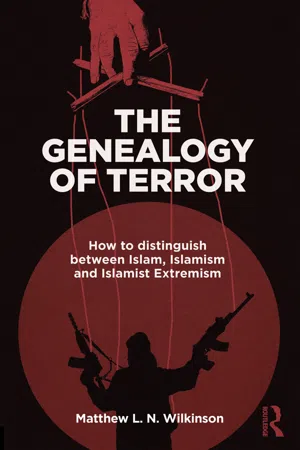
The Genealogy of Terror
How to distinguish between Islam, Islamism and Islamist Extremism
- 240 pages
- English
- ePUB (mobile friendly)
- Available on iOS & Android
The Genealogy of Terror
How to distinguish between Islam, Islamism and Islamist Extremism
About this book
In the first two decades of the twenty-first century, the events of 9/11, 7/7, the War on Terror and the Caliphate and atrocities of the so-called Islamic State have dominated Western consciousness and wreaked havoc in parts of the Muslim-majority world. In their wake, a spate of books has been written explaining the phenomenon of Islamist radicalisation and Jihadism.
Nevertheless, for normal citizens, as well as scholars of religion and legal professionals, the crucial question remains unanswered: how is mainstream Islam different from both Islamism and the Islamist Extremism that is used to justify terrorist violence? In this highly original book, which draws upon the author's experience as an expert witness in Islamic theology in 27 counter-terrorism trials, the author uses the idea of the Worldview, as well as traditional Islamic theology, to answer this question.
The book explains not only what Mainstream Islam, Ideological Islamism and Islamist Extremism are in their broad philosophical characteristics and theological particulars, but also explains comprehensively how and why they are both superficially related and yet essentially and fundamentally different. In so doing, the book also illuminates the cast of characters and the development of their ideas that constitute Mainstream Islam, Ideological Islamism and the Non-Violent and Violent Islamist Extremists who constitute the Genealogy of Terror.
Frequently asked questions
- Essential is ideal for learners and professionals who enjoy exploring a wide range of subjects. Access the Essential Library with 800,000+ trusted titles and best-sellers across business, personal growth, and the humanities. Includes unlimited reading time and Standard Read Aloud voice.
- Complete: Perfect for advanced learners and researchers needing full, unrestricted access. Unlock 1.4M+ books across hundreds of subjects, including academic and specialized titles. The Complete Plan also includes advanced features like Premium Read Aloud and Research Assistant.
Please note we cannot support devices running on iOS 13 and Android 7 or earlier. Learn more about using the app.
Information
1
Why this book is needed
A global crisis of misunderstanding: why this book is needed; who its author is; what this book will accomplish
Why? How? What?
- Why did a group of young people hate another group of young people so much that they were prepared to slaughter them in cold blood, while at the same time being prepared to exterminate themselves?8
- 2. How was it possible that a group of such violent criminals could manage to plan and perpetrate an act of violence on such a scale in the heart of one of the most iconic European capital cities?
- 3. What manner of people were these who could carry out such a sub-human act of butchery, and what were the ideas that were driving and motivating them? This last question provoked a further sub-question driven by understandable fear: What, if any, were the differences in beliefs and ideas between the killers and other people who also called themselves Muslim who were living in the heart of Europe in great numbers, especially since at least some of these people seemed to espouse outmoded and unethical attitudes towards women as evidenced by the New Yearâs Eve assaults?
Rationale: addressing a real, determinate absence
Making clear distinctions between religious/ideological phenomena and their adherents
- 1 Mainstream Islam;
- 2 Islamism (sometimes referred to elsewhere as âPolitical Islamâ14);
- 3 Islamist Extremism (see Figure 3.1 and Plate 1).
- 4 âActivistâ Islam, which is, broadly, a part of Mainstream Islam but intersects with Islamism;
- 5 Non-Violent Islamist Extremism, which lies between Islamism and Violent Islamist Extremism and sets up the Worldview of Violent Islamist Extremism without directly encouraging violence (see Figure 1.1 and Plate 1).
Table of contents
- Cover
- Half Title
- Series Page
- Title
- Copyright
- Dedication
- Contents
- Foreword
- Preface
- Acknowledgments
- 1 Why this book is needed
- 2 The roots of Islam, Islamism and Islamist Extremism: the historical fault lines of Islam
- 3 The Worldviews of Islam, Islamism and Islamist Extremism
- 4 Basic beliefs, practices and characteristic themes of Islam, Islamism and Islamist Extremism
- 5 Mainstream Islam: the people, texts and contexts
- 6 Islamism: the people, texts and contexts
- 7 The Genealogy of Terror: the people, texts and contexts of Violent Islamist Extremism
- 8 A second Age of Extremes or a second Age of Enlightenment?
- Appendix 1: Basic Guides to Mainstream Islam
- Appendix 2: Digital Islam
- Glossary of key terms and names
- References
- Index