- 301 pages
- English
- ePUB (mobile friendly)
- Available on iOS & Android
eBook - ePub
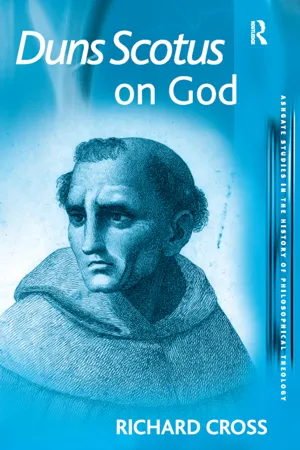
Duns Scotus on God
About this book
The Franciscan John Duns Scotus (c. 1266-1308) is the philosopher's theologian par excellence: more than any of his contemporaries, he is interested in arguments for their own sake. Making use of the tools of modern philosophy, Richard Cross presents a thorough account of Duns Scotus's arguments on God and the Trinity. Providing extensive commentary on central passages from Scotus, many of which are presented in translation in this book, Cross offers clear expositions of Scotus's sometimes elliptical writing. Cross's account shows that, in addition to being a philosopher of note, Scotus is a creative and original theologian who offers new insights into many old problems.
Information
PART I
THE EXISTENCE OF THE ONE GOD
Chapter 1
Theories of Causation
1 Efficient Causation
Medieval philosophical theories of causation are in many ways very different from modern ones. An understanding of some of these differences may help to make Scotus’s account of God’s existence intelligible, and perhaps even plausible. And it will help too with understanding Scotus’s theology of the intra-Trinitarian relations of the divine persons. Medieval views of causation generally involve an analysis in terms of substances causing effects (in other substances). The causes here are substances with (active) powers to do things, and what they do is affect things with (passive) potencies or capacities to be affected in the relevant way: paradigmatically, x brings it about that y is φ, where x and y are two different substances, and where x has the relevant power (to make things φ), and y the relevant capacity (to be made φ). Modern views of causation tend to suppose that causal relations obtain between events. Talk of causation in this way has a great ontological advantage: it renders superfluous any talk of substances and their powers. This is an advantage of economy. But the advantage comes at a price (and so is, in a different way, uneconomical): namely, a loss of explanatory force. For in event–event analyses, causation is usually reduced to one or other of two sorts of relation: constant conjunction or counterfactual dependence. On constant-conjunction theories, all there is to causation is one event’s regularly or constantly following another. Counterfactual-dependence theories specify the relation a little more closely: an event x counterfactually depends on an event y distinct from x, if both, x and y obtain, and if y did not obtain, x would not obtain. Neither of these accounts is very satisfactory. They both deny what seems to be central in our intuitive notion of causation, namely that there is some sort of connection between cause and effect. A definition of causation that is faithful to our intuitions on the matter would have to include the fact that a cause seems to make some genuine contribution to the effect: something that the cause is or does is responsible for the effect; the effect somehow derives from the cause.
Of course, the point of both of these theories is to try to do without causal powers: the strange, invisible, seemingly almost magical properties of a thing that enable it to reach out to other things and make a difference to them. With their robust acceptance of causal powers, medieval theories, I suspect, tend to conform to our intuitive understanding of causation more than modern ones do. Thus in everyday discourse we tend to operate with an account of causation modelled on our own abilities to do things, and to affect other things. And talk of active powers invites talk of passive capacities too: the liability of something to be affected. Medieval theories tend to root all of this in talk about forms. On Aristotelian theories, largely accepted by later medieval thinkers, material substances are composites of matter and substantial form – very loosely, stuff and essential structure – and these composites are the subjects of further forms – accidental ones, forms that the substance can gain or lose, and have or lack. Lying behind this sort of analysis is a rather crude account according to which causation fundamentally amounts to the transference or communication of a form from one substance or substrate to another. For example, in a much debated passage, Aquinas argues against the possibility of self-motion in a way which seems to imply that, in order to make something be in a certain way, the agent needs itself to be in that way – more technically, in order to give something a certain form, the agent must already possess the form:
Everything that is in motion is moved by another. For something is in motion only if it is in potency to the thing to which it is moved. But something moves [another] only if it is actual, for to move is nothing other than to reduce something from potency to actuality. But something can be reduced from potency to actuality only by something actual, just as something actually hot, such as fire, makes a stick which is potentially hot, actually hot, and thereby moves and changes it. But it is not possible that the same thing be simultaneously actual and potential in the same respect, but only in different respects. For what is actually hot cannot be simultaneously hot potentially. Therefore it is impossible that something, by the same motion, is both mover and moved, or that it move itself. It is therefore necessary that everything in motion is moved by another.1
On the face of it, this seems to imply that possession of a form is a necessary condition for bestowing the form on something else. And one obvious way of understanding this claim is to suppose that forms – abstract objects such as heat – are somehow ‘spread out’ from agent to effect. I do not want to adjudicate on Aquinas’s precise meaning here, or what might be grounding it.2 But I do want to suggest that by the time of Scotus, the prima facie sense of Aquinas’s text here was regarded as false. Scotus, for example, accepts the possibility of self-change, and to do this he has to allow that a power to make something φ does not require actually being φ.3 Whatever it is, a causal power need not be an instance of, or be possessed by, the kind of thing effected in virtue of, or through, the power (though, presumably, it can be: hot things, but not only hot things, make other things hot). Understood in this way, there is nothing ‘mystical’ about the notion of a form (though there may remain something mysterious about it). In this context, talk of substantial forms is at root a way of talking about the essential properties, powers, and capacities of a thing; talk of accidental forms is at root a way of talking about contingent properties, powers, and capacities of a thing.
Thus far, I have talked about material substances, and their powers and capacities to change other material substances, and to be changed by such substances. The medievals accept too a more specialized kind of causation. For x to bring it about that y is φ does not require the pre-existence of y, and one way for the relevant causal relation to obtain is for x to bring it about that y exists. Bringing about y’s existence entails bringing it about that y has at least some properties, and one way for x to bring it about that y exists is for the causal relation between x and y to admit of a more basic explanation: perhaps what it is for x to bring it about that y is φ is for x to act on a substrate z, somehow contained or included in y, bringing it about that z is ψ (such that the inclusion relation between y and z entails that, if z is ψ, y is φ). In standard cases of generation, this could be exactly what happens: matter (for us, though not for the medievals, fundamental particles, or things made up of such particles), is basically rearranged, such that what previously was one kind of thing is made to be another kind of thing.4 This account explains why Aristotle and his followers thought of matter as potency, and form as actuality. For something to have a form φ-ness is for it to be actually φ. Matter that is not φ (where φ-ness is a substantial form) but can be φ has a (passive) potency for being φ. Likewise, a substance that is not φ (where φ-ness is an accidental form) but can be φ has a potency for being φ; the accidental form φ-ness itself is actual relative to the substance, making the substance to be actually φ.5
Furthermore, however, for x to bring it about that y exists does not entail that there is any pre-existent thing out of which y is made: y does not need to be made from anything at all. And this is creation. Peter Geach many years ago suggested a way of understanding this, contrasting God’s creative and non-creative causal activity in the following way:
We may insert an existential quantifier to bind the ‘x’ in ‘God brought it about that x is A’ in two different ways:
(I) God brought it about that (Ex) (x is an A)
(II) (Ex) (God brought it about that x is an A)
(II) implies that God makes into an A some entity pre-supposed to his action; but (I) does not; and we express the supposition of God’s creating an A by conjoining (I) with the negation of (II), for some suitable interpretation of ‘A’.6
Medieval accounts tend to think of this creation relation – in the case of material substances – in terms of an agent’s causing both the form and matter of a material substance. It was a commonplace that material substances cannot themselves create.7 So talk of creation was held to entail talk of immaterial substances. Since the medievals tend – like Aristotle and his ancient followers – to think of forms as explaining causal powers, it was natural for them to think of immaterial substances as forms without matter. Again, there is not supposed, I think, to be anything mystical about this. ‘Form’ here is an equivocal notion, and we could just as easily think of an immaterial substance as something like a Cartesian soul.
The basic model of causation, as I have been outlining it, is that of an agent’s doing something to something else. Causing, then, is a kind of doing. But it is not the only kind of doing. Sometimes we just do things without obviously affecting anything. When I think, for example, I just do something. Scotus does not regard this doing as properly classifiable as an action: actions, for him, always involve patients – things affected by the action. Scotus makes a distinction between producing and operating. Producing is a causal relation of the kind I have been describing: making something to be φ (and perhaps, but not necessarily, doing so by making that thing to exist). Producing is acting in this technical sense. Operating, however, does not in itself involve a patient in this way. It is just doing. Scotus believes, nevertheless, that there is some sort of causal relation involved in this operating. A paradigm case of an operation is thinking:
[1]
1 ‘Action’ in creatures is understood in one way for action in the genus [viz. category]
2 of action, and in another way for second act, which is an absolute quality. …
3 Speaking only of the one sort of act [viz. categorial act: production], or only of the
4 other [viz. second act: operati...
Table of contents
- Cover
- Half Title
- Title Page
- Copyright Page
- Dedication
- Table of Contents
- Acknowledgements
- Abbreviations
- Introduction
- Part I The Existence of the One God
- Part II The Trinitarian Nature of the One God
- Appendix: Religious Language and Divine Ineffability
- Bibliography
- Index Locorum
- General Index
Trusted by 375,005 students
Access to over 1.5 million titles for a fair monthly price.
Study more efficiently using our study tools.
Frequently asked questions
Yes, you can cancel anytime from the Subscription tab in your account settings on the Perlego website. Your subscription will stay active until the end of your current billing period. Learn how to cancel your subscription
No, books cannot be downloaded as external files, such as PDFs, for use outside of Perlego. However, you can download books within the Perlego app for offline reading on mobile or tablet. Learn how to download books offline
Perlego offers two plans: Essential and Complete
- Essential is ideal for learners and professionals who enjoy exploring a wide range of subjects. Access the Essential Library with 800,000+ trusted titles and best-sellers across business, personal growth, and the humanities. Includes unlimited reading time and Standard Read Aloud voice.
- Complete: Perfect for advanced learners and researchers needing full, unrestricted access. Unlock 1.5M+ books across hundreds of subjects, including academic and specialized titles. The Complete Plan also includes advanced features like Premium Read Aloud and Research Assistant.
We are an online textbook subscription service, where you can get access to an entire online library for less than the price of a single book per month. With over 1.5 million books across 990+ topics, we’ve got you covered! Learn about our mission
Look out for the read-aloud symbol on your next book to see if you can listen to it. The read-aloud tool reads text aloud for you, highlighting the text as it is being read. You can pause it, speed it up and slow it down. Learn more about Read Aloud
Yes! You can use the Perlego app on both iOS and Android devices to read anytime, anywhere — even offline. Perfect for commutes or when you’re on the go.
Please note we cannot support devices running on iOS 13 and Android 7 or earlier. Learn more about using the app
Please note we cannot support devices running on iOS 13 and Android 7 or earlier. Learn more about using the app
Yes, you can access Duns Scotus on God by Richard Cross in PDF and/or ePUB format, as well as other popular books in Theology & Religion & Religion. We have over 1.5 million books available in our catalogue for you to explore.