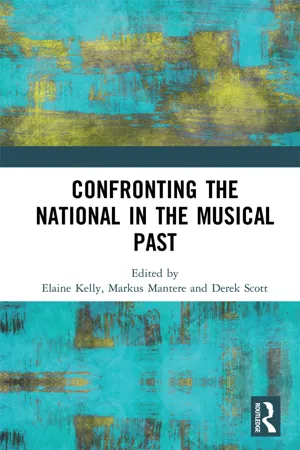
This significant volume moves music-historical research in the direction of deconstructing the national grand narratives in music history, of challenging the national paradigm in methodology, and thinking anew about cultural traffic, cultural transfer and cosmopolitanism in the musical past. The chapters of this book confront, or subject to some kind of critique, assumptions about the importance of the national in the musical past. The emphasis, therefore, is not so much on how national culture has been constructed, or how national cultural institutions have influenced musical production, but, rather, on the way the national has been challenged by musical practices or audience reception.
- 214 pages
- English
- ePUB (mobile friendly)
- Available on iOS & Android
eBook - ePub
Confronting the National in the Musical Past
About this book
Information
Part 1
Confronting the national
1
Cosmopolitan musicology
It is my belief that musicology matters not only for the understanding it can bring to the meaning and purpose of music-making, but also because it can play a role in the development of social justice and a democratic culture. I will briefly retrace my footsteps along the path that led to the arguments I am putting forward in this chapter. I set out with a commitment to multiculturalism and cultural relativism, and so an early research interest of mine was in Orientalism, in the sense in which Said and postcolonial theorists used that term. Because I have always leant to the left politically, I was ever ready to stress the link between Orientalism and Western imperialism. I was satisfied with doing this for a number of years, but then I started to have troublesome thoughts about non-Western imperialism: what about the Ottoman Empire or the Japanese Empire? Was there an Occidentalism that existed as an inverted form of Orientalism? Finally, I began to have difficulty with a whole range of concepts from cultural hybridity to globalization. Sometimes, I thought social theorists underplayed human agency, and sometimes I thought they exaggerated it. In this way, I began to conclude that if musicology engaged with cosmopolitanism rather than national narratives about music, it would solve many of my problems – I would like to call them our problems – and I will explain why.
In recent years, the optimistic vision of a multicultural society has become clouded over, and even the vigorous efforts made to create such a society in Canada have met with disappointment. The Trudeau government passed its Multiculturalism Act in 1971 with the aim of establishing a Canadian citizenship that embraced diversity and tolerance. Unfortunately, this has scarcely been achieved, and the question of whether or not efforts to attain multiculturalism in other countries have built bridges or created social divides is now hotly debated. Among critical commentators on this subject, Kenneth McRoberts has acknowledged the strength of the argument that the policy of multiculturalism ‘has impeded rather than facilitated the integration of immigrants into Canadian society’ (1997: 131), and Trinidadian novelist Neil Bissoondath, who lives in Quebec, has put forward a strong critique of multiculturalism in Canada in Selling Illusions: The Cult of Multiculturalism in Canada (1994). Donald Cuccioletta has called for a cosmopolitan citizenship that ‘recognizes that each person of the nation-state processes multiple identities that not only link him or her to their own cultural heritage, but also to the host country, continent, neighborhood, street, etc.’ (2001/2002: 4). In the twenty-first century, these words are more relevant than ever. As the number of people who have links to more than one country by descent, marriage, or other important ties constantly increases, personal identities are less and less characterized by a relationship to a single nation. Canada now stresses shared values rather than national values.
Multiculturalism never asked anyone to be open to the culture of others, or to recognize themselves in others. It merely demanded tolerance and acceptance of diversity. Charles Taylor’s Multiculturalism: Examining the Politics of Recognition (1994), for example, demanded only recognition of the identity and rights of others. Slavoj Žizěk has argued that multiculturalism follows the logic of globalization, which has seen multinational companies colonize the world (1997: 43–44). I would want to add, however, that some countries cope with this situation worse than others depending on their constitution and legal system. Multiculturalism’s contribution to an enrichment of social life on a large scale has been disappointing: it has been quite acceptable for people to occupy distinct cultural quarters within a city and hope that a cordial relationship might spring up between one quarter and another. It increasingly looks like a vain hope. A report on community cohesion produced for the UK government in 2001 stated:
Separate educational arrangements, community and voluntary bodies, employment, places of worship, language, social and cultural networks, means that many communities operate on the basis of a series of parallel lives. These lives often do not seem to touch at any point, let alone overlap and promote any meaningful interchanges.
(Cantle 2001: 9)
A report produced for the UK government fifteen years later indicates that those parallel lives continue:
Taken together, high ethnic minority concentration in residential areas and in schools increases the likelihood of children growing up without meeting or better understanding people from different backgrounds. One striking illustration of such segregation came from a non-faith state secondary school we visited where, in a survey they had conducted, pupils believed the population of Britain to be between 50% and 90% Asian, such had been their experience up to that point.
(Casey 2016: 11)
I believe the time has now come to stop encouraging the packaging of culture into distinct ethnic boxes. Where music history is concerned, I would argue that we should offer interpretations that question the extent to which critics and historians have prized ethnicity and nationality in artistic works. No branch of the arts furnishes more examples of borrowing, re-using, and appropriating across cultures than does music, and this is evident today in forms of popular music on all continents around the world. Professional musicians now find themselves interpreting and performing music from a large number of different cultural traditions, and in doing so are able to create something that speaks meaningfully to our own times.
Scholars working in urban studies have in recent years been increasingly interested in exploring transcultural exchange, examining transformations across cultures, and interrogating the meaning of cosmopolitan culture. A focus on cities offers an alternative to Ulrich Beck’s ‘methodological nationalism’ (2002). In the twenty-first century, the movements of people and the existence of transnational structures have challenged the focus on nation-states in social criticism and theory. With hindsight, we can now see the beginnings of a transcultural entertainment industry in the nineteenth century, and how it grew eventually into a globalized entertainment industry. In the UK, for example, nineteenth-century transcultural exchange was seen in the import of French operettas and American blackface minstrelsy, and in the export of music hall, Gilbert and Sullivan, and musical comedy (Scott 2008).
Cosmopolitanism has returned to the agenda in the context of debates about globalization. Beck and Edgar Grande argue not for the ‘world citizenship’ model of cosmopolitanism; instead, they call for the goodwill felt towards one’s own country to be extended to other countries (2007: 70). This presents an attitude distinct from both the nationalist and the universalist outlook, which strives to make otherness universally compatible by the exercise of tolerance based on shared norms. It is no surprise that they look to Jürgen Habermas for ideas on how to achieve consensus on norms. The necessity of raising validity claims that can be accepted across different cultures is crucial to the arguments concerning communicative action that Habermas put forward in his magnum opus Theorie des kommunikativen Handelns (1981).
The global and the local are not the oppositional entities they once were, and a reworked concept of cosmopolitanism could aid in their analysis. The experience of the global touching the local and vice versa has been characterized as ‘glocalization’ by some writers (for example, Roudometof 2005). Beck and Natan Sznaider contrast cosmopolitanism, as something that happens within individuals, with globalization, which takes place ‘out there’ (2006: 9). Cosmopolitanism helps us to recognize the everyday relations of interdependence that link people in various countries around the globe. Examples of cosmopolitanism that exist here and now are the campaigns that involve human rights or the environment.
Motti Regev argues that in the twenty-first century there has been ‘a process of intensified aesthetic proximity, overlap, and connectivity between nations and ethnicities’ (2013: 3), so that some cultural practices that once signified particular identities have become part of a complexly interconnected entity. Regev describes this process as aesthetic cosmopolitanism. It does not follow that culture is used and consumed in the same way in different countries, and this is evident in the various adaptations made during cultural transfer and exchange. The local plays as much a part in cosmopolitanism as in globalization. Aesthetic cosmopolitanism requires a disposition of openness towards new cultural experience (see Szerszynski and Urry 2002: 468; Urry 1995), but it also calls for the sense of recognition of the Self in the Other. It does not succumb to the temptation of Orientalist discourse in which the Self is defined against what is assumed to constitute the Other. Nevertheless, the political economics of consumption play a role, and Regev acknowledges that ‘the emergence and consolidation of aesthetic cosmopolitanism is closely associated with the rise and expansion of middle- and upper-middle-class fractions’ (2013: 15). That is certainly the case in the early twentieth century with regard to the cosmopolitan appetite across many of the world’s cities for adaptations of operettas from the German stage (see Scott 2017).
Regev also notes that aesthetic cosmopolitanism can be linked to the broadening of tastes that Richard A. Peterson and Roger Kern first analyzed as those of the ‘cultural omnivore’ (1996). Regev frames his ideas within the concept of ‘late modernity’, but there are arguments to suggest that the concept no longer applies, and that there has been a paradigm shift in modernity, rather than an aging process. Beck employs the term ‘second age of modernity’ to assert a paradigmatic shift into a new conceptual landscape, and to distance himself from the idea of an end of modernity found in postmodernist theory. Beck’s new modernity is characterized by the development of ‘[a] new kind of capitalism, a new kind of economy, a new kind of global order, and new kind of politics and law, [and] a new kind of society and personal life’ (2000: 81). Whether these are all quite so new is, perhaps, debatable.
A history that focuses on cosmopolitanism resonates with the world in which we now live: a world of migration and tourism, involving the constant transfer, exchange, translation, and adaptation of different cultural practices and artifacts. Cosmopolitan theorizing has become an important means of addressing the new challenges that sociology faces in the twenty-first century, when existing concepts of society and the social are being challenged by what John Brewer describes as ‘fluid mobilities and networks of exchange that render the idea of social structure irrelevant’ (2007: 173). In fact, fluid mobilities and networks of exchange can be found emerging in the previous century, through the cultural transfer of operetta from Europe, and jazz from the USA. Cosmopolitan art does not disregard local culture, but makes that culture available to others, and is open to the culture of others, too. The local is often just a part of something that is bigger than the local. Jazz is played around the globe, but there are local types of jazz even within the USA itself, such as the well-known varieties associated with New Orleans, Chicago, and New York.
In the twenty-first century, jazz, pop music, and film are the most likely candidates to feature in accounts of cosmopolitanism and cosmopolitan taste (Beaster-Jones 2015; Farrer and Field 2015; Feld 2012; Schindler and Koepnick 2007), but operetta was a forerunner. Once it was evident that the stage works of Offenbach were attracting widespread international attention, operetta became part of the new transcultural entertainment industry that developed in the nineteenth century. Long before jazz and syncopated dance music arose as cosmopolitan pleasures, the waltz and polka had become part of a music industry that was broadened and consolidated in the twentieth century. Martin Stokes remarks that record companies ‘became the dominant institutional site of global musical exchange’ (2007: 2), but well before this occurred city theatres and dance halls had played a major role in cultural transfer and exchange. That is why a focus on cities offers a productive alternative to methodological nationalism. Let us take the remarkable case of Die lustige Witwe, produced in London as The Merry Widow (1907). In the twelve months since its Vienna premiere, London’s Daily Mail (3 Jan. 1908) claimed that this operetta had been performed 450 times in Vienna, 400 times in Berlin, 350 times in St Petersburg, and 300 times in Copenhagen. The article continues: ‘It is playing every evening in Europe in nine languages,’ and, in addition, it was playing in New York and other cities aroun...
Table of contents
- Cover
- Title
- Copyright
- Contents
- List of figures
- List of musical examples
- List of contributors
- Introduction
- PART 1 Confronting the national
- PART 2 Confronting national institutions
- PART 3 Confronting national stereotypes
- Index
Trusted by 375,005 students
Access to over 1.5 million titles for a fair monthly price.
Study more efficiently using our study tools.
Frequently asked questions
Yes, you can cancel anytime from the Subscription tab in your account settings on the Perlego website. Your subscription will stay active until the end of your current billing period. Learn how to cancel your subscription
No, books cannot be downloaded as external files, such as PDFs, for use outside of Perlego. However, you can download books within the Perlego app for offline reading on mobile or tablet. Learn how to download books offline
Perlego offers two plans: Essential and Complete
- Essential is ideal for learners and professionals who enjoy exploring a wide range of subjects. Access the Essential Library with 800,000+ trusted titles and best-sellers across business, personal growth, and the humanities. Includes unlimited reading time and Standard Read Aloud voice.
- Complete: Perfect for advanced learners and researchers needing full, unrestricted access. Unlock 1.5M+ books across hundreds of subjects, including academic and specialized titles. The Complete Plan also includes advanced features like Premium Read Aloud and Research Assistant.
We are an online textbook subscription service, where you can get access to an entire online library for less than the price of a single book per month. With over 1.5 million books across 990+ topics, we’ve got you covered! Learn about our mission
Look out for the read-aloud symbol on your next book to see if you can listen to it. The read-aloud tool reads text aloud for you, highlighting the text as it is being read. You can pause it, speed it up and slow it down. Learn more about Read Aloud
Yes! You can use the Perlego app on both iOS and Android devices to read anytime, anywhere — even offline. Perfect for commutes or when you’re on the go.
Please note we cannot support devices running on iOS 13 and Android 7 or earlier. Learn more about using the app
Please note we cannot support devices running on iOS 13 and Android 7 or earlier. Learn more about using the app
Yes, you can access Confronting the National in the Musical Past by Elaine Kelly,Markus Mantere,Derek Scott in PDF and/or ePUB format, as well as other popular books in Media & Performing Arts & Music. We have over 1.5 million books available in our catalogue for you to explore.