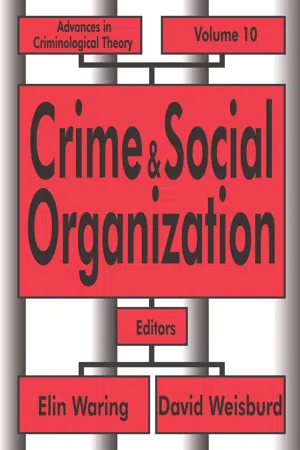
This tenth volume in the Advances in Criminological Theory series is dedicated to the work of Albert J. Reiss, Jr. It focuses on the relationship between crime and social organization that is so central to his work. This focus rejects a view of crime solely as the action of atomistic individuals and sees the criminal justice system as inseparable from its social, political and organizational context. This perspective has had a resurgence in recent years, and this volume brings together some of the most important scholars who have contributed to these developments. Articles examine the social organization of crime itself, the context of crime, and the response to crime. The concept of co-offending, originally developed by Reiss, is explored both as a way of improving understanding of juvenile offending and as a framework for understanding patterns of criminal organization across crime types and the relationship of criminal to licit organization. Other articles recast social disorganization theory in light of recent theoretical and empirical developments. They argue for a version of control theory that incorporates internal, contextual, and state-focused dimensions. Organizational actors, both as offenders and as governmental agencies responding to crime, are explored. Building from Reiss's groundbreaking work on policing, a group of articles on policing examine organizational change through reorganization, the adoption of strategies such as community policing and the increased use of empirical evidence, complicated by routines, organizational culture and political constraints. Taken together, these works develop new connections between dimensions of social organization and renew the social organization perspective on crime and criminal justice. Contributors include: Diane Vaughan, Joan McCord, Kevin P. Conway, Elin Waring, Felton Earls, Beat Mohler, Peter Manning, Stephen Mastrofski, Lawrence Sherman, David Weisburd, Robert Sampson, David F. Greenberg, Margaret Kelley, Robin Tamarelli and Jeremy Travis.
- 259 pages
- English
- ePUB (mobile friendly)
- Available on iOS & Android
eBook - ePub
Crime and Social Organization
About this book
Information
1
Clarifying Organizational Actors: The Contributions of Albert J. Reiss, Jr. to the Sociology of Deviance and Social Control
Diane Vaughan
A casual perusal of the many publications of Albert Reiss suggests a scholar of catholic interest and taste. This contention is, of course, true, but looking more analytically and deeply into the content of his intellectual interests shows that to draw the quick conclusion of diversity obscures a pattern that appears in much of his research and theory. A good deal of his scholarly attention, developed during his graduate education and expanded upon throughout his career, was and is devoted to social organization. This focus has materialized in a stream of work in the Sociology of Deviance and Social Control dedicated to clarifying organizational actors. For his students and others who have worked closely with him on this topic over the years, this comes as no surprise, but for many academics this aspect of his career is not well known, a fact attributable to publication of a definitive conceptual article in a journal that soon after went out of print, key ideas surfacing in government reports, and their elaboration appearing as chapters in books. My purpose in this brief excursus is to trace the trajectory and development of his ideas about organizational actors, thus constructing a sociology of knowledge in addition to clarifying his contributions. My method is a content analysis of relevant publications and papers listed on Reiss's curriculum vita, a personal interview, and a review of the literature on organizational deviance and control for citations as an indicator of the dissemination of Reiss's ideas. I have chosen to trace the organizational deviance and social control trajectory of his work for this paper, but someone else might trace the trajectory of his interest in social organization in another direction entirely. It is evident in his work on community studies, urban sociology, delinquency, education, career criminals, sentencing, co-offending, and violence.
A Grounding in Social Organization
Reiss was and is, first and foremost, a sociologist. His role in clarifying organizational actors in the Sociology of Deviance and Social Control must be seen as work consistent with a fundamental focus on social organization that originated during his graduate education. Reiss received his graduate degree from the University of Chicago in 1949. The core of the research and theorizing of the department at that time was social organization. Reiss took courses with Ogburn and Wirth, and taught with Lloyd Warner, all of whom had a strong organizational perspective. Whyte was at Chicago during this period writing up his thesis fieldwork (later to become Street Corner Society), in which he observed that the “slum” was organized, challenging prevailing assumptions at the time about the social disorganization of the inner city. The departmental focus on social organization also permeated the work of faculty who studied deviance and social control. Sutherland’s theory of differential association stressed the importance of differential social organization; Shaw and McKay’s ecological theory explored the social organization of crime in the city (paradoxically, at the same time that they posed a theory of social disorganization to explain it); Alinsky was involved with the practical question of how one organizes communities.
Reiss’s graduate interest in social organization strengthened over time and solidified. His work at the University of Michigan, from 1961 tol970, marked a turning point. Previous to Michigan, Reiss’s Chicago background manifested itself in an ecological point of view. At Michigan, three events crystallized his thinking in a different direction. First, Reiss co-taught with Ed Swanson, Swanson presenting the social psychological approach and Reiss the social organization perspective. Playing off the other perspective, Reiss expanded his knowledge and crystallized his understanding of social organization. Second, he became director of the Center for Research on Social Organization. Third, he affiliated with the Michigan School of Law, which added law to the other strands of his thinking, so that he came to view his interests as “deviance, social control, and law.” Embodying this crystallization and solidification of interests and understanding was the publication of “The Social Organization of Legal Contacts,” written with Leon Mayhew (1969).
The result of these three changes surfaced in his own classes, as he started thinking and theorizing about organizational deviance and control, and the course of his intellectual journey was set.
Establishing the Beginning Conceptual Apparatus
During his years at Michigan, Reiss served as president of the Ohio Valley Sociological Society (now the Midwestern Sociological Society). His Presidential Address was titled, “The Study of Deviant Behavior: Where the Action Is.” Later published in The Ohio Valley Sociologist (1966), the article lays out the beginning conceptual apparatus that Reiss would use and refine as the basis for his theorizing and research in the coming years. Conceptually innovative and strong theoretically, the article attracted little notice, laying dormant for years. In part, its invisibility was because it appeared in The Ohio Valley Sociologist, a small circulation journal that soon went out of print. Also, its publication occurred at a time when interest in research and theory on White-Collar Crime (as everyone was calling it then, following the Sutherland legacy) had waned. The article appeared during a hiatus: scholars who had done research and theorizing during the Classic Period of “white-collar crime” research had moved on to other interests, and Watergate, which triggered a renewed and sustained research program in the 1970s, had not yet occurred (Vaughan 1981). Ermann and Lundman resurrected Reiss’s “The Study of Deviant Behavior” by reprinting it in a edited collection, Corporate and Governmental Deviance: Problems of Organizational Behavior in Contemporary Society (1978a), which was widely adopted for classroom use. By that time, however, many sociologists had independently arrived at the position that the organizational perspective (and the literature on organization theory) was a useful tool for understanding the deviance and social control of organizations, and were writing and publishing using that perspective.1 In essence, Reiss’s Presidential Address/article was a groundbreaking article that never broke the ground it should have.
What is noteworthy about it is that, first, Reiss was thinking about organizational deviance and control as early as 1966 and, second, although a mere twelve pages in length, the Presidential Address was conceptually rich, identifying a number of topics that he would be engaged with in the future. Borrowing his title from Goffman’s “Where the Action Is,” Reiss emphasized that deviance was a question for which the complete answer could not be found in either the individual motivation to be deviant nor in the cultural and social structure. The answer, he argued, was in social organization. He wrote,
The Action rather is in the study of social organization—the organizational matrix that encompasses the deviant behavior of persons and the deviant behavior of organizations. A more general theory can encompass both. Indeed, the theory of organizations is easily adapted to the study of organizational deviance. Perhaps the time has come to remake the scene as well as make it. The action lies not only in a return to actors but to their organization. (Reiss 1966:12)
Reiss built his argument by noting that the Mertonian paradigm had appropriately shifted attention away from individual pathology toward institutional forces. Because of Merton, Reiss wrote, “The action began to lie in a...systematic approach to the analysis of social and cultural sources of deviant behavior” (Merton 1938: 672, cited in Reiss 1966: 1). In the 1960s, however, Reiss noted that the work of Goffman, Cohen, and Becker had shifted the scene of the action to the level of interaction (1966: 2). He pointed out that the emphasis in both the Mertonian and interactionist eras was on the person. Reiss drew attention to the deviance that characterizes aggregates, organized groups, and formal organizations. The foundation for his approach has been laid by the scholars who did research and theorizing about organizational and occupational deviance in the 1940s and 1950s, the Classic Period of “white-collar crime” research and theorizing.2 Reiss’s contribution was not only to bring the socially organized aspects of the phenomenon back in, but to make explicit the link between social organization, in a theoretically generalizable way, for a new audience. He laid out the conceptual terrain as follows:
- Reiss stressed the linkage between individual action and social organization, asserting: no individual deviance exists that does not involve social interaction and organization; much individual deviance is intricately linked to organized systems and organizations that also are defined as deviant; when organizations are defined as deviant, often all members are classified as deviant also.
- He suggested the possibility of a general theory of deviance concerned not only with the behavior of persons but of organizations.
- He observed that complex organizations create distinctive problems for social control for two reasons. First, their own deviance is enabled because massive evasion of social control is possible. Second, they are ready targets of deviance: for example, check forgery, malicious destruction of property, embezzlement.
This short Ohio Valley Sociologist article demonstrates the broad parameters of his conceptualization in 1966. Having set an intellectual agenda, his subsequent work explored more deeply the issues that he raised.
Refinement of Conceptual Interests
Reiss refined these conceptual interests by exploring three topics: organizations as violators, organizations as victims, and the regulation of organizational deviance. His chief contribution on the former two was to introduce, as sensitizing concepts, organizations as both violators and victims. However, he made no major intellectual commitment to either topic. His major intellectual investment was—and is—in the social control of organizational deviance. We will consider each of the three in turn.
Organizations as Violators:
In 1980, Reiss, together with Albert Biderman, published Data Sources on White-Collar Law Breaking. The primary purpose of this research was to explore existing sources of data and make recommendations about a general system of indicators for white-collar violations of law to the National Institute of Justice. The Reiss-Biderman report is permeated with conceptual insights that show Reiss’s social organization perspective. This influence is visible to even the casual reader, as it appears in chapter heads and subheads: for example, “Statistics as an Organizational Complex”; “Statistical and Bureaucratic Organization”; “Organizational Barriers to the Collection and Classification of Information for its Statistical Processing”; “Social Organization and Conceptualizing, Classifying, and Counting Law Violations.” Perhaps the most remarkable aspect of the Reiss-Biderman project was the identification of many existing sources of data at a time when many sociologists were stating that extensive research on (so-called) white-collar crime was impossible because corporations were powerful, making data unattainable. But in addition to its applied dimension and the identification of data sources, Reiss and Biderman developed the following conceptual definition for use in government data collection efforts:
White-collar violations are those violations of law to which penalties are attached and that involve the use of a violator’s position of significant power, influence, or trust in the legitimate economic or political institutional order to the purpose of illegal gain, or to commit an illegal act for personal or organizational gain. (1980: xxvii)
Many scholars have grappled with the conceptual definition of the phenomenon both before and after the above, the most recent being a 1996 conference organized expressly for the purpose of creating a definition (Helmkamp et al. 1996). Consensus was achieved at the 1996 meeting, but no consensus has been achieved in the scholarly community at large. What is significant about the Reiss-Biderman definition is that it shifts government attention to the organizational locus of the problem, thereby setting up a recommendation that government data be collected on both individuals and organizations as violators. Both the title of the monograph and the focus on “white-collar violations” seem oddly wrong, however, given Reiss’s background in social organization and the argument of The Ohio Valley Sociologist article. An interesting comment appears in the monograph’s preface that suggests the NIJ and enforcement/practitioner audience for the monograph was influential. They wrote, “... (the term, white-collar violations) reflects express and latent ideas about violations that are already important to law and to action...we considered but rejected the idea of using another term more nicely in accord with the denotative meanings of our definition than is the term “white-collar,” which is archaic sartorially as well as theoretically...(but) we find that “white-collar crime” has so strong a position in the common vocabulary, and now even in a statute, as well, that it would be idle to seek to replace it” (Reiss and Biderman 1980: xxix).
Organizations as Victims
Reiss was thinking about the vulnerability of organizations to victimization by crime and deviance long before others. His earliest publication on the subject was a government report that appeared in the late 1960s, the result of a survey of crime against small businesses that he helped design and execute (1969). Reiss and Biderman later discussed organizations as victims in the 1980 Data Sources on White-Collar Law Breaking. Suggesting that enforcement agencies collect data on organizations as victims, Reiss and Biderman argued for classification of data by level of social organization (Reiss and Biderman 1980: 410). Further, they considered the variation in victim and violator combinations that could occur, stressing the relationship between victim and violator rather than following the more usual data collection method of defining them as isolated statuses in an event. This early work of Reiss’s on organizations as victims was not incorporated into the work of other scholars, no doubt because it appeared in these two government publications. By 1983-1985, when Reiss began incorporating these ideas in publications in scholarly journals and chapters in scholarly books (see citations at note 18), others had independently discovered the topic an...
Table of contents
- Cover Page
- Title Page
- Copyright Page
- Dedication
- Contents
- List of Tables
- List of Figures
- Foreword
- Editors’ Introduction
- 1 Clarifying Organizational Actors: The Contributions of Albert J. Reiss, Jr. to the Sociology of Deviance and Social Control
- 2 Patterns of Juvenile Delinquency and Co-Offending
- 3 Co-Offending as a Network Form of Social Organization
- 4 The Generality of the Self-Control Theory of Crime
- 5 Organized for What? Recasting Theories of Social (Dis)organization
- 6 Social Selection and Social Causation as Determinants of Psychiatric Disorders
- 7 Authority, Loyalty, and Community Policing
- 8 The Romance of Police Leadership
- 9 From Criminals to Criminal Contexts: Reorienting Crime Prevention Research and Policy
- 10 Evidence-Based Policing: Social Organization of Information for Social Control
- About the Authors
- Index
Trusted by 375,005 students
Access to over 1.5 million titles for a fair monthly price.
Study more efficiently using our study tools.
Frequently asked questions
Yes, you can cancel anytime from the Subscription tab in your account settings on the Perlego website. Your subscription will stay active until the end of your current billing period. Learn how to cancel your subscription
No, books cannot be downloaded as external files, such as PDFs, for use outside of Perlego. However, you can download books within the Perlego app for offline reading on mobile or tablet. Learn how to download books offline
Perlego offers two plans: Essential and Complete
- Essential is ideal for learners and professionals who enjoy exploring a wide range of subjects. Access the Essential Library with 800,000+ trusted titles and best-sellers across business, personal growth, and the humanities. Includes unlimited reading time and Standard Read Aloud voice.
- Complete: Perfect for advanced learners and researchers needing full, unrestricted access. Unlock 1.5M+ books across hundreds of subjects, including academic and specialized titles. The Complete Plan also includes advanced features like Premium Read Aloud and Research Assistant.
We are an online textbook subscription service, where you can get access to an entire online library for less than the price of a single book per month. With over 1.5 million books across 990+ topics, we’ve got you covered! Learn about our mission
Look out for the read-aloud symbol on your next book to see if you can listen to it. The read-aloud tool reads text aloud for you, highlighting the text as it is being read. You can pause it, speed it up and slow it down. Learn more about Read Aloud
Yes! You can use the Perlego app on both iOS and Android devices to read anytime, anywhere — even offline. Perfect for commutes or when you’re on the go.
Please note we cannot support devices running on iOS 13 and Android 7 or earlier. Learn more about using the app
Please note we cannot support devices running on iOS 13 and Android 7 or earlier. Learn more about using the app
Yes, you can access Crime and Social Organization by Elin Waring,David Weisburd in PDF and/or ePUB format, as well as other popular books in Social Sciences & Criminology. We have over 1.5 million books available in our catalogue for you to explore.