This book provides an updated, concise summary of forecasting air travel demand methodology. It looks at air travel demand forecasting research and attempts to outline the whole intellectual landscape of demand forecasting. It helps readers to understand the basic idea of TEI@I methodology used in forecasting air travel demand and how it is used in developing air travel demand forecasting methods. The book also discusses what to do when facing different forecasting problems making it a useful reference for business practitioners in the industry.
- 156 pages
- English
- ePUB (mobile friendly)
- Available on iOS & Android
eBook - ePub
1 Introduction
1.1 Motivations
The air transportation industry has been experiencing a sustainable growth globally since the first civil aircraft was put into business operation in the year 1914. Nowadays, flying has become a prevailing mode for traveling with the rapid development of national economies. Especially when the traveling distance is longer than 500 kilometers, air transportation is considered as the most efficient and economical transportation mode (Özgen, 2011). Every year, more than 3 billion global air passengers and almost 40 percent of cargo (calculated by value) are transported by air. The annual total number of flights has exceeded 32 million sorties on average.
Air transportation is considered as a significant force to national economic developments. The flows of people, goods and technology that accelerate economic growth are enabled by the city-pair routes all around the world. According to the International Air Transport Association’s (IATA) annual review report, the total number of unique city-pair routes has exceeded 18,400 in 2016, which is over 700 more than the number in the year 2015 and almost 2 times the number about 20 years ago. There were more than 3.8 billion passengers taking a flight in 2016, which is a significant increase of about 250 million compared with the year 2015. In terms of value, the air passengers spent almost $650 billion in 2016, and the value of goods shipped by air was $5.5 trillion. Just-in-time global supply chains and multinational businesses are made possible by global airline networks.
Besides the transporting function, the air transportation industry can provide the global economy with a broader range of benefits. The related airline activities will raise jobs in both the air transportation sector and its supply chain, and then these jobs will produce more spending in other sectors of the economy. For example, the air transportation sector plays a critical role in facilitating the development of the tourism industry, especially for the global tourism industry, as well as some other associated sectors. The number of international tourists continues to increase mainly due to the reduced air traveling costs and improved service quality. It is estimated by IATA that the air transportation industry created about 30 million jobs worldwide in the year 2016, supported 67.7 million jobs within its supply chain in the year 2016 and also facilitated about 70 percent of global business activities. In summary, the air transportation industry can provide economic benefits not only for the passengers and cargo shippers, but also for the wider range of the economy by connecting businesses and individuals to global markets. Compared to the air transportation industry 20 years ago, the air transportation costs have been halved, and the quality of service offerings has been enhanced, with the city-pair connections having been expanded. More consumers are able to pay for a flight and more consumers are willing to pay for a flight. And it is believed that the flying cost for the passengers and cargo shippers will continue to fall.
When it comes to air travel demand, we can conclude that the year 2016 is another strong year for air passenger demand. According to the estimates of IATA’s annual report, the industry-wide revenue passenger kilometers grew about 7.1 percent in the year 2016 after being adjusted for the effects of the leap year. The growth rate of 7.1 percent could be regarded as a strong performance, compared with the past 10-year average growth rate of 5.5 percent. For air freight, industry-wide freight ton kilometers grew about 3.6 percent in 2016, nearly 2 times the 5-year average growth rate of 2.0 percent. Note that due to the strong seasonality of the manufacturers’ orders, the growth trend of air freight accelerated in the second half of the year 2016.
It is obvious that the industry’s center of gravity continues to shift eastward. In the year 2016, the growth in the Asia-Pacific region remained impressive, and the countries in Asia still dominated the ranks of the fastest-growing origin-destination passenger markets. Among all Asian markets, the domestic China passenger market achieved the biggest incremental change in the air passenger numbers, with 37 million more passengers in 2016. This incremental change of the air passenger number in the domestic China market even exceeded the sum of the total air passenger numbers in two of the other fastest-growing markets, i.e., domestic United States and domestic India. The domestic US market, the world’s largest air passenger market, experienced a low growth rate of 3.9 percent in 2016 compared to China’s growth rate of 7.1 percent.
According to Airbus’s global market forecast report for the period of 2017–2036, Asia-Pacific will lead the world traffic by 2036 with a three-fold increase, and among the top 20 traffic flows, 50 percent will involve Asia-Pacific and half of the new air passengers will come from this region. Meanwhile, the air traffic between emerging countries is forecast to grow at a rate of 6.2 percent per year, and will represent a 40 percent share of the total global air traffic by 2036, while the ratio was about 29 percent in 2016. Particularly, the domestic China air passenger market is forecast to be the largest market before the end of this forecast period, surpassing the domestic US market, which is forecast to increase by 50 percent from an already high base. IATA also predicted that in the year 2034, the flights to, from and within China will account for 1.3 billion passengers, with an average annual growth rate of 5.5 percent.
With the sustainable development of its national economy and the continuous improvement of people’s living standards, China has become one of the most promising air transportation markets in the world, and air transportation is playing an increasingly important role in the modernization of construction of China. As a country with the world’s largest population and one of the fastest-growing economies, China has kept an average growth rate of 10 percent in recent years. At present, China has become the second biggest air passenger market in the world. According to the National Bureau of Statistics of China, China was a country with a population of 1.37 billion in 2015, which represents an enormous potential in the continuous growth.
China has a long history of air transportation. However, before the economic reform in 1978, the air transportation system in China was under a strong regulation by the central government. Since the economic reform in the year 1978, air traffic in China has grown rapidly and persistently, and reached an air passenger number of 487.9 million in 2016, only surpassed by the United States. Figure 1.1 demonstrates an exponential growth in Chinese air passenger traffic; the air passenger traffic volume in the year 2016 is almost 210 times of that in the year 1978. In the past decades, most of the yearly growth rate was located between 0 to 30 percent, and the average growth rate of the last 5 years has been about 11.2 percent.
The relationship between the air passenger traffic and national economy is usually close and demonstrates a positive correlation (see Figure 1.2 and Figure 1.3). The graph in Figure 1.2 shows the historical relationship between air passenger number and GDP per capita in China, where the R square achieves 0.964 from a simple linear regression model; the graph in Figure 1.3 demonstrates a similar growth trend of both China’s air passenger number and GDP per capita. To sum up, China’s air passenger transportation has grown rapidly along with the development of China’s economy.
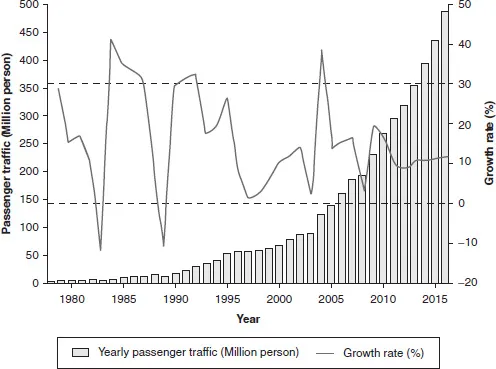
Figure 1.1 Historical air passenger traffic and growth rate since 1978
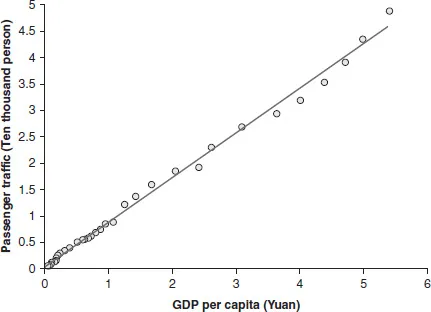
Figure 1.2 The relationship between air passenger number and GDP per capita in China
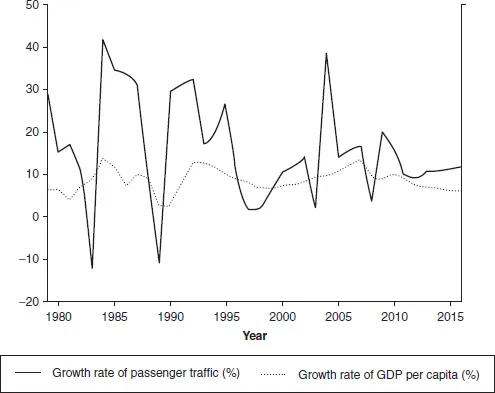
Figure 1.3 The growth of air transportation and economy in China
The sustainably growing air travel demand also stimulates the construction of civil airports in China. As the important public transportation infrastructure of a country, civil airports are the development foundation of the civil aviation industry, and play a key role in the comprehensive transportation system. Since the first version of China’s national civil airports layout planning was put into effect in the year 2008, the number of civil airports has increased remarkably, and the service quality of airports has also improved steadily. Firstly, there were 218 civil airports in service in the year 2016. The coverage of the air transportation service has been continuously extended, and the transportation ability of civil aviation has been improved tremendously. Secondly, the airports in Beijing, Shanghai and Guangdong have gradually become international transportation hubs. Specifically, Beijing Capital International Airport has become the world’s second largest airport in terms of the air passenger traffic; the total cargo throughput of Shanghai Pudong International Airport has ranked third globally.
According to the development objectives of the Civil Aviation Administration of China (CAAC), the number of civil airports will be more than 260 in the year 2020, to fulfill the travel demand of about 700 million persons. In addition, a modern airport system with wide airports coverage and rational airports distribution will be built by the year 2025. At that time, there will be 3 world-class airport groups, 10 international transportation hubs and 29 regional transportation hubs in service, to support the development of the national economy and even the international economy.
Despite the rising role of air transportation in China, there has been a lack of systematic research about the air travel demand forecasting. In the daily aviation management and operations, air travel demand forecasting plays a crucially important role. For both governments and airport authorities, the forecast of future air travel demand is an indispensable decision-making basis of transportation design, planning and operations, and for airline companies, an accurate demand forecast is considered as a determinant for profitability. Take airport management, for example. As nodes of the global air transportation network, airports link economic activities among various countries as well as regions in one single country. No matter which airport becomes congested, activities relying on the air transportation network could be easily delayed or interrupted, causing irreparable losses. Thus, forecasting air travel demand is necessary for daily airport management. Overall, the involved management decisions disperse widely according to time horizons, mainly including long-term financial commitments, facilities expansion or planning, medium-term budgeting, evaluation of specific policies and short-term operations such as staffing, aircraft scheduling, maintenance planning, etc. Therefore, various air travel demand forecasts are required for airports’ future orientation and strategy formulations.
Especially in recent years, the need for forecasting air travel demand has unprecedentedly arisen with the increasingly intensive market competition and rapid market changes. Lack of knowledge and experience in demand forecasting under current dynamic market conditions results in inaccurate market demand forecasts and unsubstantiated operation decisions, consequently. The selection of a proper demand forecasting method can improve the decision effectiveness.
Even though demand forecasting has long been investigated in academic literature, it is still faced with many challenges and considered as a rapidly evolving research field. Therefore, in this book, we provide a comprehensive review and study of air travel demand forecasting methods, and discuss specific forecasting problems within various forecasting time horizons, including short-term, medium-term and long-term. Given the rapid growth of air transportation demand in China, our empirical studies will mainly focus on the Chinese air travel market, to validate the proposed forecasting methods.
1.2 Main forecasting problems
The different forecasting problems may vary widely in many aspects, including the forecasting time horizons, particular management objectives and the frequency of historical data used. Before constructing forecasting models, the first step is to make clear what the forecasting objective is and what type of historical data you can get. Therefore, we will focus on several specific research topics in this book and describe the main forecasting problems in this section.
1.2.1 Short-term forecasting for airport’s passenger demand
Short-term forecasting normally spans a period of 1 to 12 months and is related to such operations as staffing, evaluating competitiveness and projecting equipment needs. For example, an airport might rely on the short-term forecast of total passenger arrivals as a key input for daily operation decisions such as aircraft scheduling, maintenance planning, etc. Thus, forecasting accuracy is particularly important for reducing daily operation cost which could be huge when inappropriate decisions occur. Therefore, how to generate a good demand forecast becomes an inevitable problem for both researchers and practitioners. In this book, we will mainly deal with the following two problems when faced with short-term demand forecasting.
1) Model construction under volatile circumstances
Common methods for short-term demand forecasting include univariate time series models, artificial intelligence (AI) techniques and regression models relying on macroeconomic variables, as well as the combination of these individual models. Univariate time series models, such as Autoregressive Integrated Moving Average (ARIMA) or seasonal ARIMA (SARIMA) models, are widely applied due to the low-cost implementation and a good fitting effect. However, when economic circumstance behaves with high uncertainty and volatility, the superiority of these traditional time series models becomes less evident. This is the main reason for developing AI-based forecasting models, which exhibit great nonlinearity fitting performance. In addition to univariate models, regression models with multiple macroeconomic variables consider demand influencing factors and provide better forecasts when significant changes occur, but the main drawback is the release delay of most macroeconomic variables, which leads to forecasts not being updated in time.
In this book, we will develop a novel combination forecasting technique to integrate advantages of various models and construct a better forecasting model under volatile and complex economic circumstances.
2) Moving holiday effects and seasonal adjustment
For monthly and quarterly historical data, seasonality is one of the most significant data patterns. It is necessary to measure and adjust seasonality in order to understand the underlying historical trends precisely when predicting the future. However, in the lit...
Table of contents
- Cover
- Title
- Copyright
- Contents
- List of figures
- List of tables
- Acknowledgments
- 1 Introduction
- 2 Existing research
- 3 Theoretical basis – TEI@I methodology
- 4 A scientometric analysis of demand forecasting (1975–2015): a visual description
- 5 An integrated short-term forecasting framework with empirical mode decomposition method
- 6 A novel seasonal decomposition-based short-term forecasting framework with Google Trends data
- 7 A medium-term demand forecasting method based on stochastic frontier analysis and model average
- 8 Long-term air travel demand forecasting: an integrated method with ARDL bounds testing approach and scenario planning
- 9 Conclusions and future research
- Appendices
- Index
Trusted by 375,005 students
Access to over 1.5 million titles for a fair monthly price.
Study more efficiently using our study tools.
Frequently asked questions
Yes, you can cancel anytime from the Subscription tab in your account settings on the Perlego website. Your subscription will stay active until the end of your current billing period. Learn how to cancel your subscription
No, books cannot be downloaded as external files, such as PDFs, for use outside of Perlego. However, you can download books within the Perlego app for offline reading on mobile or tablet. Learn how to download books offline
Perlego offers two plans: Essential and Complete
- Essential is ideal for learners and professionals who enjoy exploring a wide range of subjects. Access the Essential Library with 800,000+ trusted titles and best-sellers across business, personal growth, and the humanities. Includes unlimited reading time and Standard Read Aloud voice.
- Complete: Perfect for advanced learners and researchers needing full, unrestricted access. Unlock 1.5M+ books across hundreds of subjects, including academic and specialized titles. The Complete Plan also includes advanced features like Premium Read Aloud and Research Assistant.
We are an online textbook subscription service, where you can get access to an entire online library for less than the price of a single book per month. With over 1.5 million books across 990+ topics, we’ve got you covered! Learn about our mission
Look out for the read-aloud symbol on your next book to see if you can listen to it. The read-aloud tool reads text aloud for you, highlighting the text as it is being read. You can pause it, speed it up and slow it down. Learn more about Read Aloud
Yes! You can use the Perlego app on both iOS and Android devices to read anytime, anywhere — even offline. Perfect for commutes or when you’re on the go.
Please note we cannot support devices running on iOS 13 and Android 7 or earlier. Learn more about using the app
Please note we cannot support devices running on iOS 13 and Android 7 or earlier. Learn more about using the app
Yes, you can access Forecasting Air Travel Demand by Yafei Zheng,Kin Keung Lai,Shouyang Wang in PDF and/or ePUB format, as well as other popular books in Business & Business General. We have over 1.5 million books available in our catalogue for you to explore.