The global financial crash in 2008 stimulated a critical debate about the power of a small number of centres of financial capital, widening inequalities in incomes and a concern for what and who economies are for (Castells et al., 2012). Popular street protests, the Occupy Movement, new political parties, especially in southern Europe, and anti-austerity coalitions reflected a deep unease about ascendant capitalism and its destructive effects on jobs, mortgages, lives, cultures and cities. However, the collective traction of these movements, and their staying power in the face of an emboldened, reasserted and even reformed faith in the market, is often limited as cities struggle to recover via aggressive competition, a leaner state and more efficient models of service delivery. Dikeç and Swyngedouw (2017, p. 7) point to the limitations of post-crash protests and, in particular, argue that ‘An infatuation with spectacular carnivalesque outbursts, combined with global attention, has made them contentious markers of a new political imaginary and potential politicizing sequence.’ The capacity to resist rearticulated urban capitalism raises concerns about the nature of protest and whether it is possible to be successful by sitting outside the processes that force its reproduction on the modern city.
The Social Economy, the State and the City
The latest round of crises also refocused attention on the social economy as a technology to enable the state to withdraw welfare and reduce debt, as well as a survival strategy for the most marginal people and places (Nicholls and Teasdale, 2017). That it might be both and that it is inflected with conformist and radical ideas is at the heart of its own legitimation crisis, as well as its potential as a site of political struggle. The social economy is not new. Pestoff (2009) noted that mutual societies emerged as proto-welfare states in the 19thC and included insurance companies, health mutuals and building societies. Building societies and insurance companies are still significant financial institutions, although many have de-mutualised and restructured as commercial banks in order to find new markets and especially capital. As social business forms become commercially successful, they are co-opted by the market to search out new opportunities for profit, losing anchorage with the interests and values that formed them in the first place (McMurtry, 2015). The story is one of incomplete disembedding of the economic from the social, services from communities and surplus from an ethic of care.
Chapter 3 reviews the various ways in which the social economy is understood and the range of institutional, political, spatial and social perspectives in its scope and content. It is primarily concerned with trading goods and services but where profits are controlled by, and distributed to, a community of benefit (Ridley-Duff and Bull, 2016). It is the concept of solidarity that makes it different, in that it works for a collective set of interests where surplus is linked to ideas of redistribution, inclusivity and equality (McMurtry, 2015). The rediscovery of the sector by policy makers in very different institutional, political and global conditions has tended to focus on the crises of late capitalism and deepening forms of neoliberal rollout. Here, the emphasis is placed on its core economic functions in new legal structures, dedicated financial products and intermediaries that have created a narrow social enterprise culture in which communities and individuals are expected to take on responsibility for services, off-loaded and down-loaded by the state (Nicholls and Teasdale, 2017). A ‘shadow state’ has emerged in the spaces left behind by withdrawal processes but it, in turn, needs to be professionalised, re-skilled and made more business-like to perform in an effective and disciplined way (Trudeau, 2012). Certainly, there is evidence of this shift, especially in the UK and the US, but the sector is a far more variegated and complex actually existing response to a mix of forces well beyond neoliberalising welfare (Kerlin, 2012).
The social economy as the ‘conduct of conduct’ sees it as a ‘liberal Trojan horse’, designed to extend and naturalise markets or quasi-market forms across both the local and central state (McMurtry, 2015, p. 59) or as a flanking mechanism to enable neoliberal roll-out strategies (Trudeau, 2012). Moreover, it has become preoccupied with ‘inspiring examples and anecdotes of social purposes’ (Urbano et al., 2010, p. 57), hagiography and celebrated ‘war stories’ (Blundel and Lyon, 2015, p. 7) and inflated claims about its size and capacity as it appropriates sectors with only a thin connection to its values (Teasdale, 2011). Others argue that it is dominant in localised markets or low-grade labour sectors with weak value-added for its participants (Sunley and Pinch, 2014). Ultimately, its contradictory legitimacies mean that its economic capacity is muted by its social conscience in a way that will never rival predatory markets or an overbearing state (Nicholls, 2010).
In this explicitly reactionary reading, the social economy fits neatly with the neoliberal emphasis on dismantling state institutions and services, marketisation and shifting responsibility onto the independent sector (Peck and Tickell, 2002). However, the relationship between the economy and neoliberalism as a somewhat vague collection of socio-cultural, political and institutional processes, is itself poorly articulated:
In many cases where neoliberalism has been drawn deeper into culture, power and ideology, these elements tend to be over articulated at the expense of under articulated economic foundations. The problem this creates is not only that of an imbalance between an over-theorized, ideo-political superstructure perched on an undertheorized economic base, but of an absent interlocking rationale that connects them together into a congruent whole to demonstrate the desired direction of causality.
(Venugopal, 2015, p. 175)
All of this highlights the conceptual and empirical limitations of an omnipresent neoliberalism meeting an omnipresent conservative social economy. This book argues that a deeper understanding of the sector, and how it functions in urban conditions, does buy into and needs to buy into a certain form of marketisation, but looking at how it functions as an economy is also a key site of modern urban struggle. It is clearly never a complete answer, only a pragmatic space to make alternatives to the market by confronting it on its own terms, rules and logics.
Rolling Back and Rolling Out
Wall (2015) points out that the largely Keynesian architecture of global finance that emerged in the post-war period aimed primarily to smooth out obstacles to global transfers, regulate instability and enable the extension of reconstructive capitalism. The crises of stagflation that accompanied de-industrialisation, new production sites and the rise of a more flexible service economy exposed the limits of the Bretton Woods Agreement. It also signalled a new order shaped by the Washington Consensus, the liberalisation of controls, regulatory agreements and easing the flow of capital and international aid. The General Agreement on Trade and Tariffs (GATT), now the World Trade Organisation (WTO), aimed to remove barriers to trade in order to accelerate economic growth, and the International Bank for Reconstruction and Development, or World Bank, was established to lend money for infrastructure damaged or depreciated by war and underinvestment. Finally, the International Monetary Fund (IMF) offered credit to countries with balance of payment deficits, but as Wall argues, the 1980s saw these realign to stimulate exacting neoliberal outcomes, discipline ‘beneficiaries’ and align with the interests of an essentially US corporate elite:
Since the 1980s, the IMF, WTO and World Bank have advocated the so-called Washington Consensus of financial austerity (government spending cuts), privatisation and market liberalisation. Swept along by the neoliberal counter-revolution against Keynesian economics, the consensus argues that for development to occur, barriers to the market should be swept away... Advocates of the Washington Consensus argued that the poorest countries in the world should cut government spending and increase taxes to reduce indebtedness. The tax burden should, of course, fall on ordinary citizens; taxes on profits would discourage investment and enterprise. State assets should be privatised as thoroughly as possible, while barriers to free trade should be swept away.
(Wall, 2015, p. 23)
Domestic policies are encouraged to promote export-led growth, rules on capital flows stripped to a minimum and domestic policies in planning, environmental protection and business compliance deregulated to remove barriers to development. Moreover, countries that fail to comply risk disinvestment, discipline by global institutions and financial destabilisation. Controlling inflation often means that the poorest countries need to cut spending to prevent prices rising, yet joblessness and low economic growth are far more damaging to both national economies and the poor. Wall shows how countries such as Botswana, which reached some of the highest economic growth rates in Africa, concentrated wealth among the already wealthy, increased poverty, saw AIDS spread and marginalised women in this new neoliberal era.
Chang and Grabel (2014) also show that neoliberalism has increased inequalities between countries, partly because of the concentration of private capital flows within countries and partly because of a lack of wage protection, de-unionisation and cuts to welfare. They point out that international capital flows involve both state and private actors, including capital transfers between governments, multilateral organisations and international aid and foreign direct investment. Developing countries receive comparatively small amounts of global private capital and when they do, their effects are often short term, uneven and destructive:
The liberalization of international private capital flows will be allocated by markets rather than governments. This shift in the allocation mechanism increases efficiency and ensures that finance will be directed towards those projects that promise the greatest net contribution to social welfare. These, of course, will be the projects promising the highest rates of return.
(Chang and Grabel, 2014, p. 110)
The search for returns encourages speculation-led development, which as the latest financial crises shows, results in unstable currency regimes and a concentration of power in a small cadre of ungoverned and ungovernable financiers. In contrast, Chang and Grabel (2014) show that income inequality has increased faster in countries that embrace the neoliberal model, including the US and the UK, than in those that still maintain social protection systems, such as Sweden. In particular, they find little evidence that wealthy countries have achieved their economic success through an unfettered commitment to free markets. For example, they point out that countries with large and well-resourced State-Owned Enterprises (SEOs), including France, Austria, Scandinavian nations and the most successful economies in South East Asia, are the fastest growing, with high per capita incomes (relative to highly privatised countries) and significantly lower rates of social inequality.
Wall (2015) shows how Structural Adjustment Programmes (SAPs), pursued by the IMF and the World Bank, have devastated the economies of Sub-Saharan Africa by placing an emphasis on export-led growth, which has, in turn, depressed the price of home grown commodities in the interests of Western consumers. IMF policies, he charges, have led to the collapse of the Somalian economy, a catastrophic famine and, ultimately, a prolonged civil war. This new form of ‘super-imperialism’ has been accompanied by enclosure and ecocide through the intensification of agriculture, raiding resources for industrial scale farming and the displacement of millions of people for infrastructure projects (Wall, 2015, p. 63). Credit rating agencies monitor the performance of countries against a narrow range of metrics dictated by the IMF and the World Bank with disastrous consequences for the borrowing capacities of those who fail to make the grade. Here, poverty interventions are about buying-off and mutating dissent and providing just enough to supress violence without altering the conditions that privilege the financial interests of the global North (Roy et al., 2015).
Liberia emerged from two brutal civil wars with significant damage to road, port, power and water infrastructure, its industries wrecked and public services decimated as it confronted the outbreak of Ebola. The World Bank, the US government agency called the Millennium Development Commission, the IMF, EU and China all piled in to help, or rather mobilise, around a particularly aggressive form of creative destruction in raiding the country’s assets. The main hydroelectric power station in Liberia is being rebuilt with foreign aid, but the price is to regulate (or deregulate) the energy sector to enable the plant to be sold to (overseas) investors. Proposals to reduce the sovereign fishing limit from six to three nautical miles would guarantee access to foreign factory ships, and rebuilt rail and port infrastructure have enabled raw ore to be extracted and shipped to other production sites and customers more efficiently.
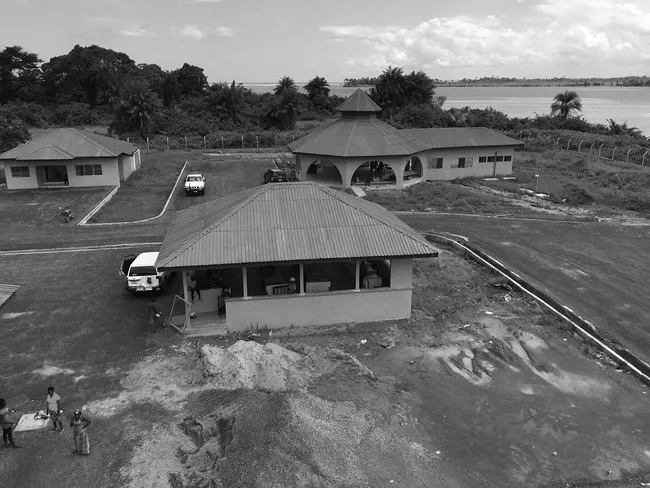
Common resources, such as mangrove forests and rubber plantations, have been privatised or enclosed, tearing them from cultural rituals and the community husbandry that renewed them over centuries. Communities are encouraged to protect the mangrove forests with the promise of new jobs and incomes in tourism and conservation, laudable in itself, but it is difficult to see where and how this alternative economy will materialise in practice. In the small fishing village of Robertsport, international aid has helped to develop a new storage and processing facility to enable the artisanal fishing community to increase supply, distribution networks and prices (Figure 1.1). However, there is uncertainty about electricity connections, road access and most of all, who will operate the facility and whether it can be sustained as a going concern. The social economy, a co-operative and access to capital might help, but traditions of sharing and exchange, skills and governance capacity and access to cheap finance reveal their limitations as transferable solutions for the world’s poor. One of the most depressing aspects of local development in Liberia is that communities, public officials, NGOs and progressive donors all know that the rules of the game are stacked and uneven and who the winners and the losers are. The price of basic services and facilities is a high one for resource-cursed regions, as wealth and assets are extracted by global regimes, in which solidarity economics have limited room for manoeuvre.
Figure 1.1 Fish processing facility in Robertsport, Liberia.
Reprinted by permission of Stephen Akester.