Poland is a particularly interesting case of truth revelation and transitional justice in a post-communist country. This is because of the radical change of trajectory in its approach to dealing with the communist past, and the profound effect this had on Polish politics. The approach moved from 'communist-forgiving' in the early 1990s, to a mild law vetting individuals for their links with the communist-era security services at the end of the decade, through to a more radical vetting and opening up of the communist security service files in the mid-2000s. This book examines the detail of this changing approach. It explains why disagreements about transitional justice became so prominent, to the extent that they constituted one of the main causes of political divisions. It sets the Polish approach in the wider context of transitional justice and truth revelation, drawing out the lessons for newly emerging democracies, both in Eastern Europe and beyond.
eBook - ePub
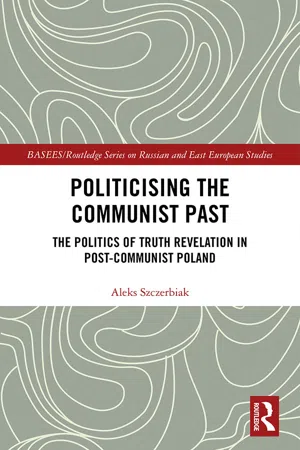
Politicising the Communist Past
The Politics of Truth Revelation in Post-Communist Poland
- 206 pages
- English
- ePUB (mobile friendly)
- Available on iOS & Android
eBook - ePub
Politicising the Communist Past
The Politics of Truth Revelation in Post-Communist Poland
About this book
Information
1Introduction
What are truth-revelation procedures and why do they matter?
This chapter sets out the conspectus for the book. It defines lustration as vetting or screening individuals, generally public officials and other prominent individuals, for their past associations and links with the communist regime that were kept secret from the public. It explains why I have adopted the distinctive and relatively novel approach of examining lustration broadly as a ‘truth-revelation procedure’ in conjunction with the issue of communist security service file access.
Having previously been one of the most under-researched and scantily understood areas of transitional justice, the former Soviet Union and Eastern bloc has become a growing area of research and academic discussion in recent years. Although it started as a subject for historians and lawyers primarily, there is now an expanding political science literature that looks at the measures taken by the former communist states to deal with past atrocities and overcome the legacy of communist dictatorship.1 However, despite the existence of a large and expanding comparative literature on this topic, the late implementation of lustration and access to communist-era security service files – together with the intense, ongoing and recurring politicisation of the issue – in countries like Poland remains something of a puzzle. Poland moved from a communist-forgiving approach that avoided radical transitional justice measures in the early 1990s, to passing a mild lustration law and legislation to open up communist secret service file access at the end of the decade, and then to a more radical lustration and file access law passed in the mid-2000s, while the issue of communist security service collaboration retained the capacity to constantly surface and re-surface in Polish political debates even decades after the collapse of the communist regime. It is this puzzle, of ‘late’ and recurring lustration and communist security service file access, that this book seeks to address.
This introductory chapter begins by reflecting upon the various definitional debates in the comparative literature that have sought to answer the questions of (a) what are lustration and truth-revelation procedures and (b) how do they fit with other transitional justice measures? It examines why it is important to focus on truth revelation in general, and lustration in particular, as a (if not the) key transitional justice mechanism for (and certainly among the most controversial means) of dealing with the non-democratic past in the post-communist states of Central and Eastern Europe. It also makes the case for examining lustration laws in conjunction with the question of the regulation of access to the archives and files compiled by the communist-era security service more generally. The chapter concludes by setting out the conspectus for, and structure of, the rest of the book.
So, what are lustration and file access? How do they fit in with other transitional justice measures? And why are they important to examine, particularly in relation to the way that post-communist states have pursued transitional justice? Stan (2009b) defines transitional justice as ‘the measures and policies adopted by governments and civil society actors to address, and possibly redress, legacies of widespread and systematic human rights abuse, mass atrocity, genocide or civil war’. Similarly, drawing upon Kritz, Horne (2014, p. 496) defines it as ‘a broad set of measures by which society confronts the wrongdoings in its past with the goal of obtaining some combination of truth, justice, rule of law and durable peace for the future’. According to Nalepa (2010a, p. 165), the transitional justice literature is ‘an inter-disciplinary field concerned with how democracies deal with collaborators of the past regime’. It has, she argues, both a normative component, originating in the literature on legal and constitutional theory that examines possible reasons for (and problems created by) retroactivity, and a positive component trying to explain empirically occurring phenomena such as why democracies try and right wrongs, who are the actors responsible for implementing transitional justice measures, and whether or not these institutions have led to reconciliation.
The repertoire of transitional justice procedures is vast and diverse, but, as Nalepa (2010a, p. 5) points out, can be divided into four broad sets of measures. The first is using court trials and criminal proceedings to bring to justice prominent or representative members of the former dictatorial regime, particularly those who are accused of being perpetrators of human rights violations. This can include both high-ranking dignitaries and low-ranking officials such as secret service officers and agents. Second are compensation packages for victims and/or their surviving relatives, such as official apologies; monetary compensation; and restitution of rights to, and the return of, property expropriated by the former regime. Third are legal or symbolic acts directed against the former regime, such as legislation condemning it and expropriating the former rulers of their assets; programmes to re-write history textbooks in order to better reflect the plight of the victims of the regimes; changing the names of streets and localities; opening new museums and exhibitions; and removing statues associated with the regime. Fourth are what might be termed truth-revelation procedures (Kaminski and Nalepa 2006; Nalepa 2008). In the post-communist context, these have included vetting public officials and other prominent individuals for their links with the former regime’s security services as either secret police officers or informers, and possibly banning them (together with other prominent or representative members of the former regime) from public office and positions of influence in society. They have also involved de-classifying and providing access to the extant secret archives and files of the former communist security services for public inspection. In other contexts, truth-revelation procedures have also involved establishing historical or ‘truth’ commissions, temporary bodies of formal inquiry appointed to re-examine the past and document the repressive activities of the previous regime, sometimes with the objective of achieving societal reconciliation.
Why is it worth focusing particularly on lustration and other truth-revelation procedures as transitional justice mechanisms in the post-communist context? Lustration was one of, if not the, most important and controversial transitional justice methods used in post-communist Central and Eastern Europe. The region was the first to embrace it so comprehensively, and it has remained an important means of dealing with the communist past; so much so that, as Stan (2009c, p. 12) put it, ‘[many] observers have employed it as a yardstick for measuring the progress of transitional justice in Eastern Europe and the former Soviet Union’. This could be attributed in large part to the level of societal surveillance by the communist authorities, as such infiltration by informants became the prevalent means by which communist regimes harassed their opponents. This was particularly the case towards the end of communist rule, as the random terror and enforced societal mobilisation of the Stalinist totalitarianism gave way to the atomisation and pervasive mass surveillance that characterised the so-called ‘post-totalitarian’ period (Linz and Stepan 1996, pp. 42–51). For example, according to Stan (2009d, pp. 76–77), the total number of full-time communist security service agents in Poland increased from 10,000 in 1957 to 25,600 in 1985, while the number of secret informers reached 98,000 in 1988. As a consequence, across the communist bloc, hundreds of thousands of citizens were functionaries of, or collaborators with, the internal security services, leaving these countries to have to deal with what Linz and Stepan (1996, p. 251) dubbed an ‘informer legacy’.2
The term ‘lustration’ had long been used by Slavophone archivists simply to refer to the compilation of an inventory or register. To lustrate someone was to check whether their name appeared in a database. The term was more widely adopted not because, as is commonly alleged, of its etymological association with ancient Roman rites of purification, but because politicians and the public heard it used by bureaucrats during battles for control of Czechoslovak files in the early 1990s. Definitional debates over the term have focused on whether it should encompass the exclusion from, or limiting of access to, certain offices or simply vetting individuals to identify those who worked for and collaborated with the communist secret services without any such consequences flowing automatically; and whether this vetting and exclusion should also include communist party officials above a certain level and those who held senior positions within the party-state bureaucracy more generally. David (2003, p. 388), for example, defines lustration as ‘the examination of certain groups of people, especially politicians, public officials, and judges, to determine whether they had been members or collaborators of the secret police, or held any other positions in the repressive apparatus of the totalitarian regime’ (emphasis added). Similarly, Stan (2009c, p. 11) defines it as ‘the banning of communist officials and secret police officers and informers from post-communist politics and positions of influence in society’ (emphasis added). Horne (2014, p. 500) conceptualises lustration as
a legislatively mandated and legally constrained process by which the backgrounds of certain public and some quasipublic/private officials are examined to determine whether they were members of, or collaborators with, the secret police, or whether they held certain positions in the former communist regime
(emphasis added)
although she leaves open the question of whether it entails removal from office or position.
My own preference is to adopt the Polish convention, which defines lustration as being aimed at revealing whether an individual (generally an occupant of, or candidate for, a particular post) had links with the communist regime that were kept secret from the public, such as working, or collaborating as an informer, for the communist security services. Leadership (or even membership) of the communist party or employment in other branches of the party-state bureaucracy was more openly known. In terms of whether consequences follow automatically, reflecting the broader vernacular usage of the term across the region,3 I would argue that lustration includes all forms of vetting and file access and not simply those which carry the consequence of (automatic) exclusion. Consequently, here, as in earlier papers that I have written or co-written (with Williams and Fowler) on this topic, I define it as ‘measures directed against former officers of and collaborators with the state security apparatus’ (Williams et al. 2005, p. 23). As I pointed out in a single-authored paper, this could include
simply vetting or screening individuals for past associations with the communist security services without any sanction necessarily following (other than the damage to their reputation that the disclosure of this information could cause) … [rather than necessarily also] then attempting to automatically exclude them from public life on the basis of such links.
(Szczerbiak 2002, p. 553)4
Moreover, although the terms ‘lustration’ and ‘de-communisation’ are often used interchangeably, I would argue that it is important to distinguish the two processes, with the latter referring to the wider removal from public life of the former functionaries of the communist party or related institutions (generally above a certain rank).5 In other words, here I understand and have defined lustration as vetting or screening individuals – generally occupants of, or candidates for, particular posts, such as public officials and other prominent individuals – for their past associations and links with the communist regime that were kept secret from the public, such as functionaries of or collaborators with the communist-era state security services, without any sanctions (such as banning them from public office or positions of influence in society) necessarily following.
Moreover, lustration, in the sense of truth revelation, depends a great deal upon access to the extant secret archives compiled by the communist-era security services. So, one can only get to grips with the issue properly by studying it both as a ‘personnel system’ (David 2011) or (regionally specialised) ‘employment vetting policies’ (albeit with moral cleansing features) (Horne 2014) and also – or perhaps, more accurately, even more so – more broadly as a ‘truth-revelation procedure’ in conjunction with the issue of de-classifying and opening up these archives and files for public inspection. Indeed, as we shall see, in Poland after the passage of the 1998 law that granted access to security service files to journalists, historians, researchers and some individuals – and in other countries that granted such access – there was also a great deal of ‘informal’ screening of individuals and groups not covered by the procedures set down in the lustration law, and public identification of former agents, conducted by state and non-state actors. Consequently, it is only by examining both lustration as a personnel and employment policy and the question of access to the communist-era security service files that one can get to grips properly with this issue in post-communist states. That is the distinctive and relatively novel approach that I have taken in this book.
This book aims to tackle three key questions: (a) Why do truth-revelation debates recur in post-communist Poland? (b) To what extent was such recurrence explained by instrumental-strategic or programmatic-ideological factors? and (c) Was recurrence popular demand- or political elite supply-driven? In order to get to grips with these questions, the book is structured as follows.
Chapter 2 surveys the progress of, and debates surrounding, the various attempts to introduce lustration and file access laws in post-1989 Poland. It reflects on why Poland is interesting as a case of late (and recurring) lustration and file access and debates about truth-revelation procedures. The chapter shows how this significant delay in introducing legislation, and the recurrence of these issues in political debate, was one of the most striking features of transitional justice in post-communist Poland – indeed, one of the leitmotifs of post-1989 Polish politics more generally – and identifies it as a phenomenon that requires further analysis and explanation. In doing so, it locates the Polish case within the various comparative and theoretical analytical frameworks and typologies that have been developed to categorise lustration laws and so-called ‘lustration systems’, together with cases of truth revelation and transitional justice that have occurred, in other post-communist states. As an archetypal case of late and recurring lustration and communist security service file access, the Polish case provides us with an excellent basis for developing frameworks to explain the phenomenon of ‘late’ and recurring lustration laws and file access debates. Examining the politics of truth revelation in post-communist Poland can both allow us to draw broader conclusions about lustration and transitional justice in Central and Eastern Europe, particularly with regard to the phenomenon of so-called late and/or recurring lustration, and provide valuable insights into patterns of post-communist politics more generally.
Chapter 3 examines the existing comparative and theoretical academic literature that has developed in recent years, including my own analytical frameworks, to understand and explain patterns of transitional justice and truth revelation in the post-communist states of Central and Eastern Europe, and specifically to tackle the extent and recurrence of ‘late’ lustration and file access in countries such as Poland. It shows that these approaches often divide into two broad schools of thought. First, there are authors who focus on parties’ political and electoral-strategic motives, what might be broadly termed the ‘politics of the present’ approach (which I, among others, developed in my earlier collaborative work). Second, there are those who argue that the motives for pursuing transitional justice may be more ideologically, programmatically – and, thus, more normatively – driven. On the basis of this analysis, it explains the shortcomings in existing approaches to explaining the phenomenon of late truth revelation in post-communist democracies. It considers whether ‘politics of the present’-type approaches need to be modified to re...
Table of contents
- Cover
- Half Title
- Title
- Copyright
- Contents
- List of tables
- Preface and acknowledgements
- 1 Introduction: what are truth-revelation procedures and why do they matter?
- 2 Truth revelation in post-communist Poland: a case of late (and recurring) lustration and file access
- 3 What drives late truth revelation? Electoral-strategic interests or ideological-programmatic concerns (or both)
- 4 Truth revelation and post-communist democratisation: the revival of lustration and file access debates in the mid-2000s
- 5 The ‘Bolek’ affair: using truth-revelation procedures for political legitimation and de-legitimation
- 6 Communist-forgiving or seeking historical justice? Public attitudes towards truth revelation and dealing with the communist past
- 7 Conclusions: the unfinished business of a contested transition?
- Appendix: list of interviewees
- Index
Trusted by 375,005 students
Access to over 1.5 million titles for a fair monthly price.
Study more efficiently using our study tools.
Frequently asked questions
Yes, you can cancel anytime from the Subscription tab in your account settings on the Perlego website. Your subscription will stay active until the end of your current billing period. Learn how to cancel your subscription
No, books cannot be downloaded as external files, such as PDFs, for use outside of Perlego. However, you can download books within the Perlego app for offline reading on mobile or tablet. Learn how to download books offline
Perlego offers two plans: Essential and Complete
- Essential is ideal for learners and professionals who enjoy exploring a wide range of subjects. Access the Essential Library with 800,000+ trusted titles and best-sellers across business, personal growth, and the humanities. Includes unlimited reading time and Standard Read Aloud voice.
- Complete: Perfect for advanced learners and researchers needing full, unrestricted access. Unlock 1.5M+ books across hundreds of subjects, including academic and specialized titles. The Complete Plan also includes advanced features like Premium Read Aloud and Research Assistant.
We are an online textbook subscription service, where you can get access to an entire online library for less than the price of a single book per month. With over 1.5 million books across 990+ topics, we’ve got you covered! Learn about our mission
Look out for the read-aloud symbol on your next book to see if you can listen to it. The read-aloud tool reads text aloud for you, highlighting the text as it is being read. You can pause it, speed it up and slow it down. Learn more about Read Aloud
Yes! You can use the Perlego app on both iOS and Android devices to read anytime, anywhere — even offline. Perfect for commutes or when you’re on the go.
Please note we cannot support devices running on iOS 13 and Android 7 or earlier. Learn more about using the app
Please note we cannot support devices running on iOS 13 and Android 7 or earlier. Learn more about using the app
Yes, you can access Politicising the Communist Past by Aleks Szczerbiak in PDF and/or ePUB format, as well as other popular books in Social Sciences & Regional Studies. We have over 1.5 million books available in our catalogue for you to explore.