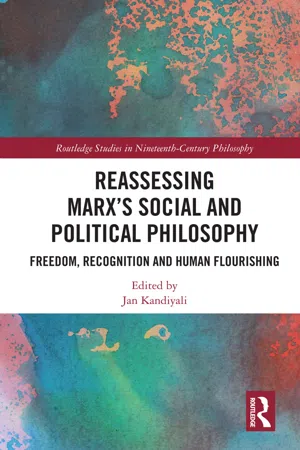
Interest in the study of Marx's thought has shown a revival in recent years, with a number of newly established academic societies, conferences, and journals dedicated to discussing his thought. This book brings together distinguished and up-and-coming scholars to provide a major re-evaluation of historical issues in Marx scholarship and to connect Marx's ideas with fresh debates in contemporary Anglo-American social and political philosophy. Among the topics discussed are Marx's relationship to his philosophical predecessors—including Hegel, the young Hegelians, and the utopian socialists—his concept of recognition, his critique of liberalism, and his views on the good life. This book will be of interest to scholars and advanced students interested in Marx, Hegel, the history of political thought, and social and political philosophy.
eBook - ePub
Reassessing Marx’s Social and Political Philosophy
Freedom, Recognition, and Human Flourishing
- 278 pages
- English
- ePUB (mobile friendly)
- Available on iOS & Android
eBook - ePub
Reassessing Marx’s Social and Political Philosophy
Freedom, Recognition, and Human Flourishing
About this book
Information
Part I
Marx and his Predecessors
1 Perfectionism, Alienation and Freedom
From the German Idealists to Marx
Hegel’s Philosophy of Right has been recently described as a kind of theodicy justifying the modern world (at least in its essential tendencies), and demonstrating that the claims it makes upon modern subjects are not mere limitations, but necessary and legitimate conditions for the exercise of freedom.1 The rationality of the real in Hegel, however, does not preclude a critical rather than exclusively affirmative engagement with modern institutions and practices. Two forms of irrationality continue to haunt the public realm: the defects of ‘positivity’, or the vestigial survivals of historical institutions which, if once rationally valid, are no longer capable of satisfying the evolving demands of reason;2 and what we might call (self-)misrecognition, or systematic misconstrual of the possibilities of emancipation that the modern world offers. By focusing here on the second kind of negativity, it is possible to identify an implicit ‘ought’ in Hegel, which places him in closer proximity to his Leftist followers. Of particular interest will be Karl Marx, and his complex relation to this tradition: Marx’s specific version of post-Kantian perfectionism.
The Philosophy of Right and Modern Freedom
In the logical structure of Hegel’s Philosophy of Right, seminal moments of negativity illustrate the defects of one form of experiencing freedom, and the need to reformulate the standpoint of practical reason. Among these transitions, ranging from crime at the end of Abstract Right, to war at the end of the theory of the state, perhaps none is more controversial than the movement from Morality to Ethical Life. Paragraph 140 of the Philosophy of Right,3 and Hegel’s illustrative remarks to it, are meant to demonstrate the failure of the subjective moral standpoint to ground adequately the imperatives which govern moral activity, and the norms of rational agency in general. Here Hegel offers a sharp critique of the vacuity of Romantic ideas of freedom, especially as encapsulated in Friedrich Schlegel’s conception of irony: a chasm between subjects and their deeds, a mere irresponsible toying with objectivity, a retreat of subjectivity into its own isolated domain.4 These remarks have been taken by eminent commentators to indicate not a flow between these two levels of objective spirit, morality and ethics, but a rupture, a discontinuity between the modern subjective principle, which here attests its bankruptcy, and the ancient substantial order. It is the latter which, on some accounts, finds itself revivified in Hegel’s theory of the rational state. It has appeared to many analysts that Hegel’s critique of subjectivism leads him back to a version of classical substance, or that he finally denies the freedom of the moderns, and reverts to a communal ethical doctrine irreconcilable with this freedom. In influential accounts, Karl-Heinz Ilting and Michael Theunissen argued that the transition from subjective morality to the ethical life of the state in the Philosophy of Right is a signal failure. Ilting described Hegel’s unsuccessful synthesis of two incompatible practical philosophies, based respectively on substantial, naturally given ends, and on liberal natural or rational rights. He contended that Hegel recurs to classical substance to overcome the unbridled particularism of modern subjectivity; but Hegel’s abiding greatness and relevance is to recognize the inadequacy of liberalism as a theory of the modern state and community.5 Following up parts of this argument, Theunissen maintained that in Hegel’s account, subjectivity exhausts itself in the vacuity of the moral standpoint. Both abstract right and the equally abstract moral consciousness demonstrate their nullity, and subjectivity is absorbed back into the substance whence modernity had fleetingly liberated it. This is negation without sublation, as no positive result is left behind by the preceding moments. The state as a unity in and for itself becomes detached from its genuinely intersubjective roots.6 On this view, Hegel reproduces a version of the classical community, sacrificing to it the specific character of modern freedom. Theunissen thus accused Hegel of the very defects that Hegel attributes to Plato, denying subjectivity in favour of community.
Rather than juxtaposing two incompatible principles of subjectivity and substance, an alternative understanding of Hegel’s position is that modern subjectivity, itself riven with conflicts, opens distinct developmental trajectories, or grounds different possible experiences of modernity. In Hegel’s account, the merit of the Enlightenment is that everything exists for the subject; 7 all institutions and relations must be assessed in light of their fitness for subjective projects, and norms bind by virtue of the free subjective judgement and endorsement that underlie them. But the modern subject can be conceived in different ways. Enlightenment materialists revive Epicureanism: the measure of good and bad is pleasure and pain. Happiness is need-satisfaction, not the perfection of rational attributes; or it is the latter only to the extent that these serve an instrumental function in appropriating the material world. The modern materialists also revise Epicureanism: the objective is no longer to minimize pain, but to maximize pleasure. The maximization of pleasures and powers is a necessary weapon in the competitive struggle that describes modern individualism.8 This is a significant shift with respect to the ancient materialists, who shared with their idealist adversaries the idea of the circumscribed places and natural limits that one ought not to overstep, without inviting retribution (in suffering from physical excess, if not in punishment from divine powers). The modern reformulation bespeaks not only the oppositions among possessive individualists, but the idea of growing technical mastery, whereby the natural world is increasingly open to transformation and consumption. It equates freedom with the accumulation and unhindered use of property. Everything exists for the subject in the register of what Kant calls empirical practical reason, or the quest for material satisfaction or happiness. This perspective offers important critical potential, particularly in regard to antiquated and irrational institutions which have persisted into the modern era, what Hegel refers to as ‘positivity’: institutions which hamper the exercise of freedom rather than enabling it, and which have forfeited the rational justification they may once have had. And yet despite their restless appropriating activity, a certain indolence or passivity prevails among subjects so conceived. On the materialist account, their desires are simply responses to the pushes and pulls exerted on them by natural objects; their actions are largely determined by the laws of causality that also operate in physical nature.
Asserted unilaterally, the particularistic and materialist account of freedom outlined above, while it contests one kind of historical irrationality, invites a second kind: a fundamental misrecognition of emancipation as the unbridling of competitive possessive individualism.9 The modern principle of freedom emerges on apparently unfruitful ground, in what Hegel (following Schiller) calls in his Lectures on Aesthetics the culture of diremption,10 where private interests remain locked in stubborn opposition, and any momentarily achieved unity is highly fragile. If it contains unprecedented possibilities for rational freedom, modernity can also appear as an alienated world marked by the shattering of customary relationships; by the loss of wholeness, of the sense of immediacy and connectedness to a community and to nature. The centrifugal forces threaten constantly to overwhelm the integrative capacities of modern institutions. The unfettering of private interests in emergent civil society also releases their opposition and conflict; the division of labour and its mutual dependencies expand global productive power, but constrict the horizons in which its individual agents live and work. With the collapse of the traditional mediating institutions of the old regime, whose passing Hegel does not mourn, and with the social transformations effected by the French Revolution, the pressing political question becomes the reflexive movement from particularity or isolated individuality to community, universality or the reaffirmation of common interests: the achievement of a unity compatible with the underlying diversity that is both the glory and the scourge of the modern world. Thus, Hegel identifies two possible developmental trajectories launched by the Enlightenment and its ensuing transformations: toward new and emancipated forms of social interaction and community, wholly unlike the old discredited forms but informed by freedom and mutual recognition; or toward growing fragmentation, conflict and alienation.
Yet, it is not ancient substantiality, but modern subjectivity itself that contains resources for overcoming the diremptions and alienations which it generates. The merit of idealism is to grasp these possibilities. Its rich conceptions of subjectivity allow a repositioning of individualism from a possessive to a creative register; and with it come new doctrines of sociality consistent with modern freedom. Gottfried Wilhelm Leibniz (1646–1716) is increasingly being recognized as the founder of German idealist philosophy that flourishes with Kant and after.11 He is fundamentally concerned with the calculus of human actions, the laws and principles which govern our deeds and interactions. To explain these movements, Leibniz introduces a conception of freedom as spontaneity, not as unreflective action, but as self-initiating change. Spontaneous changes are not induced by external forces, as in Enlightenment materialism, but are manifestations of the inner powers of subjects, who acquire and display new characteristics in accord with their specific and unique law of development. Such subjects are in constant motion, propelled and directed from within. They do not merely respond to external stimuli as in mechanistic materialism of Thomas Hobbes, but enact their own individualized transformation series, and pursue their specific ideas of the good.12 In developing their own potentialities, however, these subjects are also engaged in a common task, the ethical mission described by Leibniz’s perfectionism: the securing of the unity of unity and multiplicity, where the rich variety of contents is actualized, where implicit potential is fulfilled and rendered objective, and where the efforts of each harmonize to bring about the best possible world, in permanent evolution. Spontaneous subjects form the phenomenal world in light of their purposes, or display their inner subjectivity in objective forms, even if these are merely transient. Everything exists for, and through, the subject. The world of nature and society is constructed or shaped by constant subjective effort: it manifests not simply a given order, as on classical accounts, but a historical result. As such it is open to critical evaluation and reform. Later Leibnizians emphasized, especially in the emergent discipline of aesthetics,13 that such formative shaping does not imply that subject and object will necessarily correspond, or that subjects invariably succeed in giving adequate embodiment to their intentions. Here arises the problem of reflection as the reciprocal relation of self and world, the process by which subjects simultaneously relate to and distinguish themselves from the products of their formative activity,14 assessing their adequacy and revising them according to rational standards.
Kant develops and reformulates the Leibnizian idea of spontaneity not as a kind of internal necessity which governs subjects’ actions, but as the ability to abstract from the motives of sensibility, or as what he calls negative freedom (precisely the kind of freedom that Hobbes denies in his mechanistic account of the determination of the will). This kind of freedom refers to the will’s capacity to exempt itself from external causal determination, and to direct its course according to self-imposed rules. On Kant’s account, humans as imperfectly rational beings are affected by the senses, but not, as Enlightenment materialists maintain, ruled by them, or sensibly determined. For Kant, practical reason endows subjects with the ability to abstract from the workings of natural causes or desires, as these arise in the medium of sensibility; and to initiate changes in the objective world, changes whose origin lies in our practical orientation toward the world, the ways that we take up or relate to externality, rather than in being directly caused by anything foreign to the will.15 In Kant’s account, desires affect the will not as causal forces, but as matter for practical judgements, assessments of their fitness for subjects’ teleological projects. Negative freedom in Kant’s sense is this reflective independence of the will from desires, and the capacity to adjudicate among them; the will is not immediately determined by external causes, but only by causes which it itself admits, or allows to operate.16 Freedom is not the fulfilment of indiscriminate desires, as in Hobbes, but precisely entails the ability to judge on the basis of practical reason. Enlightenment is also a criticism of our own desires, and of their admissibility.
From this sense of spontaneity as negative freedom or non-determination, Kant derives the further concepts of autonomy and heteronomy in his theory of rational agency. Autonomy is action in accord with the moral law, and from duty: it does not depend on divine command or external sanctions, but is self-regulating, or spontaneous. It is freedom in a positive sense, where self-legislating practical reason manifests its hegemony over desire. Heteronomy, or takin...
Table of contents
- Cover
- Title
- Copyright
- Contents
- Acknowledgements
- Introduction
- Part I Marx and his Predecessors
- Part II Marx and Recognition
- Part III Marx and Liberalism
- Part IV Marx and Communism
- Contributors
- Index
Trusted by 375,005 students
Access to over 1.5 million titles for a fair monthly price.
Study more efficiently using our study tools.
Frequently asked questions
Yes, you can cancel anytime from the Subscription tab in your account settings on the Perlego website. Your subscription will stay active until the end of your current billing period. Learn how to cancel your subscription
No, books cannot be downloaded as external files, such as PDFs, for use outside of Perlego. However, you can download books within the Perlego app for offline reading on mobile or tablet. Learn how to download books offline
Perlego offers two plans: Essential and Complete
- Essential is ideal for learners and professionals who enjoy exploring a wide range of subjects. Access the Essential Library with 800,000+ trusted titles and best-sellers across business, personal growth, and the humanities. Includes unlimited reading time and Standard Read Aloud voice.
- Complete: Perfect for advanced learners and researchers needing full, unrestricted access. Unlock 1.5M+ books across hundreds of subjects, including academic and specialized titles. The Complete Plan also includes advanced features like Premium Read Aloud and Research Assistant.
We are an online textbook subscription service, where you can get access to an entire online library for less than the price of a single book per month. With over 1.5 million books across 990+ topics, we’ve got you covered! Learn about our mission
Look out for the read-aloud symbol on your next book to see if you can listen to it. The read-aloud tool reads text aloud for you, highlighting the text as it is being read. You can pause it, speed it up and slow it down. Learn more about Read Aloud
Yes! You can use the Perlego app on both iOS and Android devices to read anytime, anywhere — even offline. Perfect for commutes or when you’re on the go.
Please note we cannot support devices running on iOS 13 and Android 7 or earlier. Learn more about using the app
Please note we cannot support devices running on iOS 13 and Android 7 or earlier. Learn more about using the app
Yes, you can access Reassessing Marx’s Social and Political Philosophy by Jan Kandiyali in PDF and/or ePUB format, as well as other popular books in Philosophy & Philosophy History & Theory. We have over 1.5 million books available in our catalogue for you to explore.