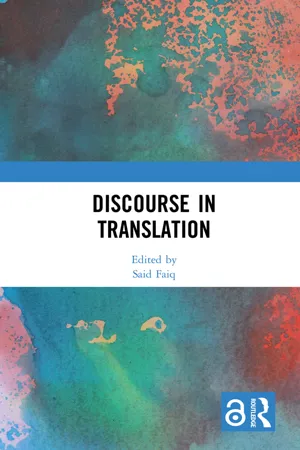
This book explores the discourse in and of translation within and across cultures and languages. From the macro aspects of translation as an inter- cultural project to actual analysis of textual ingredients that contribute to translation and interpreting as discourse, the ten chapters represent different explorations of 'global' theories of discourse and translation. Offering interrogations of theories and practices within different sociocultural environments and traditions (Eastern and Western), Discourse in Translation considers a plethora of domains, including historiography, ethics, technical and legal discourse, subtitling, and the politics of media translation as representation. This is key reading for all those working on translation and discourse within translation studies and linguistics.
- 222 pages
- English
- ePUB (mobile friendly)
- Available on iOS & Android
eBook - ePub
Discourse in Translation
About this book
Information
Chapter 1
Translating ‘translation’
What do translators ‘translate’?
Ernst Wendland
The problem: Will the real ‘translation’ please stand up?
Nowadays, in both contemporary scholarly writings and popular discourse, the term ‘translation’ (‘translate’) appears to be increasingly employed in a secondary, rather than its primary dictionary, sense: ‘to render a written or spoken text from one language to another’ (Agnes 2006: 1521). According to many theorists, ‘Translation has become a fecund and frequent metaphor for our contemporary intercultural world…. Translation is poised to become a powerful epistemological instrument for reading and assessing the transformation and exchange of cultures and identities’ (Arduini and Nergaard 2011: 8, 14). The preceding assertion is typical of a new open-endedness in translation studies, one that endeavours to metaphorically magnify the traditional, text-based understanding of ‘Translation Rigidly Conceived’ (Reynolds 2016: 18) into ‘an epistemological principle applicable to the whole field of humanistic, social, and natural sciences’ (Arduini and Nergaard 2011: 14). For example, ‘whatever a writer writes is to some extent a kind of translation, because that work will be the product that has emerged out of readings of other people’s writing’ (Bassnett 2011: 164; italics added). What is here referred to as ‘translation’ used to be termed ‘intertextuality’ in literary studies, and this statement is simply a specification of George Steiner’s equally overgeneralized notion that ‘human communication equals translation’ (1975, as cited in Reynolds 2016: 23). But how useful is such a flexible, expansible notion of translation to those of us who are actually engaged in the narrower business of text-based interlingual communication?
At the very least, the current elasticity of usage leads to a certain degree of misunderstanding and a lack of clarity with regard to what is being done when translating and what is consequently offered as an end-product,1 for example:
Translation is the performative nature of cultural communication. It is language in actu (enunciation, positionality) rather than language in situ (énoncé, or propositionality). And the sign of translation continually tells, or ‘tolls’ the different times and spaces between cultural authority and its performative practices.
(Bhabha 2011: 20)
The preceding quotation seems to reflect a very different understanding or definition of ‘translation’ than some of us may be familiar with, and yet it goes back to 1994 – over 20 years ago – so where have we been, or what have we been reading in the meantime? This is typical of approaches and proponents of the so-called cultural turn in translation. As part of an initial overview of such a culture-focused view of translation studies in his popular textbook, Jeremy Munday observes that its proponents more or less ‘dismiss’ linguistic approaches to translation ‘and focus on the way in which culture impacts and constrains translation’ (2008: 125; cf. Bassnett 2002: 136). Many of these theorists seek to promote such a cultural turn, for example, as they ‘move from translation as text to translation as culture and politics’ (125; cf. Bassnett and Lefevre 1990: 79–86). But one might question whether such a metaphorical approach represents rather too great of a ‘turn’, for is not translation most explicitly about texts and the messages being transmitted thereby from one language (the ‘source language’, SL) and sociocultural setting to another (the ‘target language’, TL)?
However, that is not how recent theorists are thinking; rather, they seek to broaden the horizons of ‘translation’ considerably:
We welcome new concepts that speak about translation and hope to reshape translation discourse within these new terms and ideas. To achieve this goal, we must go beyond the traditional borders of the discipline, and even beyond interdisciplinary studies…. In an epistemological sphere it becomes less important to distinguish and define clearly what translation is and what it is not, what stands inside the borders of translation and what stands outside.… Translational processes are fundamental for the creation of culture(s) and identities, for the ongoing life of culture(s), and for the creation of social and economic values.
(Arduini and Nergaard 2011: 9–10, 13; italics added)
One begins to wonder, however, within this ‘new paradigm’, sometimes termed ‘translationality’ (Reynolds 2016: 23), does the notion of translation actually ‘mean’ anything specific – other than some sort of general sociocultural transformation as viewed from the perspective of a certain individual’s (or group’s) ‘rhizomatic’ reconceptualization (Arduini and Nergaard 2011: 9)?2 And what are the reasons for asserting that ‘it becomes less important to distinguish and define clearly what translation is and what it is not’ (9)? Is its theory and practice not in danger then of gratuitously entering the purview of disciplines that are much more experienced and capable of dealing with the varied ethnographic and sociocultural issues being referred to?
Perhaps we should turn instead to a philosophical approach for some direction in the search for a more modern definition and associated application of ‘translation’:
Good translation…can be defined as that in which the dialectic of impenetrability and ingress, of intractable alienness and felt ‘at-homeness’ remains unresolved, but expressive. Out of the tension of resistance and affinity, a tension directly proportional to the proximity of the two languages and historical communities, grows the elucidative strangeness of the great translation.
(Steiner 1998: 413)
Unfortunately, there is not much enlightenment available in the preceding opaque observation, which seems to delight in the ‘impenetrable’ interplay of complicated terminology rather than in any coherent meaning. In the case of popular ‘deconstruction’ theory then, we reach the limits of comprehension (or incomprehension), as we must ‘[suspend] all that we take for granted about language, experience, and the “normal” possibilities of communication’ (Munday 2008: 170; cf. Norris 1991: xi). ‘Its leading figure is the French philosopher Jacques Derrida’, who employs terminology that is ‘complex and shifting, like the meaning it dismantles’ (170) – or seeks to destabilize. Accordingly, there can be no ‘relevance’ in translation ‘because, in Derrida’s view, a relevant translation relies on the supposed stability of the signified–signifier relationship’ (171; cf. Derrida 2004: 425). Such a philosophical perspective promotes an ‘abusive fidelity’ that ‘involves risk-taking and experimentation with the expressive and rhetorical patterns of language, supplementing the ST, giving it renewed energy…[tampering] with usage’ (172). The result is inevitably a new text, one that reflects the image of its creator – and hence cannot be called a ‘translation’ in the usual sense at all, certainly not where the scriptures are concerned.
As Munday astutely concludes: ‘[S]uch a translation strategy demands a certain “leap of faith” from the reader to accept that the translator’s experimentation is not just facile wordplay’, which may in fact ‘be easier if the text in question is philosophical’ (177). ‘Facile wordplay’ indeed – so much so that when attempting to read and comprehend the writings of some modern translation philosophers, one requires the assistance of an intralingual ‘translator’ to help decipher them. Back to Bhabha (2011: 24) again for another egregious example:
Translation represents only an extreme instance of the figurative fate of writing that repeatedly generates a movement of equivalence between representation and reference but never gets beyond the equivocation of the sign. The ‘foreignness’ of language is the nucleus of the untranslatable that goes beyond the transparency of subject matter.
Indeed, one wonders if it is possible to translate the preceding quote into any language by any means – except perhaps by a machine that does not know what it is thinking!
The preceding observations illustrate the warning issued by translation theorist Andrew Chesterman that ‘translation studies has been importing concepts and methodologies from other disciplines “at a superficial level” which tends to lead to “misunderstandings” since translation-oriented researchers often lack expertise in the other field and may even be borrowing outdated ideas’ (2005: 19). To give one example: ‘Robert Young’s lecture at the 2013 Nida Research Symposium was devoted to how Freud can be considered a theoretician of translation and how his psychoanalysis can be seen as a form of translation’ (translation 2013). To be sure, the Freudian practice of ‘free association’ would probably not result in a very ‘faithful’ rendition of any given source text, but on the other hand it might at least transform ‘translating’ into some manner of beneficial therapeutic exercise – self ‘empowerment’, for example, which rather mystically ‘involves a three-stage procedure that includes the experience of being translated, then of de-translation, and finally of retranslation of the self’ (ibid., italics added).
In any case, one of the reasons that Bible translation consultants and practitioners need to keep abreast with the new developments and debates in translation studies, including a workable definition of the field itself, is to avoid what Chesterman refers to as superficial or extraneous ‘consilience’ in their own specialized field (as cited in Munday 2008: 197). How might this be done? One method for establishing a firmer conceptual frame of reference would be to revisit our translation ‘roots’ in order to reassess some of the older standard definitions along with related principles and practices that some of us may still be familiar with, including a few updates. As Anthony Pym has recently concluded (2016: 15–16):
Contemporary translation theory has very little time for complex typologies of what translators do…. Our students are learning about translation, or about thought on translation, but not in a way that is in close contact with their actual translation practice…. I am going back to boring old linguistics; I am returning to a field where no empirical advances have been made; I am suspicious of over-theorization; I am turning my back on much that others see as new and exciting in translation studies.
A selective survey of definitions: Where have we come from?
In his masterful survey, Munday defines the ‘process of translation’ rather basically as ‘the translator changing an original written text (the source text or ST) in the original verbal language (the source language or SL) into a written text (the target text or TT) in a different verbal language (the target language or TL)’ (2008: 5; cf. Reynolds 2016: 18). Although Munday decides ‘to focus on written translation rather than oral translation’, or ‘interpretation’ (5–6), the issue of orality and the soundscape of texts is still relevant – for all translators. In any case, one is led to speculate as to what all is involved in this act of intertextual ‘changing’. Similarly, translation may be understood as referring to ‘the process of transferring a written text from SL to TL, conducted by a translator, or translators, in a specific socio-cultural context’ (Hatim and Munday 2004: 6), where again we note a certain degree of ambiguity inherent in the activity of ‘transferring’. Hatim and Mason (1997: 1) view ‘translation’ more specifically as ‘an act of communication which attempts to relay, across cultural and linguistic boundaries, another act of communication (which may have been intended for different purposes and different readers/hearers)’. Compare the preceding with these definitions by two literary translators: ‘Translation denotes the attempt to render faithfully into one language (normally, one’s own) the meaning, feeling, and, so far as possible, the style of the piece written in another language’ (Landers 2001: 10); ‘the most fundamental description of what translators do is that we write – or perhaps rewrite – in language B a work of literature in language A, hoping that the readers of the second language…will perceive the text, emotionally and artistically, in a manner that corresponds to the aesthetic experience of its first readers’ (Grossman 2010: 7). The important emotive-affective and artistic motives of the latter two perspectives are obvious.
Bible translation theorists tend to pay much more attention to the semantic notion of ‘meaning’ in their definitions; for example: ‘Translating consists in reproducing in the receptor language the closest natural equivalent of the source-language message, first in terms of meaning and secondly in terms of style’, that is, formal features of note (Nida and Taber 1969: 12). According to Beekman and Callow, ‘the translation process involves (1) at least two languages and (2) a message – these two essential components of a translation may be called, respectively, (1) form and (2) meaning…[the] formal linguistic elements of a language are what is meant by form – the meaning is the message which is communicated by these features of form’ (1974: 19–20, original italics). De Waard and Nida (1986: 14, 36, 25) describe the translation operation in some detail as follows:
The task of a Bible translator as a secondary source is always a difficult one, since he is called upon to faithfully reproduce the meaning of the text in a form that will effectively meet the needs and expectations of receptors whose background and experience are very different from those who were the original receptors of the biblical documents. The translator must strive to identify intellectually and emotionally with the intent and purpose of the original source, but he must also identify with the concerns of his potential receptors.… The translator, however, wants the receptor-language audience to appreci...
Table of contents
- Cover
- Half Title
- Title Page
- Copyright Page
- Dedication
- Contents
- Acknowledgements
- Contributors
- Foreword: Pragmatics on the hoof! Relevance as effort and reward
- Introduction: Translation as D-discourse
- Chapter 1 Translating ‘translation’: What do translators ‘translate’?
- Chapter 2 Theory and practice in the French discourse of translation
- Chapter 3 Specialist legal interpreters for a fairer justice system
- Chapter 4 Investigating mediation in translation
- Chapter 5 Translation as the instigator of a new Arabic discourse in Islamic intellectual history
- Chapter 6 A toolbox for critical translation analysis in specialized discourse (English/Spanish)
- Chapter 7 Types of connotative meaning, and their significance for translation
- Chapter 8 A case study of modality in legal translation: The Omani constitution
- Chapter 9 The translation of film titles in the Egyptian film industry
- Chapter 10 Strategic media misrepresentation and the Arab–Israeli conflict
- Index
Trusted by 375,005 students
Access to over 1.5 million titles for a fair monthly price.
Study more efficiently using our study tools.
Frequently asked questions
Yes, you can cancel anytime from the Subscription tab in your account settings on the Perlego website. Your subscription will stay active until the end of your current billing period. Learn how to cancel your subscription
No, books cannot be downloaded as external files, such as PDFs, for use outside of Perlego. However, you can download books within the Perlego app for offline reading on mobile or tablet. Learn how to download books offline
Perlego offers two plans: Essential and Complete
- Essential is ideal for learners and professionals who enjoy exploring a wide range of subjects. Access the Essential Library with 800,000+ trusted titles and best-sellers across business, personal growth, and the humanities. Includes unlimited reading time and Standard Read Aloud voice.
- Complete: Perfect for advanced learners and researchers needing full, unrestricted access. Unlock 1.5M+ books across hundreds of subjects, including academic and specialized titles. The Complete Plan also includes advanced features like Premium Read Aloud and Research Assistant.
We are an online textbook subscription service, where you can get access to an entire online library for less than the price of a single book per month. With over 1.5 million books across 990+ topics, we’ve got you covered! Learn about our mission
Look out for the read-aloud symbol on your next book to see if you can listen to it. The read-aloud tool reads text aloud for you, highlighting the text as it is being read. You can pause it, speed it up and slow it down. Learn more about Read Aloud
Yes! You can use the Perlego app on both iOS and Android devices to read anytime, anywhere — even offline. Perfect for commutes or when you’re on the go.
Please note we cannot support devices running on iOS 13 and Android 7 or earlier. Learn more about using the app
Please note we cannot support devices running on iOS 13 and Android 7 or earlier. Learn more about using the app
Yes, you can access Discourse in Translation by Said Faiq in PDF and/or ePUB format, as well as other popular books in Languages & Linguistics & Linguistics. We have over 1.5 million books available in our catalogue for you to explore.