Re-Locating the Sounds of the Western examines the use and function of musical tropes and gestures traditionally associated with the American Western in new and different contexts ranging from Elizabethan theater, contemporary drama, space opera and science fiction, Cold War era European filmmaking, and advertising. Each chapter focuses on a notable use of Western musical tropes, textures, instrumentation, form, and harmonic language, delving into the resonance of the music of the Western to cite bravura, machismo, colonisation, violence, gender roles and essentialism, exploration, and other concepts.
eBook - ePub
Re-Locating the Sounds of the Western
- 150 pages
- English
- ePUB (mobile friendly)
- Available on iOS & Android
eBook - ePub
Re-Locating the Sounds of the Western
About this book
Information
1 The Wild West meets the wives of Windsor
Shakespeare and music in the mythological American West
Theatre historians have long recounted the ways in which Shakespeare’s works were carried to and performed in American frontier towns: they were put on in saloons and in beautiful little opera houses, in crowded mining camps and military outposts, in hotels and brothels striving for elegance. As Jennifer Lee Carrell has written, ‘In the frontier West, the fact that Shakespeare tells good stories, and that those stories should be told well in the West, was no surprise at all – at least not to Westerners’ (Carrell 1998, 107). But what Carrell states can be read in multiple ways: in addition to being told well in the West, Shakespeare is also told well in the West. Shakespeare’s legacy in the West is strong, demonstrated by the numerous Shakespeare festivals and companies spread throughout the region. Many recent productions that have adopted approaches to their adaptations that draw on this legacy and history, locating the action of the plays in a fictional Wild or Old West. Indeed, the stories of the American West and those of Shakespeare are often concerned with the same matters: self-determination, independence, the role of women in a male-dominated society, the pursuit of wealth and power, class issues, gender roles, and violence. The Taming of the Shrew, The Comedy of Errors, The Merry Wives of Windsor, Measure for Measure, Hamlet, King Lear, Othello, Much Ado About Nothing, Two Gentlemen of Verona, Romeo and Juliet, The Merchant of Venice, As You Like It, Cymbeline, and the Henriad have all been staged with settings in the nineteenth-century American West. In many of these, music plays an important role in signifying the West or representing particular aspects of it derived from popular culture and media.
It is important to note that these adaptations are not necessarily seeking to portray the frontier American West as historically accurate, and some plays – notably those in which the role or treatment of women is problematic – are favourite choices for re-locations to a deliberately fashioned quasi-mythical West because of the ways in which our historical understanding and/or creative construction of the period can account for such problems. Thus the imagined West that is seen and heard in these performances of Shakespeare is a highly variable one that often also calls on popular thinking about the Elizabethan period, nostalgia, mythologised accounts of the time and place, cinematic and televisual imaginings of the West, and alternate-reality scenarios. At the same time that these productions bring Shakespeare into the West, they also bring the West into Shakespeare, offering coded narratives of independence and resilience and rebellion that frame early modern stories and help make them relatable to inexperienced audiences. Although the productions I discuss here costume their actors in cowboy hats and boots and add cactuses and a hitching post to the scenery, they are at their hearts Elizabethan works rather than Westerns with Shakespearean language. The plays influenced later aspects of popular culture, which in turn elucidates the plays in novel ways. The language and cruxes of the plays are not altered to fit the West, but the mythological West, with all of its trappings of music, costume, and scenery, which is transported to the Elizabethan, complete with its own attitudes and worldview. Not exactly mirror images, the fantasy West and Elizabethan eras are nonetheless often read as similar enough by the general public to create imperfect but useful and effective reflections of one another, particularly in explicating difficult material or historical social conventions.
Many productions rely on music to signify the psychogeographical space of the mythologised and/or fictionalised Western settings of such adaptations. Even on a bare stage, and without props or actors in noticeably geographically or historically influenced costuming, the mere hint of the traditional sounds of the Western – traditional diatonic harmony; open intervals; simple melodies based on folk music or hymn tunes; rhythms replicating trotting or galloping hooves; and/or the so-called ‘tom-tom’ rhythm (emphasising the first beat of every four crochets) – immediately transport audiences to desert landscapes, wide skies, and the hardships and conflicts of life on the frontier (Kalinak 2012). In this essay, I examine the use of musical tropes frequently categorised as ‘Western’ and their use and function in adaptations of Shakespeare that take place in the West. In these adaptations, the music of the West is not so much displaced in location as it is in time and culture, and often represents social constructions that cross boundaries between Shakespeare’s world, our mediated notion of the American West, and our own present.
In addition to the shared concerns of the American West and Elizabethan England, Western settings are popular re-locations for Shakespeare’s plays because of audience familiarity with the Western. Setting plays about patriarchy, re-inventing oneself, mistaken identities, revenge, the distribution of property, and family feuds in the Wild West – a place and time in which these things are accorded to be the norm of the day – makes many of Shakespeare’s plays more palatable or comprehensible to audiences who might otherwise dismiss them as too difficult, elite, or removed from contemporary experience. Countless reviews of Shakespeare-in-the-West productions cite ‘accessibility’ as a primary cause of shifting the action from Elizabethan or Jacobean England to the period of American westward expansion, but the fact is that the issues many of Shakespeare’s plays deal with are also recurring tropes in the search for American identity. Here I offer three case studies in Shakespearean plays re-located to the American West and analyse the music of each. I begin with the most minimalist example, found in a 2007 Bard on the Beach (Vancouver, B.C.) production of The Taming of the Shrew, and progress to a production with songs added to the action – a 2013 production of The Comedy of Errors by Marin County (northern California) Shakespeare – and finally to a 2004 full-fledged Broadway-style musical adaptation of The Merry Wives of Windsor called Lone Star Love.
These three very different adaptations of Shakespeare use music to signify and depict the American West in radically different ways and through different lenses. To indicate its own ironic approach to the play, The Taming of the Shrew uses the musical motif from a film that mocked traditional Westerns; music for the adaptation of The Comedy of Errors pays problematic homage to the music of the bourgeois 1960’s white-produced Western; and finally, Lone Star Love, or The Merry Wives of Windsor, Texas applies the musical code of the fantasy fun-loving West as heard through the knowingly over-the-top Broadway Americana Westerns Oklahoma!, Paint Your Wagon, and Annie Get Your Gun.
Reframing The Taming of the Shrew as a Western is common in North American playhouses because it offers a setting in which the patriarchal values of the play and Katherina’s desire for independence can be situated in a geographically close and historically recent context. While some Westernised productions of this play rely on a more involved score – music by Claude White for a 1990 Shakespeare in the Park production starring Morgan Freeman and Tracey Ullman was criticised as ‘reeking of manifest destiny in the “Bonanza” key’ (Rich 1990) – the 2007 Bard on the Beach production in Vancouver had a simpler approach in conjuring the atmosphere of the fictionalised American Old West while still retaining the play’s early modern aesthetic. It used a single motif, whistled from off-stage when Katherina and Petruchio made their entrances for the first time.
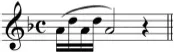
Example 1.1 The whistle of the West: Ennio Morricone’s iconic motif for Sergio Leone’s ‘Man with No Name’ Westerns
This iconic motif, consisting of two semiquaver-note oscillations between A and D followed to a return to A, is in D minor and is, of course, borrowed from Ennio Morricone’s score for Sergio Leone’s 1966 film The Good, the Bad, and the Ugly. This film, along with Leone’s other works, is a ‘spaghetti Western’, made in Italy using an aesthetic that seeks to satirise and demythologise traditional American Westerns. Leone deliberately included what he felt was excessive violence and a number of duels to mock the gun battles that were centre stage in traditional American Westerns of the period. In the American release version of the film, three men cross and double-cross one another as they search for buried Confederate gold. Ultimately, the Good, played by Clint Eastwood as ‘The Man With No Name’, saves the Ugly from death twice, and kills the Bad. The film itself grapples with concepts of morality, how two individuals do and do not work as a team, and how self-reliance and independence are a man’s most valuable attributes. In a number of ways, parallels between the film and the play make the choice of the film’s motif a clever choice with multiple layers of signification.
If we are to believe Kristopher Spencer, this motif – originally assigned to the Eastwood character – is ‘among the most quoted in film history’ (Spencer 2008). It was certainly immediately recognised by nearly everyone in the audience as a musical marker for the production’s place and time. The Good, the Bad, and the Ugly takes place during the Civil War in a nearly abandoned town in the desert West. Through the use of this motif, it was immediately apparent that the Bard on the Beach production of Shrew was set in the same geographical and chronological locations. Bard on the Beach audiences familiar with the film in detail also understood the use of the motif on a second level: neither Katherina nor Petruchio are villains, despite their actions, but protagonists for whom the audience should cheer in their progress from fighters to lovers. The wry use of the motif also indicated that this particular interpretation of Shrew was ironic: notwithstanding their complaints and fighting, Katherina and Petruchio were having a grand time of things, and that in the end, they were in on the bet about women’s subservience together. Throughout, the pair’s delight in the wordplay and bantering dialogue of the play was obvious and infectious, and the actors’ performances were full of honest laughter.
Additionally, the motif functioned as a signifier for both characters individually, tying them to specific elements from The Good, the Bad, and the Ugly. For Petruchio, the motif indicated his role as the Eastwood character, the man who arrives without warning in a new town and promptly disrupts the order of things. It suggested that Petruchio too brought with him his own code of behaviour and morality when he, like the Man with No Name, sought a fortune in a desert town. However, unlike the Man with No Name, who rescues the helpless women caught in the middle of his treasure hunting and revenge plots and re-locates them to other venues without becoming emotionally involved, Petruchio falls for his rich bride, and realises that he has the capability to give her the independence and equality she cannot achieve on her own in their patriarchal culture. Thus the simple musical phrase that heralded the coming of change and a ‘good’ bandit in Leone’s film also represented the embodiment of independence – Petruchio – in Katharina’s life.
For Katharina, or Kate, the motif also functioned as a way of calling up the reasons that she is so angry at the beginning of the show. She lives in a small, desolate town much like the one featured in the film, where her natural intelligence and wit is derided and repressed, and she chafes at the patriarchal rules that prevent her from living a more independent life. The whistle motif can be read as music for Kate’s true nature: self-reliant and even solitary, capable of self-defence and of seeing through the machinations of others, particularly those who would use her as a tool for other means, such as wedding her for her money or using her as a way to access her more conventionally desirable sister.
In using this motif, the Bard on the Beach Shrew cannily channelled the atmosphere of the American West in a singularly unique way. It brought up resonances with the time and place as depicted through a well-known myth-making film, gestured towards the social codes and restrictions in place in that setting, and suggested character attributes that fit with the production’s ethos. In doing so, the company created what Thomas Cartelli and Katherine Rowe call a ‘citational environment’ in which the words and actions of The Taming of the Shrew made sense to a present day North American audience (Cartelli and Rowe 2007, 28–29).
Few productions, however, can rely on just one musical reference to establish the setting or to speak to the other, more complex concerns Shakespeare’s plays often contain. In fact, most adaptations lean the other way, employing multiple musical works in a show. Marin County Shakespeare (MCS) staged The Comedy of Errors (retitled A Comedy of Errors to signal its status as an adaptation) in 2013, giving it an Old West/Old Texas setting. The Comedy of Errors, like Shrew, is one of Shakespeare’s earlier plays, and is a farce built around mistaken identities. The play features two sets of identical twins separated at birth; when they arrive in the same city for the first time, hilarity ensues. It has been adapted several times as a musical, most famously as Richard Rodgers and Lorenz Hart’s 1938 The Boys from Syracuse; a clever 2001 hip-hop version called The Bomb-itty of Errors was also widely hailed as a success.
For this production, the MCS used both pre-existing Western music and new tunes in the style of 1990s country music written for the show, and both principal actors and those playing smaller roles were assigned musical material. The intent of this music was quite different from that of the Bard on the Beach Shrew: where that music mitigated and contextualised serious issues in the playtext and established the interpretation of the playtext as an ironic one, the music for MCS’s Comedy cited popular, mid-century, middle-class, white, suburban stereotypes of stock Western characters through the use of pre-existing songs, and recreated that musical soundscape through the music written for the show in the same style as the music from the 1950s and 60s. Despite their similar styles, these two kinds of music – the old and the new – functioned in radically different ways. Comedy used pre-existing songs to comment on the action as the play was in progress. The inclusion of Lyle Lovett’s ‘Long Tall Texan’ (1996) and Terry Stafford’s ‘Amarillo by Morning’ (1973), both of which trade on Texas stereotypes in a slightly wry way that acknowledges their use of highly homogenised genres, established the presence of such typecast roles: the cowboy (Antipholus), the lawman (Solinus), the rodeo clown (Dromio), and the saloon dancer (the Courtesan) (Anon. 2015e). The pre-existing pieces of music chosen for this commentary were in and of themselves highly cognisant of the stereotypes they employ, and they confront and use the mythologies of the West and the Western loner to express concepts that go against received wisdom or common thinking about such characters. In referencing these very generalised character tropes, the songs indicated that this particular Western setting was an amalgamated, mythological place populated by characters whose outward appearances and manners might cast them as clichéd, but in fact establish Antipholus, Solinus, Dromio, and the others as being removed from their original context and shoehorned into roles that would not be typical or expected in Shakespeare, but would be probable in the American Western movie or television show. To put it simply, the vintage songs functioned in a tongue-in-cheek manner to describe the basic, one-dimensional characters of a standard Western, rather than serving to add familiarity or flavour to the text.
The original music written for the show, however, is neither ironic nor references period music, but instead embraces a sentimentalised, ableist, and gendered view of the West as depicted by mid-century television and film as a place for white expansion and exploitation. Songwriter Leslie Harlib explained that her musical ideas came from country-western songs and the musical film songs of the 1950s and 60s:
Some of the best storytelling comes from the Country-Western genre. So, I tried to create songs that had several elements. The songs reference classical musical theater structure, but have a country western feel. I used contemporary language. I saw the [directors’] desire for original music to be a bridge between Shakespeare and 20th century musical genres that the audience would know and appreciate. I love the way Allan Sherman in the 1960s always took familiar songs and wrote parodies to them that kept the same rhyme and pattern. Everyone knows ‘Home on the Range’. With ‘My Master’s Deranged’, the fit was fun, playing to the storyline yet also making it very clear to the audience that this is a parody of ‘Home on the Range’. I thought of ‘yee-haw’ songs from films with western settings and themes like ‘How the West Was Won’ – when Debbie Reynolds sings ‘Raise a Ruckus Tonight’ or ‘The Unsinkable Molly Brown’ – when they all sing ‘Belly Up to the Bar’. I wanted to capture that same kind of stomp your feet, clap your hands and ‘have some fun’ feeling for the audience.
(Anon. 2015d)
The musical and cinematic imagery cited here speaks to an ethos that comprises the myths of the white family building a new life on the plains, the dance hall girl with the heart of gold, the reformed professional gambler, the noble savage, and the morally ambiguous gunslinger taking down criminals and protecting law-abiders. There is no room here for the Native American, the non-English speaking settler, or others who do not fit the television-perfect Western community except as villains. Harlib’s distillation of the culture of the American West into ‘yee-haw’ indicates that she thinks of the residents of the American West as unsophisticated but pluck...
Table of contents
- Cover
- Title
- Copyright
- Contents
- List of figures
- List of tables
- List of examples
- List of contributors
- Introduction
- 1 The Wild West meets the wives of Windsor: Shakespeare and music in the mythological American West
- 2 The commodification of the Western soundscape
- 3 High-senberg noon: Breaking Bad and the sounds of the West
- 4 Reinterpreting the American Western in Ry Cooder’s soundtrack to Paris, Texas (1984)
- 5 Sonic markers of the science fiction Western
- 6 ‘You can’t build an empire without getting a mite unscrupulous’: music, ethics, and Cold War criticism in Doctor Who’s ‘The Gunfighters’ (1966)
- 7 From the Old West to the new future: Stoney Burke, The Outer Limits, and the Daystar stock music library
- 8 The soundscape of the East German Indianerfilme
- Index
Trusted by 375,005 students
Access to over 1.5 million titles for a fair monthly price.
Study more efficiently using our study tools.
Frequently asked questions
Yes, you can cancel anytime from the Subscription tab in your account settings on the Perlego website. Your subscription will stay active until the end of your current billing period. Learn how to cancel your subscription
No, books cannot be downloaded as external files, such as PDFs, for use outside of Perlego. However, you can download books within the Perlego app for offline reading on mobile or tablet. Learn how to download books offline
Perlego offers two plans: Essential and Complete
- Essential is ideal for learners and professionals who enjoy exploring a wide range of subjects. Access the Essential Library with 800,000+ trusted titles and best-sellers across business, personal growth, and the humanities. Includes unlimited reading time and Standard Read Aloud voice.
- Complete: Perfect for advanced learners and researchers needing full, unrestricted access. Unlock 1.5M+ books across hundreds of subjects, including academic and specialized titles. The Complete Plan also includes advanced features like Premium Read Aloud and Research Assistant.
We are an online textbook subscription service, where you can get access to an entire online library for less than the price of a single book per month. With over 1.5 million books across 990+ topics, we’ve got you covered! Learn about our mission
Look out for the read-aloud symbol on your next book to see if you can listen to it. The read-aloud tool reads text aloud for you, highlighting the text as it is being read. You can pause it, speed it up and slow it down. Learn more about Read Aloud
Yes! You can use the Perlego app on both iOS and Android devices to read anytime, anywhere — even offline. Perfect for commutes or when you’re on the go.
Please note we cannot support devices running on iOS 13 and Android 7 or earlier. Learn more about using the app
Please note we cannot support devices running on iOS 13 and Android 7 or earlier. Learn more about using the app
Yes, you can access Re-Locating the Sounds of the Western by Kendra Preston Leonard, Mariana Whitmer, Kendra Preston Leonard,Mariana Whitmer in PDF and/or ePUB format, as well as other popular books in Media & Performing Arts & Music. We have over 1.5 million books available in our catalogue for you to explore.