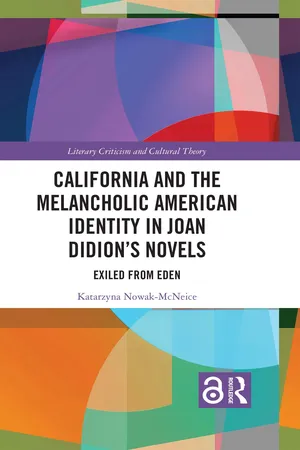
California and the Melancholic American Identity in Joan Didion's Novels: Exiled from Eden focuses on the concept of Californian identity in the fiction of Joan Didion. This identity is understood as melancholic, in the sense that the critics following the tradition of both Sigmund Freud and Walter Benjamin use the word. The book traces the progress of the way Californian identity is portrayed in Joan Didion's novels, starting with the first two in which California plays the central role, Run River and Play It As It Lays, through A Book of Common Prayer to Democracy and The Last Thing He Wanted, where California functions only as a distant point of reference, receding to the background of Didion's interests. Curiously enough, Didion presents Californian history as a history of white settlement, disregarding whole chapters of the history of the region in which the Californios and Native Americans, among other groups, played a crucial role: it is this reticence that the monograph sees as the main problem of Didion's fiction and presents it as the silent center of gravity in Didion's oeuvre. The monograph proposes to see the melancholy expressed by Didion's fiction organized into four losses: of Nature, History, Ethics, and Language; around which the main analytical chapters are constructed. What remains unrepresented and silenced comes back to haunt Didion's fiction, and it results in a melancholic portrayal of California and its identity – which is the central theme this monograph addresses.
eBook - ePub
California and the Melancholic American Identity in Joan Didion's Novels
Exiled from Eden
- 202 pages
- English
- ePUB (mobile friendly)
- Available on iOS & Android
eBook - ePub
California and the Melancholic American Identity in Joan Didion's Novels
Exiled from Eden
About this book
Information
1 The Loss of Nature
The whole gigantic sweep of the San Joaquin expanded, Titanic, before the eye of the mind, flagellated with heat, quivering and shimmering under the sun’s red eye. At long intervals, a faint breath of wind out of the south passed slowly over the levels of the baked and empty earth, accentuating the silence, marking off the stillness. It seemed to exhale from the land itself, a prolonged sigh as of deep fatigue. It was the season after the harvest, and the great earth, the mother, after its period of reproduction, its pains of labour, delivered of the fruit of its loins, slept the sleep of exhaustion, the infinite repose of the colossus, benignant, eternal, strong, the nourisher of nations, the feeder of an entire world.
—Frank Norris, The Octopus
The relationship between Californians and the natural world in Joan Didion’s novels can best be described as problematic: it vacillates between the conquering spirit of the nineteenth-century settlers and what comes close to a modern-day ecological awareness, becoming an anachronistic monument, written by the emigrants’ daughter to commemorate a past that is lost forever: the lost natural paradise that has never been anything more than an ideal. Didion’s writing celebrates the ethical code, found in the idealized, imagined natural world (which is related to the idea discussed further on in this chapter, namely, that California existed first as an ideal before it was put on the map and represented in literature), to which the emigrants were faithful and which was abandoned by their heirs.
In this chapter, I start by sketching out the main paradox underlying the traditional representation of nature in California, linking it to the particular brand that Didion’s prose represents. Nature, obviously a complicated and contested concept, will be understood here to encompass the elements of animate and inanimate landscape, together with the complex, dynamic dependencies that exist between these elements; it is thus a changeable system in which humans are one of the many coexisting parts. This definition of nature is inspired by Aldo Leopold’s land ethic, which he describes as an enlargement of the circle of the community “to include soils, waters, plants, and animals, or collectively: the land”.1 Understanding nature in light of the land ethic means recognizing the call that comes from the land: the land itself issues an ethical demand on people. Rather than drawing on the concept of a higher being as a source of ethics, a more productive framework can be found within what Joanna Żylinska calls “a nonsystemic ethics”,2 inspired by Emmanuel Levinas, which recognizes the ethical call of the Levinasian “otherwise than being”: as Żylinska explains, it is “a place of absolute alterity that cannot be subsumed by the conceptual categories at our disposal”.3 The ethical demand to respond to the other is thus placed outside the system of validation provided by the divine figure; instead, its source is one’s environs. Even though in Didion’s prose, the references to Christianity are clear (and they provide an additional dimension of the ambiguity with which California is represented, as the land is heavenly and hellish at the same time), the ethical demand comes from the land itself. Didion is not the only one to recognize such an injunction: Gary Snyder warns against a situation in which there are “just ‘rights’ and no land ethic”.4 Snyder anchors the ethical call in the Californian context, hinting at Leopold’s classic, “The Land Ethic”, which Carolyn Merchant calls “the modern form of ecocentric ethics”.5 Didion’s characters in Run River and Play It as It Lays try – and fail – to do precisely that: to go beyond their personal, human limitations and enlarge the bounds of community to embrace the land. Thus, the question that Didion poses about the reason and the end of redemption of the overland crossing, and, consequently, the question about human place within nature, must be placed in the context of nonsystemic, ecocentric ethics.
Even though the main landscapes represented in Didion’s first two novels that I analyze in this chapter are the river delta of the San Joaquin Valley and the cityscape of Hollywood, I focus on the representations of a much more sparse and unforgiving landscape, that of the desert.6 For Didion, the desert signals the impossibility of possession of the land and a denial of human ingenuity and power; thus, it becomes a complex symbol of unconquerable nature itself, standing in stark contrast to the supposedly tamed “gardens” of the West. Yet this impossibility of conquering the land goes against one of the main ideas of Didion’s fiction: that of the frontier. As its underlying assumption is an anachronistic one, Didion’s prose proposes to undertake an impossible task: that of presenting California as both a mythical and a historical reality.
Problems with American Nature
The paradox of deified nature can be traced back to the philosopher and poet who influenced American nature writing to an unprecedented degree: Ralph Waldo Emerson; Lawrence Buell calls his Nature “the American locus classicus”.7 Nature, itself divine, bestowing divinity upon humankind which is found in Emerson’s writing, parallels the presentation of a redeeming and redeemed landscape which preoccupies Didion. As he recognizes the importance of Emerson’s writing, Buell also draws attention to its more problematic aspect: “Emerson’s vision of man coming into his godship through the conquest of nature reads suspiciously like an apology for westward expansion”.8 Justification of the push of the frontier would be one of the answers to Didion’s pressing question of the reason of redemption that emigration to the West was supposed to provide. “Know, then, that the world exists for you”, urges Emerson of his fellow Americans, prophesying “the kingdom of man over nature”9 – these are the sentiments that Didion finds challenging in her writing, advocating an examination of the reasons behind Emerson’s confidence, beyond the obvious theological prescriptiveness of Emerson’s brand of Transcendentalism, and beyond the false recognition of Californian nature in terms of a paradisiacal space offering itself to the explorer and the settler.
Problems with the Garden of Eden
Imagining California as the Garden of Eden has a long tradition10; Bernard DeVoto states, “There are two visions of the West which can be neither fused nor fully differentiated. Both are creations of longing and desire”,11 and he notes that one of them is the “everlasting Eden”, or, to evoke Henry Nash Smith’s formulation, “the Garden of the World”.12 Michael Steiner tells us that this vision is universal: “Dreams of promised lands to the West – of new Edens or Elysian Fields shimmering on the horizon – have captivated many cultures across time”.13 Mark Royden Winchell states decisively, “throughout much of American history, the image of California (…) has had a fixed mythic identity”.14 Kevin Starr reminds us of the mythic beginnings of California’s literary existence when he states, “California entered history as a myth”.15 James E. Vance, Jr. makes a similar observation, noting that “the beginning of California, and its pubescence, were both creations of idealization rather than organic life”.16 Starr relates the story of the first mention of California in literature and points to a romance by García Rodríguez de Montalvo, published in 1510 in Seville, entitled Las Sergas de Esplandián. In Montalvo’s novel, California is described as an island – a geographical mistake that persisted for centuries17 – in close proximity to the Earthly Paradise.18 Ruth Putnam, who discusses extensively the etymology of the name, notes that even the first mention of the name carries a certain ambiguity about its meaning. She remarks, “It is just possible that the name ‘California’ may owe its existence to a union of high hopes and deep disappointment”,19 which suggests that exuberant expectations on the one hand and bitter disillusionment on the other are as much distinctive traits of the place as they are characteristics of its name. David Wyatt points to a similar vagueness attributed to California when he states that “California has always been a place no sooner had than lost”.20 He remarks on California’s status as the last frontier and comments on the ambiguity inherent in its being the end point of westward exploration, stating:
So great was the beauty of the land that it conferred on the completion of the quest the illusion of a return to a privileged source. As the sense of an ending merged with the wonder of beginnings, California as last chance merged with California as Eden.21
In a similar vein, H.H. Bancroft describes California as “a winterless earth’s end perpetually refreshed by ocean”, unsurpassed by any mythical land.22 Yet an inherent ambiguity of California as a paradisiacal land is that it is never free from the pressure exerted by economy; Douglas Cazaux Sackman23 suggests that the mythical California “was cultivated by boosters who put their distinctive stamp on nature and used it to advertise California’s attractions and imperial potential”.24 It reveals that the tension between “cultivation” and “nature” is what creates so much trouble: it parallels the need to impose epistemological boundaries combined with an insistence that it simultaneously remain illimitable.25
To perceive California as a Garden of Eden before putting it on the map means to attribute it with distinctive traits which mark it as different from the ordinary human sphere before it is allowed to function as the same. It is reminiscent of what Louis Althusser describes as “space without places, time without duration”26; in other words, it can never be what it promises to be, yet it can never cease promising to be what it cannot be.27
Such ambiguity or even falseness of meaning attached to California is revealed in the text that proved disastrous in a very real, physical sense. In The Emigrants’ Guide to Oregon and California, Lansford Warren Hastings describes California in the following manner:
In a word, I will remark that in my opinion, there is no country, in the known world, possessing a soil so fertile and productive, with such varied and inexhaustible resources, and a climate of such mildness, uniformity and salubrity; nor is there a country, in my opinion, now known which is so eminently calculated, by nature herself, in all respects, to promote the unbound happiness and prosperity, of civilized and enlightened men.28
Hastings’ account enticed emigrants to travel to the brink of the frontier to seek a better future just as it was designed to. In the subtle link that it makes between nature in California and the Declaration of Independence (nature promotes limitless happiness, whose pursuit is guaranteed by the Preamble as one of the “inalienable rights”), Hastings seems to be suggesting that California is the ultimate stage of American development as the earthly paradise for the nations of the world. The problem with his text is that Hastings did not test the route to California, and in particular, he did not survey the cutoff he promoted as the safest and fastest, which contributed to the demise of about forty emigrants from the group known as the Donner Party. To some, California’s paradise proved deadly.29
Joan Didion refers to the stories of the overland pass, including her ancestors’, to call the place where the Donner Party members met their demise “the locale that most clearly embodied the moral ambiguity of the California settlement”.30 Didion upholds this ambiguity; the questions about the meaning of emigration remain unanswered directly, yet they form the core of the problems that interest Didion in her California novels, most importantly in Run River; the novels which suggest that spiritual survival is indeed p...
Table of contents
- Cover
- Half Title
- Series Page
- Title Page
- Copyright Page
- Dedication Page
- Table of Contents
- Acknowledgments
- Introduction
- 1 The Loss of Nature
- 2 The Loss of History
- 3 The Loss of Ethics
- 4 The Loss of Language
- Conclusions
- Works Cited
- Index
Trusted by 375,005 students
Access to over 1.5 million titles for a fair monthly price.
Study more efficiently using our study tools.
Frequently asked questions
Yes, you can cancel anytime from the Subscription tab in your account settings on the Perlego website. Your subscription will stay active until the end of your current billing period. Learn how to cancel your subscription
No, books cannot be downloaded as external files, such as PDFs, for use outside of Perlego. However, you can download books within the Perlego app for offline reading on mobile or tablet. Learn how to download books offline
We are an online textbook subscription service, where you can get access to an entire online library for less than the price of a single book per month. With over 1.5 million books across 990+ topics, we’ve got you covered! Learn about our mission
Look out for the read-aloud symbol on your next book to see if you can listen to it. The read-aloud tool reads text aloud for you, highlighting the text as it is being read. You can pause it, speed it up and slow it down. Learn more about Read Aloud
Yes! You can use the Perlego app on both iOS and Android devices to read anytime, anywhere — even offline. Perfect for commutes or when you’re on the go.
Please note we cannot support devices running on iOS 13 and Android 7 or earlier. Learn more about using the app
Please note we cannot support devices running on iOS 13 and Android 7 or earlier. Learn more about using the app
Yes, you can access California and the Melancholic American Identity in Joan Didion's Novels by Katarzyna Nowak McNeice in PDF and/or ePUB format, as well as other popular books in Literature & Literary Criticism. We have over 1.5 million books available in our catalogue for you to explore.