The fall of the Soviet communist regime in 1991 offers a challenging contrast to other instances of democratic transition and change in the last decades of the twentieth century. The 1991 revolution was neither a peaceful revolution from below as occurred in Czechoslovakia nor a negotiated transition to democracy like those in Poland, Hungary, or Latin America. It was not primarily the result of social modernization, the rise of a new middle class, or of national liberation movements in the non-Russian union republics. Instead, as Gordon Hahn argues, the Russian transformation was a bureaucrat-led, state-based revolution managed by a group of Communist Party functionaries who won control over the Russian Republic (RSFSR) in the mid-1990s.Hahn describes how opportunistic Party and state officials, led by Boris Yeltsin, defected from the Gorbachev camp and proceeded in 1990-91 to dismantle the institutions that bound state and party. These revolutionaries from above seized control of political, economic, natural and human resources, and then separated the party apparatus from state institutions on Russian Republic territory. With the failed August 1991 hard-line coup, Yeltsin banned the Communist Party and decreed that all Union state organs, including the KGB and military were under RSFSR control. In Hahn's account, this mode of revolutionary change from above explains the troubled development of democracy in Russia and the former Soviet republics.Hahn shows how limited mobilization of the masses stunted the development of civil societies and the formation of political parties and trade unions with real grass roots. The result is a weak society unable to nudge the state to concentrate on institutional reforms society needs for the development of a free polity and economy. Russia's Revolution from Above goes far in correcting the historical record and reconceptualizing the Soviet transformation. It should be read by historians, economists, political scientists, and Russia area scholars.
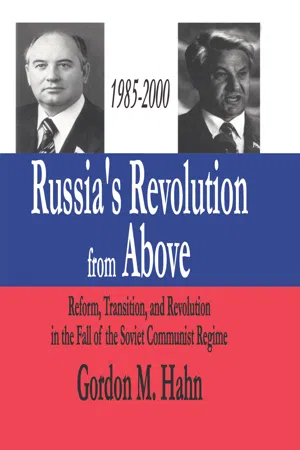
eBook - ePub
Russia's Revolution from Above, 1985-2000
Reform, Transition and Revolution in the Fall of the Soviet Communist Regime
- 618 pages
- English
- ePUB (mobile friendly)
- Available on iOS & Android
eBook - ePub
Russia's Revolution from Above, 1985-2000
Reform, Transition and Revolution in the Fall of the Soviet Communist Regime
Table of contents
- Cover
- Half Title
- Title Page
- Copyright Page
- Dedication Page
- Contents
- List of Tables and Figures
- List of Abbreviations
- Preface
- Acknowledgements
- 1. Introduction: The Model of Revolution from Above
- 2. The Breakdown of Institutional and Political Unity
- 3. The Organization of Political Groups in the Party-State and Society
- 4. Dual Sovereignty from Above and the XXVIII CPSU Congress
- 5. The First Soviet Pact-Making Episode
- 6. Gorbachev’s Turn to the “Right”
- 7. Reaction, Polarization, and Revolutionary Crisis Politics
- 8. The Nascent Soviet Transition Pact
- 9. The Hardline August Coup
- 10. The Revolutionary Seizure of Power and the Aborted Soviet Pact
- 11. Tentative Conclusions About Russia and the Revolution from Above
- Bibliography
- Index
Trusted by 375,005 students
Access to over 1.5 million titles for a fair monthly price.
Study more efficiently using our study tools.
Frequently asked questions
Yes, you can cancel anytime from the Subscription tab in your account settings on the Perlego website. Your subscription will stay active until the end of your current billing period. Learn how to cancel your subscription
No, books cannot be downloaded as external files, such as PDFs, for use outside of Perlego. However, you can download books within the Perlego app for offline reading on mobile or tablet. Learn how to download books offline
Perlego offers two plans: Essential and Complete
- Essential is ideal for learners and professionals who enjoy exploring a wide range of subjects. Access the Essential Library with 800,000+ trusted titles and best-sellers across business, personal growth, and the humanities. Includes unlimited reading time and Standard Read Aloud voice.
- Complete: Perfect for advanced learners and researchers needing full, unrestricted access. Unlock 1.5M+ books across hundreds of subjects, including academic and specialized titles. The Complete Plan also includes advanced features like Premium Read Aloud and Research Assistant.
We are an online textbook subscription service, where you can get access to an entire online library for less than the price of a single book per month. With over 1.5 million books across 990+ topics, we’ve got you covered! Learn about our mission
Look out for the read-aloud symbol on your next book to see if you can listen to it. The read-aloud tool reads text aloud for you, highlighting the text as it is being read. You can pause it, speed it up and slow it down. Learn more about Read Aloud
Yes! You can use the Perlego app on both iOS and Android devices to read anytime, anywhere — even offline. Perfect for commutes or when you’re on the go.
Please note we cannot support devices running on iOS 13 and Android 7 or earlier. Learn more about using the app
Please note we cannot support devices running on iOS 13 and Android 7 or earlier. Learn more about using the app
Yes, you can access Russia's Revolution from Above, 1985-2000 by Gordon Hahn in PDF and/or ePUB format, as well as other popular books in History & European History. We have over 1.5 million books available in our catalogue for you to explore.