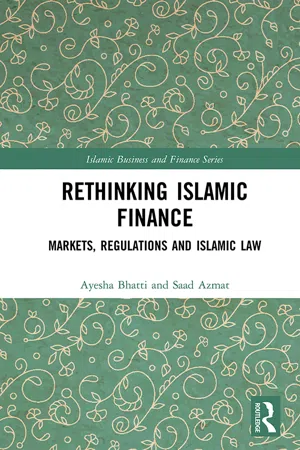
Rethinking Islamic Finance
eBook - ePub

Rethinking Islamic Finance

Markets, Regulations and Islamic Law

  1. 112 pages
  2. English
  3. ePUB (mobile friendly)
  4. Available on iOS & Android
eBook - ePub

Rethinking Islamic Finance

Markets, Regulations and Islamic Law

About this book

Islamic finance's phenomenal growth owes to the Shariah compliant nature of its financial instruments. Shariah forbids the charging of interest (Riba) and instead promulgates risk-sharing and trade-based modes of financing. The Islamic financial industry has been subject to both critique and admiration. Critics argue that Islamic instruments (bearing debt-based structures) differ from their conventional counterparts only in legal lexicon and not in economic impact. The admirers argue that such instruments, irrespective of wider economic implications, rigorously comply with 'juristically sound' Islamic principles.

This book aims to reconcile the above dispute. It argues that the financial impact of instruments is a consequence of the way they are priced and structured. The similarity in pricing and structures is an outcome not of the underlying Islamic financial modes but of the competitive environment in which Islamic instruments compete. Even risk-sharing and trade-based Islamic structures, if implemented in such an environment, would have a financial impact similar to that of conventional instruments.

This book has a wider appeal for both academic and non-academic audiences. It can complement undergraduate and graduate courses as an additional reading on the intricacies of Islamic financial instruments and markets. For PhD students, it would help identify future research areas. To non-academics, it offers a deeper understanding regarding the working of the Islamic finance industry.

Frequently asked questions

Yes, you can cancel anytime from the Subscription tab in your account settings on the Perlego website. Your subscription will stay active until the end of your current billing period. Learn how to cancel your subscription.
No, books cannot be downloaded as external files, such as PDFs, for use outside of Perlego. However, you can download books within the Perlego app for offline reading on mobile or tablet. Learn more here.
Perlego offers two plans: Essential and Complete
  • Essential is ideal for learners and professionals who enjoy exploring a wide range of subjects. Access the Essential Library with 800,000+ trusted titles and best-sellers across business, personal growth, and the humanities. Includes unlimited reading time and Standard Read Aloud voice.
  • Complete: Perfect for advanced learners and researchers needing full, unrestricted access. Unlock 1.4M+ books across hundreds of subjects, including academic and specialized titles. The Complete Plan also includes advanced features like Premium Read Aloud and Research Assistant.
Both plans are available with monthly, semester, or annual billing cycles.
We are an online textbook subscription service, where you can get access to an entire online library for less than the price of a single book per month. With over 1 million books across 1000+ topics, we’ve got you covered! Learn more here.
Look out for the read-aloud symbol on your next book to see if you can listen to it. The read-aloud tool reads text aloud for you, highlighting the text as it is being read. You can pause it, speed it up and slow it down. Learn more here.
Yes! You can use the Perlego app on both iOS or Android devices to read anytime, anywhere — even offline. Perfect for commutes or when you’re on the go.
Please note we cannot support devices running on iOS 13 and Android 7 or earlier. Learn more about using the app.
Yes, you can access Rethinking Islamic Finance by Ayesha Bhatti,Saad Azmat in PDF and/or ePUB format, as well as other popular books in Business & Business General. We have over one million books available in our catalogue for you to explore.

Information

Publisher
Routledge
Year
2018
eBook ISBN
9781317064084
Edition
1

Table of contents

  1. Cover
  2. Half Title
  3. Series Page
  4. Title Page
  5. Copyright Page
  6. Table of Contents
  7. List of illustrations
  8. Acknowledgements
  9. Preface
  10. 1. Introduction
  11. 2. The paradox of risk sharing
  12. 3. Freedom from interest
  13. 4. Financial crisis and Islamic finance
  14. 5. The little difference between Sukuk and bonds
  15. 6. Issuer’s choice of Islamic bond type
  16. 7. Risk in risk-sharing Sukuk
  17. 8. The challenge of Shariah compliance
  18. 9. Replicating conventional finance
  19. 10. Can Islamic banks have their own benchmark?
  20. 11. Islamic versus conventional equities
  21. 12. Charity in Islamic banks: A distinguishing feature?
  22. 13. Rethinking Islamic finance: The limits of our understanding
  23. 15. Conclusion
  24. Index