Commencing its search for a principled international criminal justice, this book argues that the Preamble to the Rome Statute requires a very different notion of justice than that which would be expected in domestic jurisdictions. This thinking necessitates theorising what international criminal justice requires in terms of its legitimacy much more than normative invocations, which in their unreality can endanger the satisfaction of two central concerns – the punitive and the harm-minimisation dimensions. The authors suggest that because of the unique nature and form of the four global crimes, pre-existing proof technologies are failing prosecutors and judges, forcing the development of an often unsustainable line of judicial reasoning. The empirical focus of the book is to look at JCE (joint criminal enterprise) and aiding and abetting as case-studies in the distortion of proof tests. The substantial harm focus of ICJ (international criminal justice) invites applying compatible proof technologies from tort (causation, aggregation, and participation). The book concludes by examining recent developments in corporate criminal liability and criminalising associations, radically asserting that even in harmonising/hybridising international criminal law there resides a new and rational vision for the juridical project of international criminal justice.
eBook - ePub
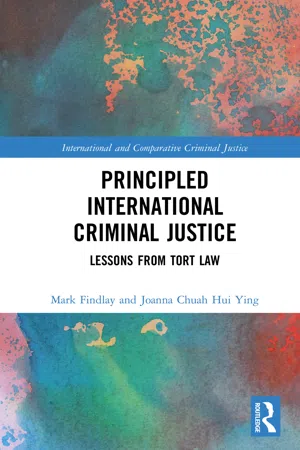
Principled International Criminal Justice
Lessons from Tort Law
- 176 pages
- English
- ePUB (mobile friendly)
- Available on iOS & Android
eBook - ePub
1 Conceptualising international criminal justice
Introduction – the aspirations of the Preamble
In searching for a convincing notion of international criminal justice (ICJ), the Preamble to the Rome Statute of the International Criminal Court (ICC)1 is an obvious starting point. The Preamble initially paints its justice constituency as the ‘delicate mosaic’ of the global community,2 which atrocity crimes3 can shatter at any time, and anywhere. With these considerations in mind, the core foci for international criminal justice4 are the communitarian consequences of atrocity.
Unfortunately, while identifying such grave crimes threatening the peace, security and well-being of the world, the Preamble consciously down-plays the role of the nation-state in such endangerment, preferring to locate responsibility5 on individualised perpetrators. This approach is consistent with the deterrent goal of ending impunity,6 however we will argue in Chapters 3 and 4 as a perspective for justice in such formidable crime settings it presents a fundamental tension within the ‘mass’ nature of atrocity crimes, in terms of victimisation and perpetration. This tension plays out in a potential and prevailing crisis of legitimacy, one where recognition of legitimate victim interests can lead to outcome-oriented trial reasoning and the attendant risks for due process.
Atrocities are committed against communities of humanity.7 The perpetrators predictably act in organised groups exhibiting cultures of violence way beyond the culpability of the individual. It is not hard to understand in such contexts, when charged with protection and peace-making8 as well as proportional punishment, judges in the international criminal jurisdictions are moved by the widest outcome-oriented deliberations (see Chapter 3).
The Preamble particularises victims9 of atrocity over the centuries (in order of significance – children, women and men) having suffered so as to ‘shock the conscience of humanity’. Therefore, justice has a broad and inclusive moral audience. Peace-building is a primary higher-order consequentialist priority for international criminal justice. This notion will be guaranteed through the inculcation of a ‘lasting respect for and the enforcement of international justice,’ however determined (discussed in Chapter 6).
The Preamble returns to more conventional aspirations for criminal justice in affirming that such serious crimes as a whole must not go unpunished. Effective prosecution is identified as the medium for punishment.10 The domain of punitive justice is seen first as national, enhanced through international cooperation. How jurisdictional (and we later argue, principled) integration and cooperation is to evolve remains unclear, and as the empirical focus of the next chapter evidences, often through politicisation proves contentious. In theory at least, the admissibility of jurisdiction functions within and if necessary beyond the conventional international law adherence to state supremacy, overlaid by the jurisdiction of a permanent international criminal court in relationship with the United Nations system,11 having jurisdiction over ‘the most serious crimes12 of concern to the international community as a whole’. When considering the punitive dimension of international criminal justice it might be argued that the unique features of global crime13 necessitate a novel understanding of the penal personality beyond the penal state,14 and certainly adopting humanity as the constituency for international criminal justice challenges the link between crime and punishment in this sphere, back to the nation-state. The harm prevention paradigm for ICJ exacerbates the strain between national and international justice considerations, while at the same time offering new opportunities for international criminal law (ICL) and procedure to create a novel and more fit-for-purpose global criminal jurisprudence.
The potential for inconsistent understandings of justice and its aims between nation-state and emerging international criminal justice traditions is much more than a simple consequence of the procedural compromise that is complementarity, or the artificial sourcing of international criminal law tied to some influential domestic criminal law traditions (see Chapter 2). International criminal law is anticipated to emerge from the harmonisation of the major procedural traditions world-wide. In fact the process of constructing an international criminal jurisprudence is more of a hybridisation of rules and procedures ill-suited to the proof of global crimes (Chapter 4), and not purpose-designed to recognise the peace-making, victim-oriented aims in the Preamble.
While responsibility might be individualised in ICL, the determination of harm through international criminal justice is required in adopting the most expansive vision of actual and potential victims. Victim-focus beyond their obvious interests in punishment and penalty means that in determining responsibility, judges and prosecutors must be moved by the massive injury caused and damage inflicted through perpetration.15 This approach we later argue (see Chapter 3) presents the necessary predisposition for augmenting proof technologies in international criminal trials, while presenting possibilities to engage comparable proof challenges from other fields of law such as tort (delict) where harm determination predominates (see Chapter 5).
Consistent with nation-state primacy, the Preamble calls on every State to fulfill its duty in exercising criminal jurisdiction over ‘those responsible for international crimes’. The document re-iterates that in so doing, states cannot challenge the territorial integrity of another state. So the pursuit of ICJ is foremost in the hands of states and the sectarian security interests of national governments (which should be subsumed by duties to action criminal responsibility) will only be trumped where the ‘ends’ of international criminal justice, and ‘for the sake of present and future generations,’ necessitate that the ICC should intervene. The discourse of public international law resonates in this inculcation, but the operational problems it invites plague the consistent realisation of ICJ.16
Clearly espoused by the Preamble, prevention is the guiding purpose for punishment. It is, but not only, to be achieved through an end to impunity for the perpetrators. Both individual and general deterrence are stipulated as the influences on individual, collective and possible perpetrators to realise the Preamble’s retributive and protective functions.
Within the body of the Rome Statute, Article 22 locates the exercise of justice against persons determined by the court to be criminally responsible. Article 25 specifies (in summary) that:
The Court shall have jurisdiction over natural persons17 pursuant to this Statute . . . A person who commits a crime within the jurisdiction of the Court shall be individually responsible and liable18 for punishment in accordance with this Statute . . . if that person:
(a) Commits such a crime, whether as an individual, jointly with another or through another person, regardless of whether that other person is criminally responsible;
(b) Orders, solicits or induces the commission of such a crime which in fact occurs or is attempted;
(c) For the purpose of facilitating the commission of such a crime, aids, abets or otherwise assists in its commission or its attempted commission, including providing the means for its commission;
(d) In any other way contributes to the commission or attempted commission of such a crime by a group of persons acting with a common purpose.19
In this light the processes and consequences of justice are dependent on the actions and mental states of individual persons, whether operating independently or in certain contexts, collectively.20 An obligation of the court in determining justice is to consider the responsibility of the individual for the commission and the consequences of atrocities. International criminal trial procedures reveal a growing trend toward the proof of conduct and causation above the intricacies of subjective mental state.21 The importance of foreseeability and risk of consequential harm drawn from the purposes, knowledge and behavior of other connected criminal actors, and the organisational context of the criminal enterprise resonates with the tortious applications of negligence as sufficient proof of liability (Chapter 5).
Justice is individualised, responsibilised and potentially contributory. As we will argue later (in Chapters 3 and 5), the use of the notion of responsibility instead of the commonly understood (in criminal law parlance) liability is much more than a drafting preference.22 As such, responsibility can be determined through parallel legal di...
Table of contents
- Cover Page
- Principled International Criminal Justice
- International and Comparative Criminal Justice
- Title
- Copright
- Contents
- Preface
- 1 Conceptualising International Criminal Justice
- 2 Principle and Pragmatism
- 3 The Mystery of Individualism
- 4 Contextualising Global Crimes
- 5 Hybrid Proof Technologies
- 6 Vicissitude or Vision?
- Bibliography
- Index
Trusted by 375,005 students
Access to over 1.5 million titles for a fair monthly price.
Study more efficiently using our study tools.
Frequently asked questions
Yes, you can cancel anytime from the Subscription tab in your account settings on the Perlego website. Your subscription will stay active until the end of your current billing period. Learn how to cancel your subscription
No, books cannot be downloaded as external files, such as PDFs, for use outside of Perlego. However, you can download books within the Perlego app for offline reading on mobile or tablet. Learn how to download books offline
Perlego offers two plans: Essential and Complete
- Essential is ideal for learners and professionals who enjoy exploring a wide range of subjects. Access the Essential Library with 800,000+ trusted titles and best-sellers across business, personal growth, and the humanities. Includes unlimited reading time and Standard Read Aloud voice.
- Complete: Perfect for advanced learners and researchers needing full, unrestricted access. Unlock 1.5M+ books across hundreds of subjects, including academic and specialized titles. The Complete Plan also includes advanced features like Premium Read Aloud and Research Assistant.
We are an online textbook subscription service, where you can get access to an entire online library for less than the price of a single book per month. With over 1.5 million books across 990+ topics, we’ve got you covered! Learn about our mission
Look out for the read-aloud symbol on your next book to see if you can listen to it. The read-aloud tool reads text aloud for you, highlighting the text as it is being read. You can pause it, speed it up and slow it down. Learn more about Read Aloud
Yes! You can use the Perlego app on both iOS and Android devices to read anytime, anywhere — even offline. Perfect for commutes or when you’re on the go.
Please note we cannot support devices running on iOS 13 and Android 7 or earlier. Learn more about using the app
Please note we cannot support devices running on iOS 13 and Android 7 or earlier. Learn more about using the app
Yes, you can access Principled International Criminal Justice by Mark Findlay,Joanna Chuah Hui Ying in PDF and/or ePUB format, as well as other popular books in Law & Comparative Law. We have over 1.5 million books available in our catalogue for you to explore.