Immigrants from the Low Countries constituted the largest population of resident aliens in early modern England. Possessing superior technology in a number of fields and enjoying governmental protection, the Flemish were charged by many native artisans with unfair economic competition. With xenophobic sentiments running so high that riots and disorders occurred throughout the sixteenth century, Elizabeth I directed her dramatic censor to suppress material that might incite further disorder, forcing playwrights to develop strategies to address the alien problem indirectly. Representations of Flemish Immigrants on the Early Modern Stage describes the immigrant community during this period and explores the consistently negative representations of Flemish immigrants in Tudor interludes, the impact of censorship, the playwrighting strategies that eluded it, and the continuation of these methods until the closing of the theatres in 1642.
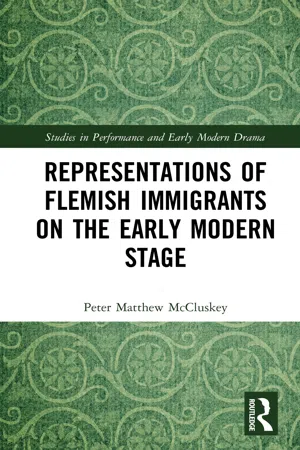
- 232 pages
- English
- ePUB (mobile friendly)
- Available on iOS & Android
eBook - ePub
Representations of Flemish Immigrants on the Early Modern Stage
About this book
Information
1A Flemynge Hyght Hansy
There are few representations of Flemish immigrants in interludes of the latter half of the sixteenth century. Both the anonymous Wealth and Health (c. 1554–5) and Fulwell’s Like Will to Like (1568) feature Flemish immigrants, while several other interludes—Wager’s Enough is as Good as a Feast (c. 1560–70), the anonymous Trial of Treasure (1567), Wapull’s The Tide Tarrieth No Man (1576), and Wilson’s Pedlar’s Prophecy (c. 1561–3) and Three Ladies of London (c. 1581)—attribute problems to the presence of “strangers” in England. In addition, George Gascoigne attempts to represent Flemish culture in his Protestant morality The Glass of Government (1575), which is set in Antwerp. However, long before the composition of these interludes had occurred, John Skelton briefly satirized the Flemish in Magnyfycence (c. 1515–23).
Although Skelton’s interlude does not refer directly to Flemish immigrants, it is nevertheless worth examining because it contains elements common to the later interludes, particularly Wealth and Health. As W. W. Greg observes, “Anyone who reads Wealth and Health and Magnificence together cannot help, I think, being struck by the fact of some evident but by no means easily determinable relation between the two” (“An Enterlude” 117). Greg speculates that Wealth and Health may be either a “popularized adaptation” of Skelton’s play or a revision of an earlier play that had influenced Magnificence (117–18). He bases his conjecture largely upon thematic and structural parallels, but he also draws attention to an intriguing line that he claims has no discernible relevance to the rest of the play: “It was a Flemynge hyght Hansy” (117).
In context, this line is nothing more than a clownish quibble. Counterfeit Countenaunce calls out to Fansy, and the following exchange occurs:
MAGNYFYCENCE: Who is that that thus dyd cry?
Me thought he called Fansy.
FANSY: It was a Flemynge hyght Hansy.
(325–8)1
Fansy’s response, Greg suggests, may have been either the inspiration for the character Hans Beerpot in Wealth and Health or an allusion to an earlier interlude (117–18). In either case, the line is noteworthy as the earliest known occurrence of what would become the stock name for Dutchmen on the English stage.
Greg overlooks several other instances of Flemish satire in Skelton’s interlude that increase its apparent relationship to Wealth and Health. In a later scene, Courtly Abusyon enters singing:
COURTLY ABUSYON: Huffa, huffa, taunderum, taunderum, tayne, huffa, huffa!
CLOKYD COLUSYON: This was properly prated, syrs! What sayd a?
COURTLY ABUSYON: Rutty bully, joly rutterkyn, heyda!
CLOKYD COLUSYON: De que pays este vous?
Et faciat tanquam exuat beretum ironice.
COURTLY ABUSYON: Decke your hofte and cover a lowce.
CLOKYD COLUSYON: Say vous chaunter ‘Venter tre dawce’?
COURTLY ABUSYON: Wyda, wyda!
ow sayst thou, man? Am not I joly rutter?
(745–52)
Dressed in the latest continental fashions, Courtly Abusyon sings snatches of different tunes from or about the Low Countries and asks if he is not a jolly ruiter, the Flemish word for horseman.2 According to Scattergood, the first of the songs seems to combine elements of a drinking satire sometimes associated with gallants and the Dutch song “Taunder naken” (439).3 The line “Rutty bully, joly rutterkyn, heyda!” combines elements of two songs associated with the Flemish; “Rutty bully” alludes to a Brabantine basse danse, while “joly rutterkyn, heyda!” closely resembles an English satire on Flemish drinking habits: “Hoyda, hoyda, joly rutterkin! / Like a rutterkin, hoyda!” (439).4
In his edition of the play, Dyce reprints from Sir John Hawkins’s History of Music the text of the latter song:
Hoyda joly rutterkyn hoyda
Lyke a rutterkyn hoyda.
Rutterkyn is com vnto oure towne
In a cloke withoute cote or gowne
Save a raggid hode to kouer his crowne
Like a rutter hoyda.
Rutterkyn can speke no englissh
His tonge rennyth all on buttyrd fyssh
Besmerde with grece abowte his disshe
Like a rutter hoyda
Rutterkyn shall bryng you all good luk
A stoup of bere vp at a pluk
Till his brayne be as wise as a duk
Like a rutter hoyda.
When rutterkyn from a borde will ryse,
He will piss a galon pott full at twise
And the overplus vnder the table of the new gyse.
Like a rutter hoyda.
(Dyce 2.245–6)5
Ramsey reprints all but the last stanza in his edition of Magnificence, and questions Sir John Hawkins’s assertion that the song satirizes the retinue accompanying Anne of Cleves (“the Flanders mare”) when she married Henry VIII in 1540; Ramsay believes that the song is earlier and that Skelton himself possibly composed it, noting that Skelton composed two other poems from the same manuscript (84). Regardless of its origins, the song is relevant to the present study for two reasons: first, it contains the commonest Flemish stereotypes exploited by later dramatists—their eating and drinking habits; second, Skelton’s allusion to the song helps prepare the audience for a subsequent satiric reference to Flemish drinking habits.
Although Courtly Abusyon sings tunes associated with the Flemish and facetiously identifies himself as a Flemish horseman, he is dressed in extravagant French fashion (Scattergood 440), and Clokyd Colusyon sarcastically addresses him in French. Although Skelton’s object of satire was not a specific nationality but rather the general subject of foreign influences on court life, he nevertheless singles out the drinking habits of Flemish and German knights. Since Henry VIII employed thousands of foreign auxiliaries and mercenaries throughout his reign, including many Flemish and German cavalry, Skelton’s courtly audience might well grasp the allusions to these horsemen and their proverbial thirst for beer.6
In a passage suspiciously similar to the “Rutterkyn” song, Andrew Borde describes this thirst and its consequences in his Introduction of Knowledge (1542):
I Am a base Doche man, borne in the Nether-lond;
Diuerse times I am cupshoten, on my feet I cannot stand;
Dyuers tymes I do pysse vnderneth the borde;
My reason is suche, I can not speke a word;
Than my tonge tayd, my fete doth me fayle,
And than I am harneysed in a cote of mayle;
Than wyl I pysse in my felowes shoes and hose,
Than I am as necessary as a waspe in ones nose.
(155–6)7
Borde’s account, allegedly based upon personal observation, also resembles a passage in the anonymous Libel of English Policy (1436):
Ye have herde that twoo Flemmynges togedere
Wol undertake or they goo ony whethere,
Or they rise onys, to drynke a baralle fulle
Of gode berkeyne; so sore they hale and pulle,
Undre the borde they pissen as they sitte.
(Wright, Political Poems ll. 284–8)
The occurrence of this anecdote in a satiric song, a poem, and an educational (albeit chauvinistic) tome says less about actual Flemish urinary habits than it reveals about an English fascination with those alleged habits, the implications of which will be considered below.
Although Skelton does not scruple to use urinary imagery in “The Tunnyng of Elynour Rummynge,” he does not employ such humor against Flemings in Magnificence.8 He does, though, target a related belief about Flemish drinking habits; Flemish soldiers were widely believed to drink heavily before battle to increase their courage. This alleged practice, which may have had some basis in reality but was doubtless exaggerated by the English, survives today in the expression “Dutch courage”.9 Although Skelton himself does not use this expression, he obliquely refers to the practice when Courtly Abusyon calls Clokyd Colusyon a coward:
CLOKYD COLUSYON: Well, and I be a coward, there is mo than I.
COURTLY ABUSYON: Ye, in faythe, a bolde man and a hardy.
CLOKYD COLUSYON: A bolde man in a bole of newe ale in cornys.
(770–2)
Clokyd Colusyon thus implies that Courtly Abusyon is brave only when drunk. This insult, combined with Courtly Abusyon’s Flemish songs and identification of himself as a “joly rutter,” glances at the notion of “Dutch courage” and provides another thematic link with the stage tradition of the drunken Fleming.
For the purposes of the present study, Magnificence is little more than a curiosity with its scattered references to the Flemish. The obvious implications of Skelton’s Flemish satire are relatively uninspired: carousing Flemings set a bad example for the English court, Flemish troops lack the courage of native Englishmen, and England should not rely upon drunken troops in its military actions. However, since Skelton does not develop any of these ideas, this satire should be regarded as incidental. Nevertheless, the interlude is remarkable as the earliest surviving use of stage Dutch and, if it did not provide the blueprint for later dramatic representations of Flemings, it at least anticipates them. Whether Greg is correct in his surmise that Wealth and Health may be “a popularized adaptation of Skelton’s play” in which the anti-Flemish satire has been developed (117), it is nevertheless tempting to regard the single line “It was a Flemynge hyght Hansy” as the seed that would germinate into a particularly long-lived ...
Table of contents
- Cover
- Half-Title
- Series
- Title
- Copyright
- Dedication
- Contents
- Acknowledgements
- Introduction
- 1 A Flemynge Hyght Hansy
- 2 The Strangers’ Case
- 3 Shall I Betray my Brother?
- 4 Fat for Slaughter, Fit for Spoil
- 5 This Dutch Blood of Mine
- Works Cited
- Index
Trusted by 375,005 students
Access to over 1.5 million titles for a fair monthly price.
Study more efficiently using our study tools.
Frequently asked questions
Yes, you can cancel anytime from the Subscription tab in your account settings on the Perlego website. Your subscription will stay active until the end of your current billing period. Learn how to cancel your subscription
No, books cannot be downloaded as external files, such as PDFs, for use outside of Perlego. However, you can download books within the Perlego app for offline reading on mobile or tablet. Learn how to download books offline
Perlego offers two plans: Essential and Complete
- Essential is ideal for learners and professionals who enjoy exploring a wide range of subjects. Access the Essential Library with 800,000+ trusted titles and best-sellers across business, personal growth, and the humanities. Includes unlimited reading time and Standard Read Aloud voice.
- Complete: Perfect for advanced learners and researchers needing full, unrestricted access. Unlock 1.5M+ books across hundreds of subjects, including academic and specialized titles. The Complete Plan also includes advanced features like Premium Read Aloud and Research Assistant.
We are an online textbook subscription service, where you can get access to an entire online library for less than the price of a single book per month. With over 1.5 million books across 990+ topics, we’ve got you covered! Learn about our mission
Look out for the read-aloud symbol on your next book to see if you can listen to it. The read-aloud tool reads text aloud for you, highlighting the text as it is being read. You can pause it, speed it up and slow it down. Learn more about Read Aloud
Yes! You can use the Perlego app on both iOS and Android devices to read anytime, anywhere — even offline. Perfect for commutes or when you’re on the go.
Please note we cannot support devices running on iOS 13 and Android 7 or earlier. Learn more about using the app
Please note we cannot support devices running on iOS 13 and Android 7 or earlier. Learn more about using the app
Yes, you can access Representations of Flemish Immigrants on the Early Modern Stage by Peter Matthew McCluskey in PDF and/or ePUB format, as well as other popular books in Media & Performing Arts & British Drama. We have over 1.5 million books available in our catalogue for you to explore.