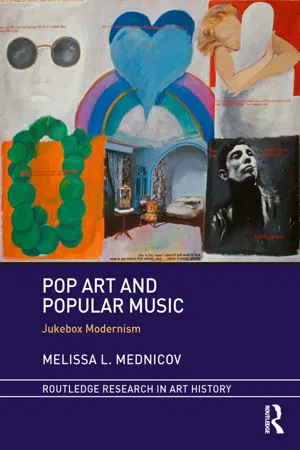
This book offers an innovative and interdisciplinary approach to Pop art scholarship through a recuperation of popular music into art historical understandings of the movement. Jukebox modernism is a procedure by which Pop artists used popular music within their works to disrupt decorous modernism during the sixties. Artists, including Peter Blake, Pauline Boty, James Rosenquist, and Andy Warhol, respond to popular music for reasons such as its emotional connectivity, issues of fandom and identity, and the pleasures and problems of looking and listening to an artwork. When we both look at and listen to Pop art, essential aspects of Pop's history that have been neglected—its sounds, its women, its queerness, and its black subjects—come into focus.
- 142 pages
- English
- ePUB (mobile friendly)
- Available on iOS & Android
eBook - ePub
About this book
Information
Table of contents
- Cover
- Half Title
- Title Page
- Copyright Page
- Table of Contents
- Figures
- Acknowledgments
- Introduction: Towards a Definition of Jukebox Modernism
- 1 How to Hear a Painting: Jukebox Modernism and Elvis Presley in Pop
- 2 Pink, White, and Black: The Strange Case of James Rosenquist’s Big Bo
- 3 The Sound and Look of Melodrama in Pauline Boty’s Pop Paintings
- 4 Soundtrack Not Included: Andy Warhol’s Sleep
- 5 Sounding Pop Art: An Exhibition History
- Conclusion: Contemporary Jukebox Modernism
- Bibliography
- Index
Trusted by 375,005 students
Access to over 1.5 million titles for a fair monthly price.
Study more efficiently using our study tools.
Frequently asked questions
Yes, you can cancel anytime from the Subscription tab in your account settings on the Perlego website. Your subscription will stay active until the end of your current billing period. Learn how to cancel your subscription
No, books cannot be downloaded as external files, such as PDFs, for use outside of Perlego. However, you can download books within the Perlego app for offline reading on mobile or tablet. Learn how to download books offline
We are an online textbook subscription service, where you can get access to an entire online library for less than the price of a single book per month. With over 1.5 million books across 990+ topics, we’ve got you covered! Learn about our mission
Look out for the read-aloud symbol on your next book to see if you can listen to it. The read-aloud tool reads text aloud for you, highlighting the text as it is being read. You can pause it, speed it up and slow it down. Learn more about Read Aloud
Yes! You can use the Perlego app on both iOS and Android devices to read anytime, anywhere — even offline. Perfect for commutes or when you’re on the go.
Please note we cannot support devices running on iOS 13 and Android 7 or earlier. Learn more about using the app
Please note we cannot support devices running on iOS 13 and Android 7 or earlier. Learn more about using the app
Yes, you can access Pop Art and Popular Music by Melissa L. Mednicov in PDF and/or ePUB format, as well as other popular books in Art & History of Art. We have over 1.5 million books available in our catalogue for you to explore.