- 1,024 pages
- English
- ePUB (mobile friendly)
- Available on iOS & Android
eBook - ePub
About this book
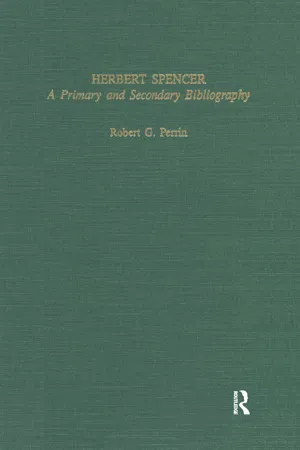
First published in 1993. Including a primary and secondary bibliography which consists of indexes, book catalogues, articles, reviews and Ph.D dissertations. With annotated notes form the author to convey the items' main idea, argument, purpose or general substance and cross-references where relevant.
Information
PART ONE
SPENCER’S WRITINGS
2
Correspondence and Manuscripts
Prefatory Note
ALL major and several minor collections that include letters written by Spencer have been identified. No attempt has been made to list every collection containing one or more of Spencer’s letters. In preparation for his autobiography, Spencer called in as many of his letters as possible. A broad selection of sometimes generously excerpted letters, both extant and (far more often) no longer existing, is found in Spencer’s Autobiography (item 23) and David Duncan’s official biography of Spencer—Life and Letters of Herbert Spencer (item 419). Spencer, for reasons which are not entirely clear, specified that his trustees eventually destroy his own letters (those recalled from correspondents). By chance, some of them escaped this fate.
It is very unlikely that all surviving letters—both from the collection used by Spencer and (later) Duncan, and otherwise—have been identified and catalogued. Spencer was a prolific writer, and his letters travelled all over the world. Where original materials are still available, they are obviously preferable to Spencer’s and Duncan’s excerpts, which, by definition, were made selectively. This is illustrated by how Duncan (item 419, 1: 135-136) excerpted an undated letter (Tyndall Papers, vol. 3, no. 1175, Royal Institution, London) that Spencer wrote to John Tyndall in late 1858 or early 1859 on the subject of “ultimate equilibrium”: The closing paragraph (quoted in item 13 below), which candidly reveals that Spencer’s ideas are still inchoate, is omitted.
Some of the letters contained in the collections cited in this chapter have been published in whole or in part. No attempt has been made to distinguish between published and unpublished letters. Entries for the former, however, are found in Chapter 5. This lists the memoirs and collected letters of Andrew Carnegie, John Fiske, Thomas Henry Huxley, and Edward Livingston Youmans, among others; and, additionally, the oftentimes more recent publication (in scholarly journals, and often with important commentary) of letters to Wilfrid Scawen Blunt, William De Morgan, Lewis George Janes, George Henry Lewes, James A. Skilton, Algernon Charles Swinburne, and Josef Ulehla, among others.

1. Carnegie, Andrew. The Andrew Carnegie Papers. The Library of Congress, Washington, D.C.
Contains a few letters to Carnegie from Spencer, including those of 18 May 1886 and 16 December 1896. In the first, Spencer challenges Carnegie’s belief that America’s material prosperity resulted from its democratic institutions: “A large part, if not the greater part, of what you ascribe to democracy, is...simply the result of social growth in a region furnishing abundant space and material for it, and which would have gone on in a substantially similar way under another form of government.” In the second, Spencer observes that while the English public had, by its unreceptiveness, “hindered” the completion of his work, the American public had, by its generous appreciation, encouraged it.
2. Fiske, John. The Fiske Manuscripts. The Henry E. Huntington Library and Art Gallery, San Marino, California.
Includes forty-one letters written by Spencer between 1864 and 1894. One (22 December 1873) recalls how he was obliged to give his philosophy a “special and Distinctive name” (“The Synthetic Philosophy”) to check “the tendency to confusion with positivism.” Another (5 September 1891) discusses the origin of his idea that both organic and “social progress” consist in “growing complexity and interdependence of parts” (the “germinal thought” is found in chapter 30 [“General Considerations”] of the first edition of Social Statics [item 68]).
3. Harrison, Frederic. The Harrison Papers. British Library of Political and Economic Science, London School of Economics and Political Science, University of London.
Contains several letters to Harrison from Spencer, including those of 7 May 1883, 5, 6, 8, 10 April, 16 July 1889, and 4 December 1892. Letters cover such subjects as the perceived need to legitimize secular ethics, why he (Spencer) must decline various party invitations (the conversation might strain his nervous system), and a requested favor—namely, that Harrison, an avowed Comtist, commission a disinterested party to locate (in the files of the British Museum Library) his (Spencer’s) 1844 articles in the long-defunct Birmingham Pilot and verify that he did not contribute his series of essays under the title of “Sociology” (as he was said to have—in die Pall Mall Gazette [London] of 2 April 1889 [no. 7,501]—by The Pilot’s original and only editor, the [now] Rev. Dr. James Wilson). (NOTE: Wilson’s recollection, if true, would have established Spencer’s awareness of at least some aspects of Comte’s work long before he had acknowledged having heard of Comte. Harrison executed the request and, much to Spencer’s relief, verified that the word “Sociology” does not appear in any of Spencer’s titles. Spencer published this information in the Pall Mall Gazette under the caption “Mr. Spencer and the Word ‘Sociology’” [item 232]. The present writer can add that the term “sociology” [coined by Comte in 1838] does not appear in the text of any of the articles.)
4. Herschel, John. The Herschel Papers. The Royal Society of London.
Contains correspondence (consequent on Spencer’s “Recent Astronomy, and the Nebular Hypothesis” [item 138]) between Spencer and Herschel on the nebular hypothesis. Spencer asks in one letter (10 January 1859) for “the benefit of [Herschel’s] valuable criticisms” vis-à-vis his work on the nebular hypothesis. On another subject, Herschel advises (16 March 1860) that there are more appropriate words (words less suggestive of Germanic philosophy) than the “Absolute” for what Spencer wishes to convey in his metaphysics (see part 1 of First Principles [item 16]).
5. Holyoake, George Jacob. The Holyoake Papers. Manchester Co-operative Union, Manchester.
Contains a few letters to Holyoake from Spencer, including one (11 April 1861) in which Spencer criticizes the term “secularism” because it “positively excludes the recognition of anything that transcends experience.” Another letter (22 April 1860) comments on the slow rate at which subscribers are signing up for his “System of Philosophy.”
6. Huxley, Thomas Henry. The Huxley Papers. Imperial College Library, University of London.
Includes several letters (dating from 1852) exchanged between Spencer and Mr. and Mrs. Huxley. Two (31 December 1858 and 6 October 1860) are especially straightforward about how Spencer valued Huxley’s advice on philosophical matters. Another letter, written to an ailing T. H. Huxley in 1888, remarks: “Well, we always have one consolation, such as it is, that we have made our lives of some service in the world, and that, in fact we are suffering from doing too much for our fellows.” Also contains an original copy of Spencer’s prospectus of 29 March 1860 for “A System of Philosophy” (reprinted in An Autobiography [item 23], vol. 2, 479-484).
7. Spencer, Herbert. Correspondence with Blackwood’s Magazine. The National Library of Scotland, Edinburgh.
Contains letters (12 August 1851, 11 May 1857, and 2 February 1858) that Spencer wrote to the editors of Blackwood’s Magazine in an unsuccessful effort to interest them in publishing his articles. Spencer offers the magazine “Force of Expression” (which had been rejected by Tait’s Edinburgh Magazine in 1843 and was later revised and published in The Westminster Review as the now-classic “The Philosophy of Style” [item 116]); “The Origin and Function of Music” (which was later published in Fraser’s Magazine for Town and Country [item 133]); and, finally, a plan to write essays on such topics as dress, love-affinities, the future of English art, flavors and odors, and male and female character.
8. Spencer, Herbert. The Athenaeum Collection of Herbert Spencer’s Papers (also known as the Herbert Spencer Papers). Senate House Library, University of London.
Comprises diverse materials, deposited (in 1936) at the Athenaeum by the Herbert Spencer Trustees and subsequently (in 1971) transferred to the University of London Library. Represents what has survived of Spencer’s personal papers and the letters received by him. Contains only a smattering of Spencer’s notes and letters (fewer than two dozen were counted), along with some abstracts that he made of his own correspondence (mainly to his intimate friend, Edward Lott). Mostly includes letters written to Spencer, as well as other items of interest, for example, Spencer’s drawings and sketches, photographs, reminiscences of Spencer by his friends, letters written to Spencer’s executors, cuttings from newspapers (articles written after Spencer’s death), and the minutes of the meetings of the Herbert Spencer Trustees (which occurred from 1905 to 1936). With respect to reminiscences, for example, Walter Troughton, who read the London Times aloud to Spencer during his final years, recalls that he (Spencer) provided a “running commentary” on all the recorded opinions and events (“Reminiscences of Herbert Spencer” [MS. 791/355/3]); and Edith Killick, Spencer’s last housekeeper, recalls that he “constantly remarked that it was a good thing there was no Mrs. Spencer” (“Some Personal Reminiscences” [MS. 791/355/5]). Collection also includes a thirty-nine page intellectual autobiography that is said by Spencer to have been written “sometime about 1870.” (NOTE: What survives of Spencer’s own letters is primarily found in the collected papers of his correspondents. The considerable correspondence from Spencer’s early years—principally with his father [William George Spencer], with whom he regularly exchanged letters for over thirty years, and his uncle [Thomas Spencer]—is not found in this collection [or in any other known source]. How much—if any—of it survived the general disposition of Spencer’s letters is unclear. Happily, David Duncan [item 419] reproduced, in whole or [more often] in part, what is probably a good share of Spencer’s family correspondence.)
9. Spencer, Herbert. The Spencer Manuscripts. The British Museum, London.
Contains, in some fourteen volumes and with occasional notations as to the time and place of writing, the original manuscripts of most of Spencer’s writings (they are partly holograph, partly in the hand of his amanuensis, and partly in proof with autograph corrections). (NOTE: These were bequeathed by Spencer to the British Museum, which assumed ownership in 1904. See Catalogue of Additions to the Manuscripts in the British Museum in the Years 1900-1905 [London, 1907], 248-250.)
10. Spencer, Herbert. The Spencer Papers. Knox College, Galesburg, Illinois.
Includes letters from Spencer to Thomas Hodgskin on several subjects. Notes in one (22 October 1849) how each of them (Hodgskin, in The Natural and Artificial Right of Property Contrasted [1832] and Spencer, in a book in progress [namely, Social Statics]) establishes “Rights on a philosophical basis.” Suggests reserving the discussion on points of agreement and disagreement for “one of [their] Friday night debates.” Acknowledges in another letter (13 January 1850) Hodgskin’s assistance with Social Statics; and asks Hodgskin (in a letter dated 10 April 1855 [when Spencer would have been completing The Principles of Psychology]) to clarify his understanding of “faculties” as “classified mental operations.”
11. Spencer, Herbert, and John Chapman. Correspondence. University of Virginia, Charlottesville.
Contains sixteen letters (seven in Spencer’s own hand, nine by his amanuensis), dating from 22 May 1857 to 16 July 1895, written by Spencer, mostly to John Chapman. Subjects discussed include Spencer’s forthcoming articles on evolution versus the “doctrine of special creations”; how he (Spencer) “dare not write [f...
Table of contents
- Cover
- Half Title
- Title Page
- Copyright Page
- Dedication Page
- Contents
- Preface
- Acknowledgments
- Introduction
- Part One: Spencer’s Writings
- Part Two: Writings on Spencer, Arranged by Subject
- Chronological Table: Herbert Spencer
- Periodicals Cited
- Index of Names
Trusted by 375,005 students
Access to over 1.5 million titles for a fair monthly price.
Study more efficiently using our study tools.
Frequently asked questions
Yes, you can cancel anytime from the Subscription tab in your account settings on the Perlego website. Your subscription will stay active until the end of your current billing period. Learn how to cancel your subscription
No, books cannot be downloaded as external files, such as PDFs, for use outside of Perlego. However, you can download books within the Perlego app for offline reading on mobile or tablet. Learn how to download books offline
Perlego offers two plans: Essential and Complete
- Essential is ideal for learners and professionals who enjoy exploring a wide range of subjects. Access the Essential Library with 800,000+ trusted titles and best-sellers across business, personal growth, and the humanities. Includes unlimited reading time and Standard Read Aloud voice.
- Complete: Perfect for advanced learners and researchers needing full, unrestricted access. Unlock 1.5M+ books across hundreds of subjects, including academic and specialized titles. The Complete Plan also includes advanced features like Premium Read Aloud and Research Assistant.
We are an online textbook subscription service, where you can get access to an entire online library for less than the price of a single book per month. With over 1.5 million books across 990+ topics, we’ve got you covered! Learn about our mission
Look out for the read-aloud symbol on your next book to see if you can listen to it. The read-aloud tool reads text aloud for you, highlighting the text as it is being read. You can pause it, speed it up and slow it down. Learn more about Read Aloud
Yes! You can use the Perlego app on both iOS and Android devices to read anytime, anywhere — even offline. Perfect for commutes or when you’re on the go.
Please note we cannot support devices running on iOS 13 and Android 7 or earlier. Learn more about using the app
Please note we cannot support devices running on iOS 13 and Android 7 or earlier. Learn more about using the app
Yes, you can access Herbert Spencer by Robert G. Perrin in PDF and/or ePUB format, as well as other popular books in Scienze sociali & Filosofi. We have over 1.5 million books available in our catalogue for you to explore.