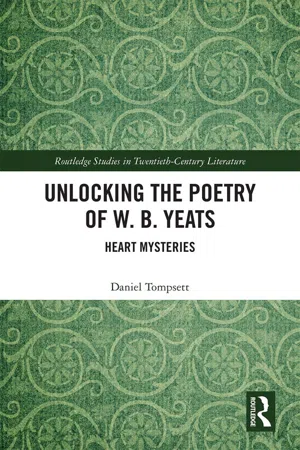
Unlocking the Poetry of W.B. Yeats undertakes a thorough re-reading of Yeats' oeuvre as an extended meditation on the image and theme of the heart as it is evident within the poetry. It places the heart at the centre of a complex web of Yeatsian preoccupations and associations—from the biographical, to the poetic and philosophical, to the mythological and mystical. In particular, the book seeks to unlock Yeats' mystifying aesthetic vision via his understanding of the ancient Egyptian "Weighing of the Heart" ceremony. The work provides a chronological narrative arc that looks to use the theme of the heart as it recurs in the poetry in order to circumvent and overcome more established frameworks. Its purpose is to offer refreshing ways of conceptualizing and building alternatives to more deeply entrenched, but not entirely satisfactory arguments that have been offered since Yeats' death in 1939, while demonstrating the centrality of the occult to Yeats' art.
- 390 pages
- English
- ePUB (mobile friendly)
- Available on iOS & Android
eBook - ePub
About this book
Information
Part I
The Desires of the Heart
1 The Wanderings of Oisin (1889) – Themes of the Embittered Heart
George Watson seems correct in his observation that “Though born into the Protestant Church of Ireland, Yeats quite early discovered that he was not or could not be at all orthodox. Yet he had an essentially religious temperament”.1 As Materer has pointed out, it was the “rationalism of the age” that “had deprived him of his childhood faith”.2 Materer shows that it was this void that caused Yeats to declare that he had made “a new religion…of a fardel of stories, and of personages, and of emotions”.3 Foster, like Eliot, has also suggested that Yeats’ Protestant background helped to facilitate his easy transition into the occult, steeped as it was in superstition and Freemasonry.4 Materer points out that Yeats first became aware of supernatural experiences from ghost stories he heard as a child and the Irish myths and folk tales later recounted in The Celtic Twilight (1893).5
As is well documented, in 1885 Yeats and his friends formed a Hermetic Society to discuss theosophical and hermetic ideas. At their request they received a visit from the Indian theosophist Brahmin Mohini Chatterji, and the encounter left a lasting impression on young Yeats. However, despite Charles Johnston and Claude Wright obtaining a charter to inaugurate an official Dublin lodge of the Theosophical Society in 1886, Yeats declined to join, though he was closely associated with it.6 The Dublin of young Yeats also included the Contemporary Club, where he met the founder of the Gaelic League, Douglas Hyde.
Son of the artist John Butler Yeats, the fledgling poet arrived at the first Hermetic Society meeting already nurtured on a diet of poetry that informed his own ideas and helped to frame his imaginative sense. With Blake and Shelley chief among his Romantic influences, it was Yeats who,
when we first made our society, proposed for our consideration that whatever the great poets had affirmed in their finest moments was the nearest we could come to an authoritative religion, and that their mythology, their spirits of water and wind were but literal truth.7
The idea of spirits as “literal truth” was engrained in Yeats from his earliest years in the form of Irish folklore. Folklore itself, as Sinéad Garrigan Mattar has pointed out, was not Yeats’ primary objective. His chief concern was “to reach the heart of the occult mystery that folklore seemed concurrently to reveal and obscure”.8 In fact, folklore, Romantic mythology and organised mythology were all equally qualified for Yeats to adopt as “literal truth”. Thus, Yeats as “the last Romantic” is inextricable from Yeats as full-blooded mystic.9
The suspension of disbelief and the grounding of the imagination and all attendant mythology within reality were hallmarks of the poet that began early. The geographical reach of his early poetry is characterised by Ireland, as well as influences from Spain, India and Arcadia in some early poems. However, The Wanderings of Oisin, the long poem which Yeats initially penned between 1886 and 1887, and published in 1889, would be clothed in a distinctly Irish mythological attire reminiscent of Samuel Ferguson.
Foster reads Oisin as containing a “superior quality and manipulation of metre” that placed it above earlier dramatic narratives such as Mosada, The Seeker and Time and the Witch Vivien.10 Foster seems on point to recognise that despite the Gaelic theme of the poem, Yeats’ Romantic leanings are fully evident in this period, suggesting that “if Jeremiah Callanan and Ferguson are echoed, so are Shelley, Pre-Raphaelitism and William Morris”.11 Yeats provided a brief account of the sources of Oisin to the editor of the Spectator in July 1889, following a review in which the reviewer had questioned where it may have developed from.12 The long poem arose from multiple sources, such as the Middle Irish dialogues of Saint Patrick and Oisin, the Transactions of the Oissianic Society (1854–1863) in Vol. 1 and Michael Comyn’s “The Lady of Oisin in the Land of Youth”.13
In context of the Irish sources and setting of the poem, the Ireland of Oisin is bound to Tír na nÓg (the Country of the Young), which Yeats adapted to comprise “three phantom islands”.14 Thus the geography of the poem is presented as partly grounded in reality and partly in the imagination. As such the journey of Oisin establishes the illusion of travel from “real” to “unreal”, with a final return to the “real”. The effect, as with the “play within a play”, is to present the imagined real as if it were truly “real”. This in turn results in a world in which the pagan Oisin is conversant with the Christian idea of Patrick, although the tale that Oisin unfurls is presented as predating Christianity, a formula that would later inform the nature of Yeats’ Rose symbolism.
Indeed, Oisin harbours embryonic forms of many of the ideas that Yeats would go on to develop. His approach to symbols would allow his work, in one sense, to retain its sense of a fixed, central core, while the outer symbols were free to evolve. As we shall see, it was the inner, secret dialogue that the outer symbols were rooted in and provided their outer sense of closed bafflement and enigma. As key holder, Yeats is hard at work in this poem to load it with the embryonic symbolic forms that, though shadows here, would unfold to ultimately show forth the flowering of their full nature. For example, the symbol of the island, interchangeable for Ireland itself of course, can be interpreted as a heart that the poet established in this period. Yeats would later identify water as lunar, indicative of “all that is simple, popular, traditional, emotional”.15 The island, and the island dweller amid the water, is at the heart of these elements from the beginning for Yeats.
In February 1889 Yeats had recognised that Oisin needed “an interpreter”, summarising the three incompatible things (islands) that man is always seeking in vain. He names them as “infinite feeling, infinite battle, infinite repose – hence three islands”.16 As “The Circus Animals’ Desertion” would revisit, the three islands man is eternally seeking in his heart are a vapour, and ultimately, of course, the quest ends in a defeat by time. Nevertheless, the wholly Romantic quest poem that Yeats described as the “asylum for my Affections” formed an imagined world where the supernatural is distinct from the rational that Yeats had already rejected by this point. The limit of the rational is defined by the specifically grey shore at the edge of the sea. The “ground” of the poem is the imagination, the sea over which Oisin, the “sea-rider”, rides to the eternal Heart of all.17
Time is also utterly displaced in this centre: “I know not if days passed or hours”.18 The rational recedes amid the sound of Niamh’s “unhuman sound”.19 They gallop past the “hornless deer”, the “phantom hound” (that is “pearly white” with “one red ear”) and the “beautiful young man” following the “lady” with the “apple of gold”.20 The symbolism here, which understandably left the initial readers of the poem somewhat perplexed, indicates firstly the desire of a man (symbolised by the hounds’ pursuit) for a woman (symbolised by the hornless deer). The white hound indicates the Country of the Young in that it is the white inversion of the black hound which symbolises death. Its red ear suggests life and passion. “The golden apples of the sun” would later appear in “The Song of Wandering Aengus”, where it is contrasted with the “silver apples of the moon”.21 The golden and silver apples indicate the alchemy of male (sun-king) and female (moon-queen), with the Irish god of love, Aengus, pursuing. Having seen these phantoms, Oisin begins to question what they signify. Howev...
Table of contents
- Cover Page
- Title Page
- Copyright Page
- Dedication
- Contents
- Permissions
- Acknowledgments
- Introduction
- Part I The Desires of the Heart
- Part II The Divided Heart
- Part III Sufficient Heart Truths
- Part IV Tragic Joy and the Weighing of the Heart
- Bibliography
- Index
Trusted by 375,005 students
Access to over 1.5 million titles for a fair monthly price.
Study more efficiently using our study tools.
Frequently asked questions
Yes, you can cancel anytime from the Subscription tab in your account settings on the Perlego website. Your subscription will stay active until the end of your current billing period. Learn how to cancel your subscription
No, books cannot be downloaded as external files, such as PDFs, for use outside of Perlego. However, you can download books within the Perlego app for offline reading on mobile or tablet. Learn how to download books offline
Perlego offers two plans: Essential and Complete
- Essential is ideal for learners and professionals who enjoy exploring a wide range of subjects. Access the Essential Library with 800,000+ trusted titles and best-sellers across business, personal growth, and the humanities. Includes unlimited reading time and Standard Read Aloud voice.
- Complete: Perfect for advanced learners and researchers needing full, unrestricted access. Unlock 1.5M+ books across hundreds of subjects, including academic and specialized titles. The Complete Plan also includes advanced features like Premium Read Aloud and Research Assistant.
We are an online textbook subscription service, where you can get access to an entire online library for less than the price of a single book per month. With over 1.5 million books across 990+ topics, we’ve got you covered! Learn about our mission
Look out for the read-aloud symbol on your next book to see if you can listen to it. The read-aloud tool reads text aloud for you, highlighting the text as it is being read. You can pause it, speed it up and slow it down. Learn more about Read Aloud
Yes! You can use the Perlego app on both iOS and Android devices to read anytime, anywhere — even offline. Perfect for commutes or when you’re on the go.
Please note we cannot support devices running on iOS 13 and Android 7 or earlier. Learn more about using the app
Please note we cannot support devices running on iOS 13 and Android 7 or earlier. Learn more about using the app
Yes, you can access Unlocking the Poetry of W. B. Yeats by Daniel Tompsett in PDF and/or ePUB format, as well as other popular books in Literature & Literary Criticism. We have over 1.5 million books available in our catalogue for you to explore.