![]()
Nostalgia
On encountering the West midway through the nineteenth century, Japan was diverted, reluctantly, from the long-travelled, twisting paths that it had been following into its own interior for centuries. These westernising forces came embodied in the black ships of Commodore Matthew Perry. As well as troops, they were carrying letters from the US government insisting (as was the way with this enthusiastic, upstart nation) that it be allowed to establish trading ports along the Japanese coast. After much procrastination (or so it seemed from a Western point of view) the Shogunate acceded, and the islands changed irrevocably. For one, the political turmoil that ensued overturned the Shogunate and enacted the country of Japan. The destinies of different dynastic prefectures that had historically gathered in little more than loose alignments became braided in increasingly tighter and more intricate patterns. As the ports were established and grew in size and wealth, new political and social structures also emerged in an attempt to administer them. Without any explicit design the islands found themselves acting together.
The form this administration took was, on the surface at least, quiescent: rather than resist trade, the Japanese were collectively undertaking to excel in it. They did, and what began as a gradual and stylistic absorption became, over time, explicit and heavily managed. Denizens of the shogunates were forcibly and even violently converted into a loyal citizen body (shimin) (Ivy 1995: 10–11) and a policy of military-backed, aggressive regional expansion sought to secure resources and markets for a growing industrial base organized by an increasingly visible central government. The shameful and deadly failures of some of these centralizing and expansionist policies during WWII seemed only to serve to put the populace on notice to redouble their efforts, ‘encouraged’ yet again by pressure from the USA. The citizens’ zeal for manufacturing seemed endless. They were diligent, industrious and governed by ‘cradle to grave’ career systems characterized by levels of micro-management that would have held Frederick Taylor and Henry Ford in rapturous awe. They also became eager customers, participating in cycles of ownership, use and disposal with seemingly few qualms about deleterious psychological, social and environmental effects. Western ways had beaten them into a new shape, and they were now beating the West hands down.
Nowhere has the mimetic rush to materialize and commodify life been more pronounced than in the gridded, neon-lit streets of Tokyo; an entire urban setting has become high on lines of production and consumption, a floating world no more. From inside this huge space (there does not seem to be an outside) the change to an entirely commercialized lifestyle seems complete. Like Kafka’s story Metamorphosis, however, this change is not at all a natural or easy one. The human being has become something very different, at first perhaps a little embarrassed and unsure, but then increasingly aware of how new, powerful movements become possible. Cities like Tokyo are testimony to this affective sense of power. And yet, just as in Franz Kafka’s Metamorphosis, where Gregor Samsa, despite becoming insect-like, retains and indeed intensifies an anxious concern for his earlier human selfhood, Japan’s commercial grab carries remains braided with traditional style. The transforming and then hardening to the rhythm of managed productiveness has been a process of absorption, not wilting exposure. Foreign influence changed the body of Japan into something more physically powerful and agile, yet rather than change completely, this material productiveness and global economic presence has perhaps served to further insulate the nation’s traditional and almost unique sense of soul and sentiment. Japan has westernized, but in a Japanese way. It is because of this persisting sense of distinctiveness that Japan has seemed well able to absorb the ironies of its own commitments. Western brands can be obsessed over and brandished joyously, but more as one might fetishize anything exotic: their attractiveness lies in them being ‘at a distance’, much as the smell of grass meadows remains sufficiently alien to throw a poetising city dweller into bucolic reverie. The same goes for the Western politics of individuality and liberalized markets, or Western dress and entertainments, all of which have been enthused over and adopted in some ways, but always with a twist, and sometimes under an inscrutable gaze.
The impress of the new millennium (a handy, Western epochal marker) has witnessed further change in this complex relationship with itself, as many in Japan have begun to realize their prowess in manufacturing and consuming mass-produced objects does not equate to a meaningful life. A collective anxiety has become palpable. Perhaps chastened by the experience of often heedless commercial development, and certainly now in awe of sublime natural forces, Japanese people are looking to what went before all this economic productiveness. Why did they want to be ‘Number 1’? As rapidly and totally as Japan has industrialized, it has also become suspicious of its experience – the sheer pace of development has meant the old ghosts and gods have not had enough time to die, they linger still in the shadows and ceremonies and subcultures that permeate the digitized and mechanized patterns of thought and action.
There is, amongst some, nostalgia for what lay behind the belching smoke from Perry’s iron-clad, US naval vessels beached off Okinawa in 1853. What is imagined is a time when seasonal rhythms and the moon and sun were more apparent, when organized activity, feeling and thought were communally governed, working smoothly, uncomplainingly, and somehow in touch with natural things. Inwardly the nation is being reminded of what has been lost and how their culture might have been different. Nostalgia does this: something is felt to be at stake and a loss has already occurred. The argument goes something like this: what is being lost is the connexion to the ‘old ways’ by which the country was distinct, unique even (Ivy 1995: 10). The lack of distinctiveness caused anxiety amongst a people who economically were becoming very successful, but only through excelling in practices that were not, fundamentally, felt to be their own. One way of alleviating this anxiety is by nurturing intense affection for substitutes that recreate the past. These recreations are stories and so always beholden to narrative form: they appear only in being continually retold, and are nothing outside of the telling. The passion for craft is one such substitute, and in Japan its stories are being forever told and retold.
Craft and Design
It is an easy association to bring craft alongside cultural and national identity and to find in its exponents a respectful and enhancing embodiment of the old ways. Easy, but in Japan at least, not simple, because in Japan the narratives of craft have so often been kneaded with the imaginaries created in branded design. Take one example amongst so many: the coloured splashes of the Japanese designer and artist Takashi Murakami that float over the fine-grained skins used to make Louis Vuitton bags. Japanese imagination meets Western heritage under the commercially managed imprint of a global design house. The quality of the leather and stitching is of minimal interest; the look governs, and the projection of status predominates. In all this representation the craft seems to get lost. Murakami, a passionate advocate for craft, is playing with the language of design, and perhaps even lamenting its pervasiveness. The gently ironic, cartoon bubbles whose impossibly uniform, bright colour pull the objects they adorn slightly out of place, also keep them there as things to be fetishized. Design concerns the projection of ideas and feelings through representation, whereas craft involves embodied work, which cannot be represented. Craft, then, is practice in which what is being done and made constitutes its own purposive structure, without need for an elaborate representational ‘superstructure’. It is quieter than design, looser in conscious direction, and perhaps less in thrall to the idea of being distinct and noticeable. Craft is about things, whereas design is about objectified things, or objects.
For David Pye, this difference between design and craft constitutes a form of hierarchy: designers could never specify a certain material or form, or elaborate on an idea, without craftwork having first laid the groundwork and experimented with available possibilities. This groundwork seems to require a form of connexion back to nature. Craft accentuates this awareness of nature by revealing its essence. It is not the natural material itself, but the skilfully worked material, the wood that has been nurtured, sawn, dried, planed, sanded, oiled and then worked and worked into something rare, revealed and accentuated. Form is similarly an attentive accentuation of what is found, yielding lines, planes and volumes of light and dark that pull maker and user alike into an entire world.
In coupling history and nature within itself craft gives voice to an inherent rather than consciously designed sense of truth and beauty. It is not something about which people can agree using rational arguments; rather, they accede respectfully and expertly. It is not as if, says Pye (1968/2002: 18), thingly materials or forms exist in their own right. You do not just find useable clay, lacquer, metal ore or wood: those who work with them must bring out the promise that lies latent in such materials. Nor is form to be found in templates, dies, patterns and stamps, for these too are formed by attending to the materials’ qualities. Craft is the working and forming of things from out of the possibilities thrown up by materials. It is work in which the outcome is under constant risk, depending as it does on the judgment, care and dexterity of the worker. Contrary to mass production and machine manufacture, craft preserves and works with the possibility of failure, and it is in this dark space that a sense of human complicity and responsibility for what becomes a distinct and distinctive thing takes root. In short, craft craves and needs risk, whereas design can and often does reach for certainty (Popp & Holt 2016; Pye 1968/2002: 20–21). Murakami’s Louis Vuitton bags have both, but the craft is managed into near non-existence by processes of quality control and financial accounting, or it becomes a represented object thrown onto the busy, noisy surfaces of a marketing campaign.
The craft for which the Japanese are developing a nostalgia is more that of risk than design; the pre-industrialized exposure to material form and purposive structures to which the skill of the worker must be brought under the impress of lengthy apprenticeships, habituated generational expectations and rigorously embodied ceremony. These processes of training in making and use ameliorate but never eliminate the risk, for without uncertainty what is created has no life of its own, and it is in the encounter with and maintenance of such a distinction that craft generates its peculiar hold. To be things of craft the pots, knives, umbrellas, theatrical performances or food are created with the possibility that they could have been otherwise. In this they are quietly unique, albeit often in very ordinary ways. This goes for all craft, irrespective of its place. In Japan, however, the capacity to imagine the ways of the past by absorbing and creating with risk seems to be gathered as a ritualistic riposte to its commercialization that few other cultures seem to match in its intensity. Moreover, whilst in the wake of the Western Renaissance civilization was equated with the separation of the social and the natural, and the human from the animal, the Japanese world view has never really worked on pushing such anthropological divisions. An electricity pylon is much like a tree, and eagles will perch on both under a common sky. This further leaves the country prone to, and animated by, the narratives afforded by craft.
For some exponents of Japanese craft, it is a process of imagining oneself back into the past, and into nature, in order, then, to act anew: a looking back into what is lost in order then to project forward. Here is one of its most persuasive exponents, Junichorō Tanizaki (1933/1991: 9):
And as for amplification, so for paper, photography, toilets, eating implements, glass making and candlelight. The lost Japan for which Tanizaki feels almost constant pangs of nostalgia is one of mellowness and opaque mystery whose inscrutable character is given heft by pensive acceptance of life’s patinas. In contrast, presumably, the Westerner is a bellicose, assertive, logocentric, neophiliac wanting only distinction. Leaving aside the quaint racism, and accepting that Tanizaki was writing at a time when Japan had yet to fully display its own vicious brand of assertiveness by laying waste to vast stretches of China (1937), or entering WWII with attacks on the United States, Singapore and Malaya (1941–1942), there is something to be learned from Tanizaki’s affections for the quiescent, sober and sensitive forms of crafting around which Japanese character might be purposively ordered.
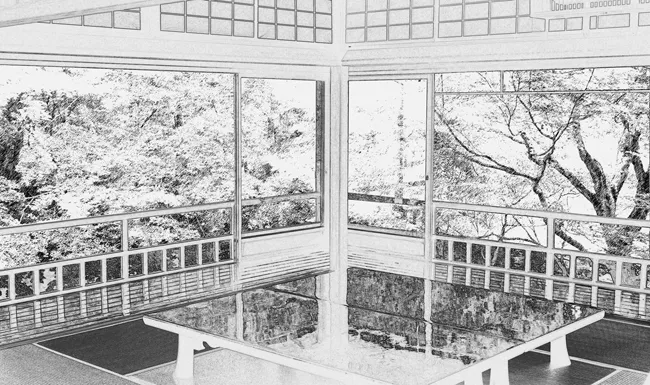
Take a traditional house. Its palely coloured walls are made with softening paper (shōji), dried clay and richly grained woods that absorb and gather a light so indirect as to be stripped of its luminosity. The floors are strewn with mats of woven straw (tatami) whose gently astringent smell and firm yield underfoot announce themselves as equals to any human presence. The alcove (tokonoma) holds a vase, stem and scroll whose pale union yields utterly to their paler burnished surrounds. The eating areas are alive with pots glazed in mannered imperfection stacked neatly next to lacquerware bowls painted in liquid darkness that comes to life in the occasional flicker of an oil lamp. And the eaves cast shadows over a balcony as a peony made heavy by late spring rain might hang over neatly tended grass.
The craft involved in making these homely things is as apparent as the things themselves and it appears in use, not representation. The mats, walls and bowls are created for everyday life, throwing themselves into the thrown condition in which the Japanese people live out their day-to-day lives – mats for sitting, walls for privacy and bowls for eating. Here all is as it is, and the craft remains equipment to be used thoughtlessly and instrumentally. Yet Tanizaki’s nostalgia evokes something more grounded than these things being just well-made tools for use. There is an attention to style and disposition that extends way beyond the presence of things. Indeed what is there physically is of far less importance than the relations that are thereby sustained, so long as the things are made well. The traditional house is made the way it is to live with its surroundings: this is how it becomes a whole, as do those who come and go across its threshold. The threshold is itself a space, and is often extended in repetition through porches, so that the distinction between inside and outside becomes vague, the one giving onto the other in muted contact rather than occluding separation, the affect being one of the transience rather than presence.
Many traditional buildings in Japan share this avoidance of solid distinction, giving voice to an impermanence and intangibility that Tanazaki (1933/1991: 46) finds evoked beautifully in a traditional song of the countryside: ‘the brushwood we gather stack it together, it makes a hut; pull it apart, a field once more’. The song line acknowledges the impermanence of all things and yet celebrates the human capacity for making that is integral to their preservation. Buildings fall into nature and occupants into the building and the entwinement gives voice to a rootedness and connectivity in which any sense of a subject manipulating objects to serve preconceived interests becomes as faint as the wisps of mist that evaporate in morning sun. The risk comes in allowing nature into the house whose apparent simplicity has very little to do with the stripped-back, tidy and efficient designs favoured by Western rationalism and its obsession with the new. Where in the West simplicity can embody ...