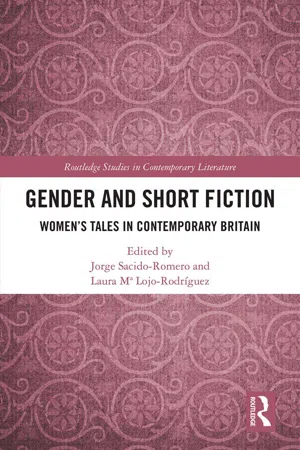
eBook - ePub
Gender and Short Fiction
Women’s Tales in Contemporary Britain
- 344 pages
- English
- ePUB (mobile friendly)
- Available on iOS & Android
eBook - ePub
Gender and Short Fiction
Women’s Tales in Contemporary Britain
About this book
In their new monograph, Gender and Short Fiction: Women's Tales in Contemporary Britain, Jorge Sacido-Romero and Laura M Lojo-Rodriguez explain why artistically ambitious women writers continue turning to the short story, a genre that has not yet attained the degree of literary prestige and social recognition the novel has had in the modern period. In this timely volume, the editors endorse the view that the genre still retains its potential as a vehicle for the expression of female experience alternative to and/or critical with dominant patriarchal ideology present at the very onset of the development of the modern British short story at the turn of the nineteenth century.
Trusted by 375,005 students
Access to over 1.5 million titles for a fair monthly price.
Study more efficiently using our study tools.
Information
Subtopic
English Literary CriticismIndex
Literature1 Introduction
Jorge Sacido-Romero and Laura Mª Lojo-Rodríguez
The British Short Story: Still Marginal after All These Years?
Gender and Short Fiction: Women’s Tales in Contemporary Britain grows out of an international seminar held at the University of Santiago de Compostela in the spring of 2016. The phrase “women’s tales” in the subtitle echoes “old wives’ tales”, an expression commonly used to refer derisively to superstitious and spurious beliefs that deserve no credit, or, as Angela Carter put it: “Old wives’ tales – that is, worthless stories, untruths, trivial gossip, a derisive label that allots the art of storytelling to women at the exact same time as it takes all the values from it” (1990: xi). Our choice of expression is, of course, ironical, as our guiding intention is, on the contrary, to give due credit to women’s tales, to explore what women authors say in and through the medium of the short narrative form. This book thus joins the ongoing vindication of the short story as a genuine, distinguishable and distinguished literary genre in which women writers have excelled and go on excelling.
The unambiguous recognition of the short story as a type of fiction different from, yet not inferior to, the novel is still a far-off goal. Unlike the case of Ireland and the United States, canonical status and strong public support still elude the contemporary British short story (Malcolm 2012: 52–56). Some timid progress seems, however, to be detectable in recent overviews of contemporary British fiction. Thus, for instance, David James’s The Cambridge Companion to British Fiction Since 1945 (2015) does include, in its chronological table of relevant publications, Ian McEwan’s debut collection First Love, Last Rites (1975), Salman Rushdie’s East, West (1994) and A.L. Kennedy’s Original Bliss (1998) (xviii, xx), while Nick Bentley’s earlier Contemporary British Short Fiction (2008) listed only Angela Carter’s The Bloody Chamber (1979) under the category “Publication of Novels” (x). In his discussion of Carter’s work, however, Bentley focused exclusively on her novels, obviating her short fiction altogether.1 Apart from its relatively more inclusive chronology, David James’s Cambridge Companion does refer to one of Helen Simpson’s short story collections (2015: 87), yet when discussing the work of prominent short story writers like J.G. Ballard, Ali Smith or Michèle Roberts, only their novels deserve attention.2
The small degree of receptiveness towards the short story, visible only under the magnifying glass in some reference works like those mentioned above, may have something to do with the recent wave of critical interest in the short form, which has become particularly intense in the last decade (Young and Bailey 2015: 2–3). As Emma Young and James Bailey point out, one of the latest trends in this growing body of critical work is the attention paid to “women’s short story writers” (2015: 3). Claire Drewery’s Modernist Short Fiction by Women: The Liminal in Katherine Mansfield, Dorothy Richardson, May Sinclair and Virginia Woolf (2011), Kate Krueger’s British Women Writers and the Short Story, 1850–1930: Reclaiming Social Space (2014) and Young and Bailey’s own British Women Short Story Writers: The New Woman to Now (2015) are important in this connection as they focus exclusively on the British literary context, which compensates for the lack of book-length, systematic approaches to women’s short fiction production in Britain. For, indeed, the great contribution of British women writers to the development of the modern short story is irrefutable; it is, for once, an objective historical fact, as evidenced in the long list of practitioners of the genre from Sarah Grand or Ella D’Arcy at the turn of the twentieth century through Virginia Woolf, Katherine Mansfield, Muriel Spark or Angela Carter, and to Michèle Roberts, A.L. Kennedy or Janice Galloway in our days. For well over a century, artistically ambitious women writers in Britain have turned to a genre that even today is a long way from reaching the degree of literary prestige, social recognition and even commercial value that the novel has enjoyed.3 Though the great majority of women authors have also produced novels, the short story clearly retains its strong appeal as a literary form in the contemporary period, which is the specific focus of the present volume.
It is commonly assumed that short stories are written because they are easier to write, or less costly to publish, or because they function as preparatory experiments for the more demanding longer narrative forms. This alone does not fully explain women writers’ attraction to the form and their great contribution to its development. The idea that connects all the pieces collected in Gender and Short Fiction is that contemporary British women writers also turn to the short story because the genre preserves its potential as a vehicle for the expression of female experience that is often critical with reality and with dominant patriarchal ideology. The attention to the ways in which formal aspects and gender concerns interrelate frames an otherwise varied array of approaches to a significant number of short stories by British women writers of the last thirty years that this volume contains.
Gender and Short Fiction: A Brief Theoretical and Historical Survey
In his 2009 book-length introduction to the genre, Paul March-Russell affirmed that “the short story has acted at various times as a resource for writers to contest the dominant beliefs in social progress and formal cohesion” (232). The ways in which women writers make use of the inherent capacities and formal features of the short story to carry out a critique of patriarchal structures cannot be removed from historical determinations and specificities. In tackling the thorny issue of the connection between gender and short fiction, indeed, one must not fall into the trap of essentialism. As Anne Besnault-Levita argued in 2007, “unless it is historicized and contextualized, the subtle question of the links between gender and the short story will not receive the theoretical answers it deserves” (484). The formal aspects intrinsically related to the genre’s brevity (such as ellipsis, elusiveness, indirection, concentration, intensity and the higher degree of readerly engagement all these features demand) can be isolated and discussed as long as we attend to the ways in which these features are refashioned by individual writers in the specific context in which they are embedded. Despite its seemingly fragile status, the strength and continuity of short story is partly attributed to its capacity to respond critically to surrounding circumstances in a more immediate, unyielding and engaging manner than a longer narrative. Thus, as Ailsa Cox states, its “elusiveness and fragmentation […] makes it harder to commodify than longer forms”, and “written with intensity and immediacy, the short story is well suited to a fast changing world which may have moved on by the time you have finished, let alone published, a novel” (2015: 116, 119). Moreover, the short story’s response to complex issues such as identity, gender and marginality, Cox goes on arguing, “is made possible by [… its] combination of virtuosity with accessibility, its ability to make demands on the reader which might be difficult to sustain at a longer length” (2015: 130). Because it requires more critically alert readers, Helen Simpson maintains, the short story is superior to the novel when it comes to dealing with uncomfortable questions, as novels may induce in readers a state of lethargy that blunts their critical faculties (2012: xxv).
The connection between gender and short fiction figured prominently already in the early stages of development of the modern British short story at the turn of the twentieth century – or even earlier, as Kate Krueger contends in British Women Writers and the Short Story, 1850–1930 (2014).4 The adversarial thrust characteristic of the modern British short story in the initial phases of its evolution was a combination of formal experimentation – breaking away from previous realistic modes and distinguishing itself from the parallel development of mass-market periodical fiction – and ideological critique of Victorian standards, particularly those related to gender roles and matrimonial harmony.5 In the specific case of “the so-called New Women writers”, Emma Liggins, Andrew Maunder and Ruth Robbins argue, they turned to the short story because “they were dissatisfied with the marriage plots of the Victorian three-volume novel and resisted the conventions of its narrative line by resisting its conventional plots. [… S]hort fiction offered an opportunity to explore new ways of being” (2011: 8).
From its inception in the late nineteenth century, the modern British short story has remained a suitable artistic mode of articulation and expression of women’s ethico-political views and concerns. The small, yet lately growing, number of studies devoted to women’s short fiction have revolved around this basic idea, beginning with Hermione Lee’s “Introduction” to The Secret Self: Short Stories by Women (1985, reedited in 1995 with the subtitle A Century of Short Stories by Women). There Lee suggested that the anthologised pieces by both British and American female authors contained particular “ways of seeing and talking and shaping which gave new power to, and made new versions of, women’s experiences” (1995: xii). In “Gender and Genre” (1989), Mary Eagleton questioned those short story critics who stressed the genre’s connection to marginality while neglecting women’s short story practice: “we can see in the image they offer of the short story writer and character – non-hegemonic, peripheral, contradictory – a reflection of the position of women in patriarchal society” (62). Likewise, Clare Hanson (1989) echoed Frank O’Connor’s The Lonely Voice (1962) in her view that alienation from dominant culture was represented more effectively in the short story than in the novel. Furthermore, Hanson considered that “the short story has been from its inception a particularly appropriate vehicle for the expression of the ex-centric, alienated vision of women” (1989: 3).
Over time, approaches to the interconnections between gender and genre became more theoretically sophisticated and context-bound. Thus, Mary Burgan related the short story by American and British women writers to écriture féminine, to a “female writing that counters the static forms of masculine inscription with an ongoingness that resists interruption by symbolic abstraction” (1995: 268). Drawing on Mary Burgan, Ellen Burton Harrington highlighted the elusive form’s “resistance to closure and perception of a different reality, one devised through discourse but not bounded by it, offer[ing] a re-envisioning of the expansiveness essential to feminine writing” (2008: 8–9). Adrian Hunter, on his part, linked the short story to the concept of minor literature: namely, “that which a minority constructs within a major language” (Deleuze and Guattari 1986: 16). Like écriture feminine, minor literature is anti-totalising, intrinsically averse to finalising definitions, categorical closures, established values, assumed hierarchies and finished conceptualisations that power structures expect and enforce. Discussing Alice Munro’s treatment of colonial and postcolonial history, Hunter pointed out that the short story form is essential to the Canadian author’s literary achievement of exploring areas hidden by major narrative forms because
[t]he short story’s interrogative economy, its failure literally to express, to extend itself to definition, determination, or disclosure, becomes, under the rubric of a theory of ‘minor’ literature a positive aversion to the entailment of ‘power and law’ that defines the ‘major’ literature […] Munro stages the interrogative short story as a counter-narrative variously to the novel, the public historical record, and even the feminist revisionary project, in order to reveal how these culturally powerful narrational models fall short of the private life stories of women.
(2004: 221)
Hunter linked form to gender without losing sight of the historical context of colonial and postcolonial Canada “in the counter-narratives of women’s lives” (2004: 219). As a distinct way of interrogating dominant discourse, the modern short story seems to boldly inhabit a liminal space of formal and thematic exploration that is both the cause of its fragile status and the source of its strong appeal. So it was for British women modernists in the interwar period, as Claire Drewery argued, when “the short story enjoyed a resurgence in popularity” (2011: 6).6 Women’s interest in the short form continued in the decades after World War II. In her useful survey of writers from different Anglophone countries in a period whose end marks the beginning of the one under inspection in the present volume, Sabine Coelsh-Foisner concludes with a reflection on how these authors’ stories adapted “the disruptive aesthetics of the genre to a feminist ethics of self-assertion via duality and discord” (2016: 301). Though it never died out, as Coelsh-Foisner showed, British women writers’ attraction to the short form became more intense during the 1970s and 1980s in the wake of the Women’s Liberation Movement and second-wave feminism (Young and Bailey 2015: 8). Political activism went hand in hand with intellectual and artistic work in questioning the ways in which culture produced and propagated gender stereotypes that still confined women to a position of otherness within society. As Christa Knellwolf argued, “women’s groups began to spring”, vindicate new rights and raise consciousness in order to gain “distance from externally imposed definitions so that it might be possible to discover an authentic understanding of female experience” (2001: 197). This led to the foundation of women’s presses, such as Pandora or Virago in the 1970s, and to the revision and vindication of women’s position in literary history, both past and present, through the publication of studies and republication of works which would otherwise have fallen into oblivion (Knellwolf 2001: 198–199). As Maunder, Liggins and Robbins argue, part of this editorial and critical interest in women’s writing brought about the publication, particularly since the 1990s, “of a number of anthologies of short stories by women, helping to create a canon of female short-story writers from the nineteenth century to the present” (2011: 19). Apart from aiding in the construction of a female tradition, sometimes collections of stories became a form of open feminist activism. Such was the case of a volume whose title openly announced an intentional reversal of generational roles: Tales I Tell My Mother: A Collection of Feminist Short Stories (1978). As one of the editors and contributors, Valerie Miner, stated: “Writing stories is activism. [… S]tories are part of our work within the Women’s Movement” (1978: 61, 63). Tales I Tell My Mother was an eighteen-month collective project and, as such, it was conceived “not [as] an anthology”, but as “a book, a single entity, an accumulation of points of view”, as another editor and contributor, Sara Maitland, made clear in the intr...
Table of contents
- Cover
- Half Title
- Title Page
- Copyright Page
- Dedication Page
- Table of Contents
- Acknowledgements
- List of Contributors
- 1 Introduction
- Part I Theorising Gender and Short Fiction
- Part II In Carter’s Wake
- Part III Body Politics
- Part IV Voicing Differently
- Part V Narrating Life
- Part VI Latest News
- Index
Frequently asked questions
Yes, you can cancel anytime from the Subscription tab in your account settings on the Perlego website. Your subscription will stay active until the end of your current billing period. Learn how to cancel your subscription
No, books cannot be downloaded as external files, such as PDFs, for use outside of Perlego. However, you can download books within the Perlego app for offline reading on mobile or tablet. Learn how to download books offline
Perlego offers two plans: Essential and Complete
- Essential is ideal for learners and professionals who enjoy exploring a wide range of subjects. Access the Essential Library with 800,000+ trusted titles and best-sellers across business, personal growth, and the humanities. Includes unlimited reading time and Standard Read Aloud voice.
- Complete: Perfect for advanced learners and researchers needing full, unrestricted access. Unlock 1.5M+ books across hundreds of subjects, including academic and specialized titles. The Complete Plan also includes advanced features like Premium Read Aloud and Research Assistant.
We are an online textbook subscription service, where you can get access to an entire online library for less than the price of a single book per month. With over 1.5 million books across 990+ topics, we’ve got you covered! Learn about our mission
Look out for the read-aloud symbol on your next book to see if you can listen to it. The read-aloud tool reads text aloud for you, highlighting the text as it is being read. You can pause it, speed it up and slow it down. Learn more about Read Aloud
Yes! You can use the Perlego app on both iOS and Android devices to read anytime, anywhere — even offline. Perfect for commutes or when you’re on the go.
Please note we cannot support devices running on iOS 13 and Android 7 or earlier. Learn more about using the app
Please note we cannot support devices running on iOS 13 and Android 7 or earlier. Learn more about using the app
Yes, you can access Gender and Short Fiction by Jorge Sacido-Romero,Laura Lojo-Rodríguez in PDF and/or ePUB format, as well as other popular books in Literature & English Literary Criticism. We have over 1.5 million books available in our catalogue for you to explore.