- 268 pages
- English
- ePUB (mobile friendly)
- Available on iOS & Android
eBook - ePub
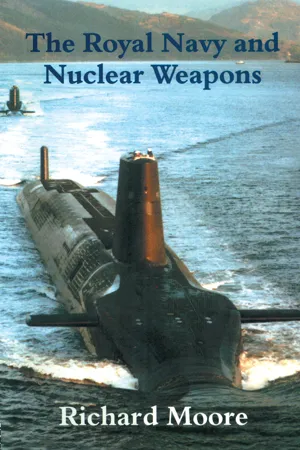
The Royal Navy and Nuclear Weapons
About this book
This work examines British thinking about nuclear weapons in the period up to about 1970, looking at the subject through the eyes of the Royal Navy, in the belief that this can offer new insights in this field. The author argues that the Navy was always sceptical about nuclear weapons, both on practical grounds and because of wartime and pre-war experiences. He suggests that this scepticism can teach us a good deal about military technological innovation in general.
1
First Thoughts
Bedevere: We have the Holy Hand Grenade. Arthur: Yes of course, the Holy Hand Grenade of Antioch. 'Tis one of the sacred relics Brother Maynard carries with him . . . How does it . . . er . . . how does it work? Lancelot: I know not my liege.
(Monty Python and the Holy Grail)
Three atomic explosions, at Alamogordo in New Mexico on 16 July and over Hiroshima and Nagasaki on 6 and 9 August 1945, ushered in the nuclear age. The new weapon, thousands of times more powerful than existing explosives, was quickly hailed as revolutionary – 'The most terrifying weapon in history', said the Daily Mail, whose science correspondent foresaw 'the end of war itself. No war potential could stand up for a week against the sort of bombing which is now a possibility . . . The Labour government need not waste time nationalising the coal industry, nor the electric and gas industries since these industries are from now on obsolete.'1 Such apocalyptic reactions were commonplace in the first nervous days of the peace.2 This chapter seeks to explore the immediate thoughts and reactions of the Royal Navy in the early months and years of the atomic age. Some context is necessary for these thoughts, and I have included a short summary of defence planning issues before moving on to look at the extent of the Navy's knowledge of the bomb and its physical effects, at the perceived implications for the Navy's defensive and offensive operations in a war at sea, and, finally, at a significant early exercise and the thoughts that it provoked.
Defence Planning Issues
A bewildering array of issues faced defence planners in the UK. The postwar world political situation had preoccupied a small group of officials in the Foreign Office and the service ministries as early as 1942. As it became clear after the war that fundamental differences between the wartime allies were likely to poison relations permanently, these planners turned with increasing concern to the problems of a possible war with the USSR. Meanwhile, there were serious imperial troubles in Palestine and India. The reconstruction of Europe and the welcome involvement of the United States later added another dimension to defence planning as strategic discussions began with various allies. Britain's finances lurched from one crisis to the next: the end of Lend–Lease, the American loan, convertibility, devaluation. As a result the defence debate was crucially constrained by financial realities; we had, as in the interwar period, to cut our coat according to our cloth.3 These factors, together with technological developments including – but not, as we shall see, limited to – the atomic bomb, provided the impetus for constant reviews of Britain's strategy and the size and shape of the armed forces she required. This is not the place for a detailed account of the ferment in defence thinking in the late 1940s. A brief look at a small number of themes, however, including strategic bombing, deterrence, the continental commitment and the search for allies, will form a useful background to consideration of naval thought.4
As I have tried to establish in the introduction, strategic bombing was by no means a new theme in 1945. Wartime arguments on the effectiveness or otherwise of the strategic bomber offensive continued to rage. The Navy was always on the side of the sceptics: thus Sir John Cunningham as First Sea Lord wondered aloud whether 'it is a safe assumption that a world power can be knocked out of a war by the exercise of air power alone . . . history has, so far, by a narrow margin, disproved this assumption'.5 Hulme (DNOR) claimed in 1945 that, on the basis of five tons of bombs dropped to kill one German, and four man-years of British effort to drop one ton of bombs, it had taken 20 man-years, or four men working throughout the war, to kill every German by strategic bombing: 'not a very decisive way to kill the enemy'.6 Inspired by Richmond, Admiral Sir Gerald Dickens published a polemic against the air offensive strategy in 1946.7 Nevertheless, by April 1946 the Chiefs were using the air offensive as a justification for the retention of bases in the Middle East in the face of opposition from Attlee, and by the early part of 1947 strategic bombing was an accepted feature of all plans for a war against the Soviet Union.8
Along with the centrality of the air offensive came the idea of deterrence. This was not a new idea in 1945 either, but as Clark and Wheeler have shown it grew to maturity in the immediate postwar years and gained a specifically British following and British flavour based on the perceived vulnerability of a small and densely populated island to atomic bombing.9 At the highest level of defence planning – the Chiefs, ministers and Attlee himself – the threat of retaliation was very quickly seized upon as the only possible basis for the prevention of atomic attack. It should be emphasised at this point, however, that, although the defence planners quite clearly regarded an air offensive as an essential part of a future war against the USSR, they were not at first certain that it would immediately involve weapons of mass destruction; a period of what would later be called intrawar deterrence was a possibility. Some documents of the period related to immediate planning for a time when neither the UK nor the USSR would possess any atomic bombs. Even those that were tied to a more distant future did not initially assume the immediate use of weapons of mass destruction. In March 1947 the JPS suggested that 'should substantial stocks of atomic bombs be available to both sides . . . we can foresee circumstances in which there might be great reluctance to initiate atomic warfare'.10 Nor should it be assumed that the phrase 'weapons of mass destruction' refers solely to atomic bombs; the same document makes it clear that biological and chemical weapons were also being considered, though without the benefit of such a firm basis of practical knowledge. In April 1948 the JPS and Joint Intelligence Committee (JIC) prepared a joint report on the likely strategic context of a war in 1957, as a discussion paper for staff talks with the Americans, which again left open the question of whether atomic weapons would be used at the outset:
Our conclusions regarding the use of weapons of mass destruction . . . are:
- (a) Weapons of mass destruction may be used from the outset by either side, in which case the other side will have resort to them.
- (b) Russia may not use weapons of mass destruction at the beginning of a war, and in that case it may be politically impossible for the allies to use them.
- (c) However, if weapons of mass destruction are not used at the start, the allies might initiate their use at a later stage when
- (i) the UK was hard pressed by attack with conventional means,
- (ii) the war had reached a stalemate by conventional means and the allies wished to press it to a decisive conclusion.
- (d) Similarly the Russians might initiate the use of weapons of mass destruction at any time they think it might be to their advantage to do so.11
Only during the course of these staff discussions of April 1948 was it made clear to the British that the Americans were planning to use atomic bombs regardless of such soul-searching. The JPS were suddenly therefore confident of an 'immediate use of strategic air forces using atomic bombs', although they had been 'quite unable to get from the Americans any estimate of the targets to be attacked or the probable efficacy of this offensive and . . . we do not believe they have any idea how many atomic bombs will in fact be available'.12 As a result of these talks, a joint 'emergency' war plan for hostilities before the middle of 1949 was adopted, codenamed Double-quick. The plan included the assumption that 'the United States Government and His Majesty's Governments in the United Kingdom and Canada will authorise the use of atomic bombs at the outbreak of war'. It was also now clear that chemical and biological weapons would not be available 'on such a scale as to be considered weapons of mass destruction'.13 What was still not clear at this early stage was whether the atomic offensive could be decisive, and when British, American and Canadian planners met again in Washington in October they specifically revised their plan, now renamed Speedway, to inject more realism for the eventuality that at D+3 months the UK might be under genuine threat of invasion.14 This time, in addition, the US appears to have presented a proper plan for the atomic air offensive, and the JPS was able to report discussions of targeting priorities: the British delegates had suggested that breaking the Communist control of the Russian people should be the chief aim, while the Americans had stressed Soviet war-making capacity. In practice, as the JPS was able to conclude, the two meant the same thing: the 'main towns'.15 In this way, it gradually became clear that a war against the USSR in the late 1940s would have to begin with an atomic offensive; the implications for the UK were becoming more serious and in 1948-49 the first opposition to such a strategy was becoming clear. Patrick Blackett published a book outlining anti-atomic views he had been expressing in private since 1945.16 Sir Henry Tizard, Chief Scientific Adviser to the Minister of Defence, and Viscount Montgomery, Chief of the Imperial General Staff, were both by now concerned to point out that the prevention of war, through deterrence, was far more important than preparations for atomic hostilities. They also attempted to secure a higher priority for conventional weapons.17 The JPS too was concerned by 1949 that while an atomic offensive made sense in the case of war in the short term, by 1957 the Russians would have enough of an atomic stockpile to make the logic once again questionable.18 These early discussions are interesting in the light of the 'nuclear sufficiency' debates of the late 1950s covered in Chapter 4.
The questions of the continental commitment and the search for allies had haunted British policy-makers throughout the interwar period, and, as the war drew to a close, some very pessimistic assessments were again produced. Papers from early in 1947 stop short of assuming that the United States or Western Europe would be allied with the UK at all.19 This was softened in March to not knowing when the US might join in on our side, but only with the April 1948 staff talks and the adoption of Plan Double-quick was the assumption changed to the more comfortable 'America will be allied with us'. France, the Benelux countries, Norway, Portugal and Turkey were also now numbered with the allies although Italy and Greece, rather ambiguously, 'could not be relied upon as an asset in any computation of forces'.20 Progress was now being made each spring with the construction of a system of alliances: the Anglo-French Treaty of Dunkirk in March 1947, the Treaty of Brussels in March 1948 and, finally, in April 1949 the North Atlantic Treaty. This fortunate new position facilitated suggestions of burden-sharing, and so for Plan Doublequick it was agreed that in the event of war the Royal Navy would share North Atlantic and Mediterranean convoy escort duties equally with the US Navy.21 In 1948, the US also moved to base some of its strategic bombers in East Anglia and the RAF was able to acquire some B~29s of its own. Along with the benefits, however, came extra responsibilities, and so the decision was made to contribute land forces to the defence of Western Europe. This was partly for political reasons and partly for sound reasons of strategy: nobody wished to see V-l and V-2 bases established on the Channel coast again, or Russian submarines operating from Brest or St Nazaire. At the same time, although Plan Doublequick envisaged at least an attempt to stand on the Rhine, it was recognised that there was little that could practically be done on the ground, and so the air offensive strategy came to be seen in a sense as an alternative to a meaningful continental commitment: 'the least we can do'.22
It is worth making a final comment to conclude this brief canter through the most politically important defence planning issues. In January 1947 the Chiefs formally discussed and approved the 'three pillars' of postwar British strategy at a conference with Prime Minister Attlee. These were the defence of the UK, of the Middle East, and of sea communications. All agreed that the Navy's key role was in the last of these: 'The Royal Navy, with its air arm, must be enabled to perform its vital role in the control of sea communications'.23 This overriding assumption is apparent too in contemporary naval writings: 'It is the main function of the Navy to protect these sea routes in w...
Table of contents
- Cover
- Half Title
- Title
- Copyright
- Contents
- List of Illustrations
- Series Editor's Preface
- Acknowledgements
- List of Abbreviations
- Introduction
- 1. First Thoughts
- 2. Broken-backed Warfare
- 3. Nuclear Ambitions
- 4. Nuclear Stalemate
- 5. Polaris and Beyond
- 6. Conclusions
- Epilogue: Thirty Years of Consensus
- Appendix: Royal Navy Nuclear Stockpiles
- Bibliography
- Index
Trusted by 375,005 students
Access to over 1.5 million titles for a fair monthly price.
Study more efficiently using our study tools.
Frequently asked questions
Yes, you can cancel anytime from the Subscription tab in your account settings on the Perlego website. Your subscription will stay active until the end of your current billing period. Learn how to cancel your subscription
No, books cannot be downloaded as external files, such as PDFs, for use outside of Perlego. However, you can download books within the Perlego app for offline reading on mobile or tablet. Learn how to download books offline
Perlego offers two plans: Essential and Complete
- Essential is ideal for learners and professionals who enjoy exploring a wide range of subjects. Access the Essential Library with 800,000+ trusted titles and best-sellers across business, personal growth, and the humanities. Includes unlimited reading time and Standard Read Aloud voice.
- Complete: Perfect for advanced learners and researchers needing full, unrestricted access. Unlock 1.5M+ books across hundreds of subjects, including academic and specialized titles. The Complete Plan also includes advanced features like Premium Read Aloud and Research Assistant.
We are an online textbook subscription service, where you can get access to an entire online library for less than the price of a single book per month. With over 1.5 million books across 990+ topics, we’ve got you covered! Learn about our mission
Look out for the read-aloud symbol on your next book to see if you can listen to it. The read-aloud tool reads text aloud for you, highlighting the text as it is being read. You can pause it, speed it up and slow it down. Learn more about Read Aloud
Yes! You can use the Perlego app on both iOS and Android devices to read anytime, anywhere — even offline. Perfect for commutes or when you’re on the go.
Please note we cannot support devices running on iOS 13 and Android 7 or earlier. Learn more about using the app
Please note we cannot support devices running on iOS 13 and Android 7 or earlier. Learn more about using the app
Yes, you can access The Royal Navy and Nuclear Weapons by Richard Moore in PDF and/or ePUB format, as well as other popular books in History & Military & Maritime History. We have over 1.5 million books available in our catalogue for you to explore.