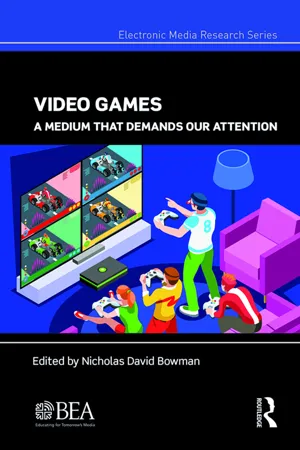
This entry in the BEA Electronic Media Research Series, born out of the April 2017 BEA Research Symposium, takes a look at video games, outlining the characteristics of them as cognitive, emotional, physical, and social demanding technologies, and introduces readers to current research on video games. The diverse array of contributors in this volume offer bleeding-edge perspectives on both current and emerging scholarship. The chapters here contain radical approaches that add to the literature on electronic media studies generally and video game studies specifically. By taking such a forward-looking approach, this volume aims to collect foundational writings for the future of gaming studies.
- 252 pages
- English
- ePUB (mobile friendly)
- Available on iOS & Android
eBook - ePub
About this book
Information
1
THE DEMANDING NATURE OF VIDEO GAME PLAY
Nicholas David Bowman
Video games are an increasingly common—perhaps, even mundane—aspect of the modern media ecology (Bogost, 2011). Moving into the 21st century, the video game industry began regularly out-performing the film and music industries in annual revenues (Nath, 2016), and popular media outlets report that over 90 percent of children are actively playing video games (Reisinger, 2011). Dispelling myths that games are “just for kids,” industry data reports that the average gamer is 35 years old and the population of gamers of women over the age of 18 is a larger proportion of the overall gaming market than boys under age 18 (Entertainment Software Association, 2017). In short, games have been demanding our leisure time (or at least, our leisure budgets) for the better part of the Digital Age (Castells, 1999).
Although there is some debate about the “first” video game (Grizzard and Francemone, Chapter 4, this volume, discusses the earliest patents filed in the US for gaming technologies), the development of the medium was focused less on creating an enjoyable leisure technology and more about demanding more of computing technology. Graetz (1981) describes the development of one of first video games in the Kluge Room of the Massachusetts Institute of Technology (MIT), and the common ethos that was embraced by its creators. For them, a “computer simulation” needed to satisfy at least three criteria:
1.It should demonstrate as many of the computer’s resources as possible, and tax those resources to the limit;
2.Within a consistent framework, it should be interesting, which means every run should be different;
3.It should involve the onlooker in a pleasurable and active way—in short, it should be a game. (para. 28, emphasis added)
For their team, the installation of a computer called the programmed data processor, or PDP-1, represented several notable advances into the (pre) Digital Age. Chief among them was the machine’s use of a cathode ray tube display scope—a digital display screen that allowed programs to view and edit programs in real-time. Prior to the PDP-1, most human-computer interactions were of a more analog nature in which data was organized onto a medium (such as a set of paper punch cards), manually input into the system’s processing unit, and after some elapsed time to process (high-speed computers of the time could perform about 100,000 calculations per second, or about 0.000003 percent of the speed of a home computer in 2017), results were then transcribed to paper by the machine. Early on, the denizens of the Kluge Room were set on moving beyond this more passive engagement to explore a new paradigm of human-machine interaction in which a display screen was a real-time, mediated reflection of the will of the former and the capability of the latter.
Pushing the limits of the PDP-1’s processor (it was only one year prior, in 1961, that the National Space and Aeronautics Agency was still using human computers to hand-calculate the trajectory of Friendship 7’s orbit around Earth), by 1962, the team had developed SpaceWar! (1962)—an intergalactic battle between the Needle and the Wedge ships with both locked in the gravity well of a central star, with limited fuel and ammunition to accomplish the end-goal of obliterating the other. This program, developed ostensibly to demonstrate the computational power of the PDP-1, as well as the creativity and prowess of its programmers, is lauded as one of the first video games. Indeed, the self-described hackers that programmed SpaceWar! because they felt compelled by the computer to do so—Graetz (1981, who was a member of the group) explains that much of the early programming was as much about writing “new stuff that couldn’t have been done before” (para. 33) as anything else. In a sense, these early programmers demanded more out of their computing equipment, and, in turn, created one of the first video games that, in turn, demanded more out of the user.
Interactivity as Demand
Although perhaps not intended by its creators, the development of SpaceWar! represents a core element of video games—they require users to engage a novel system and, while engaging, to manipulate the form and content of the on-screen displays in real-time (notions that would serve as core to later definitions of interactivity; Steuer, 1992). In this way, the user’s relationship with the medium shifts from that of a more passive recipient of information to a more active and lean-forward engagement with it (Jansz, 2005). This interactivity—the dialogue between the player and the program—is also one that is demanding of the player, as it requires constant player-side input in order to earn the desired program-side output, as outlined for the balance of this chapter.
Of course, distinguishing media along the dimension of passive and active engagement (and perhaps, even demand) is not a new concept—McLuhan (1964) suggested that media broadly can be understood as either hot or cool depending on the number, as well as the intensity, to which a user’s perceptual senses are engaged. Yet, video games somewhat complicate McLuhan’s classic distinctions in that they both engage (at least) one sense with great intensity (a marker of a hot medium) but also engage nearly the entire human perceptual system, and in a highly participatory nature (a marker of a cool medium). Adding further complication is that even the locus of a technology’s interactivity can be debated, some (e.g., Sundar, 2004) suggest that interactivity is a property of the medium itself and is tied to the system affordances, while others (e.g., Bucy, 2004) counter that interactivity is as much a psychological phenomenon as it is technical. To illustrate the pith of this debate, Sundar (2004) argues that:
If we were to theorize about the psychological effects of interactivity using such a technologically independent conception of interactivity, then we would be building knowledge about people (i.e., theories of psychology) rather than about media.
(p. 386)
On this point, and recognizing Sundar’s contributions to the psychological influences of various interactive affordances (such as his Theory of Interactive Media, or TIME: Sundar, Jia, Waddell, & Huang, 2015), I somewhat align with Bucy’s (2004) argument, at least for the case of video games—or perhaps more accurately, it is productive to follow Stromer-Galley’s (2004) suggestion in focusing more in interactivity-as-process rather than interactivity-as-product.
In fact, it is a focus on the process (rather than the product) of interactivity as the intersection of media and human experience (Rutledge, 2013)—an active relationship between the player and program that forms the basis of the model of interactivity-as-demand. Such a proposal requires us to consider (a) the interaction of the stimulus (the video game) and the organism (the player) and (b) that the various requirements that a game places on a user should be expected to mediate the relationships between the game and its effects on the player. Such a process focus is critical in gaming, because it represents the dialogic nature of interactivity (Haraway, 1991) by which the user is required to constantly co-create the experience with the system (Bowman & Banks, 2016)—as noted by designer Sid Meier (2012), video games at their core are a series of interesting decisions. This deliberative co-creation process was illustrated by Bowman (2016):
At the most basic level, one can track the first board of Super Mario Bros. (1985, Nintendo) as an example of this co-production. As the player initiates the start menu, they encounter a blue-sky world with a solid, flat terrain—entering this world stage-left with little guidance as to what lies ahead. Tapping the controller’s directional pad to the right causes the player-avatar Mario to move in that direction, which happens unimpeded in until the sight of a similarly sized (and angry-looking, given its furled brow) entity blocking in the path—quickly closing in on Mario until a remarkably primal decision must be made: fight or flight? The decision tree is further complicated and/or expanded by the presence of shiny blocks, marked with question marks that seem to beg to be explored further: three contain coins (assumed to be of some value) while one contains a mushroom-shaped object that, when consumed (re: made contact with), causes the player-avatar Mario to double in size and stature, possibly encouraging the player to reconsider an encounter with the “Goomba” or perhaps providing them with the confidence to continue exploring the gameworld. Consequently, a player choosing to ignore the tantalizing shiny boxes and trudge on ahead (regardless of whether or not they fight or flee the Goomba) is forced to take on a brave new world, in which they are of equal stature to the other word denizens as they progress stage-right through the Mushroom Kingdom.
(pp. 108–109)
The above scenario represents several of the required player-program dialogues that make games at once incredibly engaging and incredibly demanding. At the cognitive level, players must make sense of the novel symbols in the environment and their relationships with one another; on an emotional level, players must manage their implicit reactions to existential threat posed by an advancing creature; at the physical level, players must engage an abstract controller in synchronization with their visual processing of the environment; at the social level, the relationship that players have with their on-screen Mario can determine the weight given to some decisions over others. The balance of this chapter will focus more specifically on the cognitive, emotional, physical, and social demands of video games, and suggest how players’ interactions with games on (at least) these four dimensions are core to how we understand the experience of playing games.
That discussion will challenge assumptions that increased levels of interactivity are necessarily beneficial to the experience (Gonzales, Finley, & Duncan, 2009; also discussed in the Introduction of this volume), and instead, discuss the extent to which these four dimensions of demand mediate players’ experiences in games, for better and for worse. For example, Bucy (2004) notes that whereas the technological affordances of a given interactive system are constant and objective properties of that system (Sundar, 2004; Sundar et al., 2015), it is unlikely that users experience those affordances in the same way given natural variance in the users themselves (for example, their cognitive skills or past experiences with interactive system). Moreover, increasing the interactivity of the system on any one dimension probably has a curvilinear association with our positive experiences of the system (Bucy, 2004), as increased interactivity also brings with it an increased demand on the users to make sense of, and function within, the system, which can make for an increasingly negative ...
Table of contents
- Cover
- Title Page
- Copyright Page
- Contents
- List of Contributors
- Series Editor’s Foreword
- Acknowledgments
- Introduction
- 1. The Demanding Nature of Video Game Play
- 2. Video Games and Cognitive Skills
- 3. The Role of Engagement in Facilitating Games-Based Persuasion
- 4. Research on the Emotions Caused by Video Games Demands Integration
- 5. Gaming Is Awesome! A Theoretical Model on Cognitive Demands and the Elicitation of Awe during Video Game Play
- 6. Behavioral Demands as Behavioral Affordances in Video Games
- 7. Applying Psychological Theory to In-Game Moral Behaviors Through the Development of a Purpose-Made Game
- 8. A Communication Model of Social Demands in Video Games
- 9. Tandem Play: Theorizing Sociality in Single-Player Gameplay
- 10. Social Demand in Video Games and the Synchronization Theory of Flow
- 11. Explicating the Electricity of eSports: Motivations for Play and Consumption
- 12. Live Streams and Revenue Streams: Twitch as a Hybrid Gaming Culture
- 13. Development of the Video Game Demand Scale
- Appendix A
- Appendix B
- Index
Trusted by 375,005 students
Access to over 1.5 million titles for a fair monthly price.
Study more efficiently using our study tools.
Frequently asked questions
Yes, you can cancel anytime from the Subscription tab in your account settings on the Perlego website. Your subscription will stay active until the end of your current billing period. Learn how to cancel your subscription
No, books cannot be downloaded as external files, such as PDFs, for use outside of Perlego. However, you can download books within the Perlego app for offline reading on mobile or tablet. Learn how to download books offline
Perlego offers two plans: Essential and Complete
- Essential is ideal for learners and professionals who enjoy exploring a wide range of subjects. Access the Essential Library with 800,000+ trusted titles and best-sellers across business, personal growth, and the humanities. Includes unlimited reading time and Standard Read Aloud voice.
- Complete: Perfect for advanced learners and researchers needing full, unrestricted access. Unlock 1.5M+ books across hundreds of subjects, including academic and specialized titles. The Complete Plan also includes advanced features like Premium Read Aloud and Research Assistant.
We are an online textbook subscription service, where you can get access to an entire online library for less than the price of a single book per month. With over 1.5 million books across 990+ topics, we’ve got you covered! Learn about our mission
Look out for the read-aloud symbol on your next book to see if you can listen to it. The read-aloud tool reads text aloud for you, highlighting the text as it is being read. You can pause it, speed it up and slow it down. Learn more about Read Aloud
Yes! You can use the Perlego app on both iOS and Android devices to read anytime, anywhere — even offline. Perfect for commutes or when you’re on the go.
Please note we cannot support devices running on iOS 13 and Android 7 or earlier. Learn more about using the app
Please note we cannot support devices running on iOS 13 and Android 7 or earlier. Learn more about using the app
Yes, you can access Video Games by Nicholas David Bowman in PDF and/or ePUB format, as well as other popular books in Languages & Linguistics & Communication Studies. We have over 1.5 million books available in our catalogue for you to explore.