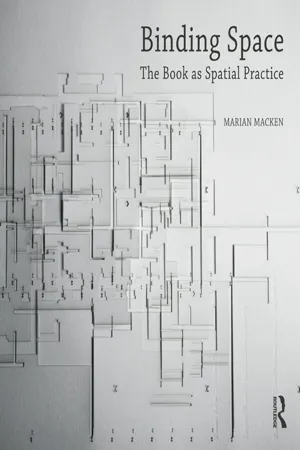
Books orient, intrigue, provoke and direct the reader while editing, interpreting, encapsulating, constructing and revealing architectural representation. Binding Space: The Book as Spatial Practice explores the role of the book form within the realm of architectural representation. It proposes the book itself as another three-dimensional, complementary architectural representation with a generational and propositional role within the design process.
Artists' books in particular – that is, a book made as an original work of art, with an artist, designer or architect as author – have certain qualities and characteristics, quite different from the conventional presentation and documentation of architecture. Paginal sequentiality, the structure and objecthood of the book, and the act of reading create possibilities for the book as a site for architectural imagining and discourse. In this way, the form of the book affects how the architectural work is conceived, constructed and read.
In five main sections, Binding Space examines the relationships between the drawing, the building and the book. It proposes thinking through the book as a form of spatial practice, one in which the book is cast as object, outcome, process and tool. Through the book, we read spatial practice anew.
Architecture stays in one place, while its meaning travels between the covers of books.
Charles Jencks1
By occupying space, by having weight and heft, and by utilizing smells and tactility as part of their own stories, books have impact.
Robert Klanten, Matthias Hübner and Andrew Losowsky2
Book | outcome
PLAN (2010–2011)
Compilation of drawings, mixed media; case binding, bookcloth cover. Unique book. 250 × 160 × 20 mm.
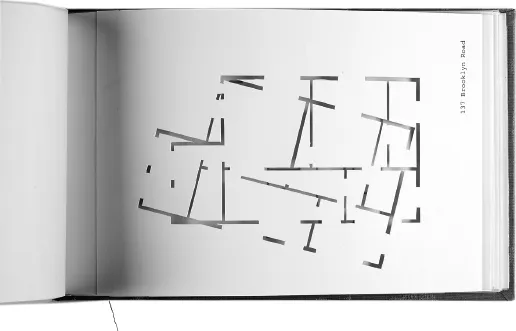
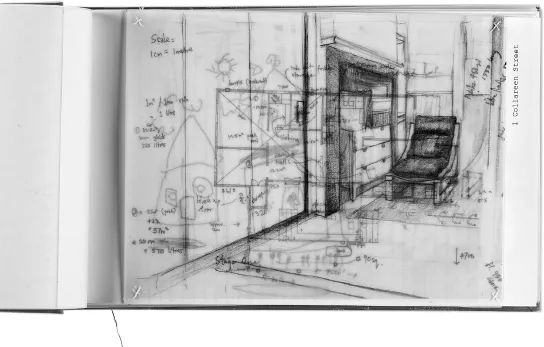
1.1 Marian Macken, Plan (2010–2011); plan by Marian Macken. Photo: Darren Glass
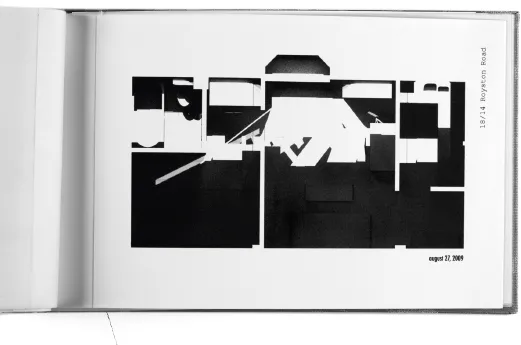
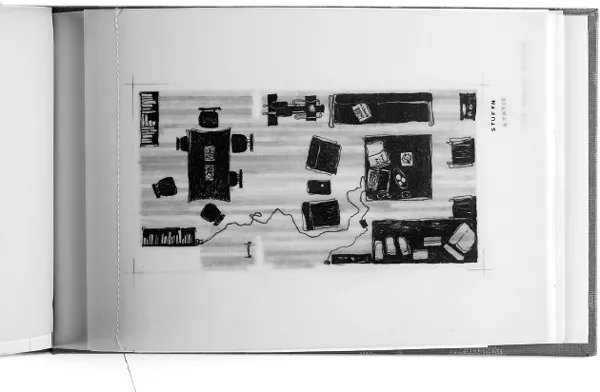
1.2 Marian Macken, Plan (2010–2011); plan by Catherine Dung. Photo: Darren Glass
1.3 Marian Macken, Plan (2010–2011); plan by Julius Chesnuliavichius. Photo: Darren Glass
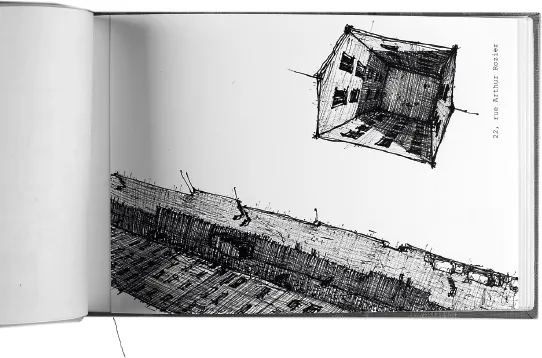
1.4 Marian Macken, Plan (2010–2011); plan by Cara Phillips. Photo: Darren Glass
1.5 Marian Macken, Plan (2010–2011); plan by Nicole Thompson. Photo: Darren Glass.
This book compiles 33 drawings by 26 contributors in seven countries on the subject of plan. Contributors – from the fields of architecture, landscape architecture, academia, art, design, illustration and filmmaking – were each posted a page with the address of their house printed on it (some had multiple residences and hence pages). They were asked to draw a plan of this house which did not necessarily need to be to scale; which may, or may not, include text and annotation; and which might be of the whole house or only a part of the house. The drawing could describe the activities within the space, rather than the built form, but the page somehow needed to relate to the idea of plan.
The bound drawings reflect a range of techniques and media, including pencil, paint, collage, sketch, photography, drafting, perspective, sewing and cut outs. The content of the plans ranges from drawings which relate to the layout of the house and its rooms and the contextual landscape siting of the house, to the experience of inhabitation, through drawing and text: circulation patterns, climatic conditions, lived history and memory and future plans for the house.
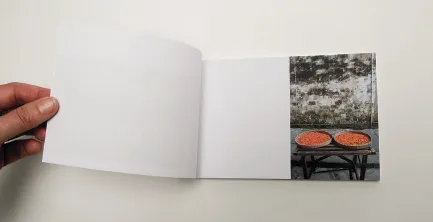
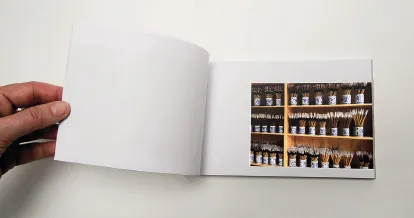
DRYING THINGS /在太阳下 (2015)
Photographs, printed and bound. Edition: 30. 195 × 120 × 7 mm.
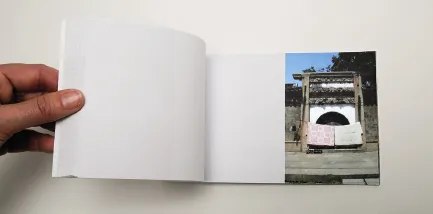
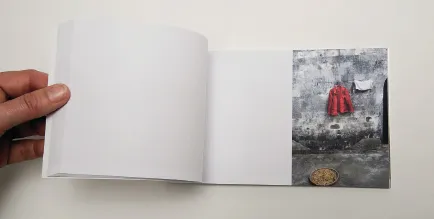
1.6 Marian Macken, Drying Things / 在太阳下 (2015). Photo: Darren Glass.
1.7 Marian Macken, Drying Things / 在太阳下 (2015). Photo: Darren Glass.
1.8 Marian Macken, Drying Things / 在太阳下 (2015). Photo: Darren Glass.
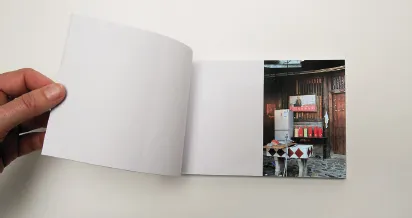
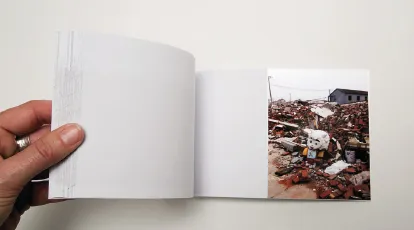
STORING THINGS, MOVING THINGS / 收纳, 移动 (2016)
Photographs, printed and bound. Edition: 15. 195 × 120 × 10 mm.
1.9 Marian Macken, Storing Things, Moving Things / 收纳, 移动 (2016). Photo: Darren Glass.
1.10 Marian Macken, Storing Things, Moving Things / 收纳, 移动 (2016). Photo: Darren Glass.
1.11 Marian Macken, Storing Things, Moving Things / 收纳, 移动 (2016). Photo: Darren Glass.
Drying Things在太阳下 and Storing Things, Moving Things / 收纳, 移动 are the outcomes of three and a half years spent living in China. These two books use the technique of thematic categorization to arrange 120 photographs taken in Hong Kong, Shanghai, Beijing, and Anhui, Jiangsu and Fujian provinces.
PLANSECTION: FUJIAN TULOU /平面剖面: 客家土楼(2016–2017)
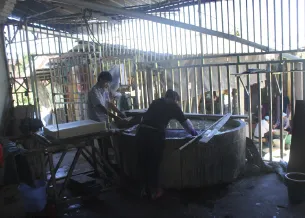
56 handmade paper pages using dian jiexian fibre, with embossed plan and section composite drawing. Made at Museum of Handcraft Paper, Xinzhuang village, Jietou, Tenchong, Yunnan Province, China, with papermaking assistance from Zhao Xiaolan, Long Zhanxian and Liu Kankan; assistance with cyanotype from Darren Glass; diagram of matrix by Lily Szumer. Edition: 1. 155 × 220 × 45 mm.
1.12 Marian Macken, PlanSection: Fujian Tulou /平面剖面: 客家土楼 (2016–2017); papermaking process, Long Zhanxian at left, Xinzhuang village, Yunnan Province, China. Photo: Marian Macken.
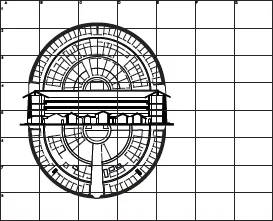
1.13 Marian Macken, PlanSection: Fujian Tulou / 平面剖面: 客家土楼 (2016–2017); diagram showing drawing embossed on matrix of pages. Drawing: Lilian Szumer.
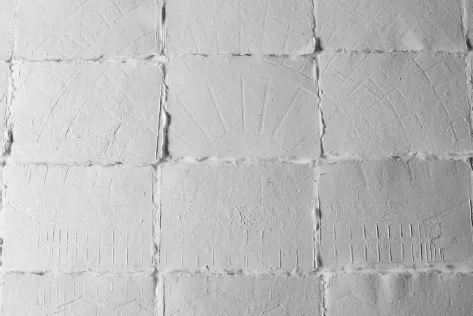
1.14 Marian Macken, PlanSection: Fujian Tulou / 平面剖面: 客家土楼 (2016–2017); detail of embossed pages. Photo: Darren Glass.
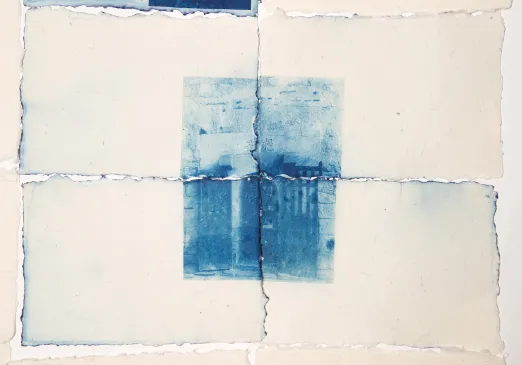
1.15 Marian Macken, PlanSection: Fujian Tulou / 平面剖面: 客家土楼 (2016–2017); detail of pages with cyanotype. Photo: Darren Glass.
PlanSection: Fujian Tulou / 平面剖面: 客家土楼 is made up of a grid of 56 pages. When assembled, they form a composite, embossed plan and section drawing of an example of a round Hakka tulou building, with cyanotype photographs printed on some pages. These distinctive clay buildings from Fujian province in southern China, built from the fourteenth century onwards, house multiple families – sometimes up to 800 people – in multistorey accommodation. The thick rammed earth walls create an inward looking form which is entered through wooden gates leading to an interior courtyard which houses smaller individual communal buildings.
Due to the importance of the entrance threshold within these buildings – to enter the tulou, one passes through the thick outer wall protecting and enclosing the interior – a section is the dominant drawing in understanding these buildings. A cardboard relief drawing was made combining the section with the plan, and pressed into handmade paper as it was drying. Photographs from examples of these buildings sit beside the subtle drawing, printed using a cyanotype process.
‘SUNBURNT: AUSTRALIAN PRACTICES OF LANDSCAPE ARCHITECTURE’ SERIES
The travelling exhibition ‘Sunburnt: Australian Practices of Landscape Architecture’ (2009–2010) aimed to interrogate specific contemporary Australian landscape architectural approaches. Curated by Julian Raxworthy and SueAnne Ware, seven artists’ books were commissioned to be included in the exhibition specifically to interpret space, form and material relationships in the projects as a complement to the exhibited project documentation of photographs and redrawn plans and sections.
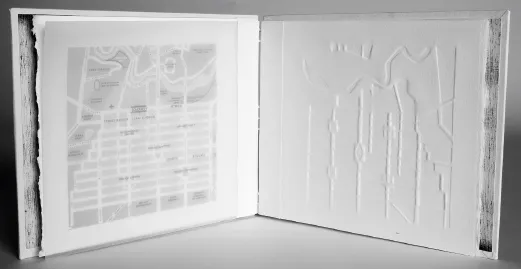
1.16 Marian Macken, North Terrace, SA (2009). Photo: Joshua Morris.
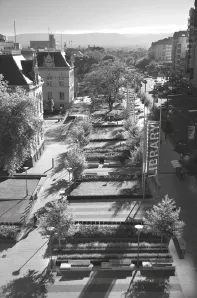
1.17 North Terrace, Adelaide, South Australia, Taylor Cullity Lethlean, in collaboration with Peter Elliott Architects, Paul Carter, James Hayter and Hossein Valamanesh, opened in 2007. Photo: John Gollings, 2006.
NORTH TERRACE, SA (2009)
Embossed pages, drawings on tracing paper, made endpapers; white bookcloth with debossed image of Sturt’s Desert Pea (Swainsona formosa), floral emblem of South Australia (front), blind blocking (back); Coptic binding; images assistance: Christopher Walsh. Documents North Terrace in Adelaide, South Australia, by Taylor Cullity Lethlean, in collaboration with Peter Elliott Architects, Paul Carter, James Hayter and Hossein Valamanesh, opened in 2007. Part of ‘Sunburnt: Australian Practices of Landscape Architecture’ series. Edition: 2. 190 × 225 × 15 mm. Public collection: University of Virginia Library, USA.
North Terrace, SA documents an urban design project, sited on one of Adelaide’s most important civic and cultural boulevards, within the planned urban grid layout of 1837 by Colonel William Light, the first Surveyor-General of South Australia. This project restitches the civic buildings within it to the urban grid and to the city, an important urban design gesture and strategy within Adelaide. The book is a series of recto embossed pages, showing the plan location of the project at varying scales: from the city scale through to the project detail scale, and verso pages showing plan drawings on trace paper. The pages of the book zoom into the project, beginning with the city grid, to the linear planting bands at a pavement scale. The rendering of these in a similar way – embossed white paper – reinforces the alignment of the project within the city.
ULURU KATA TJUTA CULTURAL CENTRE, NT (2009)
Portfolio format, with cut-out and embossed image; white bookcloth with debossed image of Sturt’s Desert Rose (Gossypium sturtianum), floral emblem of Northern Territory (front), blind blocking (back). Documents Uluru Kata Tjuta Cultural Centre (1995), located at Uluru Kata Tjuta National Park in Northern Territory, Australia, by Taylor Cullity Lethlean and Gregory Burgess Architects. Part of ‘Sunburnt: Australian Practices of Landscape Architecture’ series. Edition: 2. 130 × 265 × 10 mm. Public collection: University of Virginia Library, USA.
1.18 Marian Macken, Uluru Kata Tjuta Cultural Centre, NT (2009). Photo: Joshua Morris.
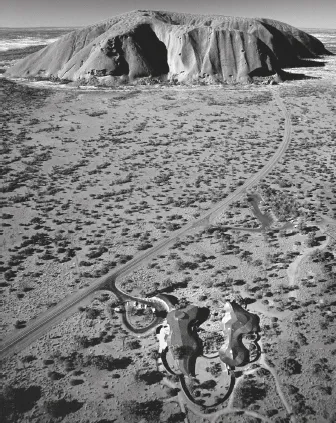
1.19 Uluru Kata Tjuta Cultural Centre, Northern Territory, Taylor Cullity Lethlean, Gregory Burgess Architects, 1995. Photo: John Gollings, 1999.
The hard cover of Uluru Kata Tjuta Cultural Centre, NT opens to reveal a single folded long page. This unfolds to show an embossed silhouette of Uluru; its surrounding horizon line is cut out of the paper on the inside cover. This long section line includes the project, demonstrating the location of it – only one kilometre from the base of the iconic monolith –...
Table of contents
Cover
Half Title
Title Page
Copyright Page
Dedication
Table of Contents
List of figures
Acknowledgements
Preface
Introduction: The book as site
Part 1. Field
Part 2. Page
Part 3. Volume
Part 4. Series
Part 5. Passage
Bibliography
Index
Trusted by 375,005 students
Access to over 1.5 million titles for a fair monthly price.
Study more efficiently using our study tools.
Frequently asked questions
Yes, you can cancel anytime from the Subscription tab in your account settings on the Perlego website. Your subscription will stay active until the end of your current billing period. Learn how to cancel your subscription
No, books cannot be downloaded as external files, such as PDFs, for use outside of Perlego. However, you can download books within the Perlego app for offline reading on mobile or tablet. Learn how to download books offline
Perlego offers two plans: Essential and Complete
Essential is ideal for learners and professionals who enjoy exploring a wide range of subjects. Access the Essential Library with 800,000+ trusted titles and best-sellers across business, personal growth, and the humanities. Includes unlimited reading time and Standard Read Aloud voice.
Complete: Perfect for advanced learners and researchers needing full, unrestricted access. Unlock 1.5M+ books across hundreds of subjects, including academic and specialized titles. The Complete Plan also includes advanced features like Premium Read Aloud and Research Assistant.
Both plans are available with monthly, semester, or annual billing cycles.
We are an online textbook subscription service, where you can get access to an entire online library for less than the price of a single book per month. With over 1.5 million books across 990+ topics, we’ve got you covered! Learn about our mission
Look out for the read-aloud symbol on your next book to see if you can listen to it. The read-aloud tool reads text aloud for you, highlighting the text as it is being read. You can pause it, speed it up and slow it down. Learn more about Read Aloud
Yes! You can use the Perlego app on both iOS and Android devices to read anytime, anywhere — even offline. Perfect for commutes or when you’re on the go. Please note we cannot support devices running on iOS 13 and Android 7 or earlier. Learn more about using the app
Yes, you can access Binding Space: The Book as Spatial Practice by Marian Macken in PDF and/or ePUB format, as well as other popular books in Architecture & Architecture General. We have over 1.5 million books available in our catalogue for you to explore.