- 205 pages
- English
- ePUB (mobile friendly)
- Available on iOS & Android
eBook - ePub
About this book
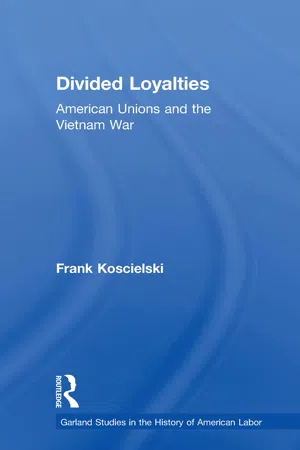
This book explores the international leadership of the AFL-CIO, the UAW and UAW Local 600, the world's largest union local, and reveals that overall, working-class response to the Vietnam War mirrored that of the American society as a whole.
Trusted by 375,005 students
Access to over 1.5 million titles for a fair monthly price.
Study more efficiently using our study tools.
Information
Chapter I
Introduction
The Vietnam War, according to historian George Herring, was “America’s Longest War.”1 Without question it was also America’s most controversial and contentious war, not so much for its effects on Vietnam and its people but for the deep and bitter divisions it created in American society.
Labor’s reaction to the war remains one of the most contentious issues. Observers all over the ideological spectrum and from assorted disciplines have commented on the subject. For the most part, with a few notable exceptions, most agree that “labor” supported American administrations’ pursuit of the war. In this dissertation, I will argue that labor’s response was much more complicated and nuanced than most experts have contended and that working people and their union representatives held multiple, diverse and often divergent views on the war that changed over time. My examination of portions of the world of labor from top union leadership through factory workers in different trades and positions will reveal a multiplicity of responses that reflected a host of factors within and outside the world of work.
In the 1950s and 1960s, the nature of work itself and the composition of America’s work force were undergoing rapid change. By 1956 the number of workers in the U.S. labor force considered “white-collar” for the first time exceeded those designated “bluecollar.” Many of those white-collar jobs were in relatively low-wage, low-prestige industries; the workers remained wage laborers. While the trade, service, government, and finance sectors expanded, manufacturing, mining and transportation declined due to changing technology and consumer demand. The expanding construction trades provide the exception to this pattern.2
By 1971, the unionized percentage of the total work force declined to 22.8 percent from a previous high of about 30 percent. Unions did experience gains organizing white-collar workers such as teachers, musicians, barbers, retail clerks, and state, county and municipal employees, and retail, wholesale and department store employees. Smaller unions included letter carriers, and postal clerks. For the most part, however, organizing growth among white collar workers remained concentrated in the public-service sector. While the white-collar segment of the population expanded, white-collar unionization only grew from 2.42 million workers in 1956 to 2.7 million by the late 1960s.3 Complicating the issue over who were “workers” in the 1960s and 1970s is the fact that people designated blue-collar often made more money than some white-collar workers.
My examination of “labor” will be limited to labor leadership at the international level, specifically George Meany, head of the AFL-CIO, Walter Reuther, head of the UAW, and their respective international executive boards. Others, as we shall see, have examined aspects of the AFL-CIO’s and the UAW’s relationship to the Vietnam War. In the most original part of this study, I will consider individuals employed by the Ford Motor Company at its Rouge River Plant in Dearborn Michigan—in other words, predominantly male, generally non-college-educated wage workers represented by the United Automobile Workers (UAW) international union.
Statistically, unionized workers were somewhere in the middle 50 percent of Americans in terms of income. But Frank Marquart, in An Autoworker’s Journal, reminds us that even if working people had a middle-class home in the suburbs and believed that they were middle-class, in the factory they were still workers.4 In addition, although some working people did approach middle-class economic status, improvements in wages did not reduce the “structural insecurity” of many working people’s lives. In the 1960s automation and decentralization of complexes such as the Rouge threatened many factory jobs and workers lacked control over the pace and type of job they did. Refinements in factory technology contributed to speed-up that consequently increased the monotony and intensity of the work. Skilled craftsmen and construction workers also labored under conditions of insecurity, due to the dependence of their work largely on factory improvements and expansion and the seasonal nature of these jobs. Wage and fringe benefit increases of the 1960s did not necessarily result in middle-class working conditions or lifestyles.5
These factors provided the context for the sometimes forgotten labor upheavals of the 1960s and early 1970s. As historian Barbara Ehrenreich reveals, this period included the greatest strike wave since 1946. Contrary to popular stereotypes, white and black workers and males and females often marched in demonstrations of class solidarity not seen since the late 1930s.6
Some of this activism was a result of generational and social change. For many, the 1960s revolve around middle-class culture, youth rebellion, and the youth movement. Yet what is not always considered, especially in the context of Vietnam, is that young workers, among the so-called baby boomers, were taking jobs in all walks of life, including factories and the trades. Young workers, sharing much of the same music, values, clothing, hair length and drug use as their rebellious campus contemporaries were entering the work force en masse.7 In addition, blacks, through organizations such as the League of Revolutionary Black Workers, carried the legacy of the civil rights and black power movements onto the shop floor,8 while women, influenced by the emergent feminist movement, were making their mark not only on society at large but in workplaces all over the country.9
Consequently, the 1960s and early 1970s were a period of tremendous labor activism. This activism explains what Barbara Ehrenreich refers to as the “discovery of the working-class” by middle-class “commentators, professors and Ivy League radicals.”10
Considering this analysis, one wonders why so much of the literature on working people and the war reports that worker support for Mr. Johnson’s War and later Mr. Nixon’s War was not only unequivocal but enthusiastic.11 Some of the authorities see workers as exclusively white and male but except for most of the skilled trades, this was simply not true. The hardhats who marched in New York in 1970, and appear in all the studies of the subject, were overwhelmingly white and male. Their actions, however, do not translate into universal working-class support for the war. The composition of the working-class—in race, gender and age terms—had changed.
Journalists Nancy Zaroulis and Gerald Sullivan conclude that worker support for the war was strong because of their general antipathy toward the antiwar movement. But opposition to the antiwar movement, which alienated much of the population, does not equate to support for the war.12 In The New Left and Labor in the 1960s, Peter Levy draws similar conclusions. He maintains that the New Left and labor unions worked together in the early civil rights movement and War on Poverty but split in 1965 over the escalation of the Vietnam War. Thereafter workers took a prowar stance. He falls into the same trap as many others by indicating that the hardhat confrontation in New York City, in which a group of construction workers attacked antiwar protesters, demonstrated working peoples’ support for the war. He does recognize that the issue has been oversimplified. There were instances of student-labor peace initiatives, but Levy confuses worker animosity toward the New Left as an indicator of support for the war.13 In The Sixties: Days of Hope and Rage, Todd Gitlin gets to the heart of the matter when he says, “As unpopular as the war had become, the antiwar movement was detested still more; [It was] the most hated political group in America, disliked even by most of the people who supported immediate withdrawal from Vietnam.”14 Some working people supported the war, others did not, but in any case, most were loath to support a movement some of whose most visible members advocated the destruction of the American system of government and way of life. In this era, many workers were just beginning to achieve what they perceived to be the “American Dream” and strongly resented those who would destroy it.
Joshua Freeman condemns construction workers as war-mongering sexist pigs largely due to the actions of the few in New York in May 1970. He asserts that the hardhats deservedly became associated with “aggressive, crude, masculinity”: they were politically reactionary, pathologically violent, and deeply misogynist, and their everyday dialogue was “remarkable sexualized.” He stereotypes workers and claims that they generally engaged in behaviors rooted in deep fears of women’s liberation and manipulation by conservative political forces.15 Similarly, historian Mike Davis, ostensibly a friend of labor, who claims that working people and their representatives had the misfortune of tying their future to the Democratic Party, also lumps all craft workers together as “mindless supporters of whatever regime in Washington was currently bombing Southeast Asia.”16
Another point of view is represented by Christian Appy who maintains that the image of a worker as “Joe six-pack, a flag-waving, blue-collar, anti-intellectual who .. . was assumed to be a bigot” is due to a number of factors.17 First of all, the media had a hand in promoting this stereotype, particularly after the hardhat incident in New York. It published sensationalist accounts of the event and then articles such as “Joe Kelly Has Reached His Boiling Point.”18 Situation comedies such as All in the Family, with its formulaic character, Archie Bunker, and films like Joe, with its sociopathic protagonist-worker furthered the stereotype. The strong blue-collar vote for the populist and racist George Wallace in the election of 1968 certainly advanced the negative image of workers among liberals and leftists as well. According to Appy, there was a sufficient amount of truth in the image of hawkish workers to perpetuate the myth that they supported the war; but he contends working people were no more supportive of the war than the middle and upper classes. Most importantly, Appy reminds us that many workers wanted to support the boys in Vietnam without supporting the war itself. Workers’ opposition to antiwar protesters, he argues, was based in class division; workers perceived antiwar protesters as people of privilege who were not forced to fight the war.19 Neither Appy nor other historians make distinctions among construction workers, unskilled factory workers, and other blue-collar proletarians.
In contrast, other historians, such as Philip Foner, claim that working people, after some initial hesitation, carried on a noble and vigorous protest against the war, joining in various antiwar activities. A Marxist, Foner celebrates the working class as revolutionary. As we shall see, a number of workers and antiwar activists interacted, particularly after 1970, but Foner exaggerates these relationships.20
Some writers have noted that public opinion polls reveal that workers and people from low-income households expressed the greatest amount of antiwar sentiment. This was the focus of Harlan Hahn’s “Dove Sentiments Among Blue-Collar Workers” published in 1970.21 The most thorough exploration of public-opinion polls and working-class opposition to the war can be found in a brief article by Henry Berger, which concludes that workers did indeed have opinions on foreign policy and that antagonism to the war among manual workers increased considerably from 1966 through 1969.22 Comparable arguments may be found in the work of Kevin Boyle, Steve Babson, Andrew Levison and Patricia and Brendan Sexton.23 Worker activity and attitudes during the Vietnam War years are not, however, the primary focus of these studies. Levison sums up the issue when he notes that, “Workers were ‘reacting’ but in significant part to the fact that their kids went to Vietnam while middle-class kids went to college.”24
As we have seen, working peoples’ behavior in the United States during the Vietnam War era has been evaluated by observers from the whole range of the ideological spectrum. Intrinsic to these arguments is an inescapable issue: Who fought the war? Whether one divides workers by income or occupation, there were more middle-and-low income workers as a percentage of the U.S. population. Workers were more often susceptible to the draft.
If the military had not been the employer of last resort for the young after World War II, if the draft was completely fair and equitable, if there had been no student deferments, if draft boards had not been generally chaired by upper-middle class professionals, and even if “channelling” had not been official government policy, working people comprised the largest single population bloc. In other words, in absolute numbers, regardless of percentages of particular population categories, there were simply more working-class individuals, than managerial or professional people, in the American population of the Vietnam War era.25
Acrimonious debate over the “class-bi...
Table of contents
- Cover
- Half Title
- Title Page
- Copyright Page
- Dedication
- Contents
- Acknowledgments
- Chapter I Introduction
- Chapter II The AFL-CIO, George Meany, and the Vietnam War
- Chapter III The United Automobile Workers, Walter Reuther, and the Vietnam War
- Chapter IV Local 600 and the Vietnam War: Part I
- Chapter V Local 600 and the Vietnam War: Part II
- Chapter VI Conclusion
- Appendix A Local 600 Interview Form
- Appendix B Local 600 Retiree’s Meeting: 11–19–95
- Bibliography
- Index
Frequently asked questions
Yes, you can cancel anytime from the Subscription tab in your account settings on the Perlego website. Your subscription will stay active until the end of your current billing period. Learn how to cancel your subscription
No, books cannot be downloaded as external files, such as PDFs, for use outside of Perlego. However, you can download books within the Perlego app for offline reading on mobile or tablet. Learn how to download books offline
Perlego offers two plans: Essential and Complete
- Essential is ideal for learners and professionals who enjoy exploring a wide range of subjects. Access the Essential Library with 800,000+ trusted titles and best-sellers across business, personal growth, and the humanities. Includes unlimited reading time and Standard Read Aloud voice.
- Complete: Perfect for advanced learners and researchers needing full, unrestricted access. Unlock 1.5M+ books across hundreds of subjects, including academic and specialized titles. The Complete Plan also includes advanced features like Premium Read Aloud and Research Assistant.
We are an online textbook subscription service, where you can get access to an entire online library for less than the price of a single book per month. With over 1.5 million books across 990+ topics, we’ve got you covered! Learn about our mission
Look out for the read-aloud symbol on your next book to see if you can listen to it. The read-aloud tool reads text aloud for you, highlighting the text as it is being read. You can pause it, speed it up and slow it down. Learn more about Read Aloud
Yes! You can use the Perlego app on both iOS and Android devices to read anytime, anywhere — even offline. Perfect for commutes or when you’re on the go.
Please note we cannot support devices running on iOS 13 and Android 7 or earlier. Learn more about using the app
Please note we cannot support devices running on iOS 13 and Android 7 or earlier. Learn more about using the app
Yes, you can access Divided Loyalties by Frank Koscielski in PDF and/or ePUB format, as well as other popular books in History & Vietnam War. We have over 1.5 million books available in our catalogue for you to explore.