- 582 pages
- English
- ePUB (mobile friendly)
- Available on iOS & Android
eBook - ePub
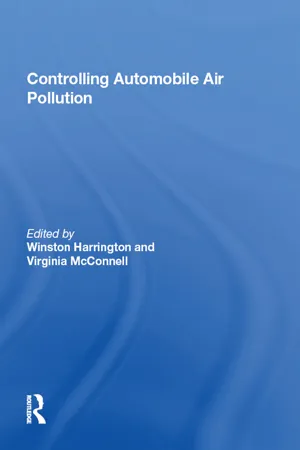
Controlling Automobile Air Pollution
About this book
This volume includes many of the most influential and interesting academic articles related to the economics of mobile source pollution control. The papers included explore why vehicles and vehicle markets are unique, provide estimates of the type and magnitude of the social costs of driving and examine estimation methods and estimates of the various elasticities of vehicle demand. Analysis of the social costs and policies to reduce both traditional air pollutants and greenhouse gas emissions are included. Selected articles review the range of evaluation of both regulatory and market-based approaches to controlling emissions. The complexity of the effects of different policies are emphasized and the unintended consequences of regulation are explored in the context of vehicle emissions reduction policies.
Part I
Dimensions of the Pollution Problem
[1]
Income’s effect on car and vehicle ownership, worldwide: 1960–2015
aESRC Transport Studies Unit, Centre for Transport Studies, University College London, Gower Street, London WC1E 6BT, UK
bEconomics Department, New York University, 269 Mercer Street, New York, NY 10003, USA
Received 5 October 1997; received in revised form 10 April 1998
Abstract
This paper makes projections of the growth in the car and total vehicle stock to the year 2015, for OECD countries and a number of developing economies, including China, India, and Pakistan. The projections are based on an econometrically estimated model that explains the growth of the car/population ratio (‘car ownership’) as a function of per-capita income; a similar model is used for vehicle ownership. The model estimations are based on annual data for 26 countries over the period 1960–1992; it is the first study to include countries covering the full range of income levels, from lowest to highest. The models are dynamically specified, so that short- and long-run income elasticities of car and vehicle ownership are estimated. These income elasticities depend upon per-capita income, ranging from about 2.0, for low- and middle-income levels (that is, ownership grows twice as fast as income), down to zero, as ownership saturation is approached for the highest income levels. The similarities and differences among countries are embodied within the model specification, and the implications for the projections are analyzed.
1. Introduction
The transportation sector is responsible for over half of world oil consumption and about 30% of the world’s total commercial energy consumption, It is also the most rapidly growing sector in terms of energy and particularly oil consumption. Over the past 20 years energy use in the transportation sector increased at an average of 2.7% per yr, far more rapidly than any other sector. The annual rate of growth in the OECD (1.8%)—and particularly in North America—has been slower than in the rest of the world (4.5%) reflecting the slower income growth and the nearing of saturation of vehicle ownership and use. Growth has been the highest in the fastest growing economies: China, East Asia and parts of Latin America. In the OECD virtually all of the increase in oil demand since the mid-1970s is attributable to transportation, while in the rest of the world the comparable figure is about 45%.
The rapid expansion in the demand for transportation services which underlies the growth in energy demand can be expected to continue over the next two decades as per-capita income continues to grow. Growth will be especially rapid among low- and middle-income countries outside the OECD, whose income growth rates and income elasticities of car and vehicle ownership are expected to be high. Continued rapid growth is also expected for the lower-income OECD countries, and somewhat slower growth for Japan and most of Europe.
The lack of viable alternative fuels for road transportation means that oil demand will continue to increase, as will the associated CO2 emissions. Because oil demand for road transportation is closely linked with the number of cars and other road vehicles in use, projections of future growth in the vehicle stock can provide an insight into future energy requirements and also to the environmental policy issues which may arise.
This paper presents projections of cars and total vehicles to the year 2015, for 26 countries at different levels of economic development, from the lowest (China, India, and Pakistan) to the highest (the US, Japan, and Europe). The projections are based on a dynamic econometric model that relates car and vehicle ownership to per-capita income. Although there are numerous studies of car and vehicle ownership, the focus is either individual countries [e.g. see Mogridge (1983, 1989), Gallez (1994), and Jansson (1989)] or limited groups of countries or regions [e.g. see Button et al. (1993), Greenman (1996), and Madre et al. (1995)]. The data used in these studies vary considerably, from individual household data to aggregate national data. Some are based on models that include the effects of variables other than per-capita income, such as costs or demographic factors. Given the differences in data sources, model specification and methods, it is difficult to compare the results for different countries.
The advantage of the present study is that it applies a single econometric specification to consistent data for a wide range of countries, extending as far back as 1960. The results allow comparison amongst countries and over time, as well as providing projections for car and vehicle ownership for a substantial part of the world’s population. The growth in car and vehicle ownership is explained solely as a function of per-capita income. The effects of prices and demographic and geographic factors are ignored within the model, being significantly less important, but they are discussed in Appendix D. Given the historical dominance of per-capita income in determining car and vehicle ownership, this simplification should not detract from the validity of the projections obtained.
The long-run relationship between the car/population ratio (‘car ownership’) and per-capita income is assumed to be defined by an S-shaped function. The income elasticity increases from below 1.0 at the lowest income levels to above 2.0 as income rises through the middle-income levels, before declining gradually to 0 as saturation is reached at the highest income levels. The model is estimated using time-series data for 20 OECD countries (including Mexico) and six less developed economies: China, India, Pakistan, Taiwan, South Korea and Israel.
Section 2 summarizes the historical patterns in the growth of car and vehicle ownership, relative to the growth in per-capita income. Section 3 presents the model to be used in the econometric estimation, and the econometric results are described in Section 4. Section 5 summarizes the projections of car and vehicle ownership, based upon assumed growth rates of per-capita income in the various countries. Section 6 presents conclusions.
2. Historical patterns in the growth of car and vehicle ownership, relative to growth in percapita income
Different countries’ stocks of cars and vehicles and their development over time vary considerably. This is seen in Table 1, which summarizes the historical data for the countries covered in this study. The first three columns show the countries included, the abbreviations used in the figures that follow, and the years included in the data samples. The following columns show percapita GDP (in 1985 US dollars) for 1970 and 1992, as well as the average annual percentage change over this period. The next columns show car ownership levels (defined as the number of cars divided by population) for the 2 yrs, the average annual percentage change over the period, and ratio of the average annual growth in car ownership to the average annual growth in percapita GDP. Similar columns then show analogous data for vehicle ownership (the number of vehicles divided by population).
The variation across countries is apparent. For example, in 1992 ownership varies dramatically. The USA is at the high end, with 560 cars and 750 vehicles per thousand inhabitants. At the low end are China and India, with about 2 cars and 6 vehicles per thousand inhabitants. The average annual growth rates also vary considerably: from 1.2% for cars in the USA (and 1.6% for vehicles) to about 18% for cars (and 16% for vehicles) in South Korea and Taiwan. Relative to growth in per-capita income, the increase in car and vehicle ownership has been greatest in the fastest growing economies, South Korea and Taiwan.
These historical patterns in car and vehicle ownership across countries are illustrated in several figures that follow. Countries are identified in the figures by their abbreviations (codes), which are listed in Table 1. Figs. 1 and 2 compare ownership levels between 1970 and 1992. Figs. 3 and 4 show the changes from 1970 to 1992, in both ownership levels and absolute numbers of cars (and vehicles), using logarithmic scales. Figs. 5 and 6 show the changes in ownership levels from 1970 to 1992, relative to the changes in per-capita income, for many of the countries. Figs. 7 and 8 plot average income elasticities (growth-rate ratios: average annual % growth rate of car or vehicle ownership to average annual % growth rate of per-capita income, for 1970–1990) versus the average levels of per-capita income over the 1970–1990 period.
Fig. 1 shows the changes in car ownership from 1970 to 1992 for all countries in the data sample. Fig. 2 shows the same for vehicle ownership. Each country’s 1970 car/population ratio is plotted on the horizontal, and its 1992 ratio on the vertical. The further a country is above the diagonal, the greater the increase from 1970 to 1992. For example, Italy’s 1970 car/population rati...
Table of contents
- Cover
- Half Title
- Title Page
- Copyright Page
- Table of Contents
- Acknowledgements
- Series Preface
- Introduction
- PART I DIMENSIONS OF THE POLLUTION PROBLEM
- PART II CONVENTIONAL POLLUTANTS
- PART III GREENHOUSE GAS EMISSIONS
- PART IV MULTIPLE EXTERNALITIES
- Name Index
Trusted by 375,005 students
Access to over 1.5 million titles for a fair monthly price.
Study more efficiently using our study tools.
Frequently asked questions
Yes, you can cancel anytime from the Subscription tab in your account settings on the Perlego website. Your subscription will stay active until the end of your current billing period. Learn how to cancel your subscription
No, books cannot be downloaded as external files, such as PDFs, for use outside of Perlego. However, you can download books within the Perlego app for offline reading on mobile or tablet. Learn how to download books offline
Perlego offers two plans: Essential and Complete
- Essential is ideal for learners and professionals who enjoy exploring a wide range of subjects. Access the Essential Library with 800,000+ trusted titles and best-sellers across business, personal growth, and the humanities. Includes unlimited reading time and Standard Read Aloud voice.
- Complete: Perfect for advanced learners and researchers needing full, unrestricted access. Unlock 1.5M+ books across hundreds of subjects, including academic and specialized titles. The Complete Plan also includes advanced features like Premium Read Aloud and Research Assistant.
We are an online textbook subscription service, where you can get access to an entire online library for less than the price of a single book per month. With over 1.5 million books across 990+ topics, we’ve got you covered! Learn about our mission
Look out for the read-aloud symbol on your next book to see if you can listen to it. The read-aloud tool reads text aloud for you, highlighting the text as it is being read. You can pause it, speed it up and slow it down. Learn more about Read Aloud
Yes! You can use the Perlego app on both iOS and Android devices to read anytime, anywhere — even offline. Perfect for commutes or when you’re on the go.
Please note we cannot support devices running on iOS 13 and Android 7 or earlier. Learn more about using the app
Please note we cannot support devices running on iOS 13 and Android 7 or earlier. Learn more about using the app
Yes, you can access Controlling Automobile Air Pollution by Virginia McConnell in PDF and/or ePUB format, as well as other popular books in Business & Business General. We have over 1.5 million books available in our catalogue for you to explore.