- 220 pages
- English
- ePUB (mobile friendly)
- Available on iOS & Android
eBook - ePub
About this book
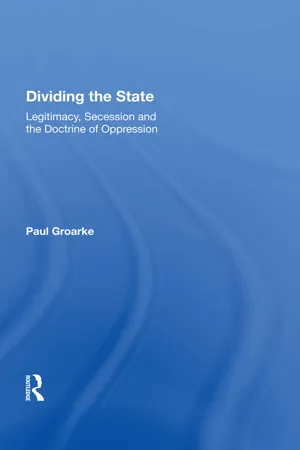
The events of recent history affirm the urgent need for a satisfactory definition of the conditions under which a minority within a state has the legal right to secede. Although the concept of sovereignty has been progressively weakened, it still presents the major theoretical difficulty in this area. There is currently no source of international law that would give a legal body like a court the authority to recognize the division of an oppressive or illegitimate state into separate legal entities. This book accordingly argues for a global system of justice based on a domestic model of compulsory law. It considers some of the technical, procedural and evidentiary issues that would arise in instituting such a regime, and develops the conceptual framework essential for the provision of legal remedies for gross violations of our fundamental human rights.
Chapter 1
Legitimacy
This chapter reviews the etymology of the word ‘legitimacy’ and discusses the political principle of legitimacy, which is predominant in the literature. This principle holds that the legitimacy of the state derives from the consent of the governed, which can usually be found in the agreement of the majority of individuals within the state.
It is worth noting at the outset that the literature speaks of ‘illegitimate’ rather than ‘illegal’ states. The explanation seems to be that states are political rather than legal entities. Although they have a legal personality, they derive their existence from other sources. The historical example is instructive here: a bastard son may have been illegitimate; he nonetheless existed. There was nothing illegal or unlawful in such a fact.
The word ‘illegal’ seems to be reserved for facts and circumstances that are not recognized in law. A corporation formed for a prohibited purpose might be called an ‘illegal corporation’, but this is because corporations are legal entities. As a result, there is a sense in which prohibited corporations do not actually exist. The same cannot be said of illegitimate states. Although a court might strip an illegitimate state of its legal prerogatives, it continues to exist, whatever its legal status.1
Allen Buchanan has written that it is possible to speak of illegitimate governments or illegitimate states. The question of secession nevertheless presents itself in the context of states.
The international legal system recognizes states, not governments, as having certain powers, immunities, liberties, and rights. Governments are recognized only so far as they are regarded as the agents of legitimate states, not as entities possessing these juridical characteristics in their own right.2
It is true that a state will naturally take on the character of specific governments and there is probably a point where a government can be identified with a state, if its policies actually permeate the constitutional structure of the state. The Third Reich is an obvious example of such a development. In spite of this, it is equally true that movements for secession normally arise in the context of historical policies that extend beyond the duration of particular governments.
There is a distinction in this context between the state and the institutions that have the authority to perform its legal and political functions. There will be situations where courts and legislatures lose their legitimacy in much the same way that a state might lose its political authority. This calls for a different kind of relief, however. The military may seize the political apparatus of the state, in Nigeria, Pakistan or Fiji, but there is no reason why that needs to call the legitimacy of the state and its territorial boundaries into question. If a court or government is illegitimate, the appropriate remedy is to dissolve the government or court and replace it. This does not require the division of the state or the termination of the existing political order. It is the legitimacy of the state that accordingly concerns us in the instance of secession.
General Usage
Although the prevailing concept of legitimacy is primarily political, it has its origins in the law. The Oxford English Dictionary (OED) traces our use of the word ‘legitimacy’ to the notion of a legitimate child, which was ‘lawfully begotten’ and ‘entitled to full filial rights’. Thus, David Hume wrote that it ‘had been formerly usual for the civil courts to issue writs to the spiritual, directing them to inquire into the legitimacy of the person’ History of England: Henry III, II (p. 54). This was naturally applied to those in a sovereign position, since the title of the monarch and nobles rested on hereditary principles.
The historical question of legitimacy isolates the adjudicative role of the courts, since it is the courts that have the authority to decide questions like paternity. This was significant because our natural obligations to other people were believed to come from our membership in the family. The moral implication was that the identity of the sovereign was determined by the ordinary laws of succession, in spite of the fact that the sovereign was above the legal order. It is the law that accordingly determines whether the political order is in keeping with the natural moral order.
The OED states that the term ‘legitimate’ originally referred to ‘the action or process of rendering or authoritatively declaring (a person) legitimate’, and by extension, to the act that renders something lawful or legal. Webster’s goes so far as to list the word ‘lawful’ as a synonym of ‘legitimate’. It notes that the root of the word lies in the Latin lex, or law, and characterizes ‘a legitimate government’ as one which is ‘accordant with law or with established legal forms and requirements’.3 The word was also used, by analogy, to indicate that a proposition follows logically from a given set of premises. It is from this usage, apparently, that the term came to express the notion that an assertion is in ‘conformity to rule or principle’.
It is from here that the word ‘legitimacy’ made its way into popular speech, occasionally in a debased form. Benjamin Disraeli wrote sardonically in 1847 that ‘in these days a great capitalist has deeper roots than a sovereign prince, unless he is very legitimate’ Tancred, III (p. iv). ‘It is not in irony’, we find the Saturday Review stating on 14 April 1860, ‘but in sober earnest, that we express our belief, that any throne is, in practice, called legitimate which has not had the consent of the nation … to its existence.’4 The latter example is interesting because the use of the term in the academic literature is predicated almost entirely on consent.
The general usage of the term ‘legitimacy’ reflects two different currents in the history of the concept. The rule of a medieval king was legitimate if it was in keeping with the moral order established by the natural law. The medieval conception was eventually pushed to the side by the concept of natural or inalienable rights, however, which rejects the idea that we derive our individual rights from our membership in society.
This inevitably shifts the focus of any inquiry into the legitimacy of the state. The question is no longer whether the political order is in keeping with the moral order established by divine authority. It is now the implicitly democratic one, whether the individuals within a state have consented to be governed. The division between these two uses of the term is not as clean as it might be, and the word still confers the speaker’s moral approval on the use of power or authority. Martha Crenshaw, for example, writes that the ‘legitimacy of the Red Brigade’, however limited, derives from the failures of the Italian government.5
Although the term ‘legitimacy’ is used in a wide variety of contexts, the moral sense of the term is still evident in its general usage. Rudolph Barnes, for example, has written about ‘military legitimacy’, in suggesting that something more than the chances of military success are necessary to justify the use of force in peacetime conflicts. This is apparently an official American view, which is endorsed in military documents. ‘Legitimacy derives from the perception that [military] authority is genuine, effective and uses proper agencies for reasonable purposes.’6 The indiscriminate use of force, without regard to human rights and the rule of law, may compromise the moral effectiveness of military intervention in a conflict.
The moral and political questions of legitimacy are commonly combined, however. Barnes refers to a related military document, ‘Military operations in low intensity conflict’, which states that the
… legitimacy of the actions of an armed force, or even individual members of the force can have far-reaching effects on the legitimacy of the political system that the force supports. (p. 62)
And the same issue arises, domestically, for a military that intervenes in a foreign conflict.
Public support has proved to be both a requirement and a measure of military legitimacy from the jungles of Vietnam to the deserts of the Persian Gulf, even to the killing fields of Somalia. These contrasting conflicts had one strategic common denominator: the legitimacy of the US military in each conflict depended upon public support back home. (p. 133)
The passage is revealing because it implies that an expression of democratic approval is sufficient to establish the moral legitimacy of military action.
This illustrates the difficulty of the current concept, which lies in the assumption that political criteria are sufficient to establish the moral legitimacy of the political order. In a similar manner, Conor Cruise O’Brien, in ‘Terrorism under democratic conditions’ argues that it is the question of legitimacy that determines whether violence can be described as ‘terrorism’. ‘The success or failure of political violence depends very largely on the extent to which it is perceived as legitimate. The use of the designation “terrorism” constitutes a declaration of the illegitimacy of the political violence referred to’ (p. 94). O’Brien essentially argues that the violence used by a minority is illegitimate if there are other means of seeking changes in the social order. This is a political judgement, as well as a moral evaluation, and rests primarily upon the agreement of the populace.
On the other hand, Paul Gilbert writes that those who describe terrorism as a ‘political crime’ are commenting on its moral character.
Such characterizations, more common among political theorists than philosophers, identify terrorist acts as breaches of the criminal law, rather than of the rules of war. These breaches are committed for political ends which ought to be pursued in accordance with the procedures permitted under a legitimate governmental authority. What makes terrorism wrong on this view is not only that it involves violence against citizens, but also that it by-passes constitutional procedures and thereby threatens the legitimate authority responsible for protecting citizens.7
What makes the existing government legitimate is that it follows moral standards in pursuing political ends, which exclude random violence against citizens. This is not a political standard.8
Most of the contemporary discussion of legitimacy refers specifically to the question of political legitimacy. The general use of such a concept often assumes that the moral and political standards of legitimacy come together in the question of consent. This is reflected in the general political literature, which tends to collapse the two uses. In King and Congress, for example, Jerrilyn Marston studies the ‘transfer’ of political legitimacy from the British monarchy to the American Continental Congress of 1776. There is a sociological tone in her discussion of the concept, which she uses to describe the perception that a government is entitled to the authority that it enjoys.9
Marston readily observes that a wide variety of principles have served as legitimating principles:
… as another student has observed, ‘in some time and place, almost every conceivable political arrangement – feudalism, monarchy, oligarchy, hereditary aristocracy, plutocracy, representative government, direct democracy – has acquired so much legitimacy that men have volunteered their lives in its defense’. (p. 3f)10
This is easily misconstrued. There is a sense in which historical principles like heredity were sufficient to establish whether a ruler governed with the consent of society at large. The issue is primarily ethical in each case however, and whatever the modern view, these principles are significant because they established that a ruler had a moral right to govern.
In spite of this, Marston’s understanding of the term ‘political legitimacy’ is implicitly democratic:
Political legitimacy, as the term is used here, refers to the belief of the governed that their government rightfully exercises authority over them. It is, as [Carl J.] Friedrich notes, the belief of the ruled in the ‘just title of the rulers to rule’. Thus for Friedrich, the basic question of legitimacy ‘is a factual one, whether a given rulership is believed to be based on good title by most men subject to it or not’.11 (p. 4)
Marston takes the position that the shift in the allegiance of the American public was based on the perception that the King’s right to govern came from a social contract, which the people were entitled to revoke. This leaves no room for disputing the popular will, and the conception that Marston is using fails to recognize that the political and moral standards of legitimacy may diverge.
In The War Against Authority, Nicholas Kittrie adopts a similar conception of legitimacy. ‘A complex term,’ he writes,
… legitimacy encapsulates the citizens’ feelings, attitudes, and trust toward their rulers and political institutions. In new as well as in older nations, political, religious, and cultural traditions help determine the populace’s sociopsychological commitment to authority and to the person who hold the reins of power. (p. 75)
Like many contemporary authors, Kittrie expresses a concern that contemporary society is too pluralistic to sustain a single standard of legitimacy.
There is a practical side to Kittrie’s concerns, which seem to have manifested themselves in a wide range of social and political crises.
The recent and unprecedented growth of political turmoil and disorder worldwide, coupled with familial, religious, and other institutional declines, compels us to face the continuously haunting questions: Is the current global unravelling of authority indeed a manifestation of the chronic and long-predicted crisis of legitimacy, or is it the product of passing … factors? In either case, what, if anything, can be...
Table of contents
- Cover
- Half Title
- Title
- Copyright
- Contents
- Acknowledgements
- Series Preface
- Introduction
- 1 Legitimacy
- 2 The Legal Concept of Legitimacy
- 3 The Historical Problem of Sovereignty
- 4 Solving the Historical Problem
- 5 Existing Theories of Secession
- 6 Institutional and Legal Issues
- 7 Philosophical Framework
- 8 A Legal Theory of Secession
- 9 Practice Issues
- Conclusion: Institutional Reform
- Select Bibliography
- Index
Trusted by 375,005 students
Access to over 1.5 million titles for a fair monthly price.
Study more efficiently using our study tools.
Frequently asked questions
Yes, you can cancel anytime from the Subscription tab in your account settings on the Perlego website. Your subscription will stay active until the end of your current billing period. Learn how to cancel your subscription
No, books cannot be downloaded as external files, such as PDFs, for use outside of Perlego. However, you can download books within the Perlego app for offline reading on mobile or tablet. Learn how to download books offline
Perlego offers two plans: Essential and Complete
- Essential is ideal for learners and professionals who enjoy exploring a wide range of subjects. Access the Essential Library with 800,000+ trusted titles and best-sellers across business, personal growth, and the humanities. Includes unlimited reading time and Standard Read Aloud voice.
- Complete: Perfect for advanced learners and researchers needing full, unrestricted access. Unlock 1.5M+ books across hundreds of subjects, including academic and specialized titles. The Complete Plan also includes advanced features like Premium Read Aloud and Research Assistant.
We are an online textbook subscription service, where you can get access to an entire online library for less than the price of a single book per month. With over 1.5 million books across 990+ topics, we’ve got you covered! Learn about our mission
Look out for the read-aloud symbol on your next book to see if you can listen to it. The read-aloud tool reads text aloud for you, highlighting the text as it is being read. You can pause it, speed it up and slow it down. Learn more about Read Aloud
Yes! You can use the Perlego app on both iOS and Android devices to read anytime, anywhere — even offline. Perfect for commutes or when you’re on the go.
Please note we cannot support devices running on iOS 13 and Android 7 or earlier. Learn more about using the app
Please note we cannot support devices running on iOS 13 and Android 7 or earlier. Learn more about using the app
Yes, you can access Dividing the State by Paul Groarke in PDF and/or ePUB format, as well as other popular books in Law & Law Theory & Practice. We have over 1.5 million books available in our catalogue for you to explore.