This is an extraordinary, first hand account of how the United States economy weathered the most devastating depression in the nation's history and how it responded to Roosevelt's New Deal initiatives.
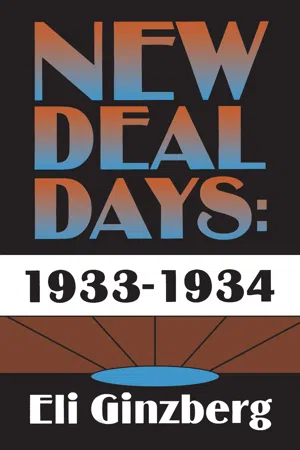
- 109 pages
- English
- ePUB (mobile friendly)
- Available on iOS & Android
eBook - ePub
New Deal Days: 1933-1934
1
The New Deal
Witches’ Brew
“Roosevelt et al.—why it is a Kulak administration trying to save the country for the Kulaks—and it’s no small job.”
The money changers were driven from the temple but Washington real estate agents maintain that they have never before been forced to deal with as unpleasant a group as swarmed into Washington with the new administration. True, there are not many Andrew Mellons and Ogden Mills in the new entourage but people with means are not rare; and these individuals are determined to rent $15,000 residences for $5,000.
Lest it be forgotten. It was Herbert Hoover who started the Reconstruction Finance Corporation (RFC)—”An organization dedicated to the noble efforts of letting smart money get out while the government held the bag.” Mr. Hoover was probably stampeded into action by the moans and groans of the Wall Street bankers. They explained that if the government did not aid the railroads many securities would go into default and the widows and orphans throughout the land would soon be destitute. No humanitarian could withstand such an appeal.
The wise remember while the ignorant forget. “Roosevelt and Hoover—there is but one major difference—that of consistency.” Farm relief was long a mainstay of Republican policies; open-market operations were not unknown to Mr. Mellon; the Republican attorney generals were not unduly concerned about the antitrust statutes; Mr. Hoover was long an advocate of public work programs in depressions. But Mr. Hoover was fearful, uncertain and therefore inconsistent. The Farm Board lost several hundred millions of dollars and then called a halt to its purchases; the Federal Reserve System bought government bonds in large amounts and then turned around and began to sell them; an occasional threat of prosecution against a monopoly and then an amiable conference.
But Mr. Roosevelt is determined, assured, and keeps pushing ahead. Agricultural commodities are destroyed; inflation of credit is pursued with a vengeance; the antitrust statutes are officially suspended; billions are spent in priming the pump. Vanitas, vanitorum...
* * *
Prior to the signing of the Steel Code, there were submitted to the National Recovery Administration (NRA) a large number of petitions from the steel workers begging the administration to force the companies to cancel all outstanding debts against their employees. Those who signed the petition, and there were several thousand, had worked an average of twelve years for the steel company to which they were in debt!
Critics of the administration have been prone to attack the increasing size and complexity of the federal bureaucracy. But they have been both shortsighted and unfair.
If the New Deal should falter, then, the NRA could prove that it was hampered by the ridiculously high wages that the Civil Works Administration (CWA) insisted on paying. The Agricultural Adjustment Act (AAA) could sustain in any court of law that its program was scuttled by the price rises that the NRA engendered. The Federal Emergency Relief Act (FERA) would have little difficulty in pointing out that a lack of funds hampered its activities. And the Treasury could convince even the uninformed that a balanced budget was impossible as long as the extraordinary expenditures of the government were not curtailed.
Hence, the bureaucracy will be vindicated, if not in life, then in death.
* * *
The administrator of the NRA, General Hugh S. Johnson, was an army man and that probably explained his distaste for the intellectuals who tried to force him to enunciate early on the principles for industrial code-making. For months they were on his neck while he was busy with more important problems. How could theories compare with facts? Clearly, a signed, though imperfect code was superior to an unsigned but perfect one. From June until October, 1933, he avoided discussions of policy. And then, one day, he had to face the issue. Secretary Wallace impressed on Mr. Roosevelt that the farmers would not tolerate the proposed 10 percent mark-up provision in the retail food code. The president decided that he had to enlighten the NRA administrator. A handful of impractical professors could be ignored; millions of farmers could not be dismissed out of hand. Theories became facts.
Our of the Mouths of Babes
We waited for him (Benjamin V. Cohen—a leading brain-truster) until we were too hungry to wait any longer. We went in and started to eat. He would doubtless appear shortly. The menu was discouraging; in fact it was close to hopeless. The young man whom we expected would have to be very charming to compensate for his lack of judgment in choosing the restaurant in which we now found ourselves. It had been his suggestion that brought us here.
The entree had just been cleared away, when our latecomer arrived. His refined and intelligent features gave no indication that he would have been so ignorant of restaurants. But then again, all the conscientious employees of the new administration had during the preceding months been working around the clock. He had probably eaten most of his meals at lunch counters or in the office. The introductions had hardly been completed, and the apologies made, when he explained that he would have to run away immediately after dinner. His desk was overflowing.
During the next few minutes the unknown turned into the known. He was a product of the Middle West and had been an honor student at two of America’s foremost universities. For the last few months, he had been doing important work for one of the new governmental agencies. He talked easily and well. Of course, one talked all day and all night in Washington: in the morning, one’s speeches affected the lives and fortunes of several millions or tens of millions of people; in the evening one talked to amuse one’s friends and oneself.
We commenced to argue about the inflationary tendencies of the administration. But the argument was soon transformed into a speech. The young man took great pains to clarify the obvious. “President Roosevelt is confronted with a comparatively easy task; a credit inflation and a large public works program can put a speedy end to the depression. And the President is at this very moment pushing these two approaches: it is perfectly clear that they will succeed.” “No!” “Why not? If two or three billion dollars are insufficient, then five will be enough.” “No, not even five.” “Well, then eight or ten will do the trick.” “Of course, there will be no great difficulty in obtaining the necessary funds for the banks will be glad to buy government bonds. And the interest rate will not be bothersome. You have doubtless read Mr. Keynes’ Treatise on Money and recall how he points out that a negative rate of interest is quite feasible.”
Dinner was finished. We said goodnight. As he walked briskly towards his office, I wondered whether he did not occasionally have to pinch himself to remember that he was no longer on a college campus but in Washington. I did.
Tricks
A high official of the Department of Agriculture came to plead in person. Ten million dollars is a tidy sum but then the ten millions might eventually lead to the expenditure of four billion, surely a substantial amount.
The CWA was allocating funds, and the Department of Agriculture wanted ten million dollars for a census—a very unusual census to be sure. Despite the combined efforts of the best brains in the country, economic recovery had not progressed very far. Farm prices remained low, many factories were working only part time, and the streets were full of the unemployed. Hence, a recovery plan had to be developed which could not fail.
A census was to be taken of all the farms in the United States to discover what articles a farmer would purchase if he had more funds. After the information had been gathered, the government would loan four billion dollars to the farmers, a loan that would run for many years without interest. Clearly, the money would be spent in much the way the census takers had uncovered. Now a concentrated demand for refrigerators, bathtubs, paint, lumber, and the like would lead to industrial prosperity. Agricultural products would then rise in price and the farm community could repay its loan without hardship. (Of course it is none too clear why the census was necessary: it seemed unlikely that the farmers would have refused the loans, or put the money in the bank.)
The representative of the Department of Agriculture was queried as to the government’s position if farm prices did not rise, or if they rose and slipped back before the loan was repaid. His answer was to the point: Uncle Sam would have to write off another four billion dollars.
One board member remarked that it was his impression that the present plight of the farmer was in large measure due to his existing heavy burden of debt. How could the Department of Agriculture justify an in crease, especially such a large increase. The answer was again to the point: the seriousness of the farm debt problem has been vastly exaggerated; it is really not so bad.
More Tricks
The secretary announced Mr. Joseph Barrows. He was an old but not overfriendly constituent of the senator’s. Mr. Barrows had come to say goodbye; he was leaving the day after tomorrow on a six-month cruise that was to take him around the world. The senator was pleasantly surprised by this information for though he knew that his csdler was a man of means, he had never placed him in the class of the idle rich. He congratulated Mr. Barrows heartily on his business acumen for clearly in times like these only a very capable businessman could afford such a long vacation. The senator was a little puzzled: how had his visitor made so much money?
For many years, his visitor had been in the habit of leasing Indian lands. It was a large-scale venture, one operated with heavy machinery—plant in the spring, cultivate in the summer, and harvest in the fall. Until the depression, profits had been quite large but during the last years a lessor was fortunate to cover his overhead. This year Mr. Barrows signed a new lease with the Department of the Interior but instead of flying west, he came east. At the Department of Agriculture, he affixed his signature to another contract. The profit from these two conferences enabled him to take the cruise.
The senator was an ardent supporter of the New Deal but when his nonchalant visitor had departed he shouted at his secretary to get the Department of the Interior on the phone. When he was connected he inquired in his most restrained language why the Department of the Interior continued to lease lands when Secretary Wallace was doing his utmost to reduce the amount of acreage under cultivation. The party at the other end asked the senator to please hold on for a very few minutes while he made the necessary inquiries. Soon the voice was heard again: “Section XY 73 of the statutes governing Indian Reservations states that the Secretary of the Interior must lease lands to any financially responsible applicant. Of course, Mr. Senator, if you disapprove, you might convince the members of Congress to change the law. In the meantime we intend to abide by it. Good-day.”
Franklin’s Dream
The king was sad and heavy in spirit. For many days and weeks he had observed the suffering of his people: they were hungry and naked, and yet he was unable to help them. If he could only once again hear the cymbals ring, and see the marketplace full. And then one night he had a dream.
He learned that the citizens of his realm were starving because they did not possess the wherewithal to purchase bread, no less cake. And the little they had today would be still less tomorrow, for their small wages would be further reduced by their almost bankrupt masters. It was only a question of time before everybody would be starving.
The king thought about how he might fill the empty stomachs and clothe the bare backs of his people by increasing their wages. Several of his knights had been anxious to improve the status of their hirelings but clearly they were unable to do so because the majority of their confrères would not follow suit. One did not dare to disregard the wishes and desires of close friends. But the king knew that if his subalterns would act in concord the difficulties that had existed would evaporate. The poor and the humble, the rich and the powerful would all gain by working in concert. True, the knights would have to reduce the hours which their retainers worked; they would have to increase the wages that they paid their retainers; and finally, they would have to add to their staffs. But when they had completed these acts of kindness, and of wisdom, they would reap their rewards. For the land they owned and the products they sold would rise in price. No longer would large estates remain untilled and apples rot because men were too poor to purchase them.
So far, so good. The king was sleeping contentedly. The dream continued. There were dangers in the plan and the kind genie took pains to point them out. It would be foolish for the nobles to lessen the labor of their serfs unless they would at the same time increase their wages. For else, the poor would become still poorer. But the lords would do the right thing: they did not wish to have their apples rot, their wheat become moldy. And the products of the earth could be saved only if the people of the realm were able to purchase them; and they could purchase them only if they had more money. The king was reassured.
But there was one other issue which disturbed the king just a little, like a fly when it tickles the ear of a lion. The nobles must not ask too high a price for the products which they sold, for if that came to pass the poor would be unable to purchase what was available and the rich would see their produce decay under their eyes. The king decided that in the morning he would issue an edict to all the sellers in the country outlawing all price advances, except in those few cases where wages had been substantially increased. For the remainder of the night, the ruler had an undisturbed sleep: his difficulties were at an end.
Daylight brought a change. His staff looked downtrodden and sad; his court was besieged by scores of cantankerous people. Supplicants be-seeched him for money so that they would not lose their lands and other possessions. He suggested that they increase the wages they were paying, and enlarge the retinue they were supporting. His chamberlain smiled: the applicants were perplexed. But the king laughed.
Late that afternoon, there arrived at the capital an intimate friend of the king, a man of great wealth and noble character. That evening he dined at court. The king inquired of his friend whether he would be willing to increase the wages of his people if the other knights of the realm did likewise. The guest thought for a moment and then smiled: “Why, yes, My Lord, I should be very happy to do so, if I did not know that my friends could not, and would not, follow my example. They are today, as you know, without funds. But even if they were not short of money, I doubt whether they could be trusted: he who picks his apples most cheaply can sell them most easily.”
That night the king slept poorly.
Free Land
The frontier is no more, but land can still be had for the asking. Not so long ago, the assistant secretary of agriculture in surveying farming conditions in the northwest, discovered two deep-sea divers who were trying to eke out a living on a farm. They were homesteaders, but he named them deep-sea farmers.
An applicant can obtain a tract of land from the federal government in any one of several western states. True, he does not come into possession of it until he has tenanted it for three to five years. In most cases, the land is good only for grazing; it cannot be farmed to advantage. A wise homesteader therefore attempts to obtain title to the land in the shortest possible time, with an aim of selling his holding to a neighboring rancher. He can seldom afford to buy livestock. Frequently, a wealthy cattle or sheep man will bargain with him: the future owner will build a shack for the homesteader so that the latter can more quickly establish his domicile. The federal government is not very strict.
The choice lands have long ago drifted into private possession. Today, a man can seldom obtain a suitable site. But even with the depressed prices of the last few years, many a homestead can be sold for $1500 to $3000.
Prairie Lands
Currency manipulation and production control will never solve the farm problems of western Kansas. During the early 1920s thousands of acres of pasture land were ploughed up and for several years the crop yields were excellent. Men made fortunes. But then came dry seasons; the rich soil was no longer rich. Meanwhile erosion was taking its toll. Today, the solution is simple. These lands should be put back into pasture, but no one has as yet been able to find a grass that will seed.
A farmer can be efficient; a bank can be cautious; a government can be helpful, but farmers, bankers and officials cannot cope with an invasion of grasshoppers. When they decide to visit en masse, automobiles are unable to drive without chains. Nor are chains always sufficient. Several years ago drivers in western Nebraska were ...
Table of contents
- Cover
- Half Title
- Title Page
- Copyright Page
- Dedication
- Contents
- Setting the Stage
- 1. The New Deal
- 2. Big Business
- 3. The University
- 4. Southwest
- 5. Hollywood
- 6. People and Places
Trusted by 375,005 students
Access to over 1.5 million titles for a fair monthly price.
Study more efficiently using our study tools.
Frequently asked questions
Yes, you can cancel anytime from the Subscription tab in your account settings on the Perlego website. Your subscription will stay active until the end of your current billing period. Learn how to cancel your subscription
No, books cannot be downloaded as external files, such as PDFs, for use outside of Perlego. However, you can download books within the Perlego app for offline reading on mobile or tablet. Learn how to download books offline
Perlego offers two plans: Essential and Complete
- Essential is ideal for learners and professionals who enjoy exploring a wide range of subjects. Access the Essential Library with 800,000+ trusted titles and best-sellers across business, personal growth, and the humanities. Includes unlimited reading time and Standard Read Aloud voice.
- Complete: Perfect for advanced learners and researchers needing full, unrestricted access. Unlock 1.5M+ books across hundreds of subjects, including academic and specialized titles. The Complete Plan also includes advanced features like Premium Read Aloud and Research Assistant.
We are an online textbook subscription service, where you can get access to an entire online library for less than the price of a single book per month. With over 1.5 million books across 990+ topics, we’ve got you covered! Learn about our mission
Look out for the read-aloud symbol on your next book to see if you can listen to it. The read-aloud tool reads text aloud for you, highlighting the text as it is being read. You can pause it, speed it up and slow it down. Learn more about Read Aloud
Yes! You can use the Perlego app on both iOS and Android devices to read anytime, anywhere — even offline. Perfect for commutes or when you’re on the go.
Please note we cannot support devices running on iOS 13 and Android 7 or earlier. Learn more about using the app
Please note we cannot support devices running on iOS 13 and Android 7 or earlier. Learn more about using the app
Yes, you can access New Deal Days: 1933-1934 by Eli Ginzberg,In K. Hwang in PDF and/or ePUB format, as well as other popular books in History & North American History. We have over 1.5 million books available in our catalogue for you to explore.