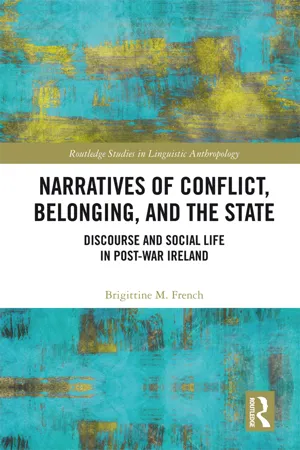
Using key perspectives from Linguistic anthropology the book illuminates how social actors take up the ideals of law, equality, and democratic representation in locally-meaningful ways to make their own national history in ways that may perpetuate violence and inequality. Focusing specifically on post-war conditions in Ireland, the author contextualizes commonplace practices by which citizens are made to learn the gap between official membership in and political belonging to a democratic state. Each chapter takes up a different aspect of state authority and power to constitute citizenship, to enact laws, to mediate conflict, and to create histories in the context of social inequalities and political hostilities. This book is an excellent ethnographic addition to courses in linguistic anthropology, giving readers the opportunity to explore applications and ramifications of key theoretical text within research.
eBook - ePub
Narratives of Conflict, Belonging, and the State
Discourse and Social Life in Post-War Ireland
- 124 pages
- English
- ePUB (mobile friendly)
- Available on iOS & Android
eBook - ePub
Narratives of Conflict, Belonging, and the State
Discourse and Social Life in Post-War Ireland
About this book
Information
1 Transforming the Legal System
Expert Knowledge and the Promise of Equality
“If ever I grow old I will write a book on the trials of a District Justice.”
—Dermot F. Gleeson, February 4, 1932
District Judge Dermot F. Gleeson’s prophetic metadiscursive commentary from the bench on a typical day in Kilkee District Court (Clare Champion 1932a: 5) reveals the voice of a learned man engaged with writing, an authoritative figure in the law, and an individual with a keen awareness that his unique perspective would be of interest in the years, decades, and perhaps centuries after he left the Irish bench and this world. In my triangulation of voices from County Clare during a fragile post-war moment, Dermot Gleeson’s (1896–1962) figures central in the pages that follow as a particularly authoritative figure in County Clare legal and social life at the time. Justice Gleeson’s words animate the stances of judge, scholar, important historical figure in the establishment of a new democratic state, and key informant to American anthropologists Conrad Arensberg and Solon Kimball during their fieldwork. As such, this chapter focuses on Gleeson’s heteroglossic perceptions of local life in County Clare as a person whose situated understandings of equality and law had consequences for many others. In particular, it highlights Gleeson’s situated understanding as an authoritative actor in changes to the Irish legal system from the colonial to the post-colonial, democratic era during which he was a local and national leader. It discusses Gleeson’s noteworthy legal and intellectual career which began in 1922 during the Civil War in order to provide a context and positionality for the legal, social, and cultural proclamations he made from the bench as an agent of the new Irish Free State. It suggests that Gleeson’s acumen as a local historian as well as his understanding of what he called newly “democratic times” (Clare Champion 1932b) influenced his congenial relationship with the North American anthropologists of the Harvard Irish Study. Dermot Gleeson was very generous with the American scholars and supported their ethnographic project, during which they faithfully documented a good deal of Gleeson’s insider perspectives on the court even though they analyzed very little of that data which fell outside of anthropological interest at the time. This chapter shows how Gleeson’s expert positions as scholar and judge enabled him to make some progressive interventions in the Irish district courtroom in the nascent democracy as well as suggests that Gleeson’s rulings, as a state agent, recreated some persistent inequalities related to the positions of women and children that were commonplace at the time.
Overall then, this chapter, which focuses on the subjectivity of one central, authoritative voice in this analysis, demonstrates a broader central argument of this book—namely that the shift to a new democratic state in a post-colonial era is not a sudden overturning of past anti-democratic and unjust practices but rather a gradual process that unfolds by means both of substantial change in and continuity with some of the unequal practices characteristic of the non-democratic past. The focus on Gleeson’s experiences as a judge, scholar, and citizen gives us the opportunity to witness the concurrent process of abrupt social change and persisting cultural continuity that manifested in relation to the court system and concomitant notions of justice and impartiality that accompanied it. I begin this inquiry by first examining the prestigious and influential position the judge rose to at a time of uncertainty and ambiguity that characterized the advent of the new state, establishing his authority as a judge and a scholar through a discussion of historical, anthropological, and his own scholarly records. I then examine how Judge Gleeson used his authority on the bench to end some corrupt colonial legal practices that threatened to continue onto the new era and to make the legal system in the democratic state abide by some of the ideals of its foundation. I end the chapter by pointing ahead to additional ways in which Gleeson used his authority as a preeminent man of law—in regards to the legal cases he presided over—in ways that recreated some past inequalities regarding laboring-class women and children and tolerated some violent and threatening forms of extralegal justice in the new democratic era. In other words, I set the stage for the continued, larger inquiry of the book that shows how the co-occurring dynamics of abrupt change and persisting continuity can be seen as playing out in the actions of the same agent of the state that will be further borne out in the subsequent analyses in chapters 2, 3, and 4.
Justice Gleeson and Free State Law: Judge, Scholar, and Key Informant
District Justice Dermot F. Gleeson was born in 1896 in Nenagh, County Tipperary into the family of Michael Gleeson, who was the Crown Solicitor for North Tipperary under the colonial administration. He was educated locally by the Christian Brothers, then studied at Mungret College in Limerick, and went on to study law at University College Dublin (Irish Times 1962: 10), an institution that bestowed upon him an honorary doctorate in literature much later in his life. Gleeson qualified as a solicitor and took his very first professional appointment as a District Justice for County Clare in the contested new courts of a tentatively independent Ireland during the Irish Civil War. He presided over his first cases dealing with local liquor licenses on November 18, 1922 (Clare Champion 1922: 1). From the beginning of his career, Gleeson was highly regarded as “a young man of great talent and promise who had already identified himself with the national cause” (Nenagh Guardian 1962: 1) and was the youngest among “twenty-seven men who set out in the midst of a civil war, without experience, preparation or guidelines, to establish the rule of law in communities who could have no certainty that the new order would survive the conflict” (Kotsonouris 2011: ix).
The structure and constitution of an independent Irish court system was a site of struggle and transformation during the anti-colonial War of Independence, the Civil War, and the tentative establishment of a democratic nation in the years immediately following (Osborough 1972; Laird 2005). The established Crown judicial system that had been in place for centuries was confronted by a rival system of the Irish Republic—the Dáil Courts—that operated concurrently as a parallel and nationalist institution from 1920 to 1922 (Kotsonouris 2004). Its Dublin center, the Four Courts, was destroyed in 1922 during an armed confrontation between pro- and anti-Treaty factions of the Irish Republican movement which catalyzed the violence of the Civil War. Subsequently, the structure of the judicial system was a matter of great political debate among Irish leaders (Kotsonouris 2011). The provisional government of the new state officially terminated the Republican Courts, did not support the old British one based upon magistrates who were much despised among the rural populace, and temporarily appointed twenty-seven new District Justices in December of 1922, one of whom was Justice Dermot Gleeson who presided in County Clare (Kotsonouris 2011: 5–11). This temporary system became permanent and fully elaborated under the Courts of Justice Act after the Civil War in May 1924 (Kotsonouris 2004), which relied heavily upon the principles of British law, but with an independent Irish judiciary (Osborough 1972: 48). This new national legal system is the one that Arensberg and Kimball encountered during their fieldwork in County Clare in the early 1930s when Judge Gleeson was entering his second decade as the presiding local official who oversaw the democratic transition and adjudicated the law well into the mid 20th century.
In total, Judge Gleeson remained on the bench for over twenty years in Clare and in 1947, he was transferred to the District Court in Limerick where he remained in service of the Irish state until his unexpected death in September of 1962. Gleeson was remembered for his enduring service and integrity to the Irish bench: “For forty years Judge Gleeson kept himself in the forefront of his distinguished calling and upheld its best traditions of thoroughness, hard work, and impartiality” within the democratic institution of the law (Nenagh Guardian 1962: 1). He was also remembered for taking on the task of administering justice informed by local knowledge in politically volatile and uncertain times when it was unclear if armed conflict would persist and eventually return to the new Irish nation: “He was successful from the beginning because of his known integrity and his knowledge and understanding of people and, coupled with these, was courage, needed in those difficult days” (Nenagh Guardian 1962: 1).
In addition to Gleeson’s historic role in the founding and practice of an independent Irish judiciary in the new state, he was an accomplished and well-respected local historian. “The great love of his academic life was what singles out Dr. Gleeson and ensures him a lasting place among his fellow countrymen and fellow-savants; [it] was his attachment to his feelings for the history of his country and particularly the locality in which he lived out his life” (Nenagh Guardian 1962: 1). Gleeson’s extensive writing focused on Irish antiquities and colonial history in particular locales in Counties Tipperary and Clare. He was the author of many books that included: The Last Lords of Ormond: Cromwellian Plantation, Prelude and Aftermath in the Countrie of the Three O’Kennedies (1938) which he wrote later in Irish under the title, Tiarnaí deiridh Urmhún (1956), Roscrea: A History of the Catholic Parish of Roscrea from the Earliest Times to the Present Day with Some Account of the Territories of Uí Cairin and Éile Uí Cearbhaill (1947), An Official Guide to Nenagh: Treorán Oifigiúil Do Aonaigh Urmhumhan (n.d.), and a book he co-authored with Aubrey Gwynn entitled, A History of the Diocese of Killaloe (1962). Gleeson also published in the Royal Society of Antiquaries of Ireland Journal (1936) and was a Vice President of the Thormond Archeological Society, to whose journal, The North Muster Antiquarian, he was a regular contributor (Nenagh Guardian 1962: 1).
In this way, it was an unfortunate, yet perhaps fitting, final moment that Dermot Gleeson took his last breaths at Bunratty Castle during a formal, recreated Medieval-style banquet on September 23, 1962. He had just given a recital of one of his monologues entitled, “A Boy from Nenagh,” that he said was the story of his youth in that town (Clare Champion 1962: 2). News of his notable passing, remembrance of his impressive career, and “lasting fame in the world of literature” in archeology and history were featured in local as well as national news (Clare Champion 1962; Irish Times 1962; Nenagh Guardian 1962).
Dermott Gleeson’s public dedication as a scholar and as an agent of the new state that welcomed the anthropologists into the country likely positioned him to look upon the anthropologists from the Harvard Irish Study with favor when he encountered the intrepid doctoral students, Conrad Arensberg and Solon Kimball, during their time in Clare from 1932–1934.1 Arensberg’s fieldnotes from an early meeting with Justice Gleeson dated Friday, the 9th December 1932, reveal that the American anthropologists had officially contacted him with a formal introduction and request to meet, as well as shows the generosity with which Gleeson responded to their request. Arensberg recorded an early ethnographic encounter in the Ennis courthouse:
I then went up to the Courthouse where I had a word of greeting with Turbridy the engineer for west Clare. I arrived at the court just in time to find it dismissed, but found Mr. Gleason [sic] still in his robes in an office behind the court . . . At this point Gleeson rose to go with me down to his room in the courthouse . . . When we got to his private room in the court house, Gleeson took off his judicial robes and put them away in a little suitcase . . . I thanked him for the letter he had sent us.
(Kimball 1902–81: Box Two, Folder Seven)
While Gleeson was only a marginal shadow in the anthropologists’ published analyses, receiving a single mention in the acknowledgements of Family and Community in Ireland (Arensberg and Kimball 1968 xvi), Gleeson was a major and helpful presence in their fieldwork. He regularly extended his authoritative perspective to them: the anthropologists dined in Gleeson’s home, observed several court sessions over which he presided, and talked about cases in the Justice’s chambers after hearings. Kimball’s fieldnotes from Tuesday, November 7, 1933 record one of many such common encounters: “About ten in the morning Justice Gleeson drove alongside me and asked if I would like to go to Kilkee [district court] with him” (Kimball 1902–81: Box One, Folder Three). What regularly follows in their unpublished research records after such an invitation shows that the anthropologists were quick to accept Gleeson’s hospitality and careful to document many of the conversations they had with the judge as well as the talk of the day among his interlocutors in and out of the courtroom. As such, the excesses of their anthropological archive allow us to render some of the uncirculated voices of Clare people audible in order to craft an analysis that demonstrates how democratic institutions of the new state were made and remade in the lived experiences of citizens that will be shown in chapters 2, 3, and 4.
The remainder of this chapter focuses on Gleeson’s situated and powerful perspective as an inaugural judge of the new Irish Free State about the major transformations in the legal system from the colonial and anti-Catholic one to the post-colonial, democratic one that he was dedicated to delivering. Gleeson understood the colonial system (in which his father practiced law) to be one with endemic corruption among the judiciary that was systematically overturned by an independent, fair, and impartial democratic one in the Irish Free State. At the same time, Gleeson’s narratives also show that, in practice, the formal institutional change in the representative legal system was a processual, rather than immediate one in which local citizens were socialized over time.
Transforming the Law: From Colonial Corruption to Democratic Impartiality
Gleeson used narratives about the “old days” in the courtroom to highlight the inherently unjust nature of British colonial law from Irish nationalist perspectives: “The system in the old days of unpaid magistrates was very much open to influence and squaring. At first they were entirely from the landlord class and it was very difficult for an ordinary person to get any judgment” (Kimball 1902–1981: Box Two, Folder Seven). Here, Gleeson shows that privilege in court generally resided with the landlord (Protestant) class to the detriment of “ordinary” Irish people. Gleeson also quickly names the practices of individuals deploying influence in the courtroom and the local notion of “squaring” the court in order to obtain a favorable outcome. These points are elaborated upon in a narrative Gleeson shared with Solon Kimball and J. Walsh, a court reporter for the Clare Champion, recorded on Tuesday, January 17th, 1933. As the three men travelled from Ennis out to district court in Killaloe, Gleeson reflected upon the story of a Judge Peter O’Brien, who was a prominent justice during the recent British colonial era:
Judge Peter O’Brien . . . who was notoriously susceptible to feminine beauty and in one case a famous character of a barrister, a Limerick man, who had a particularly shaky case, brought up as a witness—a very good looking young girl. After examining her for a short while and finding she knew nothing about the case, Judge Peter leaned over to the barrister and said in his English voice and accent: “Sir, in such matters I am an extinct volcano” (meaning it is no use to bring her here). The barrister replied: “My Lord, but I thought that perhaps there was a rumble in the old creature (crater) yet.”
(Kimball 1902–1981: Box Two, Folder Seven)
Gleeson’s narrative functions to provide illustrative details of the old, corrupt colonial system of law while simultaneously amusing his small audience of men traveling to district court with him. Gleeson re-voices the English judge through direct citation of his marked, accented response, “Sir, in such matters I am an extinct volcano,” both mocking such a “foreign” perspective through the use of humor as well as exposing that in his younger days of implied masculine virility, Judge O’Brien would have been moved by the illegal effort to win a favorable judgment by deploying a beautiful woman who had no actual knowledge of the case to give testimony. In this way, Gleeson’s narrative animates a time in the recent colonial past when the possibility of an impartial hearing in the legal system was so unlikely that it became a farcical mockery. This story contrasts with ...
Table of contents
- Cover
- Title
- Copyright
- Dedication
- Contents
- List of Figures and Tables
- Preface
- Acknowledgments
- Abbreviations and Translations
- Introduction: Telling and Re-Telling Anthropological Tales of States and Conflicts
- 1 Transforming the Legal System: Expert Knowledge and the Promise of Equality
- 2 Disciplining Gendered Citizenship in the Courtroom
- 3 In Loco Parentis: Embodied Punishment and the State in the Classroom
- 4 Unwritten Law, Legibility, and Land Conflicts
- 5 War Commemorations, the IRA, and Uncertain Futures
- Conclusion: Legacies of Conflict, Violence, and the State
- Index
Trusted by 375,005 students
Access to over 1.5 million titles for a fair monthly price.
Study more efficiently using our study tools.
Frequently asked questions
Yes, you can cancel anytime from the Subscription tab in your account settings on the Perlego website. Your subscription will stay active until the end of your current billing period. Learn how to cancel your subscription
No, books cannot be downloaded as external files, such as PDFs, for use outside of Perlego. However, you can download books within the Perlego app for offline reading on mobile or tablet. Learn how to download books offline
Perlego offers two plans: Essential and Complete
- Essential is ideal for learners and professionals who enjoy exploring a wide range of subjects. Access the Essential Library with 800,000+ trusted titles and best-sellers across business, personal growth, and the humanities. Includes unlimited reading time and Standard Read Aloud voice.
- Complete: Perfect for advanced learners and researchers needing full, unrestricted access. Unlock 1.5M+ books across hundreds of subjects, including academic and specialized titles. The Complete Plan also includes advanced features like Premium Read Aloud and Research Assistant.
We are an online textbook subscription service, where you can get access to an entire online library for less than the price of a single book per month. With over 1.5 million books across 990+ topics, we’ve got you covered! Learn about our mission
Look out for the read-aloud symbol on your next book to see if you can listen to it. The read-aloud tool reads text aloud for you, highlighting the text as it is being read. You can pause it, speed it up and slow it down. Learn more about Read Aloud
Yes! You can use the Perlego app on both iOS and Android devices to read anytime, anywhere — even offline. Perfect for commutes or when you’re on the go.
Please note we cannot support devices running on iOS 13 and Android 7 or earlier. Learn more about using the app
Please note we cannot support devices running on iOS 13 and Android 7 or earlier. Learn more about using the app
Yes, you can access Narratives of Conflict, Belonging, and the State by Brigittine M. French in PDF and/or ePUB format, as well as other popular books in Languages & Linguistics & Linguistics. We have over 1.5 million books available in our catalogue for you to explore.