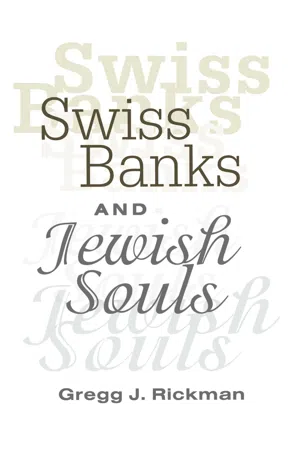
With the release of hundreds of damaging documents, a dark side of Switzerland's democracy has been unveiled. Switzerland is now seen as a nation of greedy bankers, collaborators with the Nazis, and robbers of the wealth of the victims of the Holocaust. Swiss Banks and Jewish Souls is a powerfully enlightening account of how a small and determined group of people from divergent backgrounds humbled the legendary Swiss financial empire to achieve a measure of justice for Holocaust survivors and their heirs, while shattering the myth of Swiss wartime neutrality. Rickman tells how a small group of people, none of them professional historians, pieced together a puzzle of unknown proportions and proceeded to dismantle the myth of Swiss innocence and victimization at the hands of the Nazis, and expose a fifty-year cover-up. Untold numbers of European Jews and others placed their funds in Swiss banks because they believed they offered a safe haven for funds which the Nazis were trying to control. What better place to put their money than in Switzerland? Swiss Banks and Jewish Souls discusses how investigative groups proved that Switzerland stole the money of the Jews and helped the Nazis to do the same. No one began with evidence and no one had a source of knowledge upon which to fall back. All they shared was a feeling that something was terribly wrong and that a great injustice had occurred. Propelled by this instinct, a U.S. Senator, the World Jewish Congress, a British Parliamentarian, the U.S. Holocaust Memorial Museum, and a handful of Holocaust survivors accomplished what the U.S., British, and French governments and a group of feuding Jewish organizations could not or would not do. As a result of this effort, how the world views Switzerland and how Switzerland views itself has been redefined. Most importantly, those who survived the Nazi horrors, only to be victimized again by the Swiss bankers, have now achieved some measure of justice, or at least financial compensation after more than fifty years.
- 294 pages
- English
- ePUB (mobile friendly)
- Available on iOS & Android
eBook - ePub
Swiss Banks and Jewish Souls
1
Justice Denied
Clearly no state would wish to benefit by reason of the slaughter of millions of helpless human beings. A most extraordinary situation arose as a result of the racial, religious and political persecutions of the Nazi regime, which demands, and in the main has received, unusual corrective measures. The justice of the position that heirless assets should be devoted to the relief of the miseries of persecutees falling in the same category as those who perished and who left these heirless assets can hardly be gainsaid.1
M. W. Beckelman of the American Joint Jewish Distribution Committee had penned an ironic statement. Unfortunately, there were in fact nations that did profit from the slaughter of millions. Switzerland, the land of cuckoo clocks and chocolate bars, was a nation of bankers providing a haven for “flight capital,” for the Jews of Europe and the Germans who slaughtered them.
Because of the declassification and increased availability and accessibility to documents once locked away in boxes on dusty shelves all over the world, we have a greater understanding of how this misfortune occurred. Were it not for the intense work of the archivists and staff of the National Archives at College Park, Maryland, the details would have remained sketchy and the problem unresolved.
1937, Satu Mare, Romania
He was seventeen years old, a bit young to travel, but Jacob Friedman was on his way to Zurich to make bank deposits for his father Marton. While at the time, it was illegal for Romanians to have accounts outside the country, this would certainly not stop Jacob from making the trip. It was 1937 and people like the Friedmans could see the writing on the wall, they knew that perilous times were coming. Jacob would make this trip six more times in the next year, placing deposits in three Swiss banks. According to his memory, Jacob would go on to deposit slightly more than $5,500 in a now defunct bank called Wohl and Landau in Zurich, $16,000 in the Union Bank of Switzerland, another $16,000 in the Swiss Bank Corporation, and $2,500 in another branch of the Swiss Bank Corporation in the small town of Le Loch, near the French border. Added to the amounts that his father placed in the bank accounts when he opened them, Jacob Friedman now estimates that these accounts totaled some $41,000.
Although he does not know the account numbers, he knows that they existed because he made deposits into them. His father knew the account numbers but he took them with him when the Nazis cleared out Satu Mare in spring 1944. Marton Friedman died after his deportation to Auschwitz, leaving his son Jacob with only memories.2
Marton Friedman was only one of thousands who sought to get their assets out of the reach of the authorities who made every attempt to gain control of the assets of Europe’s Jews for their own use. This was true for Jews in Romania and was even more so for the Jews of Germany, who had the great misfortune to live directly under the boot of Nazi Germany. Freidman is one of many who came to the attention of the Senate Banking Committee. In telling us his story, we gained a greater apprecation for the suffering of the time and how Switzerland came to gain millions in Jewish flight capital.
The End of Liberty, the End of Life
Upon the ascendancy of Hitler to power, Germany’s Jews were subjected to the Reichsfluchtsteuer, or Reich’s flight tax. Begun in 1931, under the Bruning government, the law forbade the transfer of capital to prevent reichsmarks from leaving Depression-era Germany. Yet, the Nazis allowed exceptions to this law in order to facilitate the emigration of German Jews. For the next few years, it was still possible, even in a limited way, albeit covertly, to transfer funds out of Germany to places such as Switzerland.
It has been suggested that Swiss banks, sensing an influx of foreign flight capital, urged the Swiss Parliament to pass the November 8, 1934 Bank Secrecy Act to protect these funds. Motivation aside, Switzerland nevertheless became the first place of refuge, or “safe haven” for Jewish flight capital. Switzerland offered anonymity and ostensible security for the assets of European Jews seeking to provide for their families against some future dark event.
Increasingly, Jews were being disenfranchised by the Nazis, especially after the imposition of the Nuremberg Laws of September 15, 1935. Aryanization measures were imposed and the Jewish ownership of business was disappearing. On April 26, 1938, by decree, all Jewish property had to be registered. Hermann Goring, planning Nazi designs on Europe, was authorized to make provision for the utilization of Jewish property “in conformity with the interests of the German economy.” Jews were denied entry into more and more professions, until November 12, 1938, a day after Kristallnacht, or “Night of Broken Glass,” when all Jewish business activity was forbidden and a collective fine of one billion reichsmarks was imposed upon the Jewish community. Further decrees were imposed, and Jews throughout the expanding areas acquired by the Third Reich were denied rights of any kind, and according to Nazi ideology, subject to extermination.
Despite the imposition of Nazi decrees, both in Germany and the countries the Nazis came to occupy, refugee funds did in fact make their way into Switzerland and beyond. As France and the low countries fell to the blitzkreig, Switzerland feared invasion. With this, moderate amounts of assets were moved overseas by the Swiss banks to safeguard them against confiscation, were Switzerland to be invaded by the Nazis.
“Institutions in European financial centers, particularly in Switzerland,” wrote W.H. Rozell of the Federal Reserve Bank of New York, in June 1940, “have for some time been engaging in an active and probably lucrative business of transferring European refugee funds to New York in accordance with a system devised by Swiss capitalists.”3 In many cases, Rozell wrote, the funds were transferred to the United States branches of the Swiss banks and commingled into a single account, therefore disguising the ownership of all the accounts. Moreover, the deposits were “no longer reported to us as foreign deposits despite the instructions on our report forms to that effect.” Using the New York branches of the Swiss banks, “immediate transfer of the ownership of these funds to third parties under certain conditions, such as invasion or threat of invasion” were to take place.
Most importantly, these omnibus accounts were transferred to Swiss banks and American banks acting as correspondent banks for Swiss banks not present in the United States. A Swiss bank could simply open an account in its U.S. correspondent bank under the name of the bank and pour funds in from a variety of sources, all of it remaining anonymous, even to the bank holding the account. How much refugee money could have been transferred to American banks in this manner is impossible to guess.
The steady rise in the flow of capital into the Swiss banks in New York, in addition to the camouflaging of German industrial concerns became of interest to the FBI. B.E. Sackett, Special Agent in Charge of the FBI office in New York wrote Director J. Edgar Hoover, that in light of the increasing volume of transactions in the foreign departments of the various banks in New York City, it appears “extremely desirable to attempt to make contact with the officials of this corporation for the purpose of monitoring transactions passing through the institution.”4
Having placed agents in the Swiss banks to monitor their actions, the FBI in coordination with the Treasury Department sought information on the dealings of the banks, as well as their personnel. The information they found convinced Treasury Secretary Henry Morgenthau to push for a freeze on the funds of these banks and a search through their records. Only in that way, could they get a better understanding of what these banks were doing, legally or illegally, on behalf of or in betrayal of their clients and for the enemy.
On June 14, 1941, President Roosevelt issued an executive order freezing the assets of the belligerent countries, all invaded or occupied countries, and the remaining unoccupied states of Europe, in order to prevent the forced transfer of funds and the manipulation of looted assets. With this order, Treasury Department auditors and investigators gained access to all the files, account information, secret account numbers, and ledger books of the three Swiss banks in New York. Credit Suisse, Swiss Bank Corporation, and the Swiss American Corporation files were now all available to Henry Morgenthau’s enthusiastic Treasury Department investigators. What these files showed scared Morgenthau and his investigators, a closely knit team that would go on to hound the Swiss banks throughout the war. What these men saw in the New York files, convinced them that the Swiss bankers were not the wholesome, honest men the Swiss wanted the world to believe.
This much was conveyed to Morgenthau in an interoffice memorandum from Edward Foley, General Counsel at Treasury. After June 14, 1941, the banks had been operating under special license, with their actions proscribed. Now, Foley wrote seeking permission to place a group of investigators in the offices of the Swiss banks in New York on a permanent basis. Foley’s concerns were many. Investigators had found documentary information on Swiss-German industrial concerns in the United States as well as the camouflaging of German concerns by Swiss companies and banks.
More ominously, Foley explained to Morgenthau that a former top executive of the Swiss Bank Corporation in Switzerland, who then moved to the United States, wrote to a colleague in a letter the Treasury obtained, that he resigned because of the fact that “certain high officials of the Swiss Bank Corporation were allowing themselves to be unduly influenced by Germany’s apparent success in establishing a new European order.”5 This was all that Morgenthau needed to hear.
Foley was now free to act. Within days, Foley sent his investigators into the Swiss banks and immediately searched the files, even opening private files. This was clearly too much for George Ludwig of the Swiss American Corporation. Ludwig wrote to Foley, “while we have no idea as to what information is being sought, we notice that special attention is being paid to what might be described loosely as refugee accounts... we are being placed at a definite business disadvantage with respect to our foreign clients.”6
In the files of the Swiss Bank Corporation, Foley’s men found thousands of accounts, including a list of demand deposits totaling over $14.5 million from all over the world that the bank had transferred to the U.S. over fears of invasion. While blocked, most of these accounts represented capital that was successfully moved out of Europe. Were the owners so lucky?
Amorality: The Swiss Banks and the Looted Gold of Europe
“Since the outbreak of the war,” wrote an American military attache in London, “Switzerland has played the role of international banker for Germany and her satellites. Swiss banks, the leading commercial and private banks as well as the Swiss National Bank, purchased gold from Germany to a value of several hundred million dollars.” He continued,
The proceeds obtained from the sale of gold provided Germany with the necessary Swiss francs (the only currency that is freely transferrable in the world today) to finance her purchases of critical war materials from the neutral countries outside the clearings and barter agreements; to pay for espionage and propaganda activities abroad; and to invest in neutral industries. The German Reichsbank and Swiss commercial banks did not hesitate to take part in transactions involving looted gold which was smuggled back and forth from other neutral countries in order to create an extra profit for the Nazi officials who handled the deals.7
For the Allies, it was already clear that Swiss bankers were the Nazis’ bankers. To use a modem law enforcement term, they were “laundering” stolen Nazi gold. Exchanging gold taken from the vaults and bodies of Holocaust victims, for untainted gold, the Swiss bankers gave the Nazis the ability to continue the war by making their stolen gold, “clean” again. With the “clean gold,” they could buy precision tools, small arms, artillery, and other vital equipment, to sustain their war effort. Sometimes they even did their shopping in Switzerland.
Allied intelligence was watching the Swiss banks. They knew how much gold was passing in and out of the Swiss banks on a weekly basis, from where it came, and to where it went. When it was added up, Morgenthau’s men came to the conclusion that the Swiss banks had to be stopped. Failing this, they had to at least be put on warning that we knew what they were doing.
On January 5, 1943, eighteen nations, including the United States, issued a joint declaration warning the neutral nations they would not recognize the legality of their purchases of German looted gold. Not all the Allies, however, were unified behind this warning. The British, came to the conclusion “that it would be undesirable for His Majesty’s Government to issue an official warning to neutrals about receiving Axis-owned gold, saying,
We are assured that difficulties of identifying bar gold would be considerable. If therefore allied [sic] governments (who are parties primarily interested) were to ask our help in recovering looted gold we should probably be unable to do so directly nor of course should we be prepared to seize for their benefit other neutral gold of equivalent value within our jurisdiction.... On the other hand our belief is that existing German gold reserves have been looted from various European countries and Germany is certainly using gold as a means of payment in neutral countries.8
The gold warning had no effect. Swiss banks bought even more gold from the Nazis in 1943, and went right on laundering it through their banks and transferring it to other neutral countries, all the while benefitting the Nazi war effort.
The weakness of the Allied warning was made very clear in a November 6, 1943 memorandum of J.W. Pehle, Director of Foreign Funds Control, memo to Harry Dexter White, Assistant Secretary of the Treasury:
Although our information is, of course incomplete, it is significant to note that transfers during the past six months total more than 100 million dollars and that such transfers have increased both in frequency and amount. It is evident that Germany is becoming more and more dependent upon sales of gold for the purpose of obtaining critical materials from European neutrals and that her credit position is growing progressively weaker. Accordingly, I believe that we should arrange for the issuance of our statement on gold as soon as possible in order to limit Germany’s ability to dispose of her gold holdings in the future.9
As the months proceeded Treasury officials convinced Morgenthau that a second warning was needed. On February 22, 1944, Morgenthau issued the second declaration, this time in cooperation with the British and the Soviets:
On January 5, 1943 the United States and certain others of the United Nations issued a warning to all concerned, and in particular to persons in neutral countries, that they intend to do their utmost to defeat the methods of dispossession practiced by the governments with which they are at war against the countries and peoples who have been so wantonly assaulted and despoiled. Furthermore, it has been announced many times that one of the purposes of the financial and property controls of the United States Government is to prevent the liquidation in the United Sta...
Table of contents
- Cover
- Half Title
- Title Page
- Copyright Page
- Dedication
- Contents
- Acknowledgements
- Preface: The Devil’s Bridge and Other Swiss Myths
- 1. Justice Denied
- 2. Unfinished Business
- 3. Exposed
- 4. “Bern, We Have a Problem”
- 5. The Righteous and the Persecuted
- 6. Writing the Check
- 7. We Were Right
- 8. The Lawyers
- 9. Boycotts and Diktats
- 10. History’s Vengeance
- Epilogue
- Index
Trusted by 375,005 students
Access to over 1.5 million titles for a fair monthly price.
Study more efficiently using our study tools.
Frequently asked questions
Yes, you can cancel anytime from the Subscription tab in your account settings on the Perlego website. Your subscription will stay active until the end of your current billing period. Learn how to cancel your subscription
No, books cannot be downloaded as external files, such as PDFs, for use outside of Perlego. However, you can download books within the Perlego app for offline reading on mobile or tablet. Learn how to download books offline
Perlego offers two plans: Essential and Complete
- Essential is ideal for learners and professionals who enjoy exploring a wide range of subjects. Access the Essential Library with 800,000+ trusted titles and best-sellers across business, personal growth, and the humanities. Includes unlimited reading time and Standard Read Aloud voice.
- Complete: Perfect for advanced learners and researchers needing full, unrestricted access. Unlock 1.5M+ books across hundreds of subjects, including academic and specialized titles. The Complete Plan also includes advanced features like Premium Read Aloud and Research Assistant.
We are an online textbook subscription service, where you can get access to an entire online library for less than the price of a single book per month. With over 1.5 million books across 990+ topics, we’ve got you covered! Learn about our mission
Look out for the read-aloud symbol on your next book to see if you can listen to it. The read-aloud tool reads text aloud for you, highlighting the text as it is being read. You can pause it, speed it up and slow it down. Learn more about Read Aloud
Yes! You can use the Perlego app on both iOS and Android devices to read anytime, anywhere — even offline. Perfect for commutes or when you’re on the go.
Please note we cannot support devices running on iOS 13 and Android 7 or earlier. Learn more about using the app
Please note we cannot support devices running on iOS 13 and Android 7 or earlier. Learn more about using the app
Yes, you can access Swiss Banks and Jewish Souls by Gregg Rickman in PDF and/or ePUB format, as well as other popular books in History & European History. We have over 1.5 million books available in our catalogue for you to explore.