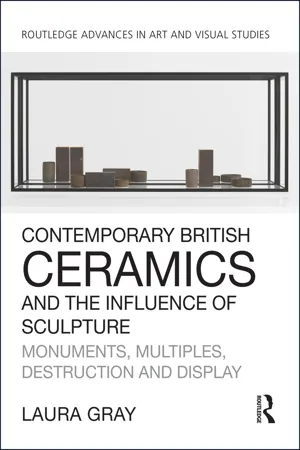
This book investigates how British contemporary artists who work with clay have managed, in the space of a single generation, to take ceramics from niche-interest craft to the pristine territories of the contemporary art gallery. This development has been accompanied (and perhaps propelled) by the kind of critical discussion usually reserved for the 'higher' discipline of sculpture. Ceramics is now encountering and colliding with sculpture, both formally and intellectually. Laura Gray examines what this means for the old hierarchies between art and craft, the identity of the potter, and the character of a discipline tied to a specific material but wanting to participate in critical discussions that extend far beyond clay.
eBook - ePub
Contemporary British Ceramics and the Influence of Sculpture
Monuments, Multiples, Destruction and Display
- 134 pages
- English
- ePUB (mobile friendly)
- Available on iOS & Android
eBook - ePub
Contemporary British Ceramics and the Influence of Sculpture
Monuments, Multiples, Destruction and Display
About this book
Information
p.1
1 Becoming Partners?
In which we start to think about classifications and relationships.
Locating the influence of sculpture on ceramics cannot be achieved without a clear understanding of both disciplines. We begin by going back to basics, defining ceramics and sculpture, and addressing why, despite having much in common, these two art forms belong to the separate camps of art and craft. By the end of the chapter we will be in a position to rethink the aspirational shorthand ‘sculptural ceramics’ so that it reflects the radical changes that both ceramics and sculpture have undergone in the late twentieth century.
Creative Tension: Defining Ceramics
At a time when the boundaries of contemporary ceramics practice are often stretched, it is worth considering whether the category of ceramics is relevant for anything more than departmental divisions in museums and art schools. Despite widening boundaries that encompass significant diversity, including for example performance and film alongside clay, for many ceramicists the history and associations of their material remains an important intellectual framework. It is the situation in which their work has its freedom, and is demonstrated by the surprising but persistent relevance of the vessel in contemporary ceramics practice. The associations of clay that are present in contemporary ceramics practice are not just incidental, they form a bedrock of meaning that can both reference and extend beyond ceramic-specific perspectives and technical skills.
If we take the view that a discipline is defined by the transmission of knowledge from one group to another, then ceramics is straightforward to understand. It is defined by the use of a single material, clay, and requires participants in the discipline to learn processes and acquire skills relating to the use of that material. While ceramics is tied to working with clay, in addition to the shared skills and material there are shared intellectual interests, knowledge and history. Today, dedication to working with clay unites a community of artists with increasingly different types of practice. As a section of the contemporary ceramics world becomes conceptually ambitious, it is restrictive to consider ceramics as only a skills-centred discipline without an intellectual aspect. Despite radically different approaches, from makers of domestic ware to the avant-garde, artists working with clay share core intellectual concerns rooted in their common material. These shared intellectual concerns include the history of clay, its industrial associations, the rarity and preciousness of porcelain, the emotional associations of domestic ware, and the possibility that functional objects can cut across many kinds of practice, from studio pottery to grand-scale installations. While emphasis on material and skills in ceramics appears to contrast with the fluidity of practice in sculpture, these historical and material-centered associations create a set of references and touch-points that are used by ceramicists in many ways. These core concerns, as much as skill and process, distinguish ceramics from other disciplines.
p.2
In the varied and growing field of contemporary ceramics practice, representation in museums and galleries becomes increasingly significant in reflecting and encouraging new areas of practice. Perceptions of the discipline are shaped by temporary exhibitions, which are less constrained by the practicalities of taking an object into a ‘permanent’ collection. Temporary projects such as the Victoria & Albert Museum’s event Clay Rocks (2006) and the exhibition Possibilities and Losses (Middlesbrough Institute of Modern Art, 2009) have provided a platform for an area of contemporary ceramics practice that is characterized by physical and conceptual ambition, dynamism and ephemerality. The Clay Rocks events at the V&A were part of the V&A’s Friday Late program, which was conceived and run by the museum’s Contemporary Team. Clay Rocks was co-curated by Laurie Britton Newell (Contemporary) and Alun Graves (Curator of Ceramics and Glass), and intended as a way to bring a fresh approach to ceramics. The Clay Rocks events featured three major installations, one by Clare Twomey and two by Keith Harrison. Each performance or event was sited in a prominent part of the building: Twomey’s Trophy in the Cast Courts, Harrison’s Last Supper in the Raphael Cartoon Court, and his Orbital bridged the John Madejski Garden and the adjacent gallery space at the center of the museum.
p.3

Figure 1.1 Keith Harrison, Last Supper, 2006. Photograph by Ted Giffords.
Curatorial practice has a significant impact on the public perception of an art form. Many permanent displays of ceramics found in museums and art galleries around the country are historically focused and give no sense of the current direction of the discipline. On the other hand, temporary exhibitions and projects have allowed cultural institutions to engage with the conceptually ambitious work of leading ceramicists. Financial and practical issues mean that permanent collections are less able to capture these changes in the discipline. Clare Twomey raises a valid concern about the importance of recording transient works that represent a distinctly new direction for ceramics,
If we don’t find a way to capture this then people like Keith Harrison will not be able to be seen as part of this evolving contemporary craft practice. And if we don’t find a way of capturing what we’re doing in museums then we could have a hole in our historical understanding.1
An intriguing aspect of contemporary ceramics is the continued use of traditional forms such as the figure and the vessel in otherwise challenging works. While there is still a thriving studio pottery scene that creates functional and beautiful domestic ware, and there are conceptually ambitious works that involve, for instance, firing liquid slip with electricity (Brother by Keith Harrison, 2009), there is also an area of practice managing do both at once (represented by Julian Stair and Edmund de Waal). The explorations at the borders and boundaries of ceramics are not only happening in visibly different ephemeral and performance-based works, but also with traditional pottery forms.
‘Vesselness’ is an important aspect of the identity of ceramics. The term is itself contentious and anxiety-provoking for many makers and writers. Alison Britton OBE, the influential potter and writer, stands resolutely against the term vessel. Britton is briskly dismissive of attempts to use language to bestow a value which should come from the work itself. She consistently describes her pieces as pots, and places emphasis on the recognizable and ordinary as a basis from which to explore the painted surface or distortions of form.
I actually hate the word vessel, I’d much rather say container or pot. Mainly pot, I suppose I’d say. The vessel seems to make it exquisite and precious in a way that I don’t like. It was giving it a special status, it was saying ‘this is not just a pot, this has some extra qualities’.2
The struggle with terminology reflects tensions about the relative values of the pot, the vessel and the object, and the status differential between the useful and the useless in the art world. Emmanuel Cooper suggests that the difference between the terms ‘vessel’ and ‘pot’ is related to the aim of the artist and the perception of the viewer, and that language sets an expectation that relates to functionality (actual vs implied),
objects defined as vessels are usually seen to have a distant, sometimes faint, relationship to use . . . they occupy the ground between the pot and the object, asserting their independence and authority, with expressive work that has freed itself from any explicit function.3
Far from being abandoned as a relic of the studio pottery era with no place in contemporary practice, the vessel is deployed with verve and purpose. What’s more, this rather humble and basic functional form can be understood using theoretical frameworks that do not consider notions of utility or traditional pottery forms as primary to meaning, or even at all.
p.4
A disciplinary challenge facing ceramics is the closure of the dedicated university courses that have the potential to develop subject-specific skills and discourse. Ceramics is a space-hungry subject that can be collapsed into other syllabi; this threatens not only the identity of the discipline but the existence of shared intellectual concerns belonging to a community of artists for whom clay is the sole material focus. Despite these challenges, ceramics has kept its distinctiveness and has not yet become a sub-set of sculpture or 3D design, though we can only guess what impact 3D printing will have on ceramics. The co-opting of ceramics into sculpture was a fear outlined by Brown in his essay ‘Theorising the crafts: new tricks of the trades’, published in Craft and Contemporary Theory. Writing in the late 1990s, Brown believed that ceramics would have to mutate into another subject in order to survive, and in certain instances this has been the case. With such anxieties about the identity of ceramics present in the background, it is worth noting that even while exploring commonalities between ceramics and sculpture, both disciplines are understood as distinct. In fact, it may be the case that ceramics’ sense of authentic identity is strengthened. Striking an optimistic note for the future, in 2015 York Art Gallery revealed a dramatic change in how it presents its world class ceramics collection to visitors. The small Gallery of Pots was transformed into the spatially and conceptually ambitious Centre of Ceramic Art, which includes a large space at the very heart of the gallery. Perhaps the outlook is brighter than some have dared hope for what Herbert Read called ‘at once the simplest and the most difficult of all arts’.
Sculpture: A Category in Danger of Collapse
What is sculpture? How do we recognize it? By what criteria do we judge it? In attempting to locate what might be the distinctive concerns of sculpture the intention is not to provide a fixed and final definition of a discipline that many curators, art historians and artists have found to be unpredictable. Instead, outlined here are a number of definitions of sculpture made at different points in time, which give something of an understanding of what is meant by ‘sculpture’ and what its particular interests might be.
Sculpture is fluid and difficult to pin down and for this reason there is a certain amount of concern over what it is. After all, if something has passed beyond the point where it can be defined, how does it manage to exist in universities and museums where classification and subject division is considered essential? For something that is hard to define, it is used liberally as a label, to the extent that it can feel that the term sculptural has been applied to so many different things that, like ‘luxury’ toilet paper, it has become a tag without any real meaning.
The simplest definition is that sculpture is a three-dimensional form in space. One might develop that by suggesting that it is three-dimensional art made by one of four basic processes: carving, modelling, casting and, more recently, by construction. Again, further development of this definition could be offered by listing materials traditionally used: stone and wood for carving, clay for modelling and bronze for casting. The exhibition Bronze (Royal Academy of Arts, 2012) showed that there is still interest in defining sculpture in relation to material. The exhibition was not only of historic works. The curators also chose to show modern sculpture in bronze (Picasso, Jasper Johns, Moore, Beuys and Bourgeois), and in doing so they made a case for an area of sculpture...
Table of contents
- Cover Page
- Contemporary British Ceramics and the Influence of Sculpture
- Routledge Advances in Art and Visual Studies
- Title
- Copyright
- Contents
- List of Figures
- Acknowledgements
- Introduction
- 1 Becoming Partners?
- 2 Monumental Matters
- 3 The Numbers Game: Multi-part Compositions
- 4 The Art of Destruction: Ceramics, Sculpture and Iconoclasm
- 5 Encounters: Ceramics on Show
- Conclusion
- Bibliography
- Index
Trusted by 375,005 students
Access to over 1.5 million titles for a fair monthly price.
Study more efficiently using our study tools.
Frequently asked questions
Yes, you can cancel anytime from the Subscription tab in your account settings on the Perlego website. Your subscription will stay active until the end of your current billing period. Learn how to cancel your subscription
No, books cannot be downloaded as external files, such as PDFs, for use outside of Perlego. However, you can download books within the Perlego app for offline reading on mobile or tablet. Learn how to download books offline
Perlego offers two plans: Essential and Complete
- Essential is ideal for learners and professionals who enjoy exploring a wide range of subjects. Access the Essential Library with 800,000+ trusted titles and best-sellers across business, personal growth, and the humanities. Includes unlimited reading time and Standard Read Aloud voice.
- Complete: Perfect for advanced learners and researchers needing full, unrestricted access. Unlock 1.5M+ books across hundreds of subjects, including academic and specialized titles. The Complete Plan also includes advanced features like Premium Read Aloud and Research Assistant.
We are an online textbook subscription service, where you can get access to an entire online library for less than the price of a single book per month. With over 1.5 million books across 990+ topics, we’ve got you covered! Learn about our mission
Look out for the read-aloud symbol on your next book to see if you can listen to it. The read-aloud tool reads text aloud for you, highlighting the text as it is being read. You can pause it, speed it up and slow it down. Learn more about Read Aloud
Yes! You can use the Perlego app on both iOS and Android devices to read anytime, anywhere — even offline. Perfect for commutes or when you’re on the go.
Please note we cannot support devices running on iOS 13 and Android 7 or earlier. Learn more about using the app
Please note we cannot support devices running on iOS 13 and Android 7 or earlier. Learn more about using the app
Yes, you can access Contemporary British Ceramics and the Influence of Sculpture by Laura Gray in PDF and/or ePUB format, as well as other popular books in Art & Art General. We have over 1.5 million books available in our catalogue for you to explore.