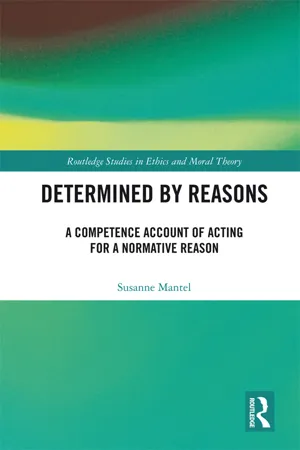
This book offers a new account of what it is to act for a normative reason. The first part of the book introduces some popular ideas and problems concerning causal and dispositional approaches of acting for reasons. The author argues that the dispositional approach should take a certain form that unites epistemic, volitional, and executional dispositions in a complex normative competence. This "Normative Competence Account" allows for more and less reflective ways of acting for normative reasons. The second part of the book clarifies the relation between the normative reason that an agent acts for and his or her motivating reasons. The chapters in this part refute the widely held "identity view" that acting for a normative reason requires the normative reason to be identical with a motivating reason. The author describes how normative reasons are related to motivating reasons by a relation of correspondence, and proposes a new understanding of how normative reasons explain those actions that are performed for them. Determined by Reasons engages with current debates from a wide range of different philosophical areas, including action theory, metaethics, moral psychology, epistemology, and ontology, to develop a new account of normative reasons.
eBook - ePub
Determined by Reasons
A Competence Account of Acting for a Normative Reason
- 190 pages
- English
- ePUB (mobile friendly)
- Available on iOS & Android
eBook - ePub
About this book
Information
1 Introduction
Suppose Finn should turn off the horror movie because a child is entering the room who will otherwise be scared. Finn turns off the movie, but he is doing this only for the fun of annoying Lisa who wanted the movie to continue. He does not act for the moral reason that a child is entering the room, but merely in accordance with that reason.1
Normative reasons are entities that favor actions. They jointly determine what we ought to do. Sometimes our actions merely coincide with normative reasons, as does Finn’s action. But when things go well, normative reasons not only determine what we ought to do, but some of them actually determine what we do. They genuinely make a difference to what happens in the world. Of course, they do not do so against our will, but via our agency, by determining our minds and motivations and, thereby, our actions. When we manifest our competence to conform to them, we make normative reasons determine what we do. The agent’s character enables this determination. This is important: not only do we want our actions to match normative reasons, we want to make them match. This is what we do when we act for normative reasons.
The present inquiry aims to develop an account of acting for a normative reason that meets certain conditions of adequacy. Most importantly, the account must explain how reasons determine action via determining the minds and motivations of agents. That is, it must provide the correct characterization of the non-accidental relation between the action and the normative reason(s) for which it is performed. Furthermore, it must capture the idea that agents deserve credit when they act for a normative reason, and it must account for many different intuitively plausible ways of acting for reasons.
More specifically, sometimes agents engage in detailed normative reflection, form well-founded beliefs about their obligations, and seem to act for a normative reason when they manifest their competence to do what they believe they ought to do. However, on other occasions agents do not act on well-founded normative beliefs. Nevertheless, they may seem to act for certain normative reasons, namely if their character is such that they give a firm and appropriate emotional and motivational response to these reasons. The contrast between the role of normative belief and motivational states might be highlighted by saying that there is both a Kantian and a Humean way of acting for a normative reason (although, of course, these labels might be questioned and Hume might have denied the very existence of normative reasons). As I will put it, there is a more reflective and a less reflective way. The account should make room for this variety. It should be more liberal, therefore, both than accounts that focus primarily on acting from moral knowledge (e.g., the account of moral worth in Sliwa 2016), and than accounts that focus on acting from the right non-instrumental desire (e.g., the account in Arpaly and Schroeder 2014).
Acting for a normative reason cannot be understood if normative theory and action theory are held separate. Ethics (or normative theory more generally) identifies normative reasons and tells us what to do. Action theory, by contrast, provides explanations for what we do. However, we need to understand not only agency as such, but also moral (and, more generally, normatively appropriate) agency. We need to understand how it is that sometimes we perform an action precisely because it is the thing to do (or, at least, is favored by a reason).
A lot of contemporary philosophy of action is concerned with a causal account of action. This tradition can be traced back to Aristotle and Hobbes, and was reinforced by Davidson (1963).2 According to this tradition, actions are causally explained by certain psychological entities (in a certain way) and this is what distinguishes action from mere behavior.3 No matter whether we agree with this tradition or not, if we want to understand acting for a normative reason, we need to find a place for normative reasons in the explanation of the action.
Because that place is hard to find, acting for a normative reason is, I think, still poorly understood and has often been misconstrued. Normative reasons do not easily fit into the causal and psychological framework, because it may be doubted both that they must cause the actions that are performed for them and that they are located within the psychology of the agent. Along with a growing number of philosophers, e.g., Parfit (1997, 2011), Scanlon (1998), and Alvarez (2010), I assume that normative reasons often are facts in the world, such as the fact that a storm is approaching. They often are independent of the agent’s mind, although they must be registered and represented when the agent acts for them. Acting for a normative reason requires responding to how things are ‘out there.’ Call this the ‘worldly’ view of normative reasons.
This worldly view of normative reasons does not seem to jive well with the psychological tradition, although this tradition arguably centers on motivating, not normative reasons. Motivating reasons can roughly be described as considerations that explain actions in a certain, characteristic way or motivate in deliberation.4 Proponents of the causal tradition, such as Davidson (1963) and Smith (1994), argue that they consist in pairs of beliefs and desires that cause actions. However, according to writers such as Dancy (2000) and Stoutland (2001), worldly normative reasons cannot be fitted into a coherent picture with a psychological account of motivating reasons because both kinds of reasons must be construed in similar ways. The received view about acting for a normative reason is expressed by the identity thesis, which states that acting for a normative reason requires the normative reason to be identical with a motivating reason. In other words, what motivates in deliberation and explains the action must be identical to that which favors it. This identity is commonly thought to refute the psychological tradition by proving that motivating reasons are no more psychological than normative reasons are (e.g., Dancy 2000, Bittner 2001, and Stoutland 2001).5
However, in my view the identity thesis leads us astray. It is both too weak and too strong to properly account for the way in which normative reasons determine actions. The identity thesis is meant to establish, or to help establish, the agent’s special relation to the normative reason, but it fails to do so. In the grip of this thesis, many philosophers have abandoned the causal and psychological tradition, and it has gone unnoticed that, despite its limits, this tradition is a better starting point for developing a theory of acting for a normative reason.
The identity thesis is too weak because it is not sufficiently informative about the relation between the normative reason and the agent’s motivation. Identity does not contribute anything of importance to help establish this relation. Even if identity holds, the agent might be motivated by the consideration not because it is a normative reason to perform the action, but rather independently of, or even despite its being a normative reason. For instance, the fact that the baby is reaching for the knife is a normative reason to put the knife away, and an older sibling might put it away for the motivating reason that the baby is reaching for the knife. Suppose that in this case the motivating reason and the normative reason are identical. However, the older sibling might merely follow an impulse of envy and take away whatever the baby wants, and he might, in this sense, be completely untouched by the normativity of the reason. If the object had been a harmless toy, he would have put it away for the motivating reason that the baby is reaching for it all the same.6 Acting for a normative reason should be understood in a more demanding sense in which it reflects well on the agent, which this action does not. The identity thesis states that acting for a normative reason requires that the reason be identical with a motivating reason. This is not specific enough to rule out the case just mentioned. The identity thesis is therefore too weak: being motivated by a fact that happens to be a normative reason does not get us far.
Instead, acting for a normative reason is, by approximation, to act such that the match between the action and the normative reason is due to the agent’s responsiveness to that reason in its role as a normative reason.7 This, at any rate, is the phenomenon that this inquiry is about.8
The causal and psychological tradition is a very helpful starting point for identifying this phenomenon. In a nutshell, the best accounts in the causal tradition help to make out various dispositions or competences that exclude merely accidental connections between mental states (e.g. Arpaly 2006, Wedgwood 2006, Smith 2009, and Turri 2011). For instance, dispositions are used to distinguish inferences that manifest instrumental rationality from deviant causal connections between desires, means end beliefs, and intentions. However, such a dispositional structure can be extended beyond mental states to cover worldly normative reasons, such as to rule out a merely accidental connection with these. All we need to do is focus on the agent’s dispositions to respond appropriately to features of the world around them.
In order to understand the full significance and nature of this dispositional structure, it must be identified as a complex tracking disposition. Tracking dispositions are structures that tend to trigger an appropriate, fine-tuned response to a condition that is thus being tracked by that response. They are manifested by exhibiting that response in the face of the condition—for instance by the wailing of a tsunami siren when there is a tsunami. Similarly, an action is a manifestation of a tracking disposition to do what normative reasons favor only if it results from a motivational structure that tends to adjust the agent’s actions to the normative force of reasons (of a relevant kind).
Since taking the knife away from the baby out of envy does not manifest a tendency to respond appropriately to the normativity at issue (but rather manifests a tendency to disadvantage the baby), this account rules out problem cases to the identity view. The identity view did not exclude this case, since the sibling’s motivating consideration seems to be identical to a normatively significant fact: that the baby is reaching for the knife. The dispositional strategy does better. It may therefore fruitfully be applied to normative reasons, although these lie beyond the boundaries of the psychological tradition.
The tracking disposition at the center of my account of acting for a normative reason is a normative competence: a competence to respond correctly to the normative force of reasons. According to the Normative Competence Account, acting for a normative reason consists in manifesting normative competence. When this competence is manifested, the normative reason determines the agent’s mind, motivation, and action: the agent manifests a tendency to represent the reason correctly, to be motivated to do what it favors, and to execute that motivation successfully. Consequently, the action matches the reason insofar as it is favored by that reason, but the match between the reason and the action is not due to luck, but to the agent’s competence. Hence, acting for a normative reason merits positive character evaluation: the agent deserves credit for doing what the reason favors. The normatively appropriate outcome reflects well on the agent.9 Acting for a normative reason can be understood as a manifestation of some form of virtue.
Equipped with this dispositional strategy, we may even call into question specific assumptions that the causal tradition is founded on. Tracking dispositions are very flexible and often respond to various different types of stimuli when they produce matches. Thus it turns out that they do not require the specific causal assumptions that the psychological tradition has adopted from Davidson. The causal tradition helps to identify the dispositional structure of acting for a normative reason, but when this structure is sufficiently understood, a more promising account emerges that crosses both the psychological and the causal limits of that tradition.
In another respect, the identity thesis is too strong and the Normative Competence Account is more liberal. Stipulating identity carries a heavy ontological burden—in fact, it seems that the identity thesis cannot account for the important differences between the nature of normative and motivating reasons. By contrast, the Normative Competence Account does, since it allows that normative reasons are objective states of affairs to which agents competently respond, whereas motivating reasons are more subjective. More precisely, the account allows for normative reasons to be in the world, i.e., to be worldly states of affairs or events, even if motivating reasons are in the mind. Locating normative reasons in the world and motivating reasons in the mind separates these two kinds of reasons, but, to me, it seems intuitively plausible. What we ought to do is determined by worldly circumstances. States of affairs or events, such as upcoming storms, make a difference to what we ought to do. They might disfavor staying outside and instead favor seeking shelter. Action, including morally good action, is primarily about reacting appropriately to the world itself. We do so via representing and conceptualizing the worldly phenomena we encounter, but we must not conclude from this that what favors action is primarily our own fine-grained mental description of the world. If a person gets injured, for instance, this is a normative reason to help, and it does not depend on how we conceptualize it.
By contrast, motivating considerations depend on the exact conceptualization that an agent employs. Although I do not identify them with mental states themselves, they belong to the mind insofar as they are contents of mental states. At any rate, I will argue that this picture, which construes motivating reasons as propositions, but normative reasons as objective states of affairs or events, is the most plausible classification from an ontological point of view.
Identity leaves no room for this ontological contrast between motivating and normative reasons. By contrast, the Normative Competence Account highlights correspondence, not identity: The agent manifests a tendency to represent the normative reason correctly, and to be motivated by this representation to do what it favors. The agent’s motivating consideration corresponds to the normative reason by representing it. This correspondence is not just due to luck, but established by normative competence. Furthermore, the action corresponds to the normative reason in the sense that it is favored by that reason. We perform an action ‘because there is a normative reason to do so’ when it is this reason that we competently track by doing what it favors. Thereby, we match our actions with the normative reasons there are, such that the match is not merely coincidental. Our action is determined by the normative reason in such a way that we deserve credit for the outcome.
In this introduction, I have pointed out how the Normative Competence Account helps to combine the worldly conception of normative reasons with the causal and psychological tradition. We might even say that the Normative Competence Account bridges a gap, namely a theoretical gap between action theory, on the one hand, and normative ethics as well as metaethics, on the other hand. The literature on action theory tends to focus on motivating reasons and mental states, and rarely takes non-psychological normative reasons into view. But certainly anyone who believes in the existence of non-psychological normative reasons should want to know how these reasons can relate to actions—in a way that is appropriate to their normative force, of course, not just by way of an accidental match between the normative reason and the action. The Normative Competence Account identifies a systematic role that normative reasons play with respect to t...
Table of contents
- Cover
- Title
- Copyright
- Dedication
- Contents
- List of Figures
- Acknowledgments
- 1 Introduction
- Part 1 Acting for a Normative Reason
- Part 2 Squaring Normative Reasons With Motivating Reasons
- References
- Appendix
- Index
Trusted by 375,005 students
Access to over 1.5 million titles for a fair monthly price.
Study more efficiently using our study tools.
Frequently asked questions
Yes, you can cancel anytime from the Subscription tab in your account settings on the Perlego website. Your subscription will stay active until the end of your current billing period. Learn how to cancel your subscription
No, books cannot be downloaded as external files, such as PDFs, for use outside of Perlego. However, you can download books within the Perlego app for offline reading on mobile or tablet. Learn how to download books offline
Perlego offers two plans: Essential and Complete
- Essential is ideal for learners and professionals who enjoy exploring a wide range of subjects. Access the Essential Library with 800,000+ trusted titles and best-sellers across business, personal growth, and the humanities. Includes unlimited reading time and Standard Read Aloud voice.
- Complete: Perfect for advanced learners and researchers needing full, unrestricted access. Unlock 1.5M+ books across hundreds of subjects, including academic and specialized titles. The Complete Plan also includes advanced features like Premium Read Aloud and Research Assistant.
We are an online textbook subscription service, where you can get access to an entire online library for less than the price of a single book per month. With over 1.5 million books across 990+ topics, we’ve got you covered! Learn about our mission
Look out for the read-aloud symbol on your next book to see if you can listen to it. The read-aloud tool reads text aloud for you, highlighting the text as it is being read. You can pause it, speed it up and slow it down. Learn more about Read Aloud
Yes! You can use the Perlego app on both iOS and Android devices to read anytime, anywhere — even offline. Perfect for commutes or when you’re on the go.
Please note we cannot support devices running on iOS 13 and Android 7 or earlier. Learn more about using the app
Please note we cannot support devices running on iOS 13 and Android 7 or earlier. Learn more about using the app
Yes, you can access Determined by Reasons by Susanne Mantel in PDF and/or ePUB format, as well as other popular books in Philosophy & Ethics & Moral Philosophy. We have over 1.5 million books available in our catalogue for you to explore.