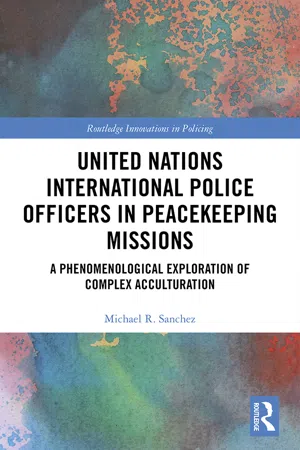
Why do international policing missions often fail to achieve their mandate? Why do United Nations Police officers struggle when serving in foreign peacekeeping missions? United Nations International Police Officers in Peacekeeping Missions: A Phenomenological Exploration of Complex Acculturation unravels these problems to find a causal thread: When working in hyper-diverse organizations such as the United Nations Police, United Nations police officers must grapple with adjusting to a kaleidoscope of different and competing cultures simultaneously—an issue the author identifies as complex acculturation. In this introduction to the novel concept of complex acculturation, Michael Sanchez explores the reasons behind the chronic performance troubles of the United Nations Police, and explains how the very fabric of the organization contributes to its ineffectiveness. While previous research has focused on private sector expatriate workers' challenges when adapting to a single new culture, this timely book describes a previously unstudied phenomenon and applies this knowledge to help businesses, governments, organizations, and citizens navigate the increasingly diverse workplace of the future. This book lays the foundation for a new area of study and provides a forward-thinking perspective that will interest multinational companies, police agencies, international relations organizations, prospective expatriate workers, and academics alike.
eBook - ePub
United Nations International Police Officers in Peacekeeping Missions
A Phenomenological Exploration of Complex Acculturation
- 136 pages
- English
- ePUB (mobile friendly)
- Available on iOS & Android
eBook - ePub
United Nations International Police Officers in Peacekeeping Missions
A Phenomenological Exploration of Complex Acculturation
About this book
Information
1 Introduction
Exploring the idea that acculturation issues could be a substantial contributing factor to the chronic poor performance of United Nations International (UNPOL) Police officers is the core of this research. UNPOL missions in general have been characterized as very poor performing, or in some cases as abject failures. While each UNPOL mission is comprised of a different mixture of nationalities, the extreme diversity of the composition of each UNPOL mission is constant. In an age of ever-expanding globalism, the cultural composition of an UNPOL mission can be seen as representative of the extreme diversity of the workforce of the future. Thus, developing an understanding of how intercultural issues, which accompany extreme diversity, affect a diverse workforce will have implications and applications far beyond the improvement of UNPOL performance.
The central question of explaining the poor performance in UNPOL missions led the author to research and investigate the subject of expatriate acculturation. Expatriate acculturation, also referred to as expatriate adjustment and expatriate adaptation, refers to an expatriate worker’s ability to adapt and adjust to their new environment. Considerable research exists linking the ability of an expatriate worker to adjust to their new environment to that expatriate worker’s work performance and ultimate success or failure in their expatriate assignment. In attempting to apply the concept of expatriate acculturation to the question of the performance of UNPOL missions, there was one significant difficulty the author needed to address. In all the existing literature pertaining to expatriate acculturation, there is but a single cross-cultural paradigm. All the existing literature refers to an expatriate worker engaging in a bi-cultural adjustment process. Expatriate adjustment consisted of the expatriate worker adjusting to a single new culture and environment. A paradigm wherein the expatriate worker must adjust to multiple cultures simultaneously was not found in any literature about expatriate adjustment. Thus, the author concluded that the concept of an expatriate worker having to adjust to multiple cultures simultaneously was an emerging phenomenon that had not yet been identified or researched.
The utter lack of research into the construct of expatriate workers adjusting to multiple new cultures simultaneously made it impossible for the author to research this phenomenon, as the construct had not yet been clearly defined or described. The first logical step in addressing an emerging phenomenon would be to conduct a phenomenological description of the emerging phenomenon. One weakness identified in current research into acculturation is that the theories, constructs, and paradigms of expatriate acculturation are in need of phenomenological study to provide a firm description of each phenomenon, upon which to build empirical research (Rudmin, 2010a). It is difficult if not impossible to research a phenomenon that has not yet been detailed, defined, and described. As the first logical step in pursuing the original question of why UNPOL missions are chronically inefficient, the author determined to conduct a descriptive phenomenological exploration of the expatriate acculturation construct whereby an expatriate worker must adjust to multiple cultures simultaneously. The author refers to this paradigm, of adjusting to multiple cultures, as complex acculturation. The original paradigm of an expatriate worker adjusting to a single new culture, the author refers to as simple acculturation.
This study explores three essential issues. The first issue is to provide a thorough phenomenological description of the construct of complex acculturation, through the lens of the lived experiences of United Nations International Police officers who have served in at least one UNPOL mission. As complex acculturation is an emerging phenomenon, heretofore unwritten about, the logical starting place is to conduct a phenomenological study to provide a foundation for future study of the complex acculturation construct. The phenomenological exploration of complex acculturation was conducted by applying Giorgi’s descriptive variation of Husserlian phenomenological method, accomplished through interviews with six different former UNPOL officers. The phenomenological reduction of the data collected through the semi-structured phenomenological interviews yielded a rich phenomenological description and modeling of complex acculturation as a construct within expatriate acculturation theory.
The second essential issue of this research was to assess the data, subsequent to the phenomenological description of complex acculturation, to determine if complex acculturation should be considered a separate and unique construct, within acculturation theory, in its own right; as opposed to merely being a variation of the existing simple acculturation construct. This analysis was important in order to determine if the findings of this research were seminal in nature, having identified a new and modern construct within acculturation theory, or if the findings of this research were merely a variation of existing constructs. The model of the construct of complex acculturation was compared to that of the construct of simple acculturation in order to determine if there were significant differences between the two constructs.
The third central issue of this research was to analyze the phenomenological data to determine qualitatively if complex acculturation could possibly be a major contributing factor to the chronic poor performance of UNPOL missions. The results of this third central issue would be very general in nature, owing to the low number of participants necessary in conducting phenomenological explorations. Nevertheless, a careful analysis of the phenomenological interviews and data could provide insight into whether or not complex acculturation might seem to warrant further research and exploration as a potential contributing factor to the chronic poor performance of UNPOL missions.
Study Method Sample and Population
Because of the time-consuming and complex nature of phenomenological reduction, phenomenological studies normally require a low number of participants. The recommended minimum number of participants when constructing a descriptive phenomenological study is three participants (Gill, 2014). The author wanted to ensure that this study accurately reflected the hyper-diversity of an UNPOL mission. Therefore, six participants were utilized for this study. All participants were former UNPOL officers having served at least one complete year in a UN police mission. The need to ensure extreme diversity in the sample for this study was critical. A cultural study where the population sample is limited to the perspective of a few select nationalities would severely limit the context and depth of the data. It is logical to assume that the perceptions of an UNPOL officer from a developed nation would differ substantially from the perceptions of UNPOL officer from an undeveloped country.
As there is no centralized database of former UNPOL officers, the author utilized several different networking tools to reach out to former UNPOL officers seeking willing participants. The author utilized Facebook, the International Network for the Promotion of Rule of Law, and the author’s own personal network of colleagues and acquaintances from his two UNPOL missions. Thirty-two former UNPOL officers from 16 different nations volunteered to participate in this study.
In order to provide for the greatest possible diversity in the study sample, the author stratified the volunteers into three categories based on the national economic attainment of each volunteer’s home country, in accordance with the United Nations Development Programs 2014 Human Development Report. The author then randomly selected two participants from each stratum, ensuring that there was no duplication of nationality within a stratum, to ensure the greatest possible diversity of the sample. The stratification of the participant pool was very important to ensuring the accuracy of this research. Ensuring that data is gathered from a variety of nationalistic and cultural perspectives ensures that the diversity of an UNPOL mission is accurately reflected in the data. Furthermore, a broad cultural and nationalistic base of responses will provide for triangulation in the data, which will correct for nationalistic or cultural bias, strengthening the internal validity of this project.
The results of the selection process yielded six participants for this phenomenological study and three backup participants, one for each stratum. The nationalities of the participants for this study, being from the United States, Denmark, Jordan, Bulgaria, Ghana, and Pakistan, were an accurate representation of the overall diversity of UNPOL missions.
Table 1.1 indicates the demographic of the selected participants and backup participants for this study, sorted by stratum. The three backup participants were selected in order to ensure, against the duplication of any nationality already represented in the selected sample. The author intended to use the backup participants in the event one of the selected primary participants proved unable to complete the study. The backup participants were from Romania, Turkey, and Kenya.
Table 1.1 Demographic of selected study participants and backup participants by stratum
| Participant | Nationality | Strata |
| Study Participants | ||
| 1 | United States | Developed |
| 2 | Denmark | Developed |
| 3 | Jordan | Developing |
| 4 | Bulgaria | Developing |
| 5 | Ghana | Undeveloped |
| 6 | Pakistan | Undeveloped |
| Backup Participants | ||
| Backup | Romania | Developed |
| Backup | Turkey | Developing |
| Backup | Kenya | Undeveloped |
Source: Sanchez, 2016, p. 80.
Collection of Data
Data was collected through scheduled semi-structured interviews with the participants either by telephone or through the Skype Internet telephone program. As the participants in this study were located around the world, face-to-face interviews were not practicable. The interviews were recorded and then transcribed by the author.
The primary goal of a study applying the method of descriptive phenomenology is to develop a rich and textured description of the phenomenon under exploration as lived by the participants (Giorgi, 2009). The use of semi-structured interviews allowed the author to explore each participant’s responses thoroughly, and allowed the participants’ responses to range wherever their answer took them, while following a general outline to ensure all research questions were addressed. In phenomenological interviewing, participants are asked open questions that seek the deeper meaning of the phenomenon under exploration. In addition, participants are strongly encouraged to recount the essence of the experience, rather than a mere report of factual information (Bevan, 2014). Having the participants convey the essence of their experiences was more difficult than anticipated, because police officers, for the most part, are programmed to report only information and facts in a non-emotional dispassionate manner.
Conducting an effective phenomenological interview requires the interviewer to have some institutional knowledge of the subject under study, while simultaneously maintaining interviewing distance (Bevan, 2014). The author’s own UNPOL experience was a benefit to the interview portion of this research study. The author’s institutional knowledge of UNPOL missions allowed for the asking of highly contextualized and specific questions that teased out more detail and more of the essence of the experiences lived by the participants. In addition, the author applied deliberate naïveté. While the author utilized his own institutional knowledge to create highly contextualized and penetrating questions, deliberate naïveté requires that the author must ask the questions, and more importantly the follow-up questions, as if the author knows nothing about the UNPOL experience. The goal of the phenomenological interview is to have the participant essentially relive the phenomenon and provide a thorough description of the phenomenon as lived. The participant should not express their thoughts or feelings in a social vacuum, but in the context of the lived experience of the phenomenon under investigation (Finlay, 2012; Giorgi, 2009).
The use of the author’s personal knowledge to formulate the questions, and the application of deliberate naïveté to the author’s responses to each answer, provided for a rich descriptive account of each participant’s experience with complex acculturation (Giorgi, 2009). Where necessary, the author conducted follow-up interviews in order to provide full and complete data. At the conclusion of each interview, each participant was asked if he or she had any recommendations for interventions that could have improved their own ability to adjust to their first UNPOL mission.
Analysis of Data
To analyze the data gathered during the interview portion of the study, the author applied Giorgi’s method of scientific phenomenological reduction. The transcript for each participant’s interview was read several times in order to gain an overarching sense of the essence of each participant’s experience. Critical passages known as meaning units were then identified. Meaning units describe or define an important element of the complex acculturation experience (Gill, 2014). In this manner, interviews are distilled down to a concentrated set of statements. Once meaning units were identified for all participants, the author applied scientific phenomenological reduction t...
Table of contents
- Cover
- Half Title
- Title Page
- Copyright Page
- Table of Contents
- List of Illustrations
- Author Biography
- Preface
- List of Abbreviations
- 1 Introduction
- 2 United Nations International Police
- 3 The UNPOL Experience
- 4 Exploring Expatriate and UNPOL Performance
- 5 Identifying Simple and Complex Acculturation
- 6 Phenomenological Description of Complex Acculturation
- 7 Sources of Cultural Dissonance
- 8 UNPOL Productivity and Complex Acculturation as a Construct
- 9 Successfully Coping with the Challenges of Complex Acculturation
- 10 Implications of this Research
- Glossary
- References
- Index
Trusted by 375,005 students
Access to over 1.5 million titles for a fair monthly price.
Study more efficiently using our study tools.
Frequently asked questions
Yes, you can cancel anytime from the Subscription tab in your account settings on the Perlego website. Your subscription will stay active until the end of your current billing period. Learn how to cancel your subscription
No, books cannot be downloaded as external files, such as PDFs, for use outside of Perlego. However, you can download books within the Perlego app for offline reading on mobile or tablet. Learn how to download books offline
Perlego offers two plans: Essential and Complete
- Essential is ideal for learners and professionals who enjoy exploring a wide range of subjects. Access the Essential Library with 800,000+ trusted titles and best-sellers across business, personal growth, and the humanities. Includes unlimited reading time and Standard Read Aloud voice.
- Complete: Perfect for advanced learners and researchers needing full, unrestricted access. Unlock 1.5M+ books across hundreds of subjects, including academic and specialized titles. The Complete Plan also includes advanced features like Premium Read Aloud and Research Assistant.
We are an online textbook subscription service, where you can get access to an entire online library for less than the price of a single book per month. With over 1.5 million books across 990+ topics, we’ve got you covered! Learn about our mission
Look out for the read-aloud symbol on your next book to see if you can listen to it. The read-aloud tool reads text aloud for you, highlighting the text as it is being read. You can pause it, speed it up and slow it down. Learn more about Read Aloud
Yes! You can use the Perlego app on both iOS and Android devices to read anytime, anywhere — even offline. Perfect for commutes or when you’re on the go.
Please note we cannot support devices running on iOS 13 and Android 7 or earlier. Learn more about using the app
Please note we cannot support devices running on iOS 13 and Android 7 or earlier. Learn more about using the app
Yes, you can access United Nations International Police Officers in Peacekeeping Missions by Michael R. Sanchez in PDF and/or ePUB format, as well as other popular books in Social Sciences & Criminology. We have over 1.5 million books available in our catalogue for you to explore.